

Helping kids build knowledge and understanding for spelling and reading. #Orthography #Phonology #Morphology #Etymology #StructuredWordInquiry #Dyslexia
Escondido, CA
Joined November 2016
- Tweets8.7K
- Following883
- Followers1.4K
- Likes23K



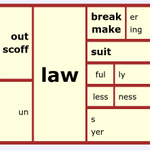

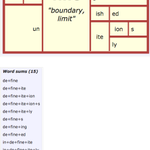
Are you arguing that kids should not study the English writing system until they have been programmed to treat it as a code for speech, a bad explanation of how written English works?

“Understanding a word’s structure and then spelling the word by announcing its morphemes is a more reliable strategy for spelling than sounding it out or judging the word on its looks.” @MaryBethSteve18 mbsteven.edublogs.org/2023/0…
Isn’t their work amazing? Check out the tools they use to deepen their understanding of the writing system, identify and correct errors in their current thinking, and create explanatory knowledge for reading and spelling.


These lucky learners are studying the English writing system, investigating “tricky” words to discover their relatives, elements, and units.
mbsteven.edublogs.org/2023/0…
Hi Jennifer. I agree that there are several strategies for word reading that are not MSV.
Did the research that you shared also look at peeling off known affixes (to reveal the base element) as a word-level action that readers can take?
Happy Anniversary! I'm glad you are here. I've learned a lot from your tweets and website. Thank you!
“The fact that the grapheme <t> in act and action maps onto different pronunciations is not evidence of a poor spelling system; rather, it is evidence that English spelling encodes morphology in a consistent manner.” cpb-eu-w2.wpmucdn.com/blogs.…

Children can use word sums and matrices to study English words in the permanent context of their morphological families. xitter.cf/GinaCookeLEX/status/13…


Morphological analysis tools such as word sums and matrices provide a useful structure for helping kids to think about word pronunciations and meanings shanahanonliteracy.com/blog/…

Tim Shanahan warns of this very real potential to harm, noting that he has been hearing from many teachers whose schools have severely cut back on critical aspects of reading instruction to facilitate phonics coverage. shanahanonliteracy.com/blog/…

Like phonics, SWI teaches grapheme-phoneme correspondences explicitly, but it does so in the context of morphological families to help kids understand how they work.
Going deeper than phonics, it helps kids (and their teachers) grow their knowledge of the *system* itself.
To be fair, teachers and students also identify all of the graphemes in written words, mapping them to phonemes and noting how they may be pronounced differently in related words (e.g., the <t> in <act> and <action>).
Spelling words out loud is only one of several activities.
Note: I meant to include a link to the source for the above <act> family matrix. It's Dr. @GinaCookeLEX's work, not mine. xitter.cf/GinaCookeLEX/status/13…

“Every time we study a word in its family, we learn more about the system.” - Dr. Gina Cooke shamelessspelling.com/time-t…

These tools and activities require children to spell and read words while analyzing and considering their phonology and morphology together.
“The morphological context provides an explanation as to why specific grapheme-phoneme correspondences occur in words (e.g., why the word <action> includes the <t> rather than the <sh> grapheme to represent the /ʃ/ of <action>).” cpb-eu-w2.wpmucdn.com/blogs.…
“Word sums reveal how the underlying meaning-bearing building blocks of words (morphemes) combine to form words.” files.realspellers.org/Petes…
“The base-centric morphological matrix helps us see that the spelling of base elements remains consistent across all members of a morphological family whenever possible, even when changes in pronunciation are observed.” ncbi.nlm.nih.gov/pmc/article…