

Helping kids build knowledge and understanding for spelling and reading. #Orthography #Phonology #Morphology #Etymology #StructuredWordInquiry #Dyslexia
Escondido, CA
Joined November 2016
- Tweets8.7K
- Following883
- Followers1.4K
- Likes23K





Stephanie Ruston retweeted

Written text is almost always ambiguous & readers have to resolve that ambiguity quickly in a process called "disambiguation.' What they rely on most of all to do that is background knowledge. Which is why it's so central to reading comprehension.
teachlikeachampion.org/blog/…
Stephanie Ruston retweeted

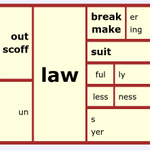
G2 Learning share and the students leading the way with teaching parents how to feel the phonemes, tap-spell & box the base. #wordinquiry #uwclearn #uwcsea #uwcsea_east #uwcliteracy @wordtorque


Stephanie Ruston retweeted

This is just a regurgitation of the age-old, unsupported CW that morphology comes later. It's been debunked.
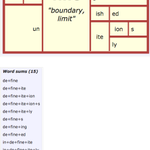
Word sums and matrices allow us to discern and pinpoint the GPCs in a word. Phonics can't do that, and ends up just calling the words it can't explain "exceptions." 1/
Stephanie Ruston retweeted
There's no evidence that children have to learn "GPCs" outside of a morphological context. None. Zero. Just false.
Stephanie Ruston retweeted
Great post by @AndrewWatsonTTB on learning objectives & pre-lesson retrieval practice. I like him was skeptical of the former.
learningandthebrain.com/blog…
Stephanie Ruston retweeted
Why are some words spelled with <wr> or <kn> instead of <r> or <n>?
Why are <here> and <hear> spelled differently?
Why does the <s> in <sure> spell [ʃ]?
That's etymology, not just phonology. Graphemes have etymologies too, as do all words, not just Greek & Latin words.
Stephanie Ruston retweeted
English orthography is challenging.
Would you prefer a teacher who says, "English is irregular. There are 250 ways to spell 44 sounds and many exceptions." Or "English makes sense. It has about 90 graphemes; choice is driven by meaning, history, and structure."
?
Yeah, me too.
Stephanie Ruston retweeted
1/ Feeling Fry-ed?
Proponents of the Fry List claim that children who memorize all 1,000 words will master 90% of all the words they’ll need to read.
But you know what will help children master 100% of words? Understanding the system.
Stephanie Ruston retweeted
“Every time we study a word in its family, we learn more about the system.” - Gina Cooke shamelessspelling.com/time-t…
Stephanie Ruston retweeted

"A classic is a book that has never finished saying what it has to say" - Italo Calvino


Stephanie Ruston retweeted

The Enlightenment was a way of pursuing knowledge with a tradition of criticism and seeking good explanations instead of reliance on authority. @DavidDeutschOxf


Stephanie Ruston retweeted

The idea that "not everyone is creative" or "not everyone can be creative" etc is a deep misconception that comes straight from the bucket theory of mind.
In reality, the only way anyone learns anything is through creativity.
Every person is necessarily creative.
Stephanie Ruston retweeted
What we know about how reading happens in the brain should not be taken to mean that we should teach phonology apart from - or ahead of - morphology. xitter.cf/StanDehaene/status/113…

For reading acquisition, I always emphasize the systematic teaching of morphology in addition to phonology. French readers must understand the differences between "il aime", "ils aiment", "vraiment", "vrai" vs "vraie", etc. Spelling is often logical!
cpb-eu-w2.wpmucdn.com/blogs.…
Stephanie Ruston retweeted
This is a beautifully rich, cross-linguistic explanation of homophones, homographs, and heterographic words in English and in Indic languages. Do not miss it.
I love that the Hindi word for 'yesterday' is the same as their word for 'tomorrow.'

there or their? hole or whole? lose or loose?
Homophones can be confusing & lead to errors, frustration, & most of all to the conclusion that Eng spelling is crazy.
It's not!
Here's my Q&A Guide in which I explore Homophony & Heterogrophy in Eng & Kannada teachingtenets.wordpress.com…
Stephanie Ruston retweeted

Is it really too much to ask that people don't misrepresent us and that senior researchers do not retweet these misrepresentations? From: Bowers and Bowers (2017). Beyond Phonics The Case for Teaching Children the Logic of the English Spelling System. Educational Psychologist

Stephanie Ruston retweeted

Twitter needs more of this..
xitter.cf/buitengebieden_/status…
Stephanie Ruston retweeted

“There is no such thing as a fixed reading level…We draw on background knowledge for everything we read.” Natalie Wexler #CVLiteracy