Professor of Law @tamulawschool | Bio and musings @ https://xitter.cf/t.co/osWaTQarro

Joined November 2016
I made an animation showing the Top 10 most-cited Supreme Court cases every year since 1792. It's remarkable how citations (by federal and state courts) have exploded in frequency in the last half century.
16
48
18
351
29,946
An interesting bit of trivia—the Texas Business Court is actually located on the first floor of the Texas A&M School of Law. We even share a break room. But shockingly, no one yet has reacted to my go-to greeting: “Howey doing?”
Important new Texas Business Court decision: After reincorporation from Delaware to Texas, the state of incorporation at the time of filing (here Texas) governs derivative standing and demand even when the claims accrued while incorporated in Delaware. 1/ txcourts.gov/media/1463428/2…
1
5
712
Admittedly an unpopular opinion, but I think even Yosemite Village itself is hugely disappointing. Imagine how much more majestic the valley would be without a grocery store (and federal court!) between El Capitan and Half Dome. Minimally, it should be like Zion, with lodging outside the valley, and low footprint transit in.
1
289
This is pretty wild. Basically, during sentencing, an AI video was shown that depicts the deceased victim sharing hypothetical posthumous comments (see below). After the AI video played, the judge was visibly emotional, stating, "I love that AI, thank you." He then sentenced the defendant to a longer prison term than what the prosecution even asked for.
Arizona Court of Appeals reverses defendant's sentence for his manslaughter conviction, finding that AI victim impact statement was "a depiction of the victim and his thoughts created from the imaginings of the victim’s sister." coa1.azcourts.gov/Portals/1/…
56
227
40
5,246
915,145
There’s a pretty well known evidence case (Bankcard America v. Universal Bancard) where a 7th Circuit panel reverses Posner, who was sitting by designation. Part of that opinion has a FRE 408 issue, where not even harmless error review could save Posner from 3-0 reversal by his colleagues. At the same time, Posner has written some of the best opinions on evidence law in the last half century. So an interesting anecdote.
Replying to @JesterInABarrel
Judge Posner used to occasionally sit as a trial court judge. The record on appeal was surprising
3
2
51
14,038
A fantastic article that is sure to play a pivotal role in conversations about how to scrutinize AI evidence. Congrats @BellinJ!
My latest article, "Evidence Law's AI Problem and the Hearsay Solution" is now available on SSRN. Comments welcome via email! @HarvLRev papers.ssrn.com/sol3/papers.…
2
1
20
2,635
I'm excited to share my newest piece that shows how prosecutors are increasingly using criminal conspiracy laws to criminalize social movements and protests, particularly in the age of ICE, building on Steffen Seitz's excellent work, as well as responding to Andrew Ingram
New from Iowa Law Review Online is Conspiracy Paradigms: Response to Conspiracy, Really? by Laurent Sacharoff. Read this Response here: lnkd.in/gWkdr87u
1
9
403
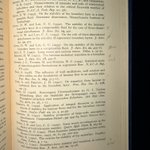
Apropos of the Navier–Stokes news, I thought I'd share one of my favorite books in my collection. It's from J. Robert Oppenheimer's private library (gifted to him by MIT's C.C. Lin) and includes Oppenheimer's annotations in the bibliography commenting on related research.
1
7
342
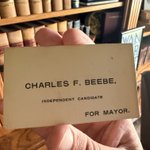
Yesterday, I was reading my copy of Greenleaf on Evidence for a research project, when this 130-year-old political ad fell out from between some pages. Turns out, it's from Charles Beebe's 1896 mayoral campaign in Portland, Oregon. Beebe lost the election to Sylvester Pennoyer, of Pennoyer v. Neff fame.
6
3
50
1,357
Vanderbilt Law Review (@VandLRev) will be publishing my latest, “Legality Canons.” It argues for a new way to understand many of the so-called substantive canons that the Supreme Court now employs. 🔗 👇🏻
2
12
1
57
4,680
I agree with Orin. And from my vantage, there seems to be a growing divide between two camps in the academy. The first treats knowledge claims as a product and, so long as those claims are true and useful, the involvement of AI in their generation is largely immaterial. The second sees the value of knowledge claims as inseparable from provenance, with the worth of a claim inextricably bound up with its genesis. My (admittedly armchair) sense is that the divide centers roughly on determinacy, both within and beyond the legal academy. In determinate fields (or jurisprudential modalities), where the academy seeks objective, falsifiable findings, the first camp's norms dominate. For example, it makes little difference whether Copernicus or an AI proposes the heliocentric model of our solar system. The key is that it is correct, which carries meaningful implications for future knowledge discovery. In indeterminate fields, where the academic pursuit is instead driven by judgment, reasoning, and persuasion, the second camp's norms predominate. In these spaces, the "right answer" to an issue isn't discerned by acquiring some heretofore missing knowledge, but rather by "making the case" for the normatively optimal path forward given the (fully explicable) tradeoffs at issue. Within this framework, having AI craft an argument feels much more uncomfortable, as it involves outsourcing considerations of morality and equity to a synthetic machine. With apologies to Langdell, my sense is that most of the legal academy's work falls in the second camp, and I therefore expect that its norms will develop in an AI-skeptical direction as a result. At least for anything beyond ministerial tasks like cite-checking, proofreading, and editing.
Replying to @MichaelRapp
I don't think a legal argument is like curing cancer. More on this next week!
9
19
8
80
43,601
Alex Nunn retweeted
C. S. Lewis, quit worrying and go do something real
68
1,963
103
13,755
464,373
A cool find for evidence folks. For those who teach Dallas County, here is the actual newspaper clipping that Judge Wisdom (again, fantastic name) deemed admissible over a hearsay objection:
1
1
4
353
Our 2024–2026 Special Report is out. We are in an exciting new era for the Georgetown Center for the Constitution. In the last two years, here's just some of what we've been up to: 175 legal scholars engaged 150 law clerks trained 80 judges convened 52 events hosted 5 meetings with U.S. Supreme Court Justices 4 new programs, from Research Fellows to Legal Philosophy & Constitutional Theory None of this happens without our small but mighty team, which punches well above its weight. It has been a privilege to build on the remarkable foundation laid by @RandyEBarnett as the Center's Founder, to work alongside @lsolum, our longtime collaborator, and to open a new chapter with a community this extraordinary. Take a look at our full report here: georgetowncenterforconstitut… @GUConstitution @GeorgetownLaw
2
10
2
79
8,423
Very excited to add this Sidney Harris print to my office. Although, as I'm wading through the first draft of my next article, I do feel a bit like it's calling me out . . .
1
17
1,783
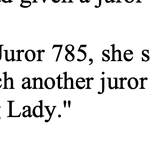
How would you even prove that a juror isn't "following the law" in deliberations without violating Rule 606(b)? The Massachusetts Supreme Court in 1984 has directly held, "Although a mistrial may be expensive in both human and monetary costs, it is not to be avoided by intrusion into the jury's domain. The possibility that an unreasonably stubborn or eccentric juror will be seated is an unavoidable risk of the jury system." Commonwealth v. Connor, 467 N.E.2d 1340 (Mass. 1984)
Why did defense attorney Kevin Reddington request a “stay” in the Lindsay Clancy trial? Reddington wants to file a single justice appeal to the Supreme Judicial Court of Massachusetts, the highest court in the state, because he believes that the lone holdout juror that we learned about Thursday is essentially breaking the law. CBS News’ @CarolinePolisi explains more.
4
13
1
191
56,457
Very excited to be joining Ron Allen, Mike Pardo, and Deb Tuerkheimer as a new co-author on their excellent evidence casebook. Certainly, big shoes to fill (as Alex Stein and David Schwartz are rolling off), but I'm looking forward to the work.
1
1
29
1,018
Alex Nunn retweeted
Technological substitution in 4 screenshots: 17th Century, 1929, 2017, and today.
2
4
1
13
4,343
Apropos of the discussion this weekend surrounding Pangram, AI, and legal scholarship, it seems to me that AI will require a fair amount of field-wide reflection on the precise areas where we value human provenance. At the extremes, the answer feels relatively clear. With artistic expression and areas of moral judgment (e.g., factfinding at a criminal trial), we value a distinctly human provenance. In other areas like typo-catching and Bluebooking, human provenance proves largely immaterial as the goal is just alignment with an objective criterion. Between those two ends of the continuum, though, are infinite points where norms will have to develop to pinpoint exactly what components of legal scholarship, legal argumentation, and the role of a "legal academic" generally ought to be distinctly human. To my mind, the extreme positions of AI-prohibition and AI-maximalism seem wrong. No one cares if Microsoft Word catches and corrects typos, and so AI doing the same task is equally unobjectionable. But there are certainly areas where a specific, human provenance is indeed essential. What exactly falls in that category will, I imagine, be fodder for many very long faculty meetings this year! (Thanks to @OrinKerr, @david__simon, @HoffProf, @AnthonyMKreis, @BrennerFissell, and others for teeing this issue up.)
5
5
32
5,409
And from @HoffProf (pulling his reply into this thread) xitter.cf/HoffProf/status/209409…
1
198
A thoughtful article from @msmith750 on the topic xitter.cf/msmith750/status/20941…
Replying to @zach_pohlman
Genuine answer! papers.ssrn.com/sol3/papers.… (In short: all parts of the process provide complex instrumental and intrinsic benefits; suggesting that shortcutting one doesn't harm the others is dubious; etiquette requires respect for the reader's time by putting in the time)
1
201