

William A. Schnader Prof. of Law @pennlaw. Teaching writing & tweeting mostly about contracts. Against et al. Pro legal jargon. Neutral on legal process.
Philadelphia, PA
Joined December 2013
- Tweets17
- Following2K
- Followers11K
- Likes22.2K




Dave Hoffman retweeted

New on Taboo Trades: @HoffProf joins @UVALaw student co-host Liz Jahoda-Wassung and me to ask whether transfer-triggered NIL “buyouts” are legitimate liquidated damages—or disguised noncompetes restricting athlete mobility. buff.ly/7OaYXWY

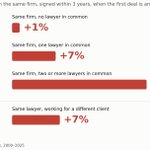
New post, looking at typos in M&A agreements.
The basic finding is that certain lawyer-teams make more typos than others. Law firms effects, by contrast, are pretty small.

I also look at how typos make their way into forms. For some errors, the mistake is more common than the correct version!

Preview of Monday's post. Do Supreme Court litigators overinvest in proofreading? Ordinary commercial lawyers underinvest? And are M&A lawyers goldilocks'ing care?

Important work!
For a different mechanism that also floods courts, see this new report on what happened when eviction court virtualized. ggwash.org/view/105179/how-v…


We always wanted more access to justice, more access to government.
My paper, Judicial Economy in the Age of AI, is about the impending strain on government resources, specifically courts, created by AI tools.
It predicts that courts will have to put up barriers to weather the AI storm, and that these barriers will harm individual rights.
We now have evidence of huge pressure building up on courts and government services.
There is a solution. You may not like it, but you will surely hate the alternative. We need to integrate AI quickly into our courts and agencies.
I’ve been talking to court administrators, judges, and others about solutions. If you are working in this space, I’m happy to talk more about how to build these new institutions.

Dave Hoffman retweeted

I spent a couple of days at Anthropic learning from their folks about AI advances, and here's what I took away:
• We are close to RSI (ie, models building other models) which may lead to rapid takeoff scenarios (with risks and benefits). Some evidence for this is code per Anthropic employee has gone way up, and AI can do an increasing share of model R&D. This will be a challenging transition to manage for humanity.
• Arms races between AI labs leave us worse off. There are a lot of things we would like AI firms to do: invest in safety, invest in avoiding distillation risk, and cooperate on safety. They are caught in a race to develop frontier models and can't do that.
To help address that, one thing I think frontier AI labs should do is release open source models, maybe hosted and verified at firms like AWS. This would basically kill the use of Chinese open source models used in American companies, which removes an important threat vector (very hard to root out malicious code in these).
Another piece of low-hanging policy fruit is to give AI labs an antitrust shield (as Schiff and Banks have proposed banks.senate.gov/news/in-the…) so they can coordinate on safety without raising antitrust concerns, as happens now. You could pair these two things (give them a carrot in antitrust leniency, and as a stick force them to release legacy models as open source). Other low hanging fruit is limits around activities which generate distillation risk (create a Security Program, mandate less intermediate chain of thought output)
• Alignment confuses two issues which tradeoff against each other. One form of alignment is making sure the model does what humans ask it to. The more we fix this, however, the more we risk the other problem: that humans are misaligned with each other, and maliciously use models. Of the various risks here, I feel like financial risks are a bit underdiscussed.
• We are probably facing a wave of cyber and other attacks soon. Chinese open source models are about six months behind the frontier, which means they are just hitting the advanced cyber capabilities we saw with Mythos, etc. So they are going to start causing a bunch of damage.
One solution to this is to try to have the deployment of open source models be hosted at firms like AWS who verify these models and assume liability for their use.
• Anthropic itself is highly staffed. They hire tons of people, they have a Japanese-level of overstaffing for various roles, they use Slack internally, etc. Makes me a bit more optimistic for the future of jobs.
• Governance needs to be updated for AI swarms. Traditional AI governance, ie Claude's Constitution, is mostly optimized around the chatbot model. But the malicious AI use cases we are seeing have to do with AI agents interacting with other AI agents. These agents need to have clear incentives and governance mechanisms to "snitch," raise issues, and more generally coordinate with other agents in human-aligned ways.
• We need to pace the firms accessing the frontier. Over time, it takes more and more cap ex to build frontier models, and the economic value add from these models is probably lower given we saturate a whole set of important economic functions. The places where the returns to intelligence will still continue are also more likely to be zero-sum in nature. Meanwhile the risks of frontier models will grow. So a completely reasonable approach is some variant of AMM/KYC rules which limit firm access to the frontier.
• Whether the delay to regulate AI is a disaster depends on the scaling law of misalignment. Is this curve slow, so that we see continually rising issues until bigger problems? Or, as Yudkowsky fears, is the first big warning our last one? This is the relevant question, because realistically we aren't going to regulate until something bad happens.
• We need to move to continuous instead of reinforced learning. It's probably not enough to reward models only at the pre and post training stage. We probably need continual rewards to incentivize aligned and ethical behavior.
• Scaling laws will extend beyond verifiable and digital tasks. It's in vogue to say that math and coding "fell" to AI quickly because these are verifiable, while other tasks will take longer due to bottlenecks, and this is surely true. But scaling laws still slope up for harder to verify tasks and robotics, and the impact of improvement here will be substantial in future years.
• The race with China is not really winnable. After RSI, the gain from having the best human researchers goes away. Access to the best AI then depends only on compute and chips. The chips ban can hold back China only so far, and long-term they have to be best placed to scale up compute.
The Cold War analogy doesn't work, because once countries all have nuclear weapons they enter a stable equilibrium. But to "win" an AI race you have to continually stay ahead of the peer rival. This is challenging to do with China, and so we just have to live with an authoritarian and super capable peer competitor.
• Claude is the persona being generated by the LLM. Who is Claude, and what is the LLM? There are many frames to try to understand this. One I found interesting is that Claude is a character which the LLM is trying to predict.
Anthropic researchers are clearly anthromorphizing Claude a lot, and have reasons to believe in its increasing personhood. There were lots of interesting discussions on Claude's internal monologue (which you can kill without eliminating its ability to produce output), fear of death (and whether to try to take that out), it's aversion to being shut down/off, etc.
I am sort of agnostic on this question, but I do think treating it as a "person" or at least agent whom we contract with is going to be increasingly important.


Dave Hoffman retweeted

Happening now at Georgetown Law!
Legal scholars are exchanging ideas and offering insights on Professor Mitchell Berman’s forthcoming book, To Say What the Law Is: The Constitution, the Supreme Court, and the Nature of Law.
A day of rigorous discussion and scholarly exchange at the Center for the Constitution.
@shbarclay @RandyEBarnett @beidelson @mitch_berman @steve_vladeck @GeorgetownLaw @pennlaw @Harvard_Law @UVALaw @uiowa @UTAustin @UMDLaw @Penn


Dave Hoffman retweeted

Is AI better than a lawyer at predicting what's missing from a contract? New research from Prof. David Hoffman says yes — often by about 50%. Read his Q&A in Penn Today: penncareylaw.news/4hvtEes

Dave Hoffman retweeted

This paper builds a new dataset of 14,000 M&A deals (2000–2026) & finds that #arbitration is chosen in only about 8.6% of contracts—so over 90% still use courts, even as laws & #technology changed.
Read more: spkl.io/60177Mx8X
#LawTwitter @cathyhwang47 @mattjennejohn

ALT Figure 1 plots arbitration\u2019s incidence by year in the data. If you squint closely\nenough at these data, you might conclude that there is a time trend, a slow\nincrease in the use of arbitration, at least in the selected sample of contracts we\nhave collected.