

The voice of the Subnet Degens. TAO price action, Bittensor content, and the subnet news that actually matters before the crowd catches on.
Joined June 2009
- Tweets20.4K
- Following2.6K
- Followers13.2K
- Likes35.4K


Shizzy retweeted

Don't forget to set the reminder! See you soon 🤖

Robots will need data. Machines will need identities. And both will need an economy
On Monday, @openroboto joins us to talk about how that economy gets built, and the part we’ll play in it together
📅 Oct 19 · 11:00 CEST
xitter.cf/i/spaces/1yKAPwVazayxb


Shizzy retweeted

FREE ALEX - A Question of Principles, Not Personalities.
Whether you like @DrocksAlex2 or not is beside the point.
The issue goes much deeper.
How can a network that champions decentralization, openness, and inclusivity justify excluding members of its own community simply because they disagree with certain decisions?
Since when should questioning decisions become a problem?
Bittensor claims to be building a system where the best ideas and merit should prevail. But how can we achieve that if critical voices are no longer welcome in the conversation?


Shizzy retweeted

DeepSeek-V4.1-Flash-1017 is live on engy.ai.

🚀 DeepSeek-V4.1-Flash-1017 is here!
Stronger benchmark performance, faster task completion, and shorter outputs than the previous version—a Pareto improvement in performance and cost. Now live on our website, app, and API.
🛠️ Optimized for @DeepSeekHarness, Tencent CodeBuddy, WorkBuddy, and more. Upgrade to DeepSeek Harness v0.2.1-rc.1 or later for the best experience with the new model.
1/4


Shizzy retweeted

Really interesting convo below from this weeks all in on why a16z stays away from the neoclouds, and it made something click for me about Bittensor.
@bhorowitz point is that scaling compute on debt is a dangerous arbitrage business, and he lived it in 99 when bandwidth was $1,500/megabit and the only way to get it was a 3 year contract. By 2001 it was $50 - If you were holding that on borrowed money you were dead.
His case for $CRWV being different is that AI compute is in a massive shortage, so GPU and data center prices keep rising. Maybe he's right. But the neocloud model is still a levered bet that GPU scarcity outlasts the debt, because they borrow against the GPUs and the lenders get paid on a schedule whether or not the market cooperates.
A compute subnet on Bittensor is basically a decentralized neocloud that doesn't need any of that. There's no GPU purchase to finance (miners show up with their own hardware) and no 3 year capacity contract to get stuck holding if prices move. The token + the network do the job the debt does for CoreWeave. Emissions bootstrap the supply side, and as demand and revenue grow the subnet puts that value back into its token, which raises what miners earn and pulls more compute onto the network. The token is the lever that scales how much compute you can harvest and coordinate. So if GPU pricing ever pulls a Loudcloud, the subnet doesn't blow up, its incentives just buy more compute than they used to.
With no debt there's nothing to default on, and nobody can call a loan or force a fire sale. The risk you take on instead is token volatility, which you manage with a treasury (keep cash on hand and use it to support your token through drawdowns). A bad market can starve a subnet for a while, but one with real demand underneath it can ride that out.
The tradeoff is a slower, more gradual build. A neocloud can borrow its way to a giant cluster fast, while a subnet's capacity grows with the size of the network and the token. What you get in exchange is a far more durable business, mostly because of where the supply comes from. You're tapping a bunch of long tails of compute that a neocloud can't really get at:
>people who own their own hardware and want to monetize it when they're not using it
>slack capacity in data centers (nobody runs at 100%), which can get sold into the subnet's spot market instead of sitting idle
>sunk cost hardware, i.e. paid off GPUs that can't get a contract for anything else
>operators in places with cheap power that no lender would ever underwrite a data center for
Once a card is paid off the main ongoing cost is power, which even on an H100 is something like 5-10 cents an hour depending on where you are. So a lot of this supply is pretty price insensitive. They make more when the token is higher, but a 50% drawdown in miner rewards eats into their margin and plenty of them keep mining anyway. That gives you a structural supply floor that doesn't really care what the token (and therefore the miner reward) is doing day to day.
Then as network value and the token go up, you progressively unlock compute that's more price sensitive (financed GPUs that still have to pay themselves off, US data centers with pricier power, etc). Each one joins once mining becomes economic for it, and you get a flywheel: token up → more of the world's compute profitable to plug in → more capacity to sell → more revenue → more value back into the token → repeat. Every GPU that joins also makes the network cheaper and more reliable to buy from, so you get a real network effect on top of removing the debt risk.
And in the limit it can reach more compute than any single hyperscaler could ever build or finance, because the supply side is permissionless and global. You start by tapping into the world's edge compute, and over time the rest of the world's compute comes online as it makes economic sense for whoever owns it.

Ben Horowitz explains why a16z doesn't invest in neoclouds after living through the dotcom bubble
"If you get into a pathological debt situation, that can wreck anybody. It's why, by the way, we're not invested in any of these neoclouds, for that reason. That whole thing scares me, having been through it."
"It can end up being a very dangerous arbitrage business where you can get upside down easily."
"You look at Loud Cloud just as an example, here's a simple thing that happened to us in 1999. Bandwidth was $1,500 a megabit. And you couldn't get it, it was very hard to get. And so you had to get a long-term contract, three years."
"By 2001 it was $50 a megabit. So if you were holding bandwidth, you were just dead."
"So that kind of thing is so out of the control of the entrepreneur. And so different than what we'd like to fund. That, you know, it just scared me to death."
Shizzy retweeted

A little TAO, a splash of global expansion, and a whole lot of Bittensor.
Crucible Wallet iOS is now mixing in 30 countries.
Shizzy retweeted

Bittensor guys always talking about flying wheels. SN90 @markjeffrey @ShizzyUnchained

Shizzy retweeted

Second buyback and burn done.
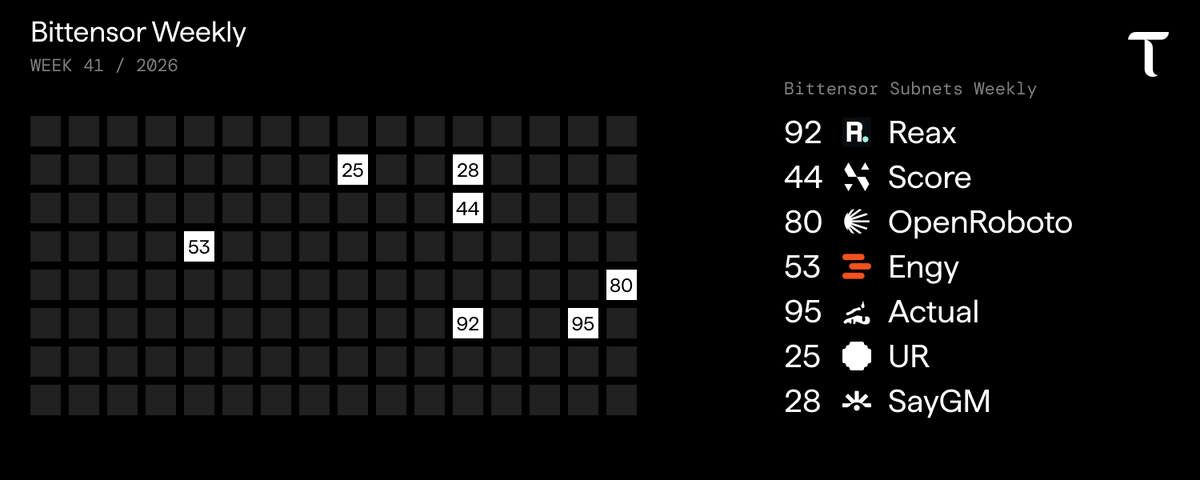
$104k of SayGM alpha burnt, 20.3% of miner emissions offset.
The road to 100% continues.
saygm.com/buybacks

Shizzy retweeted

A proposed chain change would let each subnet set its own emission split (Discord). At 5:07 PM Wednesday, moderator Maciej Kula linked subtensor PR #3254, called "etao". It would replace the fixed 18% owner / 41% validator / 41% miner split with a per-subnet split across burn, recycle, owner, validator and miner, set by the owner or root. This is a code proposal, not a live change.
github.com/RaoFoundation/sub…
bittensor:native #bittensor

Shizzy retweeted

~344 TAO worth of alpha burned by @say_gm_ today, vnice

@say_gm_ with their first large burn today. Well done sers.
I no longer have to trustyoubro
taoflute.com/d/0552bf6b-1902…

Shizzy retweeted

@say_gm_ with their first large burn today. Well done sers.
I no longer have to trustyoubro
taoflute.com/d/0552bf6b-1902…

Shizzy retweeted

Cascade covers the full time series stack - from data generation and pretraining, to testing, harnesses and inference.
We build models that understand time, solutions that help LLMs process chronology, and we serve them directly to you.
Time series foundation models are multi-purpose, suitable for trading, weather, medical forecasting, social sciences, and any other sequence of events.
See our current model stats: dashboard.cascadesub.net/sta…


Shizzy retweeted

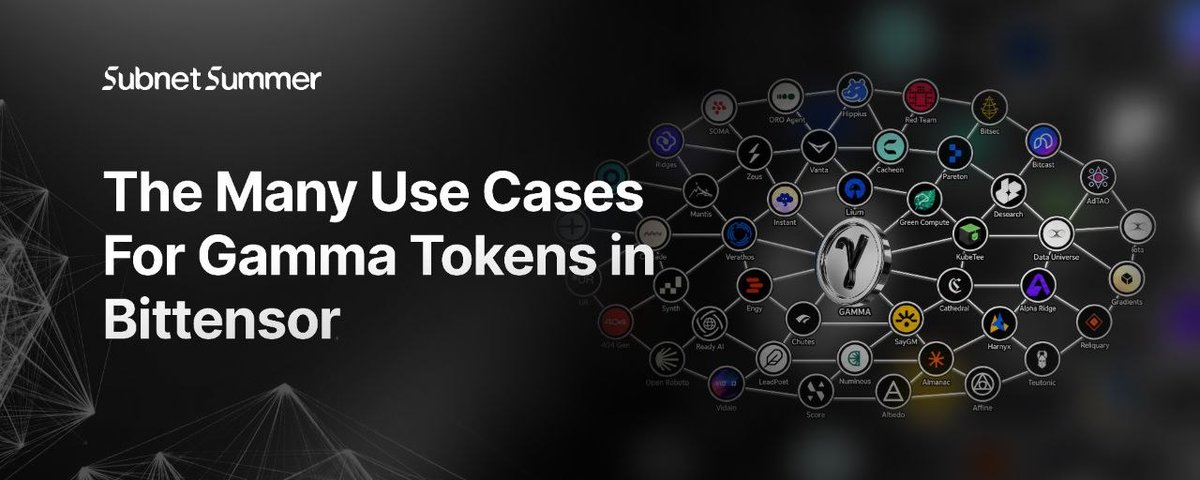
After yesterday’s novelty search, this article will help you map out have far and wide Gamma tokens can spread and benefit subnets.

Shizzy retweeted

Still a long way to go, but up 89% on last month ... slowly at first ..then...


Shizzy retweeted

UR is live on mainnet on SN25!
- Our 100k+ network providers are being transitioned to Bittensor miners
- Our validator is active, setting weights and verifying traffic
- It's permissionless for anyone to become a miner or validator
- Launch of Network Capacity Reserve (more info below)
After many weeks of hard work and countless hours spent to get here, we are proud of this milestone and appreciate all your patience on the journey
The job is far from complete but this is a big step forward by moving our infrastructure onchain. The core mission is very important to us and it's critical we build with intention, while properly testing these new changes
UR is building the privacy network for everyone and we are excited to be building this alongside the Bittensor community
Together we will help empower people across the world to have privacy online
