
Genomes, molecular evolution. Often seen wielding camera. she/her. Find me at bsky.
Cambridge, England
Joined March 2009
- Tweets1.5K
- Following544
- Followers566
- Likes554



Pinned Tweet
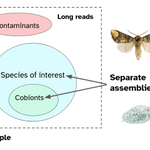
Have long-read data and want to know what you've really sequenced, and how much of it? Reliable taxonomic labels are often scarce if the target is from a less well-explored group. VAE embeddings can tease apart different organisms in read sets:
biorxiv.org/content/10.1101/…

Dr Claudia C. Weber retweeted

Kudoa genomes from contaminated hosts reveal extensive gene order conservation and rapid sequence evolution biorxiv.org/cgi/content/shor… #biorxiv_genomic
Now out in G3: academic.oup.com/g3journal/a… (thanks to the editors and reviewers for attention to detail and efficiency!)

Have long-read data and want to know what you've really sequenced, and how much of it? Reliable taxonomic labels are often scarce if the target is from a less well-explored group. VAE embeddings can tease apart different organisms in read sets:
biorxiv.org/content/10.1101/…
…and there are widgets to filter, query, and extract sequences for downstream analysis. For code and more examples, see:
github.com/CobiontID/read_VA…
For more microsporidian content and tricky genomes, also see this new review from @KhalafAmjad1, @orefrancis & @blaxterlab onlinelibrary.wiley.com/doi/…

Dr Claudia C. Weber retweeted

Disentangling Cobionts and Contamination in Long-Read Genomic Data using Sequence Composition biorxiv.org/cgi/content/shor… #bioRxiv
For more from @KhalafAmjad1 on microsporidian polyploidy, check out the Meio- and Micro-Eukaryotes session tomorrow at #BG23, 10am BST! events.venue-av.com/e/BG23_r… Also featuring myxozoans (me), and nematodes (Erna King) @SangerToL

First preprint of my PhD is out! We survey all publicly available microsporidian datasets on the SRA and show that polyploidy is widespread in Microsporidia! biorxiv.org/content/10.1101/…

Happening today (don't tell the UK Conservative Party...)

Don’t forget! There a workshop on JEDI and #Genomics tomorrow at #BG23. Free to attend! Got some great presenters and facilitators like @SadyePaez @MahUliano @LuckyLinckia @NtangaMapholi @katrinalearned @rzarcone! See you there at 14h UTC+1 or whatever time that is where you are!

A short thread on disentangling cobionts and contamination in Darwin Tree of Life samples for #pgg55 #pggflash. This work is part of the @SangerToL @darwintreelife projects (I usually work on molecular evolution 🦋, but this project was a great excuse to play with other models)

ALT CobiontID: Disentangling cobionts and contamination in Darwin Tree of Life samples. Popgroup 2022 Twitter flash presentation #pgg55 #pggflash
To bin sequences by composition, I count tetranucleotide patterns and reduce them to 2D with a Variational AutoEncoder for visualisation. In this animation, reads from buff tip (red) readily separate from those of its Wolbachia endosymbiont (blue; labels from MarkerScan).
Combining these approaches, we can robustly capture cobionts that are poorly represented in DBs (see drive.google.com/file/d/1ght…).
Want to know more? Interactive example on GitHub: cobiontid.github.io/ ToL-QC species report with output of our pipelines: tolqc.cog.sanger.ac.uk/darwi…
Dr Claudia C. Weber retweeted

Our first forum starts soon! Check it out... + shoutout to our committee @CartneyAnn @timmybash001 @PalmadaMarc @Dr_Stoat @Felipe_SilvaE @samfrowe @drjuefish @jasonwilliamsNY @IgiehonOzede @cc7740, John, Jianguo, Taukondjo, Nicolette, Bouabid, + Olivia

During #BG2021 we have 2 Fora on Justice, Equity Diversity and Inclusion organised by our @EBPgenome JEDI Committee. How this committee came to be? What genomics for all means? Check this small piece by @SadyePaez & I
Genomics for all sangerinstitute.blog/2021/09… via @sangerinstitute
Dr Claudia C. Weber retweeted

Now out in Systematic Biology (academic.oup.com/sysbio/arti…), for those of you who might like to (e.g.) estimate dN/dS using dinosaur amino acid sequence data (there are other applications too).
xitter.cf/EBIgoldman/status/1183…


Who knew you could estimate dN, dS and predict ancestral protein structures from amino acid sequences alone?
Well done @cc7740 @uperron3 @DearbhaileCasey @zihengyang for this piece of work:
xitter.cf/biorxiv_evobio/status/…
Now out in Systematic Biology academic.oup.com/sysbio/adva… @systbiol
Our latest work on inferring evolution from “hidden” data - estimating the strength of selection and reconstructing side chain configurations from amino acid sequences: doi.org/10.1101/802603 (with @uperron3, @DearbhaileCasey, @zihengyang and @EBIgoldman)


Shiny final version academic.oup.com/sysbio/arti…