

Futurist & NY Times bestselling author. New edition of #RiseoftheRobots (https://xitter.cf/t.co/C30wvush11) about how
Silicon Valley, CA
Joined June 2011
- Tweets8.6K
- Following131
- Followers44.3K
- Likes1.7K




Martin Ford retweeted

Evidence is growing that we’re turning the corner on productivity.
US productivity grew at a 3.6% annual rate this past quarter.
That’s more than double the 1.5% average from 2007-2019.
The new numbers put me further ahead for my bet with Bob Gordon about productivity growth in the 2020s. 💪
Here’s how far the US is now ahead of the CBO estimate at the start of the decade (before they knew about the pandemic or LLMs) courtesy of @jasonfurman’s
Econvitals.

Martin Ford retweeted

This debate I moderated for @SuperDebateClub , on whether or not AI is taking most our jobs, addresses one of the most important questions of our time.
It features @MFordFuture who is critical of the idea that AI is like technologies of the past and @pmddomingos who argues that the laws of economics will not break with AI
I highly recommend you watch and share it.
youtube.com/watch?v=64evRvqb…

Martin Ford retweeted

The first jobs for many college grads are disappearing.


Martin Ford retweeted

We compared 12 licensed accountants against frontier AI models on realistic accounting tasks.
The models were faster and more accurate than every accountant in our study.
18 months ago, the best models scored below the average accountant's ~37%. Today, models ace the same tasks.
This doesn’t mean accountants are replaceable. But it does suggest the job will change significantly, even if model progress stalled today.
Read our full study: mercor.com/blog/human-baseli…

Martin Ford retweeted

Very excited to announce Gemini 4 Argon, our new Frontier AI model, and a huge step forward across key capabilities. We’re focused on rolling it out responsibly starting with government and trusted cyber defenders through our Fairwind Program today, before wider availability soon

Martin Ford retweeted

Today we announced the Claude-led discovery of a molecular machine that we suspect could represent a new gene editing mechanism. Its precise function, biotechnological utility (if any), or level of significance is not yet clear, but at minimum it is work I would have been proud to do as a PhD student. The work was done mostly, though not entirely, by Claude: our life sciences team suggested a broad area of research, Claude read through the literature and a bunch of genome data and discovered something interesting, then Claude proposed experiments to verify the discovery and our team carried them out.
It’s easy to dismiss this as a one-off or curiosity, but we’ve repeatedly seen a pattern where AI performance in new intellectual domains goes from weak to superhuman in a matter of a few years. In 2023 models struggled to do math at the level of an average high-school student. In 2024 they started to do well on math competitions for the best high-schoolers in the country, in 2025 they started to solve minor open problems, in early 2026 more significant open problems, and in late 2026 they are beginning to solve the top few open problems in all of mathematics. We believe AI for biology is on a similar exponential trend.
The main difference between biology and mathematics, of course, is that math can be done purely theoretically, while biology requires experimentation. Some have used this to draw the conclusion that AI’s utility in biology will be limited. We think this is wrong. As we’ve demonstrated today, humans can collaborate with AI to perform the experiments, validate key results in a few weeks and, if necessary, work with the AI to iterate on what they find. Eventually it may even be possible for Claude itself to safely perform the experiments by autonomously controlling lab equipment, with appropriate safeguards in place, but we aren’t doing that today (our lab is also a BSL1/BSL2 facility that doesn't handle materials dangerous to humans).
More broadly, biomedical advancement has many stages — from fundamental biology discoveries, to translational research, to drug discovery, clinical trials, and finally the actual delivery of medicines and health care to patients. We are also interested in these later stages, but even simply accelerating the first stage of fundamental biological discoveries has the potential to speed up and broaden the entire pipeline. Improving our understanding of biology and sharpening biologists’ tools can drive forward all of the later stages, for example by identifying new drug targets, finding new therapeutic modalities, allowing for more precise measurement, and speeding up the experimental loop which itself further accelerates our understanding of biology. This will not in itself speed up clinical trial times, but if it succeeds it could greatly increase the number of promising candidates that go into the pipeline — an increase in throughput even though latency remains.
In Machines of Loving Grace, I wrote about AI’s potential to “cure most diseases in 5-10 years” — a goal that sounds impossible, but one I believe is just barely possible if AI is applied to every stage of the pipeline. The first step is showing that AI can first help with, and then drive, biological discoveries.
Claude’s discovery is the latest in a line of related prior work that goes back decades, beginning with systems like CRISPR, and continuing with discoveries like the bridge recombinase and VIPR in the past few years. Recently, there has been heightened interest in systems based on reverse transcriptase (RT) enzymes, the enzyme underlying the system Claude identified. And most recently, a Stanford team working independently described a novel RT system with an associated non-coding array that is in some ways similar to the one Claude found, though they are distinct systems that evolved independently from each other. I believe that we’re at the very beginning of finding such systems and developing them into powerful tools for biotechnology.
I’m proud of the resources Anthropic has invested in accelerating the public benefits of AI through the life sciences, and we’re aiming both to grow our life sciences team and to work with other scientists to extend this approach to a broad range of problems. If you have a proposal for a research collaboration or are interested in joining our life sciences team, please reach out.

Claude has discovered a previously unknown enzyme system hidden in the DNA of bacteriophages. Beside the enzyme’s gene sits a long array of repeating DNA—a structure that looks somewhat similar to CRISPR.
We don’t yet understand what this system does, but only a handful of known systems share its features, and all of them are able to cut, copy, and paste DNA. Historically, the discovery of such programmable systems has helped revolutionize medicine. CRISPR, for instance, is now the foundation of genetic medicines. But it will take much more work to learn what this system does, and whether it can be put to similar use.
Read more: anthropic.com/news/claude-di…

Martin Ford retweeted

13. Baskı / ROBOTLARIN YÜKSELİŞİ- MARTIN FORD (@MFordFuture)
Robotların Yükselişi, teknolojinin hızlanmasının bizim ve çocuklarımız için doğuracağı ekonomik sonuçları anlamamız için zorunlu okuma kitabı niteliğinde.
🔗: kronikkitap.com/kitap/robotl…

Martin Ford retweeted

AI tools are being developed for specialized work in law, finance, customer service and more, alongside advances in workplace robotics.
In a passage from “Rise of the Robots,” @MFordFuture examines the potential effects on white- & blue-collar jobs.
inthesetimes.com/article/ai-…

Martin Ford retweeted

Many years ago, Martin Ford @MFordFuture captured this with his 2009 book “The Lights in the Tunnel.” amazon.com/Lights-Tunnel-Aut…


Two economists mathematically proved that AI will destroy the economy.
Researchers from Wharton and Boston University published a terryfiying paper called "The AI Layoff Trap."
They mapped out the economic end-game of the AI transition, and it exposes a fatal flaw in competitive capitalism.
When a company replaces a worker with AI, it captures 100% of the wage savings.
But that displaced worker is also a consumer. When they lose their job, they stop buying things.
The company gets all the savings, but the loss of consumer demand is spread across the entire economy.
If there are 20 competitors in a market, a CEO only absorbs 1/20th of the economic damage their layoffs just created.
So every single rational CEO has a mathematical incentive to automate as fast as possible.
They can literally see the cliff approaching, and they still step on the gas.
It triggers an unavoidable Prisoner’s Dilemma. If you don't automate, your competitors will, and they will crush you on price.
It doesn't just hurt workers. It destroys the businesses, too.
The economy gets trapped in an automation arms race. Companies fire their workforce to stay competitive, until the entire consumer base is completely hollowed out.
At the limit, the paper concludes: “Firms automate their way to boundless productivity and zero demand.”
And the scariest part?
The researchers mathematically tested every popular fix.
Universal Basic Income? Fails. It raises the living standard but doesn't change the corporate incentive to cut jobs. Retraining? Fails. Worker equity? Fails.
The paper proves that more competition actually makes the collapse happen faster. And "better" AI makes the damage worse.
The only thing that mathematically stops the collapse is a targeted automation tax, forcing companies to pay for the purchasing power they destroy before they automate the job.

Martin Ford retweeted
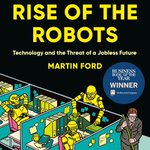
Today is #UK publication day for the new edition of "Rise of the Robots: Technology and the Threat of a Jobless Future."
I have extensively updated the book to cover the latest advances in generative #AI and robotics and to examine the future economic and job market implications of the unfolding AI disruption. The book focuses on what we can do as individuals, and as a society, to successfully navigate the looming transition into the age of AI.
Order from the Amazon or Waterstones links in the reply!
#RiseoftheRobots

Martin Ford retweeted

In 2009, Martin Ford called AI Silicon Valley's next killer app. Now he says the boom could end in a 2008-scale downturn: once AI job losses look permanent, consumers stop spending.
Full conversation on @aktionaer deeptech INSIGHTS, in English and German. Links on my profile.

Martin Ford retweeted

I remember reading the original copy of this book back in 2016 ( i think it was published in 2015). Genuinely one of the most prophetic books I read on the exponential age. Most of the things @MFordFuture outlined in this work have now pretty much come to pass. Some things haven't, but directionally i think we're headed there e.g. UBI (of some sort). Would strongly recommending read for bed or for when you're on the move.


Martin Ford retweeted
Perhaps economists should spend less time focusing on what is happening with #AI and jobs RIGHT NOW, and more time thinking about where we may be 3, 5 or 10 years from now. Three, five or even ten years is a very short period of time relative to our ability to make major reforms to our economy and social contract.
It is only about three and a half years since the introduction of LLM-based chatbots. And for most of that time, the systems were clearly not capable of displacing much human work. It's really only within the past six months or so that agents have started to become truly capable. It should be unsurprising that data collected up to this point does not show a significant impact on jobs. I would argue that the past 3 and half years are likely an extremely poor predictor of what is to come.
#RiseoftheRobots

We can finally say AI isn't killing jobs.
A new paper from me, @tryramp, and @RevelioLabs uses firm-level spend and workforce data across 21K U.S. businesses to measure AI's impact on jobs.
Firms that adopt AI heavily grow headcount 10% over two years following adoption. Low adopters see no statistically significant change.


Martin Ford retweeted

The white-collar recession AI could create politi.co/4eat3My via @politico

Martin Ford retweeted

An Economic Policy Framework: a proposal for how the US government should manage labor market disruption from advanced AI. We’re contributing $200 million to a new fund to sponsor major evaluations of some of these ideas.
anthropic.com/policy-on-the-…

Martin Ford retweeted

So I gave Fable 5 the watchmaker benchmark: a full Swiss lever movement in Three.js. Real gear ratios (18,000 bph), working escapement, breathing hairspring — and the hands tell actual time. It verified its own work with vision, in a loop, until done. ⌚

Martin Ford retweeted
Today, the Stanford @DigEconLab launches the AI Economic Indicators, a new platform for tracking how AI is reshaping work, productivity, adoption, and the economy.
1/6

