

Graphics @ Huawei
France - he/him
Joined January 2025
- Tweets2.1K
- Following1.1K
- Followers1.9K
- Likes10.7K





Amélie Heinrich retweeted

À Paris, lors des manifestations du 17 octobre, une jeune femme partage son échange avec un CRS qui se déroulait plutôt bien, avant de montrer le comportement de deux autres CRS, dont un homme, qui s’est montré agressif physiquement envers elle. 😳


I think whoever wins the next election in France as long as one of their projects is to fire every ticket inspector and publicly humiliate them for the rest of their lives I don’t want it
Legit children of the devil. Anything to pick out of the pockets of teenagers or hardworking people EVEN if they have a ticket


Amélie Heinrich retweeted

society does not value art enough. we should be using modern tech to empower artists to build shit that wae never possible before.
i want to leave my house and think "woah im the future".

Amélie Heinrich retweeted
MicroSDF: Microfacet-Driven Hybrid Neural SDFs for Mixed-Reflectance Surface Reconstruction
Lejia Ye, Yuhua Xu, Yulan Guo, Lian Xu, Xiaohu Zhang
arxiv.org/abs/2610.19681
Abstract:
Accurate 3D reconstruction in real-world environments remains a significant challenge due to the coexistence of reflective and non-reflective surfaces, which pose distinct modeling demands. Existing methods often treat these surface types separately, limiting their generalizability and physical plausibility. To bridge this gap, we propose MicroSDF, a novel neural implicit framework that facilitates geometry and reflectance modeling through microfacet theory. Our approach incorporates three core innovations: (i) a microfacet-guided geometry model that extracts multi-scale surface normals (macroscopic and microfacet) from a signed distance field (SDF), regularized by a proposed microfacet normal consistency loss to enforce physically plausible surface orientations; (ii) an enhanced dual-branch color model, where the specular branch leverages the microfacet normals to model high-frequency reflectance, and the vanilla branch, unlike prior works, uses reflection direction (instead of viewing direction) to better model diffuse and low-frequency specular components; and (iii) a detection-guided color blending strategy that adaptively fuses the color outputs based on reflection priors, providing more physically intuitive blending than implicitly learned blending weights. Combined with a tailored multi-stage optimization scheme, the proposed MicroSDF achieves robust and high-fidelity reconstruction across reflective and non-reflective surfaces. Extensive experiments on DTU, Shiny Blender, Ref-NeRF, and DeepVoxels datasets demonstrate state-of-the-art performance, establishing a new direction for physically grounded neural reconstruction.


Amélie Heinrich retweeted

As a computer graphics person, M3 goes in S tier. It was the first Apple Silicon chip to gain dynamic caching and hardware ray tracing, and Apple’s implementations of both of those features is really good.


If you are a graphics programmer making your own engine, I'd like to ask a question.
Currently you might be using graphics API X or Y or Z or whatever. Take a look at AGFX (link in comments) -- what's one thing that would stop you from using it?
I'm mostly trying to get AGFX to be more attractive to indies, beginners, AAA...
If there's any QOL features or things that would make you switch, I'd like to hear your input
github.com/AmelieHeinrich/ag…


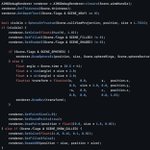
Expanding the AGFX ecosystem, so currently working on AIMD, an immediate mode debug renderer (CPU *and* GPU driven) that is just a drag and drop in your project. Should be ready sometime this week


Amélie Heinrich retweeted

Graphics Programming weekly - Issue 456 - September 20th, 2026 jendrikillner.com/post/graph…
