

PhD student @sheffielduni in @RobFagan lab, looking at vancomycin resistance in C. difficile 🦠 | Lover of pizza, cake and labradors 🐕
West Yorkshire
Joined October 2019
- Tweets513
- Following822
- Followers691
- Likes1.7K





Jess Buddle retweeted

We have 2 fully funded PhD studentships available through the new Yorkshire Biosciences DTP (starting Oct 25) - please share! Both projects are focussed on #phage that infect #Cdifficile


Jess Buddle retweeted

The second chapter of my PhD is out! We are bringing new elements for the potential use oof auranofin as a Clostridioides difficile treatment
nature.com/articles/s41522-0…

Jess Buddle retweeted

#Cdifficile is mainly treated with #vancomycin, so why is resistance not yet a problem? @BuddleJess @BrockhurstLab @RobFagan &co identify 2 resistance pathways that evolve rapidly but with fitness costs that could affect transmission #AMR #PLOSBiology plos.io/3YNHS1m

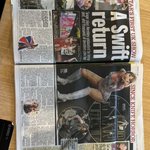
Nothing says "made it" like sharing a newspaper page in the @DailyMirror with @taylorswift13 😭🥳🤩


Jess Buddle retweeted

Researchers @BuddleJess, @RobFagan and team have discovered how the hospital superbug C.diff rapidly evolves resistance to the frontline drug used for treatment in the UK.
Read Rob's thread to find out more about the study 👇
This quoted post is unavailable.
🧵16
A final note to say (first) thanks for reading!
And (second) i am #opentowork - looking for roles in the life sciences sphere. Grateful for any reposts, connections and advice :)
🧵14
This project came at the right time - vancomycin is the current front-line antibiotic for treatment of C. difficile infection in the UK. It is crucial we better understand the multiple routes to resistance. We hope this will pave the way to guiding genomic surveillance.
🧵13
Recapitulating both dacS and vanS together allowed full recapitulation of the end point isolate resistance phenotype, providing a 16x increase in MIC compared to the WT, and suggesting synergistic interactions.
🧵12
This was far from the full story however, and a deeper dive into genome sequencing using nanopore allowed us to identify a further mutation in the end point isolate harbouring the dacS SNP - a mutation in vanS (histidine kinase regulating the C. difficile vanG like operon).
🧵11
We used vancomycin BODIPY microscopy to look at differences in labelling between WT and dacS SNP strains. The dacS SNP strain showed no vancomycin labelling, suggesting increased expression of dacJ leads to increased cleavage of D-Ala, and loss of vancomycin binding sites!
🧵10
D,D-carboxypeptidases cleave the terminal D-Ala from the pentapeptide chain in the cell wall (the vancomycin binding site). With this knowledge, we predicted the mutations in dacS led to increased expression of dacJ, meaning increased cleavage of the terminal D-Ala by DacJ.
🧵8
We then used qRT-PCR to investigate the mechanism of resistance associated with dacS. We found dacS SNPs led to huge increases in expression of dacRS, and neighbouring gene dacJ (a predicted D,D-carboxypeptidase).
🧵7
We recapitulated mutations in dacS, the predicted histidine kinase, and showed these SNPs alone could produce a 4x increase in MIC!
🧵6
Through genome sequencing end point isolates, we found a two component system (dacRS) was frequently mutated in vancomycin resistant clones. We sequenced populations at multiple time points, and found the dacRS mutations always fixed early on in the evolution.
🧵5
We first performed a large-scale evolution of C. difficile under ramping vancomycin selection. We found resistance evolves rapidly in laboratory settings.
Resistance was accompanied by fitness costs - resistant isolates displayed differences in growth and sporulation.
🧵 4
Thanks to the editors at PLOS biology for their help in the process, the University media team, and everyone for their support over the last 4 years.
Read on for some more info!
I'm immensely grateful to everyone who got us to this point! Thanks to my amazing supervisors @RobFagan and Mike Brockhurst, @LucyThmpsn and @asw_stafford, and @ClaireyBaggins @RoyChaudhuri, Rosanna Wright and
William Durham.
