

Exposing Holocaust-era art theft. Public evidence, provenance research, and restitution documentation.
Detroit, MI
Joined July 2025
- Tweets782
- Following7.5K
- Followers504
- Likes91


Pinned Tweet
⚔️ THE YELLOW STAR, A LAST WILL, AND SEVENTEEN SWORDS ✡️
🕯️ “On the day before the wearing of the yellow star”
Károly Dénes was a Hungarian Jewish mechanical engineer, a wartime army captain and a collector of historic swords. He had converted to Christianity some thirty years earlier. In April 1944, neither his conversion nor the military service he recalled protected him from persecution as a Jew.
On the third page of his handwritten will, immediately after the date 4 April 1944 and above his signature, Dénes wrote:
“a sárga csillag hordása előtti napon”
“On the day before the wearing of the yellow star.”
The compulsory yellow-star requirement took effect on 5 April. Dénes placed the approaching requirement beside the date of his will. His own handwriting ties this document to the public humiliation he was facing. [2,5]
In the opening, headed Végakaratom—“My last will”—he explained what persecution had done to his life. In translation:
“I have decided to take my own life because, as a captain with above-average wartime service, I will not wear the yellow star thirty years after my conversion. Moreover, today I also lost my job.”
His words connect the loss of his livelihood with the compulsory identification he faced. His references to conversion and military service reveal how profoundly persecution had violated his understanding of his place in Hungarian society. Historian Katalin Fenyves discusses his testimony in examining the persecution of Christian Hungarians of Jewish origin, whose chosen identities were overridden by the state’s racial classifications. [2–4]
Dénes signed the main testament on 4 April. Further handwritten bequests and instructions are dated 5 and 6 April, showing that he added to the document over several days. The WJRO–Zekelman backgrounder reports that he died by suicide in April; the June correspondence confirms that he was then deceased. His exact date of death has not been established in the material examined here. [1,2,14]
📜 The bequest: Swords, books and catalogue
Clause 7 of the will bequeaths Dénes’s sword collection to the museum in Szeged, southern Hungary, together with its associated literature and catalogue. He chose a public beneficiary and included the records of his collecting. The objects and the material documenting them were to go together. [2]
His will also names the people he trusted. Jenő Karczag was the relative designated as his general heir. The later purchase application describes Karczag as a representative of the legal heirs, placing him directly within the dispute over the estate.
Dénes Zábrák was a senior civil servant, a close friend and a neighbor in the same building. Dénes credited evenings spent with Zábrák’s family with prolonging his life by weeks. He asked Zábrák to oversee his affairs and prevent his treasured possessions from being squandered. Other provisions remembered friends and his housekeeper. [1,2]
Zábrák’s professional standing is independently documented. The Hungarian College of Fine Arts’ rector’s council minutes of 11 September 1942 identify him as a ministerial departmental councilor and inspector, a financial-administration role. They also record his receipt of the Officer’s Cross of the Hungarian Order of Merit. Dénes had entrusted his affairs to a friend familiar with government and cultural administration. [6]
These instructions give the June file its human stakes: a family inheritance, a friend’s responsibility and a museum bequest. Dénes had made decisions about his possessions. The subsequent correspondence shows those decisions being challenged.
⚔️ The applicant: A Defense Ministry official seeking seventeen swords
The six pages on Reel 143, slides 337–342, file 95/1944, concern 180 catalogued swords and a request to purchase seventeen. The applicant was Dr. Antal Belitska-Scholtz, a civil servant and arms collector.
A 1937 Somogy county directory lists him as a szolgabíró, a district administrative official, at Nagyatád in southwestern Hungary. By June 1944, he signed himself as a ministerial secretary in the Defense Ministry, giving his address as Budapest XI, Szent Imre herceg útja 83–85. He sought the swords for a private purchase. [1,7]
On 19 June 1944, following a conversation on 13 June, Belitska-Scholtz wrote to Dr. Dénes Csánky, director of Budapest’s Museum of Fine Arts and government commissioner for the registration and safeguarding of sequestered Jewish-owned artworks. A Defense Ministry official was addressing the museum official administering the anti-Jewish art measures.
Belitska-Scholtz called Dénes his fellow collector and acknowledged the Szeged bequest. He knew both the owner and the destination the owner had chosen.
According to his application, negotiations had begun before the anti-Jewish decrees, and Dénes had allowed him to take seventeen swords home for examination and valuation. He expressly acknowledged that the transaction had not been completed, referring to the decree of 25 May and Dénes’s death. He said he subsequently handed the swords to the XI District administration’s committee handling the estate’s liquidation. [1: slides 339–340]
This distinction is essential: Belitska-Scholtz said he had temporarily held the swords, but he did not claim that the purchase had been completed. His June application sought permission to acquire them. The district committee’s receipt, inventory and disposal records are therefore a crucial next source for establishing where the seventeen swords went.
To support his account, he named Zábrák, Karczag, Dr. László Belenay—a lawyer bearing the title of government councilor—and Dénes’s housekeeper as people familiar with the proposed transaction. He also claimed that the legal heirs had granted him a purchase option. These are the applicant’s representations; the six-page file contains no separate statements from those individuals. [1: slides 340–341]
🏛️ The authenticity argument: Zoltán Tóth and the alleged forgeries
Belitska-Scholtz challenged the will’s formalities, while acknowledging that the probate court would decide its validity. He also argued that the swords he wanted offered little benefit to public museums.
Seven requested objects—nos. 105, 141, 142, 150, 152, 159 and 160—were described as forgeries. The remainder were characterized as ordinary examples. He invoked insufficient exhibition space at the National Museum and the museum in Szeged.
For two weapons, he cited Dr. Zoltán Tóth (1888–1958), a military historian, university professor and specialist in historic arms. Tóth joined the Hungarian National Museum in 1913 and took charge of its military-history collection in 1919. He became a corresponding member of the Hungarian Academy of Sciences in 1927 and a full member in 1940.
Tóth also knew the arms market. He purchased weapons at foreign auctions for the National Museum and participated as an arms specialist in negotiations over Austro-Hungarian collections. His opinion could carry substantial weight in deciding whether an object warranted museum acquisition. His surviving papers in the Academy’s manuscript collection offer a further research route. [8]
According to Belitska-Scholtz, Tóth examined no. 141, an apostle-blade sword, and no. 142, a calendar-blade sword, and judged them to be later imitations. Those two swords appear first and second on the purchase list. Belitska-Scholtz was asking to acquire the very objects whose authenticity he challenged most specifically.
The file contains the buyer’s account of Tóth’s opinion; no separate signed assessment by Tóth appears in these pages. It gives no basis for declaring the expert dishonest. It does show how the buyer used an authenticity judgment to argue that the objects should be available for private purchase.
Whether a sword was authentic could not answer who was entitled to dispose of it or whether Dénes’s bequest would be respected. The application sought to turn an assessment of museum value into a reason for releasing selected objects to the applicant. [1: slides 341–342]
📂 Csánky’s response: The bequest made conditional
Csánky’s draft response of 28 June 1944 stated that the collection had not yet entered the holdings of Jewish-owned artworks sequestered by his commission. The competent authority dealing with Jewish property first had to determine the legal question.
He described two possible outcomes. If the bequest were recognized as lawful, the collection would be distributed according to Dénes’s intentions. If the existing measures meant that Dénes was no longer entitled to make that disposition, the commission would inventory the collection, allocate museum-quality pieces to appropriate public collections and probably auction the remainder. Belitska-Scholtz could then bid.
The continuation expressly describes this as preliminary planning. It asks the applicant to renew his request after the commission’s work was completed. The file contains no decision granting the June request and no record that the swords were subsequently sold or returned to Belitska-Scholtz. [1: slides 337–338]
Dénes had already chosen a public museum. Csánky’s alternative would allow the state to substitute its own allocation of objects, including sales, for that choice. The applicant questioned the will’s formalities; the commissioner also raised the possibility that the prevailing measures had deprived its Jewish author of the authority to make the bequest.
That is the consequential finding in these pages. The file documents a threat to Dénes’s ability to determine his collection’s future, even though the outcome of the private purchase request remains unknown.
For any surviving sword, the question is how it left the estate and under whose authority. Its later presence in a public museum would not, by itself, establish that the bequest to Szeged had been honored.
🗂️ After the war: What happened to the Szeged bequest?
The will survives at Budapest City Archives under HU BFL VII.6.e V.(I)74/1947. An endorsement records its formal proclamation on 15 April 1946. The archive identifies VII.6.e as the proclaimed-wills series of the Budapest I–III District Court. [2,9]
That endorsement records the formal announcement of the will. It does not record a final decision distributing the estate or the delivery of any swords. Those answers require the associated estate proceedings and museum records.
The Móra Ferenc Museum in Szeged is central to this inquiry. Was it notified of the bequest? Did it claim or receive the swords, books or catalogue?
The sections examined in Ferenc Temesváry’s 2013 catalogue of the museum’s militaria have not yielded a documented Dénes identification. This limited finding cannot establish that the collection never arrived. Acquisition registers, deposit records and correspondence may preserve ownership information absent from the published catalogue. [10]
🔎 The Sárvár sword: A specific candidate, an unproved transfer
Dénes no. 137, position XI on the 1944 purchase list, is described as a court smallsword with a pierced blade. It was among the seventeen requested by Belitska-Scholtz and was not among the seven labelled forgeries.
Temesváry’s 1980 catalogue of the Nádasdy Ferenc Museum in Sárvár, western Hungary, describes an eighteenth-century smallsword, F.72.114.1, formerly 62.65, acquired through purchase of the Belitska collection.
Its recorded measurements are 930 mm overall, a 795 mm blade and a blade width of 28 mm. The description identifies repeated blade piercings, small circular openings and a stamped mark depicting two male figures. Printed page 78 illustrates the pierced blade section. [11]
The weapon type, pierced blade and recorded Belitska provenance justify investigating this particular object. But the 1944 entry supplies no measurements or illustration, and no examined document connects the Sárvár sword to Dénes.
The missing evidence is a transfer: did the sword requested as no. 137 ever become Belitska-Scholtz’s property? Until that connection is established, F.72.114.1/62.65 remains a comparison candidate, not an identified Dénes sword.
The later museum acquisition also requires its original documentation. The 1980 catalogue records a municipal purchase of the Belitska collection in 1962. The museum gives that year for another weapon from the collection, while its biography of director Géza Nógrádi places the collection’s arrival in 1961. Purchase and accession records should resolve the chronology and identify the vendor. [11,12]
A Budapest City Archives estate catalogue entry, HU BFL VII.6.a, 1945, 01610, records Belitska-Scholtz’s death on 7 February 1945 and lists a residence corresponding to the address in his June application. The museum purchase came roughly seventeen years after his death.
That creates a second documentary task: identify who held and sold the Belitska collection, and what records accompanied it. The collection name alone does not establish the seller’s identity, its intervening custody or the acquisition of any sword from Dénes’s estate. [13]
⚔️ Search identifiers: Follow the physical details
The 1944 list preserves features that can remain useful when catalogue titles, dates and authenticity judgments change:
• No. 77: French smallsword with a broken, repaired blade and a brass Phrygian-cap pommel.
• No. 119: Sword with a Passau blade, shell-shaped guard and horn grip.
• No. 125: Hungarian sabre with a Virgin Mary blade and yellow leather scabbard.
• No. 137: Court smallsword with a pierced blade.
• Nos. 141 and 142: Apostle- and calendar-blade swords, described in the application as later imitations.
These are the descriptions recorded in 1944, not independently verified modern attributions. Searches should include objects now catalogued as reproductions and examine repairs, blade modifications, inscriptions, scabbards and old collection numbers. A convincing identification will require correspondence between the object and its ownership history. [1: slide 342]
📚 The records needed now
The Holocaust Art Recovery Initiative calls for access to the records that can connect Dénes’s testament, the June application and any surviving objects:
• Budapest City Archives: the estate proceedings linked to Dénes’s proclaimed will; XI District committee receipts, inventories and disposal records; and the separate Belitska-Scholtz estate file.
• The Museum of Fine Arts and relevant archival repositories: registers and later correspondence continuing file 95/1944, including decisions, inventories, transfer authorizations and auction records.
• The Móra Ferenc Museum and Szeged’s archives: bequest correspondence, acquisition and deposit registers, and records of Dénes’s swords, books and catalogue.
• The Nádasdy Ferenc Museum: the 1961–62 Belitska acquisition file, seller identity, itemized schedules, earlier provenance and photographs of marks and labels on F.72.114.1 / 62.65.
Tóth’s papers may preserve examination notes. Dénes’s books may carry ownership inscriptions. His catalogue could connect original numbers to descriptions that later inventories separated. These records could strengthen the proposed comparison, rule it out or establish a different destination.
The @WJRORestitution/@HolocaustMI backgrounder of 2025 already drew attention to Dénes’s unaccounted-for collection. The will and the June file provide a precise starting point for further investigation: a named owner, a named museum beneficiary, a numbered group of requested objects and a documented challenge to the bequest. [14]
“On the day before the wearing of the yellow star,” Károly Dénes recorded the persecution he faced and the decisions he still sought to make for himself. He named people he trusted and a museum he wanted to receive his collection. Within months, officials were discussing whether his wishes could govern its disposal.
His will preserves his voice. The remaining task is to establish what happened to his bequest. Wherever his ownership of a sword, a book or a catalogue can be proved, its provenance should name Károly Dénes and explain how the object left his estate.
#HolocaustArtTheft #ProvenanceResearch #Hungary #Szeged #Sarvar #OpenTheArchives
Sources-
[1] June 1944 correspondence, file 95/1944, Reel 143, slides 337–342. Analysis of the six supplied scans. Csánky’s draft: slides 337–338; Belitska-Scholtz’s application: slides 339–341; seventeen-sword list: slide 342. Public reel index:
hfilms.holocaustcenter.org/r…
[2] Budapest City Archives, Dénes Károly végrendelete, 4–6 April 1944, HU BFL VII.6.e V.(I)74/1947. Page 1: opening statement, heir and personal bequests. Page 2, clause 7: Szeged bequest. Page 3: main testament dated 4 April, the yellow-star phrase above the signature, and “A levelek kézbesítendők” (“The letters are to be delivered”) below it; a further signed instruction is dated 5 April. Page 4: additional entries dated 5 and 6 April and an endorsement recording proclamation on 15 April 1946.
holocaust.archivportal.hu/hu…
Full scan:
holocaust.archivportal.hu/hu…
[3] Budapest City Archives exhibition, “Az öngyilkosságok rekord-éjszakája.” Includes a transcription of Dénes’s opening statement.
holocaust.archivportal.hu/hu…
[4] Katalin Fenyves, “Széttépett esztendők” – Megkülönböztetés, üldöztetés és a zsidó identitás. Discussion of Dénes on page 5.
holocaust.archivportal.hu/si…
[5] United States Holocaust Memorial Museum, Holocaust Encyclopedia, “1944: Key Dates.” Entry for 5 April 1944: compulsory yellow-star identification in Hungary.
encyclopedia.ushmm.org/conte…
[6] Hungarian College of Fine Arts, rector’s council minutes, 11 September 1942, page 3. Zábrák’s administrative titles and decoration.
library.hungaricana.hu/hu/vi…
[7] György Sipos, Somogyvármegye kis lexikonja (Kaposvár, 1937), page 75. Belitska-Scholtz among Nagyatád district officials.
tgyk.hu/sek/0723/Somogyvarme…
[8] Tamás Csikány, “Tóth Zoltán (1888–1958),” in Ludovikás életutak, edited by Tamás Csikány and Gábor Hausner (Ludovika, 2022), pages 337–347. Museum career, acquisitions, academic standing and manuscript sources.
doi.org/10.36250/01084_26
Chapter PDF:
openaccess.ludovika.hu/nke/c…
[9] Budapest City Archives, “Testaments.” Identifies VII.6.e as the proclaimed-wills series of the Budapest I–III District Court; does not supply the outcome of Dénes’s estate proceedings.
bparchiv.hu/en/adatbazis/tes…
[10] Ferenc Temesváry, A Móra Ferenc Múzeum Gyűjteményeinek militáriái, volume I (Szeged, 2013). Introduction, printed page 11; swords section, printed pages 52–65. No documented Dénes identification found in the sections examined.
library.hungaricana.hu/hu/vi…
library.hungaricana.hu/hu/vi…
[11] Ferenc Temesváry, A sárvári Nádasdy Ferenc Múzeum fegyvergyűjteménye (Budapest: Akadémiai Kiadó, 1980). Printed page 11: municipal purchase in 1962. Printed pages 77–78, PDF pages 81–82: F.72.114.1 / 62.65, description, illustration and Belitska provenance. No Dénes provenance is recorded for this object.
real-eod.mtak.hu/11996/
Full catalogue:
real-eod.mtak.hu/11996/1/Aka…
[12] Nádasdy Ferenc Museum, two accounts of the Belitska acquisition. “17. századi dragonyos szablya” gives 1962 for a different weapon, inventory 74.81.1; the biography “Nógrádi Géza” gives 1961 for the collection’s arrival.
nadasdymuzeum.hu/17-szazadi-…
nadasdymuzeum.hu/nogradi-gez…
[13] Budapest City Archives, estate catalogue entry for Dr. Antal Belitska Scholtz, HU BFL VII.6.a, 1945, 01610. Records death on 7 February 1945 and Budapest XI, Szent Imre herceg útja 83–85, with a question mark appended to the address. The entry lists no estate inventory; the underlying case has not been examined.
archives.hungaricana.hu/hu/l…
[14] WJRO–Zekelman Holocaust Center, “Preserving the History of Hungary’s Jews Through Microfilm Archives” (2025), page 2. Earlier public identification of Dénes’s collection as unaccounted for; reports his death by suicide in April 1944.
wjro.org.il/wp-content/uploa…
Related @ArtRecoveryInit posts:
xitter.cf/ArtRecoveryInit/status…
xitter.cf/ArtRecoveryInit/status…
@nytimesarts @SecRubio @CathyHickley @GideonTaylorNY @artlawalex @444hu @Telexhu @tedcruz @SenBlumenthal @RepLaurelLee @Pontifex @RepJerryNadler @ClaimsCon @yadvashem


🖼️ FROM THE HERZOG COLLECTION TO A MUSEUM WALL: GIOVANNI SANTI’S MISERICORDIA DOMINI
🕯️ In June 1944, Hungarian authorities operating under the Zsidó Kormánybiztosság (Jewish Government Commissioner) inventoried artworks stored by the Herzog family in the cellars of their Budafok factory.
Among the recorded crates was one marked:
“H.I.V. Santi”
Inside appeared the following entry:
“G. Santi: Miseri Cordia Domini, olajf. vászonra, mérete: 67 × 54.5 cm.”
Translated:
“G. Santi: Misericordia Domini (Mercy of the Lord), oil on canvas, 67 × 54.5 cm.”
Eighty years later, a painting matching that description remains on public display in Budapest.
🖼️ The Artwork
Giovanni Santi (c. 1435/1440–1494)
The Man of Sorrows (also known as Dead Christ with Two Angels, Christ the Dolorous, or Christ with a Fly)
• c. 1490
• Tempera on canvas (transferred from wood)
• 66.5 × 54.5 cm
• Inventory No. 51.799
• Museum of Fine Arts, Budapest (Szépművészeti Múzeum)
• Currently on view in the European Art collection
Museum record:
mfab.hu/artworks/9766/
The painting depicts the wounded Christ supported by two angels in the traditional Imago Pietatis (“Man of Sorrows”) format. The inventory’s reference to Misericordia Domini—the Mercy of the Lord—corresponds naturally with this devotional subject.
📜 The Documentary Trail
The convergence is striking:
• Artist: “G. Santi” appears in both records.
• Title: “Miseri Cordia Domini” corresponds to the devotional subject represented by the painting.
• Dimensions: 67 × 54.5 cm in 1944 versus 66.5 × 54.5 cm today.
• Medium: Wartime inventories often simplified technical descriptions; minor differences between “oil” and modern conservation terminology are common.
• Collection history: The painting was part of the Herzog holdings and appears in the documented 1944 Budafok inventory.
🏛️ The Herzog Collection
The Herzog Collection, assembled by Baron Mór Lipót Herzog, was one of the most important private art collections in Central Europe.
After the German occupation of Hungary in 1944, the collection was systematically inventoried, seized, dispersed, and transferred into state custody. The surviving inventories provide an extraordinary documentary record of that process.
This Giovanni Santi painting was:
• Published before World War II in scholarly literature.
• Owned by the Herzog family after its acquisition from the Marcell Nemes collection.
• Listed in the 1944 Budafok inventory.
• Retained in Hungarian museum custody after the war.
• Included in restitution litigation brought by Herzog heirs.
⚖️ Why This Matters
This is not an anonymous painting with an uncertain history.
It is a published Renaissance masterpiece with a documented ownership record, a wartime seizure inventory, an identifiable present location, and an ongoing restitution history.
Cases like this demonstrate why provenance research remains essential. The archival record survives. The object survives. The ownership history can be reconstructed.
📂 Call for Transparency
The Holocaust Art Recovery Initiative encourages the publication of:
• The complete provenance file for Inventory No. 51.799.
• All 1944 intake and transfer records.
• Conservation and accession files.
• Any archival materials documenting postwar custody and ownership.
Transparency is the foundation of ethical stewardship and fair resolution under the Washington Principles on Nazi-Confiscated Art.
🕯️ The inventory survived.
🖼️ The painting survived.
📜 The paper trail survived.
What remains is a full public accounting of its journey.
Sources:
• Museum of Fine Arts, Budapest object record: mfab.hu/artworks/9766/
• 1944 Herzog Budafok inventory
• David L. de Csepel et al. v. Republic of Hungary filings
• O. Fischel (1924) and subsequent scholarly literature
#HolocaustArtRecovery #HerzogCollection #GiovanniSanti #ProvenanceResearch #Restitution #WashingtonPrinciples #NaziLootedArt #MuseumTransparency #HEARAct


🩺 THE RESCUER WHO SOUGHT A JEWISH WOMAN’S PAINTINGS
On April 12, 1944, Dr. József Prugberger drove a Jewish colleague’s son to safety. Less than two months later, he approached the Hungarian official responsible for sequestering Jewish-owned art. A Jewish woman possessed two portraits that had once belonged to his family. By his own account, she had repeatedly refused to sell them. Now he invoked the regime’s seizure of Jewish property as a possible way to obtain them.
Prugberger would later be recognized by Yad Vashem as Righteous Among the Nations. His rescue work was real. So was his June 4, 1944 letter, preserved in Reel 143, slides 347–350, file 97/1944. These four pages document an approach to the confiscating authority; they do not establish that the paintings were ultimately seized or that he acquired them. They nevertheless belong in the historical record alongside his acts of courage.
🖼️ A FAMILY SALE—AND AN OWNER WHO WOULD NOT SELL BACK
On February 25, 1923, Prugberger’s father, Dr. Vince Prugberger, a retired judge of Hungary’s Kúria, sold two portraits by Miklós Barabás to Ferenc Gergely of Budapest. A surviving certified copy of the receipt records a combined price of 340,000 Hungarian korona and the purchaser’s acknowledgment that he had bought and received the paintings. The father’s name appears in the receipt as Vincze.
The sitters were the physician’s great-grandparents: József Prugberger, described as a senior mining official who died in 1853, and his wife, Baroness Mária Geramb, who died in 1847. The receipt describes original oil portraits dating from 1871, both in gilt frames, with the artist’s signature on one. It does not identify which portrait was signed.
In his 1944 letter, the physician explained that inflation and the cost of supporting and educating his younger sisters had strained his parents’ finances. His own earnings and his brother’s, he wrote, barely covered their living expenses. Other valuables had already been sold before the family parted with the portraits. This was his explanation of the circumstances; the receipt itself documented the sale.
The surviving copy also records a preparatory step: on May 30, 1944, Prugberger presented the original receipt for certification in Szombathely. Five days later, he wrote to the government commissioner and enclosed that certified copy. He was supporting his request with documentary evidence of his family’s former ownership.
According to the letter, the paintings were now in the possession of Gergely’s widow, who had subsequently married Dr. Ernő Menzer. Prugberger supplied her address: Budapest V., Tátra utca 23/b. He then described his unsuccessful efforts to recover the portraits, writing, in translation: “Over the past years I have repeatedly attempted to buy the paintings back, but on every occasion received a refusal.”
His next paragraph invoked the persecution of Jewish owners. “Given that Jewish property, and thus these paintings of artistic value, is passing into state ownership,” he asked how the pictures could return to his family upon payment of their assessed value. The proposed payment matters: he was seeking a purchase, not a free gift. But a price assessed through the confiscation system would not supply the consent their owner had withheld.
🕯️ THE WOMAN AT TÁTRA UTCA 23/B
The woman appears in the correspondence through the names of two husbands. Prugberger called her “dr. Menzer Ernőné”—Mrs. Dr. Ernő Menzer. That Hungarian married-name form does not reveal her own given name. The file contains no statement from her and no account of what the portraits meant to her.
Two contemporary telephone directories provide an independent lead. The 1943 Budapest directory lists “Menczer Ernőné dr.-né,” described as the widow of a chief physician, at precisely V., Tátra utca 23/b. The 1942 directory gives the same name, description, address and telephone number: 290-174.
That convergence strongly supports identifying the woman in Prugberger’s letter with Dr. Ernő Menczer’s widow. It also supplies a useful spelling variant: Menczer, with a “c,” rather than Menzer. Both spellings belong in searches of marriage and estate records, wartime inventories and restitution files. The directories corroborate a resident’s identity and address; they do not independently establish her ownership of the portraits.
Her birth name and wartime fate remain unverified. We have not established whether she survived the Holocaust or what happened to her possessions. Identifying her is part of this investigation in its own right. Even the account written by the man who wanted her paintings preserves something important about her: she had repeatedly declined to part with them.
⚖️ THE PHYSICIAN WHO SAVED A CHILD
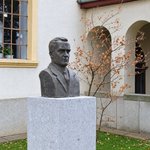
Dr. József Prugberger, 1895–1965, was a chief pulmonary physician in Szombathely, western Hungary, where he is commemorated by a bronze bust. Yad Vashem’s official Hungarian list records his recognition as Righteous Among the Nations in 2004, case 10103. A public ceremony honoring him followed in December 2005.
His rescue work involved the family of his friend and colleague Dr. Dénes Görög, the hospital’s pathologist. Physician and author Ferenc Garzuly records that on April 12, 1944, Prugberger drove Görög’s son Sándor to Kőszeg, Hungary, where the Divine Word missionary community concealed him. The rescue accounts identify the priest István Őri Wachter as caring for the boy. Sándor survived and became a chemist and member of the Hungarian Academy of Sciences.
Prugberger also helped arrange concealment for Sándor’s sister, Klára. When she developed pneumonia, she was admitted to his hospital department, where he instructed staff to record only her first name. According to the account published at the 2005 commemoration, a hospital employee denounced her. She was taken from her hospital bed and subsequently deported with her family to Auschwitz. She did not survive.
Those actions belong in any fair account of Prugberger. They also make the June letter difficult to confront: a physician who helped protect Jewish children approached the state about acquiring paintings from a Jewish woman who had refused to sell. His courage in helping the Görög children deserves recognition, and his request concerning the portraits deserves scrutiny. The published sources cited here do not establish whether Yad Vashem reviewed this correspondence.
The chronology matters. Germany had occupied Hungary on March 19, 1944. By June, the Hungarian government under Döme Sztójay was participating in persecution and mass deportation. The Arrow Cross takeover came in October. Prugberger made this request months earlier, while Hungarian officials were already administering the dispossession of Jewish owners.
📄 THE COMMISSIONER’S ANSWER: MUSEUMS, THEN POSSIBLE AUCTIONS
The recipient was Dénes Csánky, the government commissioner responsible for sequestering Jewish-owned artworks. His reply is dated June 22, 1944, with a dispatch notation for June 23. He told Prugberger that the two Barabás portraits had not yet entered the body of artworks sequestered by his commission. He could not say whether they would.
Csánky then explained the intended disposition of the collected material. Works of museum quality were to be secured for museums. Other objects might, under plans then being considered, be sold at auction. In that event, Prugberger would have an opportunity to acquire the paintings concerning his family.
The reply offered a possible route through a future sale. It was not an order returning the portraits, confirmation of their seizure, or evidence that an auction occurred. The surviving exchange ends without establishing what happened to either painting.
What it does reveal is the official response to an interested purchaser. Csánky discussed custody, museum selection and possible sale. He did not address the owner’s refusal or propose obtaining her consent. Her willingness to sell, which had frustrated Prugberger’s earlier approaches, had no stated place in this discussion of how the state might dispose of the pictures.
🔎 TWO PORTRAITS TO FIND—AND AN OWNER TO IDENTIFY
The surviving descriptions give researchers a specific pair to investigate: oil portraits attributed to Miklós Barabás, both recorded as dating from 1871, depicting József Prugberger, the mining official who died in 1853, and Baroness Mária Geramb, who died in 1847. One was signed; both had gilt frames in 1923. The support is unspecified, and these four pages contain neither dimensions nor photographs.
The documented sale runs from Dr. Vince/Vincze Prugberger to Ferenc Gergely on February 25, 1923, for 340,000 korona. The last reported holder in this file is Gergely’s widow, subsequently Mrs. Dr. Ernő Menzer—very likely the Menczer widow listed at Tátra utca 23/b—named in the June 4, 1944 letter. That is the ownership trail available here, not a complete account of the paintings’ later history.
Both sitters’ recorded death dates precede 1871. If those dates are correct, these were posthumous portraits, potentially based on earlier images. That is a useful search consideration, not proof of how Barabás produced them.
We have not established a present-day location for either work. The portraits could now be separated or catalogued under generic titles such as “Portrait of a Man” and “Portrait of a Woman.” Attributions and recorded dates may have changed, and the frames may no longer survive. A persuasive identification would require a connection beyond appearance: an inscription, a label on the reverse, an earlier photograph, a documented ownership link, or evidence establishing the works as a pair.
The next records to seek include Gergely family estate papers, the widow’s subsequent marriage record, commissioner’s entries under Menzer or Menczer, and museum intake, object and restitution files. The Barabás oeuvre catalogue is another resource for testing possible identifications.
Prugberger’s letter preserves her refusal in his own words. His next paragraph asks how the paintings might become available through the state. That sequence is the heart of this case. A full account of his life must include his rescue work. A full account of these paintings must include their owner’s decision to keep them.
@yadvashem @WJRORestitution @444hu @Telexhu
#HolocaustArtRecovery #ProvenanceResearch #MiklosBarabas #HungarianHistory
SOURCES -
Primary archival documents: Reel 143, slides 347–350, file 97/1944. Slide 347: Csánky’s reply, June 22, 1944, marked dispatched June 23. Slides 348–349: Prugberger’s request, June 4, 1944. Slide 350: copy of the February 25, 1923 receipt, certified May 30, 1944. English translations above are from the original scans.
Yad Vashem: “Righteous Among the Nations Honored by Yad Vashem by 1 January 2024: Hungary,” p. 14; Prugberger Jozsef, case 10103, recognition year 2004.
wwv.yadvashem.org/yv/pdf-dru…
Ferenc Garzuly: “A múlt árnyai: A szombathelyi patológia jegyzőkönyveinek üzenete (1920–1946),” Vasi Szemle, 2004/3, especially note 4 for the April 12, 1944 rescue.
vasiszemle.hu/2004/03/garzul…
Alon: “Két Vas megyei is a Világ Igazai között,” December 14, 2005; account of the rescue efforts and the commemoration.
alon.hu/node/3136
Budapest telephone directory, January 1943, p. 353: Menczer Ernőné dr.-né, widow of a chief physician, V., Tátra utca 23/b, telephone 290-174.
library.hungaricana.hu/hu/vi…
Budapest telephone directory, 1942, p. 332: Matching name, description, address and telephone number.
library.hungaricana.hu/hu/vi…
Köztérkép: Prugberger József memorial, with photographs and an inscription recording 1895–1965.
kozterkep.hu/17846/prugberge…
Barabás Miklós digital oeuvre catalogue: Resources for continuing the search, including works whose present whereabouts are unknown.
barabasmiklos.hu/muvek-keres…
barabasmiklos.hu/lappango-mu…
United States Holocaust Memorial Museum: “The Holocaust in Hungary,” for the German occupation, the Sztójay government and the October Arrow Cross takeover.
encyclopedia.ushmm.org/conte…
Related @ArtRecoveryInit post:
xitter.cf/ArtRecoveryInit/status…


🕯️📜 Dr. Emil Stein Helped Build Hungary’s Cultural Institutions — The Man Who Ran Hungary’s Art Looting Machine Denied His Plea for Protection
Dr. Emil Stein (1874–1945) helped build Hungary’s financial and cultural life. In 1944, Dénes Csánky — the official who orchestrated Hungary’s systematic seizure of Jewish-owned art, and the director of the very museum Stein had personally supported at Csánky’s own request — dismissed Stein’s petition for protection as insufficient.
Within months, Stein was dead. The documents survive at the @HolocaustMI.
Dr. Stein was born in Pozsony (today Bratislava) and rose to become one of Hungary’s most prominent bankers, ultimately serving as managing director of the Pesti Magyar Kereskedelmi Bank. His influence extended well beyond finance into Hungary’s industrial and economic development during the interwar period.
He was also deeply engaged in cultural life. In 1937, at the personal initiative of Dénes Csánky — then director of the Szépművészeti Múzeum — Stein organized a fundraising effort among his circle to support the museum’s picture gallery expansion. His contribution was formally acknowledged in an official letter from Minister of Religion and Education dr. Hóman Bálint. It is in the archive.
That life unraveled rapidly in 1944.
Following the German occupation, Csánky was appointed Government Commissioner for Jewish Art Collections — coordinating the systematic seizure, inventory, and redistribution of thousands of Jewish-owned artworks and cultural artifacts, targeting families including the Hatvanys, the Herzogs, and many others. Archival records confirm his direct oversight of the entire process: he gave orders for inventorying, corresponded with museum directors about receiving shipments, and ensured that prized collections were secured for the state.
At the same time, Stein — then in his seventies — was forced into a yellow-star house. Facing escalating persecution, he submitted a formal petition for exemption from the compulsory Jewish badge: file ref. 66.928/1944.IV.3., later cross-referenced as Kb. 277/1944. In it, he documented his decades of service — and specifically cited the 1937 museum campaign that Csánky himself had initiated.
The ministry routed the petition directly to Csánky for his opinion.
Csánky’s response, dated August 17, 1944, acknowledged that Stein had indeed shown interest in the museum in 1937 and had organized the fundraising effort. Then he dismissed it. The contribution, he wrote, could not be compared to those of earlier donors — not even the lesser ones — and therefore carried insufficient weight to support an exemption. He signed as m.kir.kormánybiztos, Royal Hungarian Government Commissioner, and főigazgató of the Szépművészeti Múzeum.
The man who initiated the campaign Stein had joined declared that campaign too small to save him — while simultaneously signing orders to seize the cultural property of Jewish families across Hungary. The full file — Stein’s original petition, the ministry routing sheet, and Csánky’s denial — survives.
Within months, as Budapest descended into violence during the final siege, Stein was murdered by Arrow Cross forces on January 15, 1945 — weeks before liberation. He was seventy years old.
Amid rising postwar scrutiny, Csánky quietly fled Hungary in 1949, settling in São Paulo, Brazil, where he lived freely until his death in 1972. He was never investigated nor held accountable. Far from being remembered as a perpetrator, he is still honored in Hungarian cultural circles — as an artist. The Hungarian National Gallery’s official website lists Dénes Csánky as a featured artist, with no mention of his central role in the looting.
Dr. Emil Stein petitioned the very man running that machine — a man he had helped, at that man’s own request. The answer was no. 🕯️
Photo caption: Hóman Bálint, Hungarian Minister of Religion and Education, in official ceremonial dress.
#HEARAct @VP


🪜“The Director Was Upstairs”: Elemér Kőszeghy, the Herzog Art Seizure, and the Case for Museum of Applied Arts Disclosure⚖️
Budapest, 1944 | Reel 143, slides 650–657
Wartime officials were moving through the Herzog palace, systematically inventorying private art treasures and attaching seizure labels to the walls. When a resident diplomat confronted the workers to ask who was authorizing the operation, they replied that a museum director was upstairs directing the work. The official complaint that followed identified him by name: Elemér Kőszeghy, director of Budapest’s Museum of Applied Arts.
Preserved in file 157/1944, this contemporary June 24, 1944 Foreign Ministry correspondence places a senior specialist directly inside an operation to control Jewish-owned art. A subsequent letter confirms that inventoried objects were removed from the palace. Read alongside published accounts of Kőszeghy’s work, these documents establish a specific investigation: what did he direct, what reached his museum, and what happened to the family’s property?
📜 The Archival Record: A Diplomatic Protest at Andrássy út 93
The address was Andrássy út 93, Budapest, the Herzog family palace. Miklós Stateloff, a Bulgarian commercial counsellor occupying accommodation there, complained about repeated visits by officials conducting an inventory. The account described officials entering rooms without appropriate introductions and affixing conspicuous inventory labels to artworks.
During one visit, Stateloff asked whose instructions they were following. He was told that a museum director on the first floor was directing the work. He asked that the director come downstairs to discuss the inventory.
The account explicitly identifies him as “Kőszeghy, az Iparművészeti Muzeum igazgatója”—Kőszeghy, director of the Museum of Applied Arts. It reports that Kőszeghy sent word that he had no time to come down; if Stateloff wished to speak with him, he could come upstairs.
The significance is the responsibility attributed to Kőszeghy. A contemporary complaint identifies him as the person giving instructions inside the palace. Transmitted through the Foreign Ministry and forwarded by the Ministry of Religion and Public Education on June 24, 1944, it provides evidence of his reported operational role.
🏛️ Weaponized Knowledge: The Specialist Inside the Palace
Elemér Kőszeghy (1882–1954) brought specialist knowledge to that role. The Museum of Applied Arts’ own catalogue identifies him as its director in 1939–1945. His 1936 reference work, Magyarországi ötvösjegyek a középkortól 1867-ig, documented Hungarian goldsmiths’ marks from the Middle Ages to 1867—the identifying marks used to establish the makers, places of production and dates of historic metalwork.
A later published account specifically describes Kőszeghy as knowing the Herzog family’s material well through his research on goldsmiths’ marks. His expertise therefore bears directly on the investigation. He possessed knowledge relevant to recognizing and documenting valuable objects in the family’s collection.
Within the seizure system, identifying an object could determine how it was classified, labelled and handled. An inventory could preserve its owner’s name while also enabling officials to take control of it. Kőszeghy’s reported presence connects museum authority to that consequential stage of the operation.
🕯️ Force, Coercion, and Disappearance: The Herzog Dispersal
The commissioner’s correspondence identified the objects on the palace’s ground and first floors as belonging to Baron András Herzog. András had inherited a share of his parents’ collection and remained in the family residence with his artworks. He was conscripted into forced labor service, disappeared on the Soviet front in 1943, and was later declared dead, leaving two daughters. Hungary’s discriminatory labor-service system subjected Jewish men to compulsory labor under military authority.
The property had an owner and heirs. Yet the wartime correspondence debated the Hungarian state’s interest in securing the artworks and whether a diplomat’s privileges restricted the officials’ access.
Even the Bulgarian complaint was expressly limited. The Foreign Ministry’s account stated that the legation had no intention of saving Jewish property and accepted that the artworks should be inventoried. Its objections concerned diplomatic privileges and official conduct. The family’s right to retain its possessions was not the protection being requested.
🚚 State Sequestration: Csánky and the allocation of liability
The reply came from Dénes Csánky, the government commissioner responsible for Jewish-owned artworks and director of the Museum of Fine Arts. He explained that he had ordered the palace inventory through the Finance Directorate and defended the museum and finance officials involved.
Csánky described securing the palace’s art treasures as a primary interest of the Hungarian state. He asserted that the objects on both floors belonged to András Herzog and argued that sequestration—placing property under official control—could not simply be omitted because of the rooms in which the objects stood.
His reply dated July 25, 1944, then recorded a completed action. After reporting serious bomb damage to the palace, he stated that, to prevent further damage and dispersal, he had had the sequestered or inventoried objects transported away.
The two directors’ roles must remain distinct. Kőszeghy was identified as giving instructions during the inventory; Csánky claimed responsibility for ordering the inventory and having objects removed. The July reply supplies no itemized shipment list or destination.
🔎 The Salvage Narrative: Why physical preservation is not restitution
A separate published account does connect Kőszeghy, Herzog property and that museum. Writing about the dispersal of Herzog silver in 2011, Emőke Gréczi described Kőszeghy as trying to save furniture and silver by bringing them into the Museum of Applied Arts. She also reported that no list had survived for that particular group of objects.
That account describes a protective purpose. The contemporary file places him within an official inventory operation conducted under the regime’s control of Jewish property. Both belong in the history. The connection between them must be established through records identifying the objects, dates and recipients.
Physical preservation and restitution answer different questions. An object might survive bombing or theft in museum custody while its owners remained dispossessed. Establishing that it was protected does not tell us whether the family recovered it. That requires evidence of ownership, custody, subsequent transfers and return.
🗂️ Unmasking Custody Changes: Postwar recovery documents as active leads
Kőszeghy later assisted Sándor Jeszenszky’s postwar art-recovery commission. Historian Kornél Farkas records that he spent three months helping catalogue applied arts, especially old silver. He supplied ownership lists for tapestries and Italian paintings; the latter included the heirs of Lipót Herzog. He also prepared a memorandum on signed furniture.
Farkas identifies a digitized collection of Kőszeghy’s object survey cards in the Museum of Applied Arts’ archive. These records may preserve the descriptions and ownership information needed to connect family possessions with wartime inventories and postwar custody. His recovery work belongs alongside his reported wartime involvement in a documented account of his career.
🖼️ Archival Record Utility: Modern recovery lessons from the Courbet case
A separate Herzog case demonstrates their practical importance. A Polish provenance-research handbook reproduces an entry from a Herzog catalogue compiled by Kőszeghy for Gustave Courbet’s Landscape near Ornans. Christie’s later recorded the painting’s restitution to the Herzog heirs in 2011, following decades in the National Museum in Warsaw.
This painting is not identified in the palace file examined here. Its published provenance traces its 1944 confiscation to a Herzog family bank deposit. Its relevance is that Kőszeghy’s catalogue preserved evidence connecting an identifiable artwork to the family. Comparable records for furniture and silver could help reconnect objects with ownership histories lost or obscured during their subsequent movement.
📂 The Disclosure Imperative: Institutional obligations and the formula for public transparency
The Museum of Applied Arts should publish a documented account of Kőszeghy’s involvement at Andrássy út 93, supported by surviving assignments, correspondence, field notes and inventories. Those documents should be examined alongside its 1944–1948 intake books, temporary-deposit registers, packing lists, transfer receipts and return records. Temporary custody may be documented outside the permanent collection register.
The required accounting is specific:
• Receipt and custody: Identify every Herzog object the museum can establish it received, including the date, sender, recorded owner and inventory or deposit number. Distinguish palace removals from other Herzog shipments.
• Movement and return: Document what was returned to owners or heirs, transferred elsewhere, retained, or remains unlocated. Identify recipients and supporting receipts wherever possible.
• Missing records: State which relevant records have not been located, which are known to have been lost or destroyed, and what searches have been undertaken.
Object comparisons should preserve the evidence that survives changes in catalogue wording:
• Archival identifiers: Former owners, addresses, inventory numbers, packing and shipment records, deposit entries and return receipts.
• Physical identifiers: Historical photographs, inscriptions, hallmarks, stamps, labels, distinctive construction and documented alterations.
A revised maker attribution, a changed title or a modest measurement difference should be tested against the other evidence. Each proposed identification should explain both the points of agreement and the discrepancies.
The 1944 correspondence names the director, identifies the family’s property and records a removal. The next accounting must identify the objects and their destinations. For every Herzog object that entered the Museum of Applied Arts, the institution should make the evidence of receipt, subsequent custody and any return accessible to the family and the public. Preserving an object’s history includes preserving—and disclosing—the history of the people from whom it was taken.
📚 Sources and Documentary Record
@HolocaustMI/@WJRORestitution Hungarian microfilm collection, RG-52, Reel 143, slides 650–657, file 157/1944. Ministry communication 66.795/1944 IV.3, June 24, 1944; commissioner’s reply dated July 25, 1944. Slides 654 and 657 form the two-page typed reply; handwritten draft pages intervene.
Museum of Applied Arts, Kőszeghy portrait and directorship record, accession Kf 140.7:
collections.imm.hu/gyujtemen…
Kőszeghy’s 1936 goldsmiths’ marks reference, Hungarian Electronic Library:
mek.oszk.hu/26900/26983
Metropolitan Court judgment, November 16, 2005, historical findings concerning the Herzog family and collection, pp. 2–3:
hungarylootedart.com/wp-cont…
United States Holocaust Memorial Museum, “The Holocaust in Hungary,” including the Hungarian forced-labor service:
encyclopedia.ushmm.org/conte…
Emőke Gréczi, “Széthordták a Herzog-gyűjtemény ezüstjeit,” Műértő, June 2011, p. 14:
cdn.hvgblog.hu/amu/archive/m…
Online version:
hvg.hu/kultura/20110607_herz…
Kornél Farkas, Hadtörténelmi Közlemények 133 (2020), no. 2, “A II. világháború következménye a magyar nemzeti műkincsállományra,” especially printed pp. 348–349 and 370:
m.militaria.hu/hadtorteneti-…
Archival leads cited by Farkas: MNL OL XIX-I-13, box 7, dossier 22, unnumbered, “Kőszeghy olasz képek”; MNL OL XIX-I-12, box 2, 785/1947, memorandum on signed furniture. His bibliography also identifies the 2009 digitized Ingó műemlékek leltára in the Museum of Applied Arts’ archive.
The Basics of Conducting Provenance Research, p. 55, reproducing the Kőszeghy Herzog inventory entry:
nim.gov.pl/files/publication…
Christie’s, Courbet, Paysage près d’Ornans, provenance including restitution in 2011:
christies.com/en/lot/lot-583…
#HolocaustArtRecovery #HerzogCollection #ProvenanceResearch #ArtRestitution #Hungary
@nytimesarts @ClaimsCon @WorldJewishCong @Telexhu @444hu @UNESCO @USAmbHungary @SecRubio @RepLaurelLee @tedcruz @RepJerryNadler @SenBlumenthal @StateSEHI @bbcarts @guardianculture @artnews @TheArtNewspaper @cnni @brand_arthur @raydowd
#HolocaustArtRecovery #HerzogCollection #ArtRestitution #ProvenanceResearch #LootedArt #MuseumDisclosure #Hungary #HEARAct #OpenTheArchives
Related @ArtRecoveryInit post:
xitter.cf/ArtRecoveryInit/status…
🤖 Made with AI


🪵📜 What the Furniture Remembers: The Hatvany Castle Seizure and a Renaissance Chest With No Past
🏰 In 1944, officials bearing the stamp of the Magyar Nemzeti Múzeum recorded a Provincial Renaissance chest in the corridor of the Hatvany castle in Hatvan. Height: 63.5 cm. Seized under wartime decree. Transferred into state custody.
Today, the Museum of Applied Arts in Budapest holds a Renaissance wedding chest with no published history before 1945. Height: 63 cm.
The difference is half a centimeter. The question it raises is considerably larger.
📋 Document 195/1944, dated 14 July 1944, records items inventoried at the Hatvany castle — the property of the heirs of Baron Sándor Hatvany. The Hatvany family were among Hungary’s most prominent Jewish industrialists, their collection ranked among the finest in Central Europe. In 1944 they became a specific target of the wartime machinery of confiscation.
Item 6 reads:
“Folyosó. Prov. renaissance láda fa, mag. 63.5 cm.”
Corridor. Provincial Renaissance chest. Wood. Height 63.5 cm.
🗝️ The Museum of Applied Arts, Budapest currently holds:
Wedding Chest (Kelengyeláda)
Transylvanian workshop | First half of the 17th century
Pine base with elm, maple, and walnut intarsia
Inventory no. 61.332.1
🔗 collections.imm.hu/gyujtemen…
1944 Inventory:
— Object: Provincial Renaissance chest
— Material: Wood
— Height: 63.5 cm
— Location: Hatvany castle, Hatvan
— Date: 14 July 1944
Museum Record Today:
— Object: Wedding Chest (Kelengyeláda)
— Material: Pine, elm, maple, walnut intarsia
— Height: 63 cm
— Pre-1945 history: not published
— Source: blank
No stronger candidate has been identified in any other Hungarian museum collection.
🔍 Furniture is the blind spot of Holocaust-era provenance research. Paintings dominate the field — named artists, catalogue numbers, auction records. Furniture disappears more easily into institutional holdings, catalogued under generic descriptions, its wartime journey unremarked. It sits in galleries and study rooms, admired for its craftsmanship, its history quietly erased.
A Renaissance chest with a precise height correspondence, a named Jewish collection, a dated seizure document, and a museum record with no published provenance deserves exactly the same scrutiny as any painting on these walls. The 1944 inventory did not distinguish between paintings and furniture. The seizure machinery did not either.
⚖️ The record establishes:
— Seized from: Hatvany castle, Hatvan
— Owner: Heirs of Baron Sándor Hatvany
— Recorded: 14 July 1944, Document 195/1944
— Object: Provincial Renaissance chest, wood, height 63.5 cm
— Currently held: Museum of Applied Arts, Budapest, inventory 61.332.1
— Pre-1945 provenance published: None
🕯️ Why is the pre-1945 history of Inventory 61.332.1 still a blank page?
The Museum of Applied Arts should publish the complete acquisition and provenance record for this object — including any documentation from the 1940s that records how it entered the collection.
The chest survived the war. The inventory survived the war. The Hatvany name is on the document. Eighty years is long enough to leave this page blank.
#HatvanyCollection #Holocaust #ProvenanceResearch #Renaissance #Furniture #MuseumOfAppliedArts #WashingtonPrinciples #HEARAct
@MikeJohnson @RepJeffries @RepLaurelLee @RepGoodlander @artnet @nytimesarts @hyperallergic @cnni @BBCWorld @guardianculture @USAmbHungary @HolocaustMI @ClaimsCon @yadvashem @SecRubio @googlearts @UNESCO @MELANIATRUMP @USAmbUN @HillaryClinton @BarakRavid @PressSec @CUFI @antiquemark @HouseHistorian @historywithamy @ArtandHistory @archeohistories @AlmanacAntiques @AnnieWHistory @MedievalScholar @FRANCE24 @nypost @ArtDetectivePod


🕵️♂️ SÁNDOR THIRY: THE POLICEMAN ON THE MUSEUM RECEIPT
A museum receipt can preserve more than the movement of an artwork. It can preserve the identity of the official through whom dispossession became an administrative transaction.
In May 1944, Budapest’s Museum of Fine Arts recorded transfers from the Royal Hungarian State Security Police’s anti-Jewish subdepartment, IV/4. The file names the police official to whom the museum sent its acknowledgment: vitéz Sándor Thiry, detective inspector.
Following that name takes us beyond the museum’s storerooms—to Péter Hain’s “Hungarian Gestapo,” the prosecution of its leaders, and a postwar report identifying Thiry as an organizer of police and intelligence work in exile.
The museum transaction is documented. The reckoning with the man behind it remains unfinished.
📜 SIX PAGES, SIXTY-FIVE OBJECTS
File 3/1944, Reel 143, slides 10–15, contains three numbered lists: fourteen works received on 13 May 1944, a continuation listing forty-five additional objects, and a separate receipt for six objects from Aladár Mautner’s home at Andrássy út 88.
Together, those lists account for sixty-five objects. Fifty-nine is the subtotal of the first list and its continuation; it excludes the six Mautner objects.
The cover records that the first fourteen works were labeled and placed in the museum’s air-raid shelter. A handwritten entry dated 16 May records the collection of forty-five further objects from the police. The 20 May entry records dispatch of an acknowledgment addressed to Thiry.
The Mautner receipt, also dated 16 May, is particularly revealing. It identifies a private home, names the police subdepartment delivering the property, and lists six objects, including Japanese and Tibetan material. Beneath the list is the signature of Dénes Csánky, the museum’s director-general.
That signature makes the institutional relationship concrete. The transaction reached the museum’s leadership. These were objects received through a named police organization, recorded on museum paperwork, and acknowledged back to a named police official.
The receipts describe custody for safekeeping. They do not establish lawful ownership, the circumstances of every original seizure, or the objects’ eventual destinations. Their evidentiary force lies in what they do establish: a functioning channel between the anti-Jewish police and the Museum of Fine Arts.
There is also a striking imbalance in the documentation. The fourteen-object list and forty-five-object continuation record artists, subjects and categories without identifying the dispossessed owners. The police official’s identity survives more clearly than those of the families whose property passed through his organization.
🚨 THE COMMAND STRUCTURE BEHIND THE RECEIPT
Historian Krisztián Varga’s reconstruction places Thiry in a clear hierarchy: Interior Ministry secretary of state László Baky, State Security Police commander Péter Hain, IV/4 chief László Koltay, and Thiry, leading IV/4-1.
Thiry’s group handled “Zsidó vagyonok értékbiztosítása”—the protection of the value of Jewish assets. A neighboring group conducted anti-Jewish raids.
Thiry retained a Jewish-affairs command through the summer reorganization. After Hain’s return under the Arrow Cross in October, Koltay headed Division V and Thiry led V/1. Varga lists cooperation with German security services, anti-Jewish raids, deportations and Jewish-property control among V/1’s responsibilities.
Another detail deserves attention: Varga’s reconstruction of the late-1944 police organization also lists detectives assigned to the government commissioner responsible for collecting art treasures. These officers appear in a separate group of detectives on detached duty. The entry documents an organizational connection between policing and art collection. Varga further identifies Thiry as the head of a police group responsible for the “value protection” of Jewish property.
⚖️ HAIN’S RETURN—AND THE VOICES AT HIS TRIAL
The pursuit of Hain involved a remarkable reversal.
As Varga explains in his introduction to Tibor Wayand’s prison memoirs, former Budapest political-police chief József Sombor-Schweinitzer helped the Americans identify and capture Hungarian officials accused of war crimes, including Hain and Koltay. Hain himself had helped bring about Sombor-Schweinitzer’s arrest following the German occupation in March 1944. After surviving imprisonment and liberation, the former police chief assisted the hunt for his former subordinate.
An October 1945 Hungarian newsreel records Hain’s return from American custody. Whatever the propaganda language surrounding the footage, the film provides a contemporary visual record of his transfer back to Hungary.
The proceedings also survive in a very different source: Gyula Illyés’s March 1946 diary.
At the Hain trial, Illyés recorded the testimony of József Weisz, who described being taken from the Majestic Hotel’s cellar to an Arrow Cross house in Városmajor Street, and then beneath the Chain Bridge. Bound to András Péter, Weisz managed to loosen the rope and escape. From a rubbish pit where he hid, he heard the volley fired at the others.
Illyés also recorded Hain and Koltay confronting one another in court, each trying to rebut the other’s account.
This is a courtroom observer’s diary, not a judicial finding concerning Thiry. Its importance here is that it restores human experience to the bureaucratic names: prisoners, terror, an escape, and gunfire.
By 3 July 1946, the Jewish Telegraphic Agency reported that Hain had been convicted and hanged for his role in deportations to death camps and forced labor.
🕵️ 1949: THIRY HEADS A POLICE AND INTELLIGENCE GROUP IN EXILE
Thiry appears again in a February 1949 report cited by historian Tamás Kovács. It identifies him as the head of a police and intelligence group working for Ferenc Kisbarnaki Farkas, a Hungarian general who had served the Arrow Cross regime and was attempting to organize a political comeback from abroad.
In August 1947, Farkas and other Hungarian exiles—including former Arrow Cross politicians—formed a self-styled government at Altötting, Bavaria, Germany. They claimed to be Hungary’s legitimate representatives and rejected the postwar governments in Budapest. Farkas became the head of this government in exile.
According to Kovács, Thiry’s assignment was to bring police personnel together, prepare a manual setting out how a police force would be organized, and conduct intelligence work. This is the organization Kovács calls Farkas’s “police line,” which he describes as a kind of secret service. His account therefore places Hain’s former detective in a leadership role organizing police and intelligence work several years after the war.
That is a specific lead, but its limits matter. We have Kovács’s published account; we have not examined the underlying report. It does not establish what operations Thiry’s group carried out, whether any Western intelligence service employed or protected him, or whether he later faced prosecution.
📂 FOLLOW THE NAMED PEOPLE INTO THE RECORDS
The next stage should connect Thiry’s police service, the museum transfers and the postwar report through documents that establish identity and responsibility.
Useful starting points already identified in the scholarship include ÁBTL 3.1.9. V-77426, the Hain and associates case, and ÁBTL 3.1.9. V-102121, concerning Koltay. These should be examined alongside the report cited by Kovács, Thiry’s personnel records, and any surviving criminal-investigation, wanted-person or extradition files.
For the 1949 report, the questions are specific: Who supplied the information? Was it firsthand? Which former policemen were involved? What correspondence or organizational documents supported the account? Where was Thiry living, and what identifying details distinguish him from people with similar names?
The Museum of Fine Arts should make File 3/1944 and its connected records accessible together: the receipts, correspondence, temporary-label registers, storage records, and subsequent transfers or returns. Each entry should be traceable through the surviving documentation, including cases where the owner or later destination remains unknown.
The signature of the museum’s director-general and the acknowledgment addressed to Thiry provide two ends of a documented institutional exchange. They give researchers specific officials, dates and transactions to investigate.
🕯️ THE NAME IS A STARTING POINT
These six pages preserve the movement of objects into protected storage. They also preserve a relationship between museum administration and anti-Jewish policing.
The missing owners deserve to be identified. The officials whose names survived deserve equally careful scrutiny.
Hain was executed in 1946. Whether Thiry ever faced prosecution remains unresolved in the sources located so far. But the museum’s own correspondence names him in connection with these transfers, and Varga identifies him as the head of a police group responsible for Jewish property. The question is not simply what happened to the art. It is whether Thiry was ever held accountable for what happened to its owners and their property.
Archival record: Museum of Fine Arts, File 3/1944; Hungarian Documents Microfilm Collection, Reel 143, slides 10–15.
#HolocaustArt #SándorThiry #PéterHain #HungarianGestapo #MuseumOfFineArtsBudapest #ProvenanceResearch #ArtRestitution #OpenTheArchives
Sources:
The Zekelman Holocaust Center, Hungarian Documents Microfilm Collection, Reel 143, slides 10–15; the six reproduced pages examined for this post:
hfilms.holocaustcenter.org/
Krisztián Varga, organizational history of Hungary’s wartime political police, Betekintő, 2012/4; particularly the organizational charts and archival references:
real.mtak.hu/145860/1/2012_4…
Tamás Kovács, Detours in the Life of a General: Ferenc Kisbarnaki Farkas, Order of Vitéz (2015), p. 255, footnote 80, citing ÁBTL K-1709/1, V/1012, p. 293.
doi.org/10.1080/13518046.201…
Krisztián Varga’s introduction to Önvallatás: Wayand Tibor fogságban írt visszaemlékezései, 1945–1946, pp. 7–8; publisher’s excerpt:
media.ekonyv.hu/shared/produ…
Gyula Illyés, Naplójegyzetek 1946–1960, March 1946 entries concerning the Hain trial, Digital Literary Academy:
konyvtar.dia.hu/html/muvek/I…
Jewish Telegraphic Agency, report of Hain’s conviction and execution, 3 July 1946:
jta.org/archive/hungarian-ge…
Related @ArtRecoveryInit Post:
xitter.cf/ArtRecoveryInit/status…
@Telexhu @444hu @nytimesarts @WJRORestitution @USAmbHungary @SecRubio @tedcruz @SenBlumenthal @RepLaurelLee @WorldJewishCong @INTERPOL_HQ @NewYorkFBI @dirkmoses @DrHelenFry @JeffreyHerf @BarnabasBalint @SmithHelmut @HolocaustMuseum @WW2TV @RealTimeWWII @JewishChron @jewishinsider
🤖 Made with AI


Chasing Justice: One Year of Exposing Stolen Holocaust Art
The Holocaust Art Recovery Initiative launched @ArtRecoveryInit on @X with two goals: help push the strengthened HEAR Act through Congress before the original Act’s January 1, 2027 sunset, and get as much archival evidence into the public domain as possible before that deadline — evidence heirs and claimants might need to identify property and act while they still had time. The HEAR Act of 2025 was signed into law this April, permanently removing the sunset provision. But the underlying need for transparency hasn’t gone away.
Over the past year we worked through thousands of pages of 1944 Hungarian confiscation records on archival microfilm, publishing the originals, citing reel and inventory numbers, tracing institutional transfer paths, and comparing wartime descriptions against present-day collections. A few threads stood out.
We reconstructed the complete 1944 paper trail for 259 pieces of Herzog Palace jewelry, gems, and coins — inventoried, formally transferred, and received “without shortage” into the Museum of Applied Arts’ safe on August 1, 1944, with government acknowledgment. That chain of custody is fully documented. What the museum has never published is what came after: eighty-two years on, the public record simply stops at their own door.
🔗 xitter.cf/ArtRecoveryInit/status…
A June 1944 inventory led us to strong candidate matches at the Museum of Fine Arts, Budapest, for a portrait attributed to Nicolaes Maes and a revolutionary scene attributed to Eugenio Lucas Velázquez.
🔗 xitter.cf/ArtRecoveryInit/status…
Records from the Surányi apartment seizure — thirty-two paintings and a sculpture, transferred under Government Commissioner Dr. Dénes Csánky’s authority — pointed to a Gerrit Dou Halberdier and an Italian portrait closely corresponding to works now in that same museum’s collection.
🔗 xitter.cf/ArtRecoveryInit/status…
A Late Bronze Age sword — recorded even in an earlier handwritten draft of the 1944 Herzog inventory (Reel 145, Slide 490) as “Kard, késő bronzkor, zöld patinával, 103 cm hosszú, bársony talpazaton,” before the typed version (Reel 145, Slide 507) — has a strikingly matching candidate that traveled as part of the “First Kings of Europe” exhibition, on loan from the Hungarian National Museum to both Chicago’s Field Museum and NYU’s Institute for the Study of the Ancient World. The match raises real jurisdictional questions — decades of claims that this artwork has no connection to the U.S. don’t hold up if it was here on loan.
🔗 xitter.cf/ArtRecoveryInit/status…
A Csetényi family inventory from June 17, 1944 records a Rachel Ruysch flower still life at 107×82 cm. A near-identical Ruysch — “Roses, Convolvulus, Poppies, and Other Flowers in an Urn on a Stone Ledge,” 107.95×83.82 cm — hangs today at the National Museum of Women in the Arts. We’ve called on NMWA to publish its full pre-1986 provenance.
🔗 xitter.cf/ArtRecoveryInit/status…
And we traced the machinery itself: how Dr. Dénes Csánky, as both Museum of Fine Arts director and Government Commissioner, ran a centralized system for processing confiscated Jewish property through state and museum channels.
🔗 xitter.cf/ArtRecoveryInit/status…
🔗 xitter.cf/ArtRecoveryInit/status…
These cases are a sample of hundreds we’ve documented this year. The pattern is the same: the confiscations were meticulously recorded by the perpetrators themselves, and those records survive intact, eighty-two years on. Inventories. Transfer receipts. Signatures. That’s no longer in question.
The Washington Principles were signed by 44 countries in 1998 on the premise that this kind of documentation, once it surfaces, obligates action — not just from the institution that happens to hold the object, but from the wider museum, cultural heritage, and governmental community that endorsed those principles in the first place. Publishing complete provenance is a standing international commitment, and the record we keep finding shows how much of it remains unmet.

🖼️ “PAINT OVER THEM”: A Museum Director’s Proposal for Confiscated Jewish Art
On June 2, 1944, museum director Lajos Kiss reported on paintings taken from Jewish homes in Nyíregyháza, northeastern Hungary. After examining approximately 200 pictures, he selected 37 for a list. For the paintings he rejected, he proposed another use: sell them to artists who would paint over them. The original images were expendable; the canvas was valuable.
His recommendation appears in a signed report to Dénes Csánky, Hungary’s government commissioner responsible for confiscated Jewish art and director of Budapest’s Museum of Fine Arts. Preserved on Reel 143, slides 168–172, the file documents a museum professional considering how confiscated paintings could become raw material for someone else’s work.
Kiss wrote, in translation:
“I do not know what will happen to the rejected pictures and frames. It would be a pity to burn them. Not, of course, because of the picture painted on them, but the canvas is very good and cannot be obtained today even at a high price. It would be advisable to sell them only to painters who will surely paint over them. There are active painters locally too.”
The Hungarian is explicit: “Csakis festőknek volna célszerű eladni akik biztosan átfestik.” Sell them to painters who would surely paint over them. This was a proposal to sacrifice the existing images while extracting value from their supports.
📄 The report explains how the paintings reached this point. Pictures and carpets had been removed from Jewish homes when their occupants were forced into the ghetto. Objects were gathered in official buildings, and Kiss arranged his inspection through the finance administration. Two state officials and two municipal officials were to accompany him.
The main holding site was the gymnasium of Nyíregyháza’s Széchenyi Commercial School, where the confiscated objects were kept under seal. The attached list places 36 selected paintings there. A thirty-seventh, a still life attributed to Endre Komáromi-Kacz and marked “Nyírpazony,” was held separately in the Finance Directorate building. The report establishes these storage locations; it does not establish that the paintings entered the museum’s collection.
Kiss’s assessment was sweeping. He considered none of the pictures suitable for the country’s leading public collections. He explained that recognizable artists’ names—not his assessment of the works’ quality—had determined his selection. The list included works attributed to Béla Iványi Grünwald, Béla Pállik, János Pentelei Molnár, Géza Kukán and other established artists.
Then, immediately before his proposal about the canvases, he asked:
“Should I inventory the inferior pictures I have disregarded?”
That question deserves to be read alongside the recommendation to paint over them. A judgment about artistic quality could determine whether a confiscated painting received further documentation and whether its image was considered worth preserving. The finance administration was conducting its own inventories, so this passage does not prove that the rejected paintings went entirely unrecorded. It does show Kiss questioning whether they warranted inclusion in his inventory.
Even the selected list leaves a serious gap. It names no individual Jewish owner. It records artists and brief subjects, without dimensions and with very few technical details. The people from whose homes the paintings came appear collectively as the Jews of Nyíregyháza. Their individual relationships to the objects—the information essential to reconnecting a painting with a dispossessed family—are absent from this list.
Overpainting would create a further obstacle. If the proposal was implemented, an identifiable composition could disappear beneath another artist’s work while the physical canvas continued to circulate. Searching later catalogues for the original title or subject would then fail to locate the visible object. That is a possible consequence of the proposal, not a finding that any particular surviving painting conceals one of these confiscated works.
These five pages document the recommendation. They do not document its approval or execution. There is no authorization from Csánky here, no sale receipt, no named recipient and no confirmed example of an overpainted canvas. Nor does Kiss’s reference to burning establish that an order to burn the paintings existed. The evidence supports a precise claim: he proposed selling rejected confiscated paintings to artists who would paint over them.
The author was Lajos Kiss (1881–1965), the ethnographer celebrated for documenting the lives of poor people. His books included A szegény ember élete and A szegény asszony élete—the lives of the poor man and poor woman. He received the Kossuth Prize in 1948 and subsequently worked at Budapest’s Museum of Ethnography. In 2019, the Jósa András Museum honored him with an exhibition presenting him as the chronicler of poor people.
His scholarly achievements and this signed recommendation belong in the same historical account. Here, a museum director’s expertise was being applied to property taken from people persecuted as Jews, and his proposed disposition of the rejected paintings would have erased their images.
🔎 There is a concrete place to pursue what happened next. In 2022, the Jósa András Museum received a 1,666-item family collection associated with Kiss and his son-in-law, painter Géza Boross, including 155 documentary and object items. The acquisition announcement does not establish that it contains relevant 1944 correspondence, and the family relationship supplies no evidence that Boross received confiscated canvases. It does identify surviving material that warrants examination.
The records needed are specific: the response to Kiss’s June 2, 1944 report, no. 110/1944; correspondence under the commissioner’s file 45/1944 Kb.; the finance administration’s household inventories; and any sale, release or disposal records for paintings held at the commercial school. These could identify the owners, establish whether the proposal was acted upon, and name any recipients.
The question left by this file is whether paintings taken from Jewish homes were subsequently sold as canvases—and whether the records needed to recover that history still survive.
Sources:
Primary record: RG-52.000, Reel 143, slides 168–172. Cover file 45/1944 Kb.; Lajos Kiss to Dénes Csánky, report 110/1944, Nyíregyháza, June 2, 1944. The overpainting proposal spans slides 170–171; the 37-item list is on slide 172. English translations above are from the Hungarian scans.
Museum of Ethnography, “Kiss Lajos újra – könyvajánló,” April 4, 2023. Biographical information, publications, 1948 Kossuth Prize and subsequent commemorations:
etnofoto.neprajz.hu/index.ph…
Tornyai János Museum, presidential notification of Kiss’s Kossuth Prize, dated March 10, 1948; inventory 93.21.13.2, Hungarian National Digital Archive:
mandadb.hu/tetel/416210/Kiss…
Nyíregyháza municipal portal, November 21, 2022, announcement of the Kiss–Boross family collection acquisition:
nyiregyhaza.hu/post/ezer-tet…
Related @ArtRecoveryInit post:
xitter.cf/ArtRecoveryInit/status…
🤖 Made with AI


📰⚖️ Propaganda as Evidence: Magyar Futár, the Herzog Collection, and the Public Staging of Art Seizure in 1944
In May 1944, the perpetrators brought cameras because they wanted the public to see what they had found. Eighty-two years later, those same images have become evidence.
On 31 May 1944, the antisemitic Hungarian weekly Magyar Futár published a two-page photo-reportage on the discovery, unpacking, and inventorying of artworks and valuables seized from Jewish collections in Budapest. The headline was meant to humiliate: “Zsidó kincsesláda a napfényen” — “Jewish Treasure Chest in the Sunlight.” The subtitle identifies the spread as Magyar Futár’s original photo-report on the inventorying of hidden art treasures.
In the magazine’s telling, Jewish-owned cultural property had been brought into public view for the benefit of the Hungarian nation. In reality, the spread documents the forced seizure and handling of private Jewish cultural property in the weeks after the German occupation of Hungary.
This was not neutral journalism, and it was not merely hateful commentary after the fact. It was propaganda produced at the scene of dispossession. The magazine framed the opening of crates, the handling of paintings, the unrolling of carpets, and the display of valuables as the patriotic recovery of concealed treasure. What it actually captured was the machinery of cultural plunder in operation: police, museum officials, journalists, crates, paintings, carpets, jewels, books, religious materials, and collection objects being processed under Hungary’s 1944 anti-Jewish property regime.
What Magyar Futár presented as triumph has become evidence.
The scene: Budafok, police, museum officials, and crates
Konstantin Akinsha’s article, “Lunching under the Goya. Jewish Collectors in Budapest at the Beginning of the Twentieth Century,” identifies the 31 May 1944 Magyar Futár spread as a photo-reportage on the confiscation of the Herzog Collection. The works had been hidden in cellars in Budafok, on the outskirts of Budapest. The published photographs show Hungarian security police and officials examining major artworks after the crates were opened.
The same scene appears throughout the archival record preserved in the 1944 microfilms. The paper protocols record crate marks, attributions, titles, media, dimensions, owners, and the involvement of the Museum of Fine Arts. The magazine spread supplies the visual counterpart: men standing around paintings in the open air, carpets being handled, valuables being photographed, and major Old Master pictures presented as trophies of state control.
Among the figures associated with the scene was Péter Hain, head of the Hungarian State Security Police and a notorious collaborator with the Nazi security apparatus. Dénes Csánky, Director-General of the Museum of Fine Arts, also appears throughout this seizure environment. His role was not merely curatorial. Csánky served as Government Commissioner for the registration and safekeeping of Jewish-owned artworks placed under seal, the office responsible for administering the very property regime these images document.
That distinction is essential. The Museum of Fine Arts was not simply a passive “safe haven” for endangered artworks. Its director was functioning within the state apparatus created to register and control Jewish-owned cultural property. Museum expertise was present. Museum ambition was present. Museum records were being created.
Csánky’s statement and the motive of museum enrichment
Akinsha records that Csánky gave interviews at the scene. He described the Mór Lipót Herzog Collection as containing works of extraordinary artistic value and reportedly stated that if the state took over the Goyas, El Grecos, and other masterpieces, the Museum of Fine Arts would become a collection ranking just behind Madrid.
That statement is devastating in context. It shows that the officials handling these objects understood their artistic significance and collection identity. The works were not being treated as anonymous abandoned property. They were recognized as major paintings from a Jewish private collection, and their seizure was discussed in terms of the enrichment of the state museum.
This is the moral inversion at the center of the 1944 records: cultural dispossession described as museum advancement. It also cuts directly against any sanitized account of “safekeeping.” The photographs, captions, interviews, and protocols show the same reality from different angles. Jewish ownership was mocked. Concealment was criminalized. Confiscation was recast as public benefit.
The collapse of the “safekeeping” narrative
The language of the 1944 records often sounds administrative: inventory, registration, safekeeping, transfer. The Magyar Futár spread strips that language of its false neutrality. The objects were not quietly protected for their owners. They were publicly displayed, photographed, handled by police and museum officials, and celebrated in an antisemitic magazine as treasures now exposed to the Hungarian public.
That matters for provenance. A later museum file may use bureaucratic terms, but the contemporary propaganda tells us how the seizure was understood by the people carrying it out. These were not ordinary deposits. They were trophies of dispossession.
The objects visible in the spread
The images show a wide range of seized property: framed paintings outdoors, a large Passion scene, carpets and textiles, silver, jewelry, books, and other collection materials. Officials and police appear handling or examining objects that had been removed from private Jewish custody.
Several images intersect directly with works discussed in the 1944 protocols. The clearest example is Goya’s The Topers / Los borrachos / Ivók. Akinsha identifies The Topers among Herzog’s Goya paintings and discusses the Magyar Futár photograph showing Hungarian security police posing with the work. The magazine also published a cartoon of the same painting under the caption “The Joy of the Drinkers,” using antisemitic wordplay.
That detail is grotesque, but it is also evidentiary. The painting was not only listed in a protocol. It was photographed, mocked, and publicly staged as part of the seizure.
Reel 144, slide 80 supplies the corresponding inventory line from 20 May 1944:
“H.I. jelzésű ládából / oldalán III. / F. Goya: Ivók, olajf. vászonra, keretben mérete: 101 × 79.5 cm.”
Translation:
“From the crate marked H.I. / on its side III: F. Goya, Drinkers / Topers, oil on canvas, framed, size 101 × 79.5 cm.”
That line can now be read together with the magazine photograph, Akinsha’s article, and the later public record for the North Carolina Museum of Art painting known as The Topers, measuring 101 × 80 cm. The magazine spread helps bridge the space between inventory text and object image. It is not a substitute for an acquisition file, but it is a rare contemporaneous visual record of the seizure.
The same spread also matters for other works already traced through the 1944 protocols. A large Passion scene visible in the imagery corresponds to the El Greco-related group; the standing young prince holding a rifle corresponds to the Infante Don Baltasar Carlos now recorded in Budapest; and a full-length Brocky Woman in Black has its own archival trail through the Kornfeld-related records. Each of these identifications needs its own object file, but the spread supplies something the inventory alone cannot: a visual record of the paintings together, in the seizure environment, at the moment they were being handled by the authorities.
From propaganda page to provenance evidence
The Magyar Futár spread matters because it joins propaganda, physical handling, and archival documentation in one place. Read together with the microfilm protocols, it shows that the Herzog seizure was not a rumor, a later recollection, or a vague postwar allegation. It was a public event, photographed in real time and celebrated by an antisemitic magazine.
The photographs help turn inventory language into visual evidence. A painting listed in a crate can be compared against a painting shown in the yard. A title such as Ivók can be tested against the image of The Topers. A large Passion painting visible in the spread can be compared against Greco-related works listed in the same seizure protocols. Carpets, books, and valuables visible in the photographs can be checked against decorative-arts and household-object inventories.
The magazine does not supply complete provenance. Its importance is different: it captures the seizure at the moment of official handling and public display. The spread makes visible what later museum catalogues often omit — police presence, museum participation, propaganda framing, state control, and the ideological context in which Jewish cultural property was removed from its owners.
That is why this spread should be treated as a research document, not merely an illustration.
Why this matters now: the Herzog case has returned to federal court
This evidence has renewed urgency because the Herzog family’s litigation has now been reinstated in federal court for nearly all remaining claims.
On 23 January 2026, the United States Court of Appeals for the District of Columbia Circuit affirmed dismissal of the Herzog heirs’ claims on jurisdictional grounds. The court acknowledged the family’s victimization, but concluded that American courts lacked authority to provide a remedy under the legal framework then applied.
Congress then enacted the Holocaust Expropriated Art Recovery Act of 2025, signed into law on 13 April 2026 as Public Law 119-82. Congress provided that covered Holocaust-era art claims “shall be deemed to be an action in which rights in violation of international law are in issue” for purposes of the Foreign Sovereign Immunities Act, without regard to the nationality or citizenship of the victim. Congress also substantially limited the application of numerous procedural and discretionary defenses — including laches, adverse possession, forum non conveniens, prudential exhaustion, international comity, and the act of state doctrine — to otherwise timely claims.
Importantly, those amendments apply to pending cases, including cases already on appeal. The legislation does not decide who owns any particular artwork. It reflects Congress’s judgment that Holocaust-era art claims should, whenever possible, be heard and decided on their historical and factual merits.
On 24 July 2026, confronted with that intervening legislation, the D.C. Circuit issued a per curiam order substantially vacating its January 2026 opinion and remanding all but two of the Herzog family’s approximately twenty-eight remaining claims to the district court. The court did not decide who owns the paintings. It decided that the heirs may once again attempt to prove their claims.
That makes documents like the Magyar Futár spread newly relevant. The case is not only about legal doctrine. It is about evidence. The spread shows how the seizure was staged, how officials understood the collection, and how state and museum actors treated the works at the moment they were taken.
The broader evidentiary chain
The Herzog record now includes several kinds of evidence that should be studied together. The microfilm protocols provide dates, crate labels, titles, attributions, dimensions, and official pathways. The Magyar Futár spread provides photographs, public staging, and propaganda language. Court records provide the history of restitution claims and disputed ownership. Museum catalogues provide current locations, inventory numbers, and public-facing descriptions.
Together, these sources reveal the architecture of the 1944 cultural seizure. Private Jewish collections were hidden, discovered, opened, inventoried, photographed, routed through police and museum channels, and later absorbed into institutional or market histories that often fail to disclose the 1944 context.
That omission is no longer defensible. The records are too specific, and the photographs are too direct.
What should happen now
The Magyar Futár spread should be used as a working research document. Museums, archives, courts, and provenance researchers should identify visible artworks and objects, compare them against the 1944 protocols, and trace them into later museum, market, or restitution records.
For each identifiable object, institutions should publish or make available the wartime inventory record, crate references, front and verso photographs, old labels, frame marks, depot numbers, Kormánybiztos markings, accession files, postwar registration records, transport and evacuation files, conservation reports, and claimant correspondence. The review should include paintings, carpets, silver, books, religious objects, decorative arts, and any other items visible in the spread or listed in the related protocols.
The 2024 Best Practices for the Washington Conference Principles call for proactive provenance research, accessible records, and meaningful disclosure of relevant images and documentation. The Magyar Futár spread shows why that standard matters. A photograph may identify what a catalogue omits. A caption may reveal what an institutional record avoids. A propaganda spread may become proof of the taking it tried to glorify.
The point
The headline “Zsidó kincsesláda a napfényen” was intended as ridicule. Today, it reads as an admission. The page shows Jewish cultural property being exposed, handled, celebrated, and claimed by the state. It shows the officials, the objects, the public staging, and the museum ambition behind the seizure.
What Magyar Futár published as triumph should now be read as evidence. The task is to use it carefully: object by object, crate by crate, photograph by photograph, until the full provenance of the Herzog, Weiss, Mauthner, Kornfeld, and related collections is made public.
The magazine brought the “treasure chest” into the sunlight for propaganda. The archives must now be brought into the light for truth.🕯️
#HolocaustArtRecovery #ProvenanceResearch #HerzogCollection #MagyarFutár #Goya #TheTopers #ElGreco #NaziLootedArt #LootedArt #Hungary1944 #Budapest #MuseumProvenance #HEARAct #WashingtonPrinciples #OpenTheArchives
Sources and relevant links
Yad Vashem photo archive — reproduction of the Magyar Futár spread, “Zsidó kincsesláda a napfényen”
collections.yadvashem.org/en…
Konstantin Akinsha, “Lunching under the Goya. Jewish Collectors in Budapest at the Beginning of the Twentieth Century,” Quest. Issues in Contemporary Jewish History, 2011
quest-cdecjournal.it/lunchin…
PDF version of Akinsha article with figures
quest-cdecjournal.it/wp-cont…

🧶 “TAKE THE CARPETS INTO STATE POSSESSION”: HOW BÉLA KISS MAPPED 43 JEWISH COLLECTIONS FOR HUNGARY’S 1944 SEIZURE APPARATUS
On 22 June 1944, one day after the deadline by which Budapest’s Jewish population had been forced from their homes and into designated yellow-star buildings, a prominent carpet restorer, designer and dealer wrote to Dr. Dénes Csánky, the government commissioner responsible for registering and “safeguarding” Jewish-owned art placed under state control.
His name was Béla Kiss—Kiss Béla in Hungarian name order.
Kiss urged the Hungarian state to take immediate possession of valuable carpets belonging to Jewish collectors. He proposed expert inspections, warned that antique rugs could be ruined by moths and poor storage, and reminded Csánky that he had already submitted a separate document containing the addresses of 43 Jewish carpet collectors.
According to Kiss, inspecting those 43 collections would cover approximately 90 percent of the relevant declarations.
That address list was dated 5 June 1944, sixteen days before Budapest’s Jews were required to leave their ordinary homes. In practical terms, it was a pre-relocation map of valuable Jewish-owned carpet collections at their original addresses.
The list itself is not among the surviving pages examined here. But Reel 143, slides 500–504, File 129/1944, proves that Kiss compiled it, dated it, delivered it to Csánky and proposed that the state use it to inspect and take control of the carpets.
Finding that missing list could restore names and homes to dozens of rugs that may now survive only under generic descriptions such as “Persian carpet,” “Ladik prayer rug,” “Ghiordes,” “old Turkish carpet” or “museum inventory number.”
📜 CONSERVATION LANGUAGE INSIDE A CONFISCATION OFFICE
Kiss began his memorandum with a legitimate technical concern. Wool carpets require continual care. Moths, dampness, folding, pressure and improper storage can quickly damage them, while older and museum-quality examples are especially vulnerable because of their materials, age and rarity.
He wrote from experience, claiming 22 years of professional practice, broad knowledge and specialized expertise. Even ordinary household carpets, he argued, could be harmed by small errors in treatment. Rare carpets of museum significance required still greater care.
Had the letter stopped there, it could have been an ordinary preservation memorandum. It did not.
Kiss turned the conservation problem into an argument against the Jewish owners. He claimed that Jewish collectors knew the penalties for failing to declare property and might, from “revenge” or “negligence,” fail to protect treasures that were, in his formulation, no longer securely their property.
He invoked the antisemitic allegation that Jews were destroying valuables or hiding them from surrender. At the same time, he acknowledged why many owners were unable to care for their collections: a large proportion of the “former collectors”—his phrase—had been interned or were in flight.
The circular logic is stark. The state persecuted the owners, removed them from their homes and deprived them of control over their property. Their resulting absence was then offered as proof that the state needed to take the carpets.
Kiss was not merely describing a risk created by wartime disorder. He was advising the office created to process Jewish-owned cultural property and giving that office a professional rationale for expanding its custody.
🏛️ “THE STATE AUTHORITY SHOULD IMMEDIATELY TAKE POSSESSION”
Kiss’s proposed solution was direct:
“azonnal birtokba venné az államhatalom ezeket a szőnyegeket”
A careful translation is:
“The state authority should immediately take possession of these carpets.”
The wording matters. Kiss was not asking owners to improve storage conditions. He was not proposing that conservators advise families while their ownership remained intact. He wanted the state to take possession.
He referred Csánky to an earlier memorandum dated 25 May 1944, apparently titled Sürgős teendők—“Urgent Tasks.” Point 6 of that proposal called for carpets taken into custody to be examined by a specialist commission, assessed for condition and treated as necessary.
Kiss anticipated that centralized removal might take days or weeks. If the state could not immediately transport the carpets, he wanted experts sent to the locations where the declared objects were being held so their condition could be inspected and their placement arranged.
He had already supplied the addresses.
🗺️ THE MISSING LIST OF 43 JEWISH COLLECTORS
Kiss reminded Csánky that on 5 June 1944 he had delivered a list containing the addresses of 43 Jewish carpet collectors. He said that checking those addresses would cover roughly 90 percent of the declarations.
The dates transform the significance of that list.
On June 5, Budapest’s Jews had not yet been ordered into the yellow-star houses. The relocation decree followed on June 16, and the deadline for leaving their homes was midnight on June 21. Kiss’s list therefore appears to preserve the collectors’ original residences before the mass displacement.
That makes it more than an address book. It may be a map connecting particular owners, apartments and collections at the last moment before those relationships were deliberately broken apart.
If recovered, the list could be cross-referenced against:
• Jewish-property declarations;
• apartment inventories;
• yellow-star-house relocation records;
• Finance Directorate files;
• warehouse receipts;
• museum and depot registers;
• Kiss’s workshop files;
• photographs of carpets before and after treatment;
• postwar release and restitution claims; and
• museum or auction records for rugs with incomplete wartime provenance.
The 43 people should not be reconstructed by guesswork. Other Holocaust-era files identify well-known Jewish collectors who owned carpets, but that does not prove that any particular person appeared on Kiss’s list. The original names and addresses must come from the missing document itself or a reliable copy.
Despite targeted searches in Hungarian and English, @ArtRecoveryInit has found no prior publication or scholarly discussion of Kiss Béla’s 5 June 1944 list of 43 Jewish carpet collectors. The surviving memorandum identifies the list by its date, contents and recipient, but the names and addresses themselves do not appear in the accessible literature we reviewed. The list may therefore represent a previously unexamined provenance source of unusual importance.
🕯️ THE TIMING: ONE DAY AFTER FORCED RELOCATION
Kiss dated the memorandum 22 June 1944.
By midnight the previous day, approximately 220,000 Budapest residents subjected to Hungary’s racial laws had been required to leave their apartments and move into one of nearly 2,000 designated yellow-star buildings. The relocation was not an ordinary housing measure. It concentrated and exposed the persecuted population and formed part of the preparation for further dispossession and possible deportation.
Kiss’s memorandum treated the resulting crisis as a problem of object management. Owners had been interned, displaced or forced to flee; carpets were now unattended; specialists should inspect them; the state should take possession.
The collections had become vulnerable because their owners had first been made vulnerable.
The June 5 list may record where those owners lived before the forced move. The June 22 memorandum shows how quickly that knowledge could be repurposed after their removal.
🧑🔧 WHO WAS BÉLA KISS?
The Kiss Béla in this file was not the notorious Cinkota criminal who shared the same common name. He was a recognized Budapest applied artist, carpet and tapestry restorer, designer, antiques dealer and commercial adviser.
By 1928, advertisements identified his business as:
Kiss Béla Iparművészeti Műterme
Budapest IV., Cukor utca 6
The advertisements promoted awards and certificates received by the workshop. In 1929, Kiss and Jenő Kiss published a substantial illustrated booklet titled:
Régi gobelinek és szőnyegek javítása
The Repair of Old Gobelins and Carpets
The publication used multilingual text and before-and-after photographs to demonstrate the workshop’s restoration ability to an international clientele.
Kiss’s work extended beyond commercial repair. The Christian Museum in Esztergom records that he restored its major fifteenth-century Tournai Calvary tapestry in 1928. Later scholarship reports that, in a 1978 autobiography, Kiss stated that he had restored approximately twenty tapestries, including several belonging to the Christian Museum.
The Museum of Applied Arts also holds a knotted carpet designed by Kiss around 1925, confirming that he was an applied artist and textile designer as well as a restorer.
This professional history explains why Csánky would listen to him. Kiss knew how carpets were made, damaged, repaired, valued and classified. He also knew the private collecting world well enough to produce 43 addresses.
⚠️ A CLOSED LOOP OF EXPERTISE, ACCESS AND MARKET KNOWLEDGE
Kiss signed the memorandum not only as a government-appointed expert and commercial councillor. The typed professional line also identifies him as a carpet and antiques dealer and an applied artist.
That combination created a potentially consequential closed loop.
He knew the collector community. He possessed the expertise to distinguish an ordinary floor covering from a rare or museum-quality carpet. He operated a workshop capable of receiving and treating important textiles. He advised the state to take possession of the objects and proposed expert decisions about their condition and placement.
The file does not prove that Kiss personally acquired any Jewish-owned carpet. It does not show that his workshop received a contract arising from the 43-address list, that he charged the state for treatment, or that he profited from a confiscated collection.
Those questions require invoices, contracts, workshop ledgers, payment records and subsequent ownership evidence.
But the conflict is real enough to require investigation. A private dealer and restorer was simultaneously serving as a state-appointed expert, supplying the government with collectors’ addresses and advocating the transfer of their property into state possession.
The question is not whether professional textile care was necessary. It plainly was. The question is who selected the objects, who received the work, who was paid, where the carpets went and whether the owners’ names remained attached to them.
🏛️ HIS WORKSHOP WAS ALREADY SERVING THE MUSEUM SYSTEM
The official Museum of Applied Arts catalogue adds an important piece of context.
A sixteenth-century Lotto carpet fragment in the museum’s collection was restored and extensively completed in Kiss Béla’s Budapest workshop in 1943–44.
That does not connect the Lotto carpet to a Jewish owner or to the 43 collectors. It does establish that Kiss’s workshop was actively handling a significant Ottoman carpet for Hungary’s national museum sector during the same period in which he was advising Csánky about Jewish-owned collections.
His relationship with the museum world was therefore current and operational—not merely a reputation inherited from work done in the 1920s.
The museum’s restoration file for the Lotto fragment may also help identify the workshop’s practices in 1943–44: its intake records, photography, labeling, billing and documentation methods. Those practices could become useful when searching for Jewish-owned rugs that later passed through the same workshop.
🖼️ WHAT THE LADIK PHOTOGRAPHS DO—AND DO NOT—SHOW
Slides 503–504 reproduce two photographs of an eighteenth-century Ladik prayer rug, one before restoration and the other after treatment.
The captions identify:
“Ladik ima szőnyeg. XVIII. sz. Javítás előtt.”
“Ladik prayer rug, eighteenth century, before repair.”
And:
“Ugyanazon Ladik szőnyeg javítás után.”
“The same Ladik carpet after repair.”
The first image shows extreme moth damage and extensive loss. The second shows the architectural prayer design and borders substantially restored.
The photographs appear to derive from Kiss and Kiss Jenő’s 1929 restoration publication. They functioned as professional credentials and visual evidence of the damage Kiss claimed could occur without immediate expert intervention.
They should not be presented as photographs of a rug confiscated from one of the 43 Jewish collectors. The surviving pages make no such connection.
Their significance is different. Kiss used images of successful conservation to support a proposal for state possession. The photographs helped turn his technical expertise into administrative authority.
🧾 THE LANGUAGE OF DISPOSSESSION
Several phrases in Kiss’s memorandum deserve close attention.
He called the owners “former collectors.” He described the treasures as objects that were no longer securely their property. He blamed possible deterioration on their revenge or negligence, even while acknowledging that many had been interned or forced to flee.
The words converted persecution into an administrative condition.
People who had been removed from their homes became “former” collectors. Property rights deliberately stripped away by the state became uncertain ownership. The danger created by internment and forced relocation became evidence that the owners could not be trusted to care for their possessions.
“Taking over” sounded temporary. “Protection” sounded benevolent. “Expert inspection” sounded neutral.
Within the structure of 1944 Hungary, those words could conceal a direct transfer of control from persecuted owners to the state institutions and professionals surrounding them.
🔍 THE RECORDS THAT MUST NOW BE FOUND
The first priority is Kiss Béla’s list dated 5 June 1944, containing the names or addresses of the 43 Jewish carpet collectors. File 129/1944 proves that Csánky had received it. The list may survive as an attachment, a separately registered submission, a working copy or part of another administrative file.
The second is Kiss’s 25 May memorandum, Sürgős teendők, particularly Point 6 concerning the proposed specialist carpet commission. That document may show whether the inspection plan was conceived specifically for carpets or formed part of a broader strategy for decorative arts.
The third is Csánky’s response and implementation record. The present file preserves Kiss’s proposal but no substantive answer. Routing slips, orders, appointments, travel authorizations or expense approvals would show whether the 43 addresses were acted upon.
The fourth is the collector-by-collector inspection trail: declarations, apartment inventories, warehouse transfers, condition reports, photographs, object tags and museum receipts. These records should show whether owners’ names were preserved or replaced by anonymous categories and storage numbers.
The fifth is the documentation of Kiss’s Cukor utca 6 workshop: intake registers, invoices, treatment reports, correspondence, photographs, outgoing receipts and postwar accounting files. Any wartime payment by Csánky’s office, the Finance Directorate or a museum should be disclosed.
The sixth is the Museum of Applied Arts restoration and acquisition file for the Lotto carpet fragment treated in 1943–44. That file could reveal how Kiss documented objects then passing through his workshop and whether labels, images or numbering systems survive.
Finally, the names from the missing list should be checked against postwar return and restitution files. Survivors and heirs may have sought carpets that had been reduced in official paperwork to generic type, color and dimensions.
🌍 WHY THE LIST SHOULD BE PUBLIC
The Washington Conference Principles call for relevant Holocaust-era records and archives to be open and accessible to researchers. The 2024 Best Practices reinforce proactive provenance research and transparency concerning property lost through Nazi persecution and the actions of collaborating governments.
Here, the requested document is not hypothetical. It is identified by its author, date, subject and recipient:
Béla Kiss
5 June 1944
Addresses of 43 Jewish carpet collectors
Delivered to Dr. Dénes Csánky
Publication of that list would not, by itself, prove the present location of any carpet. It would provide something essential that generic museum and auction descriptions often lack: the owner’s name and the place from which the collection was taken.
⚖️ THE HISTORY THAT MUST BE RESTORED
File 129/1944 captures a moment when conservation expertise became part of confiscation policy.
Béla Kiss knew that antique rugs could be destroyed by moths and poor storage. He also knew where the Jewish collectors lived. He provided their addresses to Hungary’s Holocaust-era art authority and urged the state to take possession of their carpets after the owners had been interned, displaced or forced into hiding.
The file does not tell us whether all 43 collections were inspected. It does not identify the owners in the surviving pages, establish that Kiss received their carpets or prove that he personally profited.
It establishes the plan, the professional who proposed it and the missing records that can show what followed.
The central questions are no longer general:
Where is Kiss Béla’s 5 June 1944 list of the 43 Jewish carpet collectors? Has it ever been catalogued, transcribed or cross-referenced against Hungary’s museum, warehouse and restitution records—and what became of the collections it identified?
The rugs may survive in museums, storerooms, auction records or private collections. Their owners’ names should survive with them.
Sources and documentary record -
Primary archival source: Zekelman Holocaust Center/ WJRO Hungarian Holocaust-era art-seizure archive, RG-52, Reel 143, slides 500–504, File 129/1944. Slide 500 is the file cover. Slides 501–502 contain Béla Kiss’s memorandum to Dénes Csánky, dated 22 June 1944, including the request for immediate state possession, the reference to the 25 May memorandum and the 5 June list of 43 Jewish carpet collectors. Slides 503–504 reproduce the Ladik prayer rug before and after repair.
hfilms.holocaustcenter.org/
Blinken OSA Archivum, Yellow-Star Houses 1944–2014. Documents the June 16 decree and the June 21 deadline requiring approximately 220,000 Budapest residents subjected to the racial laws to relocate into 1,944 designated yellow-star buildings.
archivum.org/public-programs…
yellowstarhouses.org/
Advertisement for Kiss Béla Iparművészeti Műterme, A Társaság, 27 May 1928. Identifies the workshop at Budapest IV., Cukor utca 6 and advertises its awards and certificates.
epa.oszk.hu/06300/06394/0065…
Kiss Béla and Kiss Jenő, Régi gobelinek és szőnyegek javítása, Budapest, 1929. Illustrated multilingual publication documenting the workshop’s restoration work.
antikvarkonyvekbudan.hu/hu/i…
axioart.com/tetel/1929-kiss-…
Christian Museum, Esztergom, Calvary tapestry. Records restoration by Béla Kiss in Budapest in 1928 and cites the 1929 Kiss publication.
katalogus.keresztenymuzeum.h…
keresztenymuzeum.hu/collecti…
Christian Museum restoration publication. Identifies the illustrated before-and-after materials as coming from Kiss Béla and Kiss Jenő’s 1929 publication.
keresztenymuzeum.hu/content/…
Historical and contemporary tapestries in Hungary. Reports Kiss’s statement in a 1978 autobiography that he restored approximately twenty tapestries, including several belonging to the Christian Museum.
dobranyifoundation.hu/034_do…
Museum of Applied Arts, Budapest, knotted carpet designed by Béla Kiss, ca. 1925, inventory no. 80.77.1.
gyujtemeny.imm.hu/gyujtemeny…
Museum of Applied Arts, Budapest, sixteenth-century Lotto carpet fragment. The official catalogue records restoration and completion in Kiss Béla’s Budapest workshop in 1943–44.
gyujtemeny.imm.hu/gyujtemeny…
Rugtracker, “The Holbein-Lotto Carpets, V: Lotto Carpets, Kilim Style.” Secondary source referring to a carpet from a “Bela Kiss Collection.” That ownership description requires verification against the Museum of Applied Arts’ acquisition records.
rugtracker.com/2014/01/the-h…
Washington Conference Principles on Nazi-Confiscated Art. U.S. Department of State
state.gov/washington-confere…
Best Practices for the Washington Conference Principles on Nazi-Confiscated Art, 2024. U.S. Department of State
state.gov/office-of-the-spec…
#HolocaustArtTheft #LootedArt #ProvenanceResearch #TextileHistory #OpenTheArchives #WashingtonPrinciples #HEARAct
@WJRORestitution @HolocaustMI @ClaimsCon @WorldJewishCong @CathyHickley @ZacharyHSmall @nytimesarts @artworldcurator @SallyTuckett @PrincessHamira @pasttimesewing @ferrengipson @Serena_Dyer @ncph @MuseumTextiles @TexMinIndia @GWTextileMuseum @HALIMagazine
🤖 Made with AI


🕯️🖼️ THE LABEL STILL ON THE FRAME: WAS BUDAPEST’S PORTRAIT OF JULIA CZINDERY THE CSETÉNYI PASTEL RECORDED IN 1944?
In June 1944, Hungarian officials removed paintings and other cultural property from the Budapest home of collector József Csetényi and his wife, Erzsébet Frisch, and transferred the principal group to the Museum of Fine Arts.
A second inventory in the same wartime file records an anonymous eighteenth-century pastel portrait of a woman measuring 72 × 58 cm. Officials placed it on a sheet headed Selejt anyag—a secondary category for objects excluded from the principal inventory.
Today, the Museum of Fine Arts, Budapest holds an anonymous eighteenth-century pastel titled Portrait of Julia Czindery. It measures 73.5 × 58 cm, bears inventory number 9840, and remains attributed only to a “French or Austrian painter.”
The comparison is already close: same century, same subject, same medium, an exact match in width and a difference of only 1.5 cm in height. But the museum photograph preserves an additional clue that deserves far more attention. Along the lower edge of the frame is an older institutional label:
“9840. FRANCIA, XVIII. sz. 2. f.”
In English:
“Inventory no. 9840. French. Eighteenth century, second half.”
The classification still attached to the physical object agrees with the 1944 Csetényi record on the century and is consistent with the museum’s present dating. A specialist catalogue adds another significant fact not disclosed on the museum’s public object page: the pastel is reported as acquired in 1949, five years after the wartime inventory.
None of this proves that the museum portrait and the Csetényi pastel are the same object. It does create a focused provenance question that the museum’s 1944 receiving records, 1949 accession file and conservation documentation should be able to answer.
📜 THE PASTEL ON THE SECOND CSETÉNYI INVENTORY
The principal protocol records the removal of works on 17 June 1944 from the Csetényi residence at Budapest, Ilona utca 10 and their delivery to the Museum of Fine Arts. Its 44 numbered entries include paintings and graphic works attributed to Bellini, Pieter Brueghel, Jan van Os, Rachel Ruysch and other European artists.
The pastel appears on the following page, Reel 143, slide 286, beneath the heading:
“Csetényi Józsefné II. számú jegyzék. Selejt anyag.”
A careful English rendering is:
“Mrs. József Csetényi. Second inventory. ‘Selejt’ material.”
Item 5 reads:
“XVIII. sz.-i ismeretlen festő: Női képmás, pasztell, 72 × 58 cm.”
In English:
“Unknown eighteenth-century painter: Portrait of a Woman. Pastel. 72 × 58 cm.”
The Roman numeral is XVIII—eighteenth century. The wartime dating therefore agrees with the historic frame label and with the Museum of Fine Arts’ present classification of its pastel as a work from the second half of the eighteenth century.
The heading also illustrates how the archival language obscured the individual owner. Csetényi Józsefné means “Mrs. József Csetényi,” identifying the woman only through her husband. Art historian Sándor Juhász’s reconstruction of the collection restores her own name: Erzsébet Frisch.
The state paperwork catalogued her family’s paintings, porcelain, carpets and silver in detail while reducing her identity to a marital formula. Restoring her name is part of restoring the history of the collection.
🗂️ WHAT DID “SELEJT” MEAN?
The Hungarian word selejt can mean reject, discard, cull, scrap or material considered unsuitable. In this file, it shows that officials separated these objects from the main inventory and assigned them an inferior administrative status.
It does not establish that the objects were destroyed, abandoned by their owners, returned to the Csetényi family or released from state control. The heading records how the wartime bureaucracy classified the group, not what ultimately happened to it.
The second sheet contains five pictorial works followed by two colored engravings: an anonymous Romantic landscape, a Flight into Egypt, an Italian male head, a city view, the female pastel and the two prints. The pastel is the only work on the sheet in that medium, and its dimensions are specific enough to permit an object-level comparison today.
The irony is difficult to miss. A portrait assigned to a secondary or reject list in 1944 may correspond to a work now held permanently in Hungary’s national collection with a named sitter, a formal inventory number and an established place in the Old Master Paintings department.
That possibility makes the word selejt an archival clue, not a conclusion.
🔢 THE FILE’S ARITHMETIC MAY SHOW THAT THE FIVE PICTORIAL WORKS WERE RECEIVED
A handwritten notation on the principal Csetényi protocol appears to state that its 44 listed works were entered on 6 October 1944 in the Museum of Fine Arts inventory daybook under numbers 53–96.
That sequence contains exactly 44 numbers, matching the 44 entries on the principal inventory. It therefore appears likely that daybook entries 53–96 correspond to the main list rather than automatically including the seven objects on the separate selejt sheet.
A later report in the same file, however, records the delivery of 49 pictures, together with three sculptures, seven carpets, thirteen vases and two bowls.
The numerical relationship is striking:
**44 works on the principal inventory
• 5 paintings or pastels on the second list
= 49 pictures in the later delivery tally**
The two remaining selejt entries were colored engravings and may have been counted separately or handled under another category.
This arithmetic does not prove that Item 5 was received, retained or assigned a museum number in 1944. The surviving summary does not identify the five secondary-list works individually, and pictures may not have been used with perfect consistency across every document.
But the alignment is too precise to ignore. It strongly suggests that the first five objects on the selejt sheet may account for the difference between the principal 44-item inventory and the later total of 49 pictures.
The museum’s receiving books, depot registers and temporary inventories should be able to confirm or disprove that reading.
🏷️ THE LABEL STILL ON THE FRAME
The historic label visible along the lower edge of the museum object reads:
“9840. FRANCIA, XVIII. sz. 2. f.”
The abbreviations identify the object as:
Inventory no. 9840. French. Eighteenth century, second half.
That label is important because the agreement with the 1944 record exists on the physical object itself, not only in the museum’s current online database.
The comparison now involves three descriptions:
1944 Csetényi inventory: unknown eighteenth-century painter; female portrait; pastel; 72 × 58 cm.
Historic label on the frame: inventory no. 9840; French; second half of the eighteenth century.
Current museum catalogue: French or Austrian painter; second half of the eighteenth century; pastel on paper; 73.5 × 58 cm.
It does, however, preserve an older museum classification that aligns with the wartime description and appears to predate the current, slightly broader “French or Austrian” attribution. That makes the label part of the provenance inquiry.
The museum should identify when it was attached, what catalogue card supplied its wording, whether it dates from the reported 1949 acquisition, and whether any earlier label or temporary number survives beneath it or elsewhere on the frame.
🖼️ THE PRESENT MUSEUM OBJECT
The Museum of Fine Arts currently catalogues the portrait as follows:
French or Austrian painter
Portrait of Julia Czindery/Czindery Júlia képmása
Second half of the eighteenth century
Pastel on paper
73.5 × 58 cm
Inventory no. 9840
Old Master Paintings
Not currently on display
The wartime recorder described an eighteenth-century female portrait in pastel and could not identify the artist. The museum likewise names no individual painter, narrowing the attribution only to a French or Austrian artist from the second half of the century.
The wartime title, Női képmás, simply means “Portrait of a Woman.” The museum now identifies the sitter as Julia Czindery. That change is entirely compatible with a possible match: an official rapidly inventorying seized property could record an unfamiliar ancestral portrait generically, while an old inscription, family tradition, backing label or later owner might preserve the sitter’s name.
The dimensions remain one of the strongest points of convergence:
Csetényi inventory, 1944: 72 × 58 cm
Museum of Fine Arts, inv. 9840: 73.5 × 58 cm
The 58 cm width is exact, while the height differs by 1.5 cm.
For a framed pastel on paper, that difference deserves examination rather than dismissal. Historical inventories frequently measured the visible image inside a frame or mount, while modern museum measurements may record the full paper support. Rounding, remounting, trimming or conservation treatment could also affect the recorded height.
Those are possible explanations, not findings. The museum’s historic measurement and conservation records are needed to establish whether the work, support or mount changed over time.
🩹 THE VISIBLE DAMAGE MAY PRESERVE FURTHER EVIDENCE
The museum photograph appears to show significant condition problems. There are broad tears, losses or disruptions across the upper field, scattered damage in the background, abrasion or loss along the lower edge and further deterioration near the sitter’s arm.
The photograph cannot establish when that damage occurred, what caused it or whether every affected area belongs to the pastel sheet rather than its mount or backing. There is no basis to attribute the condition to the 1944 transfer without documentary or technical evidence.
The visible damage nevertheless makes the conservation file especially important. If the pastel was removed from an earlier mount, backed, flattened, trimmed, remounted or reframed, the treatment records may contain older measurements approaching 72 × 58 cm.
Conservation photography may also preserve evidence no longer visible from the front: inscriptions, stamps, inventory numbers, removed labels, backing papers and traces of earlier mounting. For an object with an unresolved wartime comparison, that physical evidence may be as important as the written catalogue.
The museum should therefore publish the complete condition and treatment history, including recto and verso photographs, historic measurements and documentation of any change to the support or mount.
👤 WHO WAS JULIA CZINDERY?
The museum’s short public record names the sitter but does not explain when or how that identity was established.
Historical sources point toward Julia—or Julie—Wächtler, wife and later widow of Rókus Ferenc Czindery. The Hungarian Academy of Sciences’ death-notice collection indexes her as:
“nagy-attádi Czindery Rókus Ferencné (Wächtler Julia, 1809)”
That identifies Julia Wächtler as the wife of Rókus Ferenc Czindery and records her death in 1809. An adult portrait from the second half of the eighteenth century would therefore be chronologically consistent with her life.
A surviving musical dedication independently confirms the maiden name. Around 1804, the Bohemian composer Franz Krommer published three string quartets, Op. 54, dedicated to:
“Madame Julie de Czindery, née de Waechtler.”
Other historical accounts place the widow Czindery within the cultivated social world of late eighteenth-century Hungary and associate her household with literature, language, music, books and educated conversation.
If she is the woman represented by inventory no. 9840, the portrait preserves the likeness of an identifiable historical figure rather than an anonymous decorative sitter.
The museum’s file should explain what evidence connects the portrait to her. Did the name accompany the pastel when it was acquired? Is there an inscription, old label, family tradition or earlier catalogue reference? Did Portrait of a Woman become Portrait of Julia Czindery, and if so, when?
A specialist pastel catalogue introduces a complication, describing the sitter as née marquise de Ville. That conflicts with the death-notice record and the contemporary Krommer dedication, both of which identify her as Julia Wächtler. The 1949 accession file and earlier museum catalogue cards may help establish where the conflicting identity arose.
🕯️ ERZSÉBET FRISCH AND JÓZSEF CSETÉNYI
The modern object comparison should not obscure the people whose property appears in the wartime file.
József Csetényi (1875–1956) was a journalist, writer and collector who assembled a significant group of European paintings. His wife was Erzsébet Frisch, although the 1944 documents refer to her only through the customary marital form Csetényi Józsefné.
The file arose within Hungary’s system for taking control of Jewish-owned cultural property. It was not an ordinary voluntary museum consignment. The surviving pages record paintings, decorative arts, carpets and other family possessions moving into state institutions while the owners had been stripped of ordinary control over their property.
The file also preserves handwritten communications concerning the packing and removal of the collection. Behind the inventory numbers was an identifiable household watching its property divided among national museums.
Postwar history remains essential. Juhász’s research indicates that at least part of the collection returned to family control after the war and was later dispersed through inheritance, private sale and the art market. Some works subsequently entered museums.
That history means that identifying inventory no. 9840 as the Csetényi pastel would not automatically establish unlawful present possession. The portrait may have been returned and later sold or donated to the Museum of Fine Arts. It may have been reacquired through a documented transaction, or it may have followed an unrelated path.
The 1949 acquisition record should establish which.
🔎 “ACQUIRED 1949” IS THE HINGE
The Museum of Fine Arts’ public object page does not identify a pre-museum owner or explain how the portrait entered the collection.
Neil Jeffares’s Dictionary of Pastellists before 1800 lists the work as entry J.9.1456 and includes the notation:
“Acqu. 1949.”
That date is the central modern clue.
It does not tell us whether the museum purchased the pastel, received it as a gift, obtained it through an institutional transfer, permanently registered an earlier deposit, or reacquired it after a postwar return. “Acquired” is not a chain of ownership.
The underlying 1949 accession entry should identify the exact date, source, method of acquisition, prior owner, donor or purchase price, title, attribution, measurements and every earlier museum, depot or temporary number.
It should also show whether the sitter’s identity accompanied the object in 1949. If “Julia Czindery” came from the acquisition source, that information may lead directly to a former family or collection history.
If the file names an unrelated prior owner and establishes a convincing location for the pastel during the war, the Csetényi candidate may be eliminated. If it refers to the Csetényi family, Erzsébet Frisch, Ilona utca, a wartime repository or a postwar restitution proceeding, the comparison would become substantially stronger.
⚖️ A MATCH CANDIDATE, NOT A RESTITUTION CONCLUSION
The evidence supports a serious unresolved candidate. It does not establish identity, unlawful present possession or a completed restitution claim.
Other Csetényi works show why the distinction matters. A Pieter Brueghel the Younger composition and a Jan van Os still life appear to have passed through wartime museum custody and later resurfaced with Csetényi family provenances. Those cases suggest that at least some works were returned or otherwise came back under family control before later dispersal.
The pastel could have followed the same route. It may have been returned and lawfully acquired by the museum in 1949. It may have entered from an unrelated source. It may have remained in institutional custody and received a permanent number later. The two records may also describe different female portraits with similar dimensions.
The museum’s own documentation can distinguish among those possibilities.
🗃️ THE RECORDS THAT CAN ANSWER THE QUESTION
The first necessary document is the 1949 accession entry and acquisition file for inventory no. 9840. That file should identify the source, acquisition method, former owner, title, dimensions and earlier numbers.
The second is the Museum of Fine Arts inventory daybook for 6 October 1944, entries 53–96. Those 44 entries should be compared line by line with the principal Csetényi inventory.
The museum should then identify the receiving, depot, temporary or secondary register used for the selejt material. The later total of 49 pictures makes that record particularly important.
The complete object file for inv. 9840 should include every earlier catalogue card, title, attribution, provenance note, movement entry and photograph. It should explain when the portrait became “Julia Czindery,” when the attribution changed from French to French or Austrian, and what evidence supported those conclusions.
The museum should also date and document the historic frame label reading “9840. FRANCIA, XVIII. sz. 2. f.” If the label was attached when the object was acquired in 1949, its corresponding catalogue card may lead directly to the acquisition source. If it replaced an earlier wartime or depot label, the frame may retain physical traces of that prior custody.
Finally, the museum should make available the conservation and treatment history, including photographs of the reverse, paper edges, mount, backing, frame, labels, stamps and inscriptions. The visible condition and the 1.5 cm dimensional difference make those records potentially decisive.
The relevant postwar files should be searched under József Csetényi, Erzsébet Frisch, Csetényi Józsefné, Ilona utca 10 and File 84/1944, together with any temporary numbers associated with the second inventory.
🌍 OPENING THE FILES WOULD SERVE THE WASHINGTON PRINCIPLES
The Washington Conference Principles call for relevant records and archives to be open and accessible to researchers and for resources to be devoted to identifying Nazi-confiscated art that has not been restituted. The 2024 Best Practices reinforce the need for transparent research into property lost through Nazi persecution and the actions of collaborating regimes.
The useful next step here is documentary disclosure, not accusation. Publishing the 1944 receiving records, the 1949 accession file, the historic label documentation and the conservation history would directly serve those standards and could resolve the comparison without speculation.
🕯️ THE QUESTION IS NOW SPECIFIC
The 1944 file records an anonymous eighteenth-century female portrait in pastel measuring 72 × 58 cm. The Museum of Fine Arts holds an anonymous eighteenth-century female portrait in pastel measuring 73.5 × 58 cm. The width is exact, the height differs by 1.5 cm, and both records leave the artist unidentified.
The historic label still on the frame classifies inventory no. 9840 as French and from the second half of the eighteenth century, reinforcing the period match on the physical object itself. The wartime arithmetic suggests that the five pictorial works on the selejt sheet may account for the difference between the principal 44-item inventory and the later tally of 49 pictures.
The museum work is reported as acquired in 1949, and its visible condition suggests a conservation history that may preserve older measurements, labels and markings.
None of those facts proves that inventory no. 9840 is the Csetényi pastel. Together, they make the question too specific to leave unanswered:
Was the pastel now catalogued as Portrait of Julia Czindery the female portrait recorded among the Csetényi property in 1944—and what happened between that wartime inventory and the museum’s reported acquisition in 1949?
The answer may document a postwar return and lawful reacquisition. It may establish an unrelated provenance and eliminate the candidate. It may reveal continuity from wartime custody into the permanent collection.
Whatever the answer, the record should be opened. The histories of Julia Czindery, Erzsébet Frisch, József Csetényi and the Museum of Fine Arts itself deserve that clarity.
Sources and documentary record:
Primary archival source: Zekelman Holocaust Center / WJRO Hungarian Holocaust-era art-seizure archive, RG-52, Reel 143, File 84/1944, slides 283–299. Slide 284 records the 17 June 1944 transfer from the Csetényi residence to the Museum of Fine Arts and bears the apparent 6 October inventory-daybook notation. Slide 285 completes the principal 44-item inventory. Slide 286 contains the second inventory headed Selejt anyag, including Item 5, the eighteenth-century female pastel measuring 72 × 58 cm. Later pages contain delivery summaries, institutional allocations and correspondence concerning the property.
hfilms.holocaustcenter.org/
Museum of Fine Arts, Budapest — Portrait of Julia Czindery, inv. 9840:
mfab.hu/artworks/9093/
Neil Jeffares, Dictionary of Pastellists before 1800, entry J.9.1456:
pastellists.com/articles/fre…
Sándor Juhász, “Egy rejtőzködő kollekció: Csetényi József festménygyűjteménye,” Művészettörténeti Értesítő 73 (2024), 271–282:
doi.org/10.1556/080.2024.000…
real.mtak.hu/237185/
Hungarian Academy of Sciences Library, death-notice record for Julia Wächtler, wife of Rókus Ferenc Czindery:
real-ms.mtak.hu/27410/
Franz Krommer, Three String Quartets, Op. 54, dedicated to “Madame Julie de Czindery, née de Waechtler”:
imslp.org/wiki/3_String_Quar…
Juliane Brandt, discussion of the widow Czindery and her cultural milieu:
publikacio.uni-eszterhazy.hu…
Washington Conference Principles on Nazi-Confiscated Art:
state.gov/washington-confere…
Best Practices for the Washington Conference Principles, 2024:
state.gov/office-of-the-spec…
Related @ArtRecoveryInit reporting:
Pieter Brueghel the Younger/Sotheby’s:
xitter.cf/ArtRecoveryInit/status…
Georg Emanuel Opiz pair:
xitter.cf/ArtRecoveryInit/status…
Jan van Os/Sotheby’s:
xitter.cf/ArtRecoveryInit/status…
Diadalmenet/Museum of Fine Arts, Budapest:
xitter.cf/ArtRecoveryInit/status…
Sébastien Bourdon candidate/Art Institute of Chicago:
xitter.cf/ArtRecoveryInit/status…
Original Csetényi archival series:
xitter.cf/ArtRecoveryInit/status…
xitter.cf/ArtRecoveryInit/status…
xitter.cf/ArtRecoveryInit/status…
xitter.cf/ArtRecoveryInit/status…
Rachel Ruysch candidate/National Museum of Women in the Arts: xitter.cf/ArtRecoveryInit/status…
#HolocaustArtRecovery #Csetényi #ProvenanceResearch #OpenTheArchives #WashingtonPrinciples #ArtRestitution #HEARAct
@WJRORestitution @HolocaustMI @ClaimsCon @CathyHickley @ZacharyHSmall @nytimesarts @USAmbHungary @SenBlumenthal @SenTedCruz
🤖 Made with AI


🕵️♂️ A 107 cm “Fingerprint”: Is a Large Rachel Ruysch Oil Painting in Washington, D.C., Linked to a 1944 Budapest Seizure Record?
From a 1944 Budapest wartime inventory record tied to the Csetényi family residence, officials listed a work attributed to Rachel Ruysch:
1944 inventory entry #14:
“Ruysch, Rachel – Virágcsendélet – Vászon, olajf. – 107 × 82 cm”
(“Rachel Ruysch — flower still life — oil on canvas — 107 × 82 cm.”)
A U.S. museum holds a Ruysch floral still life with a strikingly close size:
🏛️ National Museum of Women in the Arts (NMWA), Washington, D.C.
Rachel Ruysch, Roses, Convolvulus, Poppies, and Other Flowers in an Urn on a Stone Ledge (late 1680s)
Oil on canvas, 42½ × 33 in. (≈ 107.95 × 83.82 cm)
NMWA inventory: 1986.282
Museum record: nmwa.org/art/collection/rose…
Key comparison:
1944 Budapest inventory: 107 × 82 cm (oil on canvas)
NMWA record: ≈ 107.95 × 83.82 cm (oil on canvas)
At this scale, a variance under ~2 cm is remarkably tight for wartime paperwork—especially where 1940s clerks often measured sight size (visible image within a frame), while museums often record stretcher/canvas size, plus rounding and different measurement conventions.
What this does—and does not—say:
This is not an identification. The 1944 line item includes no photo and gives only “flower still life,” and Ruysch produced many floral compositions. This is a research flag based on publicly available records placed side-by-side. We have also canvassed other Ruysch flower still lifes at or near this size in public catalogues and, as far as we can determine, have ruled out the other plausible candidates.
Why this matters for the international market:
@ArtRecoveryInit has been warning that Hungary’s hidden microfilm archive is a ticking time bomb for wall labels and the international art market: it turns vague postwar narratives into checkable wartime custody evidence.
nypost.com/2025/11/23/opinio…
We’ve already seen another work from this same Csetényi inventory surface on the international market — a Brueghel-the-Younger motif sold at Sotheby’s:
xitter.cf/ArtRecoveryInit/status…
That doesn’t identify the Ruysch. But it does show that works tied to this inventory can be highly prized and can travel beyond Hungary—which is exactly why cross-border reconciliation of Holocaust-era records is necessary.
📢 Call to Action: A Request for Documentary Clarity
The Washington Conference Principles (1998) call for relevant records and archives to be open and accessible to researchers.
The Ask: We invite the National Museum of Women in the Arts to publish the pre-1986 provenance and dealer trail for inventory #1986.282. Specifically:
1. Does the museum have documentation of the work’s location between 1944 and 1986?
2. Does the "dealer trail" lead to any intermediaries known to have handled art from Central Europe or the "gray market" post-WWII?
The goal is to bridge the gap and reconcile the historical record. Documentation clarifies history.
#ProvenanceResearch #HolocaustEraAssets #RachelRuysch #WashingtonPrinciples #OpenTheArchives #ArtRestitution #CulturalHeritage #HEARAct
@nytimesarts @brand_arthur @RepLaurelLee @nypost @isareport @JohnCornyn @tedcruz @SecRubio @HolocaustMI @StateSEHI @NicholasMOD @guardianculture @RepJeffries @RepJerryNadler @USAmbHungary @HolocaustMI @CNN @RobertEdsel @GideonTaylorNY @ahistoryinart @artlawalex @cyrilrosman @IvankaTrump @NEAarts @ables_kelsey @geoffedgers @elonmusk @JANUSZCZAK @AndrewGrahamDix @wmarybeard @DrJaninaRamirez


📚 FROM JEWISH READER LISTS TO SEIZED ART: SOÓS ANDRÁS AND THE NAGYVÁRAD PUBLIC LIBRARY, 1944
On 30 May 1944, between deportation transports carrying the Jews of Nagyvárad to Auschwitz, the director of the city’s public library reported to Dr. Dénes Csánky on the machinery he was assembling to process Jewish cultural property.
Soós András had received his appointment that day as the Government Commissioner’s local representative for Jewish-owned art. He immediately sought access to the Finance Directorate’s inventories, requested ten teachers and several specialist teachers, proposed using an apartment formerly occupied by Jews as a repository, and planned to recruit local painters, sculptors and archaeologists to select the artworks.
If those experts required compensation, Soós asked whether their fees could be paid from confiscated Jewish money.
Five days later, Csánky’s office approved the general structure of the work, prescribed a method for compensating and accounting for expert assistance, asked how large an advance Soós required, and confirmed that his authority extended throughout Bihar County.
Reel 143, slides 103–105, File 27/1944 (at @HolocaustMI) therefore documents much more than an administrative appointment. It shows a municipal cultural institution helping to design the personnel, premises, expertise and financing needed to process Jewish property while its owners were being deported.
It also adds an earlier chapter to @ArtRecoveryInit's prior reporting on Soós. The later records documented thousands of seized books, hundreds of artworks and a custody system administered through the city library. These three slides show how that system was organized.
📖 BEFORE THE ART, THE LIBRARY IDENTIFIED JEWISH READERS
The public library had already been drawn into the exclusion of Nagyvárad’s Jews before Soós received the art commission.
Historian Antonio Faur, citing records preserved in the Bihor County branch of the Romanian National Archives, reports that acting deputy mayor László Gyapay instructed the library on 28 April 1944 to prepare a list of its Jewish readers. The purpose was to prevent them from continuing to use the city’s books.
Soós completed the list on 10 May and transmitted it to Gyapay. The document, preserved in the Oradea mayoral archive, identified 541 Jewish borrowers. Nearly half—265—were pupils attending the city’s schools.
These were not anonymous numbers. The surviving record identified people by name and occupation, and a separate description of the archival lists reports that they also included addresses. The library’s readers included students, teachers, physicians, lawyers, merchants, private employees, homemakers, artists, journalists, engineers, tradespeople and retirees.
The surviving evidence does not establish every later use made of the list. Its immediate purpose is clear enough: the city library identified its Jewish readers so that they could be excluded from a public cultural institution.
The library was also involved in the removal of Jewish authors from its collection. A 12 May 1944 article in the newspaper Nagyvárad, titled Megtisztítják a városi könyvtárt a zsidó írók könyveitől—“The Municipal Library Will Be Purged of Books by Jewish Writers”—reported that Soós had been assigned to inventory the library’s books by Jewish authors. The books were being identified under the state program that prohibited the publication, circulation and public availability of works by authors classified as Jewish.
Within three weeks, the same library director who had identified Jewish readers and Jewish-authored books was organizing the selection of art and books from Jewish homes.
📜 THE MAY 30 REPORT
Soós’s report carries outgoing number 464/1944 on the letterhead of the Nagyvárad Municipal Public Library. He signed it as könyvtárvezető, kormánybiztossági megbízott—library director and representative of the Government Commissioner.
His first action was to contact the Royal Hungarian Finance Directorate in Nagyvárad. He informed the office of his appointment and requested in writing that, when Jewish assets were inventoried, he be permitted to identify and separately record the artworks formerly owned by Jews.
Soós was therefore not simply waiting for books and paintings to arrive at the library. He was seeking access to the larger inventorying process so that property regarded as culturally valuable could be separated from the remaining contents of Jewish homes, businesses and storage facilities.
Contemporary Nagyvárad reporting identifies Nagy Dezső as the local finance director overseeing the wider inventory system. The May 30 letter does not describe a personal exchange between Soós and Nagy, but the Finance Directorate’s correspondence and inventory files are an obvious place to seek the next part of the custody chain.
🏠 “APPROXIMATELY 20,000 JEWISH APARTMENTS”
Soós represented the assignment as enormous. He wrote that artworks had to be selected from “approximately 20,000 Jewish apartments” in Nagyvárad.
That figure most likely does not represent 20,000 separate households. Yad Vashem records 21,333 Jewish residents in Nagyvárad in 1941 and approximately 20,500 members of the city’s Orthodox and Neolog communities in April 1944. Soós’s figure is close to the Jewish population itself, not a plausible number of apartments.
It may reflect loose administrative shorthand, a conflation of people with dwellings or an inflated estimate of the work ahead. It should not be repeated as proof that officials processed 20,000 separate residences.
What the statement does establish is the scale Soós claimed to be preparing for. This was not an occasional examination of a few famous collections. He described a citywide selection operation that required substantial additional personnel.
👨🏫 WHO WERE THE TEACHERS?
Soós reported that he had asked the mayoral administration to obtain ten elementary-school teachers and several specialist teachers from the Debrecen school-district directorate.
The May 30 letter does not name any of them. Nor does the presently available evidence identify a teacher who actually reported for work under Soós.
A contemporary follow-up in Magyar Lapok on 28 June 1944 confirms that the request was real but indicates that the personnel had not been supplied. The article was titled: Miért nem adott tanerőt a művészi tárgyak leltározásához a tanfelügyelőség?—“Why Did the School Inspectorate Not Provide Teaching Staff for the Inventorying of Artworks?”
Soós complained that the absence of teaching personnel was seriously obstructing the work. The article names education officials Dr. Zoltán Balogh and Dr. Dénes Marisa, the royal school inspector, in the explanation offered for the shortage. They were officials responding to Soós’s complaint, not teachers identified as members of his inventory team.
The explanation was that Bihar County’s educational workforce had already been consumed by wartime administration. Of 182 teachers, 126 had reportedly been assigned to City Hall, the Finance Directorate, the social-insurance administration and the Air-Defense League. Others were serving in the military or were unavailable for additional reasons.
The distinction is important. Soós requested ten teachers, and Csánky approved the use of educational personnel, but no specific teacher can yet be named as having participated. School-district assignment registers, payroll documents and correspondence after 28 June may show whether that changed.
🎨 WHO WERE THE PAINTERS, SCULPTORS AND ARCHAEOLOGISTS?
The May 30 report likewise does not identify the local painters, sculptors or archaeologists whom Soós hoped to recruit. It says only that several distinguished Nagyvárad specialists would be asked to assist in selecting the artworks.
Later newspaper reporting supplies the names connected to the public debate over expert valuation.
János Szabó, a member of Parliament, advocated creating a museum from paintings and sculptures confiscated from Jews and enlarging Nagyvárad’s impoverished public collections with Jewish-owned books and art. He proposed István Balogh as an expert to value the artworks found in Jewish homes.
Balogh was a recognized Nagyvárad painter, graphic artist and miniaturist who lived from 1890 to 1956 and was active in the city’s cultural life.
Bihar County lord lieutenant vitéz Károly Rajnay supported the proposal to use a qualified artist. Acting deputy mayor Dr. László Gyapay, however, responded that the valuation work had already been assigned to Soós. Rajnay continued to urge the involvement of a properly qualified “abszolút művészember”—a thoroughly competent artist.
This establishes that Balogh was publicly proposed for the work. It does not establish that he accepted, inspected an object, signed an inventory or received payment. No sculptor or archaeologist involved in the operation has yet been identified by name.
The follow-up records worth locating are therefore specific: signed valuation sheets, inventories countersigned by experts, payment vouchers, expense accounts and correspondence between Soós, Balogh, Rajnay, Gyapay and Csánky. Those documents may show whether the proposed expert group ever came into existence.
🏠 AN APARTMENT FORMERLY OCCUPIED BY JEWS
Soós also addressed the condition in which Jewish property was being stored. Movable assets were being accumulated in large warehouses, and he feared that paintings, books and other cultural objects would deteriorate through dampness, dust or unsuitable handling.
He asked the mayoral administration to provide “egy tiszta, rendes volt zsidó lakás”—a clean, orderly apartment formerly occupied by Jews—for the temporary storage of the selected artworks.
The preservation concern was real. Paintings, books and works on paper could be seriously damaged in an unsuitable warehouse. But preserving an object’s physical condition did not protect the ownership rights of the person from whom it had been taken.
By 30 May, Nagyvárad’s Jewish residents had been forced into ghettos, and deportation transports were already leaving for Auschwitz. An apartment “formerly” occupied by Jews had become available because its residents had been forcibly removed.
Soós’s proposal joined two consequences of the same persecution. Jewish families were expelled from their homes, and one of those homes could then be used to store cultural property selected from other Jewish households.
The address and former occupants are not given in this file. The mayoral housing records, Finance Directorate files and later storage reports may make it possible to identify the apartment and restore the names of the people who had lived there.
💰 CONFISCATED JEWISH MONEY TO HELP PROCESS JEWISH PROPERTY
Soós anticipated that the expert work might consume a substantial amount of time. He therefore asked for permission to establish an hourly fee that could later be paid:
“a lefoglalt zsidó pénzekből”
—“from confiscated Jewish money.”
He also requested a modest sum to cover the administrative expenses generated by the inventorying operation.
The proposal is stark. Money seized from Jews could be used to compensate the professionals selecting and processing other property seized from Jews, while an apartment emptied of its Jewish occupants could serve as the repository.
Csánky’s 5 June response requires a precise distinction. His office approved the general use of additional personnel and described Soós’s proposals as practical, but it did not expressly authorize payment from confiscated Jewish funds.
Csánky rejected hourly billing and instructed that compensation instead be calculated as a daily allowance or payment for a full day’s service. He said his own budget was heavily depleted, required Soós to keep proper expense accounts and obtain receipts, and asked him to report urgently how large an advance he needed.
Soós proposed the confiscated Jewish money. Csánky approved paid expert assistance through a different accounting mechanism. The surviving expense records, if found, should establish what source was ultimately used and who received the money.
🗺️ A COUNTYWIDE COMMISSION
Soós ended his May 30 letter by asking whether his authority covered only Nagyvárad or all of Bihar County.
Csánky’s answer was unequivocal. The appointment extended throughout the whole county.
The public library director was therefore not merely helping manage a local storeroom. He had become part of a countywide state system for identifying, selecting, inventorying and placing Jewish cultural property under official control.
His signature reflects the dual institutional role he had accepted: library director and Government Commissioner’s representative.
🕯️ WRITING BETWEEN DEPORTATION TRANSPORTS
The date of Soós’s report gives the document its full meaning.
Yad Vashem records that a first transport left Nagyvárad on 24 May 1944, followed by transports from the main ghetto on 28 May, 29 May, 31 May, 1 June and 3 June.
Soós wrote on 30 May, between the transports of 29 and 31 May. The people whose homes, books and artworks were being processed were being transported to Auschwitz while he was arranging personnel, storage, expert selection and financing.
The letter is therefore not a plan for handling unidentified property left by an absent population after the war. It is a contemporary administrative report written while the owners were being forcibly removed.
👥 THE SOÓS BROTHERS
Soós András was the younger brother of Dr. István Soós, the mayor of Nagyvárad. A local biographical study identifies András as the family’s younger son and records that he became the municipal librarian.
István made a different documented choice in the spring of 1944. Yad Vashem records that he resigned as mayor before the 30 April ghettoization meeting, did so in protest and declined to participate. Acting deputy mayor László Gyapay then signed the city’s ghettoization order on 2 May.
Within weeks of his brother’s resignation, András accepted Csánky’s cultural-property commission. He sought access to Jewish-property inventories, requested public employees and cultural experts, proposed a repository and a source of compensation, and accepted authority throughout Bihar County.
The contrast does not tell us what the brothers said privately or how they understood one another’s actions. Their later family history was not one of permanent estrangement: the same local biography reports that András became a principal source of support for István and his family when they suffered serious persecution and deprivation under the postwar communist regime.
That later loyalty belongs in a full biography. It does not alter the different official choices documented in the spring of 1944. Within the same family and city, one brother resigned rather than participate in the ghettoization process, while the other accepted a new administrative role in processing the cultural property of the dispossessed community.
📰 THE CITY OPENLY DISCUSSED USING JEWISH PROPERTY TO BUILD ITS COLLECTIONS
The later newspaper coverage shows that Soós’s work was part of a broader and publicly discussed policy.
János Szabó argued that paintings and sculptures confiscated from Jews could support the creation of a museum. Nagyvárad’s public collections, he said, had previously been poor; Jewish-owned art and libraries could change that.
The language removes any suggestion that the entire operation was conceived solely as temporary protection pending the owners’ return. Local political figures were discussing how confiscated Jewish cultural property could be used to improve municipal museums and libraries.
The disagreement was not whether Jewish-owned objects should be processed. It concerned who should value them, what expertise was needed, how quickly the work could be completed and which institution would benefit.
📚 THE LATER REPORTS SHOW WHAT THE OPERATION PRODUCED
@ArtRecoveryInit previously published Soós’s later reports from Reel 143, slides 898–902. Those documents record more than 4,000 books taken from Jewish ownership, together with hundreds of paintings, sculptures, graphic works, porcelains and other objects placed under official custody.
The later records include works attributed to Mihály Munkácsy, József Rippl-Rónai, Pál Szinyei Merse, János Vaszary and Béla Iványi Grünwald, together with Zsolnay porcelain. They also describe objects being packed into crates, marked with library seals and reported through the Csánky apparatus.
Those records establish seizure, inventorying, packing and an official custody chain. They do not establish the final destination of every item or prove that every work became a permanent part of a Hungarian state collection.
Slides 103–105 supply the earlier chapter. Before the rooms filled with books and artworks, Soós was seeking authority, staff, premises, expert assistance and money.
🔎 THE RECORDS THAT SHOULD NOW BE OPENED
The first priority is to identify the apartment requested as a repository. Municipal housing files and mayoral correspondence may reveal its address, its former occupants and the objects placed there.
The second is to identify the people who performed the selection and valuation work. The surviving documents presently establish Balogh István’s nomination but not his participation, while no sculptor, archaeologist or assigned teacher has yet been identified. Signed inventories, payment records and daily-fee vouchers may supply those names.
The third is to reconstruct the financial trail. Csánky demanded receipts and expenditure accounts and asked Soós to state the advance required. Those records may disclose who was paid, how much they received and whether any confiscated Jewish funds were ultimately used.
The fourth is to examine the files of the Finance Directorate then headed by Nagy Dezső, together with the school-district records involving Zoltán Balogh and Dénes Marisa. Those offices controlled the inventories and the requested personnel on which Soós’s operation depended.
The fifth and most important task is to trace the books and artworks themselves. That requires the wartime registers of the Nagyvárad Public Library, municipal transfer books, card catalogues, museum files, national-government correspondence and postwar restitution records.
The present-day Bihor County “Gheorghe Șincai” Library traces its institutional history through Nagyvárad’s public library and records that the institution operated at 10 Avram Iancu Street from December 1940 until November 1944. Its surviving accession books, correspondence and older holdings should be examined for names, ex libris marks, ownership stamps, earlier shelf numbers and unexplained 1944 entries.
Institutional continuity does not prove that a particular book currently held by the library was looted. It identifies where the records and physical evidence needed to answer the question may survive.
⚖️ THE LIBRARY’S HISTORY MUST INCLUDE WHAT THE LIBRARY DID
The cultural plunder of the Holocaust did not depend only upon soldiers and police entering Jewish homes. It also depended upon professionals who could recognize valuable books and artworks, officials who could assign rooms and personnel, and institutions capable of converting private property into inventories, repositories and crates.
In Nagyvárad, the public library became part of that system. Its director compiled a list of Jewish readers, inventoried Jewish-authored books for exclusion, accepted an appointment over Jewish-owned art, sought access to the wider property inventories and organized a countywide selection operation.
He proposed that an apartment emptied of its Jewish occupants be used to store Jewish art and that confiscated Jewish money be used to compensate the experts processing it. Csánky’s office approved the operation’s general structure and extended Soós’s authority throughout Bihar County.
The final location of every book and artwork remains to be established, but the absence of a complete modern provenance chain does not erase the surviving 1944 record. The people, offices and institutions that created that chain can already be identified.
Justice now requires the publication of the underlying registers, the identification of the participating experts and officials, the restoration of the owners’ names and an object-by-object examination of everything that passed through Soós’s custody.
The history of the Nagyvárad Public Library should record that its director helped identify Jews first as readers to be excluded and then as owners whose cultural property was to be selected and placed under state control.
That history belongs in the institutional record. It also belongs in the provenance of every surviving object and book that can still be connected to this operation.
Sources and documentary record
Primary archival record: Zekelman Holocaust Center / WJRO Hungarian Holocaust-era art-seizure records, Reel 143, slides 103–105, File 27/1944. Slide 104 is Soós András’s report, Nagyvárad Municipal Public Library outgoing No. 464/1944, dated 30 May 1944. Slide 105 is the Government Commissioner’s response dated 5 June 1944.
Searchable Hungarian microfilm archive:
hfilms.holocaustcenter.org/
WJRO and Zekelman Holocaust Center announcement of the archive: This describes the public portal’s 180 searchable reels and more than 160,000 frames.
wjro.org.il/archival-website…
Antonio Faur, Un deceniu din existenţa evreilor bihoreni (1942–1952): Contribuţii istoriografice şi documentare. Faur documents Soós’s 10 May 1944 submission of the Jewish-reader list, identifies 541 readers and records that 265 were pupils. He cites the surviving municipal document in Arhivele Naţionale–Serviciul Judeţean Bihor, fond Primăria Municipiului Oradea, dos. 14/1944, fols. 146–160.
academia.edu/40306949/Antoni…
JewishGen, “Oradea—An Introduction to its Jewish History.” Describes the surviving handwritten Jewish-borrower lists and identifies Soós András as the mayor’s brother and director of the city library.
jewishgen.org/databases/holo…
Nagyi József Levente, “A másik város,” ME.dok, 2025/4. This study cites contemporary Nagyvárad newspaper reports concerning the removal of Jewish-authored books, the proposed use of confiscated Jewish art to enlarge municipal collections, and the roles of Szabó János, Balogh István, vitéz Rajnay Károly and László Gyapay.
medok.ro/multisite_storage/m…
The contemporary articles cited in that study include: Megtisztítják a városi könyvtárt a zsidó írók könyveitől, Nagyvárad, 12 May 1944, p. 7; Múzeum létesítése, városi könyvtárgyarapítás a zsidó ingóságokból, Nagyvárad, 24 June 1944, p. 9; and Szakértő művészemberre bízzák a volt zsidók műtárgyainak felértékelését, Nagyvárad, 26 June 1944, p. 3.
Magyar Lapok, 28 June 1944, “Miért nem adott tanerőt a művészi tárgyak leltározásához a tanfelügyelőség?” This contemporary article concerns Soós’s unsuccessful request for teaching personnel and names Zoltán Balogh and Dénes Marisa in the educational authorities’ response.
epa.oszk.hu/05500/05556/0214…
Yad Vashem, Encyclopedia of the Ghettos, “Nagyvárad.” Records the city’s Jewish population, Mayor István Soós’s resignation in protest before the ghettoization meeting, Gyapay’s 2 May order and the late-May and early-June deportation transports.
wwv.yadvashem.org/yv/he/rese…
Kupán Árpád, “Dr. Soós István, a városmentő polgármester,” Várad. Identifies András as István’s younger brother and the city librarian, describes István’s resignation and records András’s later support of his brother’s family.
varad.ro/dr-soos-istvan-a-va…
Kieselbach Gallery, “Balogh István.” Biographical information on the Nagyvárad painter proposed to assist with the valuation of Jewish-owned art.
kieselbach.hu/muvesz/balogh-…
Bihor County “Gheorghe Șincai” Library, “Istoria bibliotecii publice din Oradea.” Traces the institutional history of the public library and places it at 10 Avram Iancu Street between December 1940 and November 1944.
bibliobihor.ro/Istoria-bibli…
Earlier @ArtRecoveryInit posts:
- Reel 143, slides 103–105:
xitter.cf/ArtRecoveryInit/status…
- Post on the later Soós reports, including more than 4,000 Jewish books and hundreds of artworks:
xitter.cf/ArtRecoveryInit/status…
- Post identifying the artists, Zsolnay porcelain and the later crate-and-library-seal evidence:
xitter.cf/ArtRecoveryInit/status…
Related @ArtRecoveryInit post:
xitter.cf/ArtRecoveryInit/status…
#OpenTheArchives #HEARAct #Hungary #UNESCO #Holocaust #LootedArt #Books #SoósAndrás #Nagyvárad #Oradea #ProvenanceResearch
@WJRORestitution @CathyHickley @nytimesarts @StateSEAS @StateSEHI @SecRubio @RepJerryNadler @yadvashem @HolocaustUK
🤖 Made with AI


🎨Restoring the Legacy of Tibor Ernő: The 1944 Looting Ledger Entries for a Jewish Painter Murdered in Dachau
The 1944 Hungarian wartime inventories from Nagyvárad — today Oradea, Romania — preserve something more than a list of confiscated objects. They preserve the broken outline of an artistic world.
Across Reel 145, slides 21–33 (digitized by @WJRORestitution and @HolocaustMI), the name Tibor Ernő appears repeatedly in inventories of Jewish-owned cultural property gathered, stored, and processed under the Hungarian Government Commissioner system for the “inventory and safekeeping” of assets placed under seal. The entries list paintings of markets, interiors, workers, peasants, village streets, women, fields, harbors, still lifes, and landscapes. These were not random subjects. They were the visual vocabulary of Tibor’s life and work, and they belonged to the city and region he spent decades painting.
Tibor Ernő, born Fischer Ernő in Nagyvárad in 1885, was a Hungarian Jewish painter whose art was inseparable from the cultural life of Oradea/Nagyvárad. He studied in Budapest with Zemplényi Tivadar, continued at the Académie Julian in Paris, and developed close ties to the literary circle of A Holnap, especially Ady Endre and Dutka Ákos. His 1907 portrait of Ady is remembered as one of the earliest and most faithful likenesses of the poet.
He became known as a painter of Nagyvárad itself: its streets, squares, markets, interiors, surrounding villages, and people. He painted the region around Élesd / Aleșd, Belényes / Beiuș, and Félixfürdő / Băile Felix, recording not only landscape but also custom, labor, dress, and atmosphere. He worked at Nagybánya and Felsőbánya, spent time in Paris and Italy, and returned again and again to the human and architectural world of Nagyvárad. He was not merely an artist from that city. He was one of the artists through whom the city saw itself.
In 1944, that world was destroyed. Nagyvárad’s Jewish community was stripped of property, forced into ghettos, and deported. Tibor Ernő himself was deported into the Nazi camp system and died in Dachau/Kaufering in 1945. That history gives these inventory entries their weight. They are not just art-market clues. They are fragments of a murdered artist’s life and a community’s cultural memory.
The Reel 145 file includes reports from Soós András, the local government-commission delegate in Nagyvárad. His correspondence was sent from the Városi Könyvtár — the City Library — a civic cultural institution that appears here as an administrative address in the processing of seized Jewish-owned art. The reports identify several locations where artworks were gathered and inventoried, including the Ullmann Palace at Kossuth tér / Mussolini tér 9, the Klobusitzky Palace at Papp-Váry Elemér utca 2, and a collection site at Várady Zsigmond utca 46.
These were not neutral spaces. They were real urban sites inside Nagyvárad, repurposed during the destruction of Jewish life in the city. The report states that the most valuable paintings were found in the Klobusitzky Palace and were marked with red pencil. That detail is chilling because it shows selection, appraisal, and prioritization. This was not accidental loss. It was organized cultural seizure.
The same report states that more than 1,500 pictures had been gathered and names major artists represented among them, including Munkácsy Mihály, Szinyei Merse Pál, Magyar-Mannheimer, Neogrády, Iványi-Grünwald, László Fülöp, Rippl-Rónai, Perlrott Csaba, Szüle, and others. Within this same machinery, Tibor Ernő appears again and again.
The records do not yet prove that every Tibor work listed was taken from Tibor’s own studio or estate. Some works may have belonged to Jewish collectors. Some may have been dealer stock, household property, gallery material, or mixed deposits. But the larger fact is clear: substantial numbers of works by a Jewish artist later murdered in the Holocaust were present inside the 1944 Jewish-property seizure system in the very city that shaped his art.
The surviving entries show the breadth of what was recorded. Tibor’s works appear under titles and descriptions such as Vásár/Market, Interieur/Interior, Erdőrészlet/Forest Detail, Falusiak/Villagers, Munkások /Workers, Pihenő férfiak/Resting Men, Parasztasszonyok/Peasant Women, Falu-határ/Edge of the Village, Utcarészlet/Street Scene, Női arckép/Female Portrait, Anya leányával/Mother with Daughter, Tájképek/Landscapes, Mező/Field, Aratás/Harvest, Cséplés/Threshing, Gémeskút, parasztlány/Well Sweep with Peasant Girl, Csendélet/Still Life, Műhely mellett/Beside the Workshop, Parti vendéglő/Riverside Inn, Tengeri kikötő/Sea Harbor, Tehenek/Cows, and Birkanyá/ Flock of Sheep.
The dimensions also matter. The inventories record recurring Tibor formats including approximately 100 × 70 cm, 75 × 100 cm, 70 × 50 cm, 80 × 60 cm, 98 × 68 cm, 101 × 71 cm, 69 × 50 cm, 65 × 50 cm, 62 × 47 cm, and 49 × 50 cm. These measurements create a practical due-diligence map for museums, auction houses, galleries, and private holders. A wartime Vásár may later appear as Piac, Nagyváradi piac, or Market in Nagyvárad. An Interieur may later be catalogued as Interior, Enteriőr, or a room-specific title such as Red Salon. A generic Csendélet may become Still Life, Flower Pots, or a more descriptive modern title. These shifts do not prove identity, but they explain why a serious review must look beyond exact title matches.
That is the central point: this is not a single-object hunt. It is a call for a full provenance review of Tibor Ernő’s surviving market and museum record.
There is no famous restitution story attached to Tibor Ernő’s stolen work. No single painting has become an international symbol. That absence is part of the tragedy. For many Jewish artists murdered in the Holocaust, cultural erasure happened twice: first through dispossession and death, and then through archival silence. Their works did not become test cases. Their claims did not become films. Their names survived in local biographies, auction records, museum labels, and inventory lines, while the specific mechanics of seizure remained buried.
Reel 145 changes that for Tibor Ernő. It shows that his works were not merely “lost.” They were recorded inside a wartime system that gathered Jewish-owned cultural property in Nagyvárad, sorted it, marked it, and treated it as state-administered property. That discovery changes the ethical burden for today’s market. It does not mean every Tibor painting is looted. It does mean that silence in the ownership history between 1944 and the present cannot be treated as clean provenance.
A responsible review should now focus on several priority fields: market scenes such as Vásár, Piac, and Nagyváradi piac; interiors such as Interieur, Enteriőr, and Red Salon; rural and peasant subjects such as Falusiak, Parasztasszonyok, Aratás, Cséplés, Falu, and Falu-határ; street and city views such as Utcarészlet and Falusi utcarészlet; still lifes such as Csendélet and Flower Pots; portraits and figure works such as Női arckép, Anya leányával, and Pihenő férfiak; and landscapes or travel subjects such as Erdőrészlet, Mező, Tájkép, and Tengeri kikötő.
Public auction and gallery records show Tibor Ernő works continuing to circulate under these same subject families, including market scenes, interiors, still lifes, Oradea/Nagyvárad views, village streets, and rural compositions. Those later records should not be treated as accusations; they should be treated as the beginning of an audit field. The question is not whether a web listing alone can prove a match. The question is how many Tibor Ernő works entered the postwar museum and market system from 1944 seizure deposits, and how many still circulate without a disclosed wartime ownership history.
The due-diligence steps are clear. Museums, auction houses, galleries, and private holders should conduct chain-of-custody audits for Tibor works with gaps between 1944 and the present; publish or share high-resolution front and verso images; examine labels, stamps, wax seals, frame inscriptions, depot marks, and old inventory numbers; search under Tibor Ernő, Ernő Tibor, Fischer Ernő, Tibor E., and Tibor; compare dimensions with allowance for frame removal, sight-size measurement, support changes, and remeasurement; and cross-reference works against Nagyvárad-related terms including Ullmann-palota, Klobusitzky-palota, Várady Zsigmond utca 46, Kossuth tér, Mussolini tér, Papp-Váry Elemér utca, Soós András, and the 1944 Kormánybiztosság files.
This review should also include museum intake books, postwar depot registers, restitution files, restoration records, photo archives, old catalogue cards, and auction-house due diligence materials where legally shareable. The goal is not to presume guilt. The goal is to restore evidence.
The Washington Principles call for Nazi-confiscated art that has not been restituted to be identified, for relevant records and archives to be open and accessible, and for gaps or ambiguities in provenance to be evaluated in light of the circumstances of the Holocaust era. Those principles apply here. They apply not only to famous Old Masters and headline-grabbing trophies, but also to works by Jewish artists whose lives, communities, and archives were shattered.
Tibor Ernő should not be remembered only as an auction name, a footnote, or a line in a seizure inventory. He was the painter of Nagyvárad. He belonged to the world of Ady, A Holnap, Paris, Nagybánya, Felsőbánya, Oradea, and Bihor. He painted streets, workers, markets, women, interiors, villages, peasants, fields, and light. He was Jewish. He was murdered in the Holocaust. And his works appear repeatedly in the 1944 seizure inventories.
The market now owes him more than sales descriptions. Museums and auction houses should open their files, publish the backs, identify the historic owners, and account for the years between 1944 and the present. By opening archives, publishing versos, and reconstructing chains of custody, we do more than trace lost property. We restore a stolen legacy.
This is how memory is reclaimed: through records, names, images, and truth. 🕯️
#HolocaustArtRecovery #TiborErnő #ErnoTibor #FischerErnő #Nagyvárad #Romania #JewishArtists #HungarianArt #RomanianModernism #NaziLootedArt #LootedArt #ProvenanceResearch #Hungary #HolocaustRestitution #ArtRestitution #Kormánybiztosság #WashingtonPrinciples #OpenTheArchives #HEARAct
Sources and relevant links:
Biographical source — Galéria Savaria, Tibor Ernő artist biography
galeriasavaria.hu/muveszek/t…
Kieselbach artist biography — Tibor Ernő
kieselbach.hu/muvesz/tibor_-…
Muzeul Țării Crișurilor, Oradea — Artists from Oradea 1860–1940
mtariicrisurilor.ro/en/artis…
Muzeul Țării Crișurilor — Oradea interwar artists, including Tibor Ernő
mtariicrisurilor.ro/3543-2/
Ans Azura artist page — Tibor Ernő biography and works
ansazura.com/en/artist/tibor…
Wikimedia Commons — Tibor Ernő, The Studio of the Painter Macalik
commons.wikimedia.org/wiki/F…
JewishGen — Oradea Jewish history and Holocaust context
jewishgen.org/databases/holo…
Tikvah — Oradea ghetto context
tikvah.ro/en/holocaust/1944-…
Tikvah — Ullmann Palace / Oradea ghetto reference
tikvah.ro/en/holocaust/escap…
Article on Oradea synagogues and ghetto geography
arhitectura-1906.ro/en/2019/…
Villás Galéria auction record — Tibor Ernő, Vásár
villasgaleria.hu/aukcio.php?…
Kieselbach listing — Tibor Ernő, Piacon
kieselbach.hu/alkotas/nagyva…
xn--mtrgy-yqa02h.com — Tibor Ernő, Falusi utcarészlet alakokkal
mutargy.com/mutargy/festmeny…
Virág Judit Gallery — Tibor Ernő, Nagyváradi piac
viragjuditgaleria.com/hu/lot…
MutualArt — Tibor Ernő auction results overview
mutualart.com/Artist/Erno-Ti…
Invaluable — Tibor Ernő auction results overview
invaluable.com/artist/tibor-…
Washington Principles on Nazi-Confiscated Art
lootedartcommission.com/Wash…
@nytimesarts @WorldJewishCong @TheJewishMuseum @AGJArt @JArtsBoston @cjewishhistory @hey_alma @PopChassid @thenicoleraviv @jdforward @Commentary @IsraelMFA @israelmuseum @TelAvivUni @Israel @ArtLevinStudio @MarcPro @TheArtistZ @JudeDevir @broiledink @radialasymmetry @ShahakShapira @FrancescaBerry9 @jerrysaltz @brand_arthur @raydowd @bartov_omer @dirkmoses @BarnabasBalint @TheIHRA @Telexhu @MAERomania @adriancioflanca @bbcarts @guardian


🕯️ NINE SCHOLARS, ONE CLAIM: THE BID FOR TRANSYLVANIA’S JEWISH COLLECTIONS
On 21 June 1944, the leadership of the Transylvanian Museum Society asked Hungary’s finance minister to direct Jewish-owned cultural and scholarly collections into its museum in Kolozsvár—today Cluj-Napoca, Romania. Its memorandum described valuable objects in Jewish residences as possessions “which naturally constitute state property.” The proposed museum deposits would retain the Hungarian State Treasury’s ownership, not preserve the ownership of the Jewish people being dispossessed.
The document records nine scholars’ names. Two days later, the society’s vice-president and chief secretary signed a covering letter asking the government’s art commissioner to support the proposal. On 1 July, he replied approvingly: regional material should, where possible, enter regional museums’ possession—or be used to establish such museums.
This was not simply a discussion about protecting objects from wartime destruction. It concerned who would select Jewish property, which institutions would receive it, and whose ownership would be recognized.
Among the proponents were a senior Reformed Protestant church leader and a Roman Catholic Piarist priest, alongside specialists responsible for archives, books, archaeology, art and natural science. Their scholarly reputations remain well documented. The June 1944 proposal belongs in those biographies too.
The institution behind it also survives. Erdélyi Múzeum-Egyesület—EME, the Transylvanian Museum Society—remains active in Cluj-Napoca. Its continuing work provides an opportunity to establish what its predecessors requested, what was actually implemented, and what happened to any property that entered institutional custody.
🧭 A Romanian city today, under Hungarian rule in 1944
The changing borders are essential to understanding this correspondence. Cluj was in Romania during the interwar period. On 30 August 1940, the Second Vienna Award, imposed through German and Italian arbitration, required Romania to cede Northern Transylvania, including Cluj, to Hungary. Southern Transylvania remained Romanian. Hungary and Romania were separate states that subsequently belonged to the Axis alliance; they did not form a common administration.
By June 1944, therefore, the society in Kolozsvár was addressing the Hungarian finance minister in Budapest about property under Hungarian jurisdiction. The memorandum’s description of Northern Transylvania as “liberated” reflected the authors’ vocabulary for the 1940 territorial change—not liberation from Nazi persecution.
Germany occupied Hungary on 19 March 1944. Hungarian anti-Jewish persecution had begun well before that occupation; afterward, Hungarian authorities and German officials worked together in the ghettoization and deportation of Jews. Hungarian police, gendarmes and civil officials were indispensable participants, not merely spectators to a German operation.
Two levels of coordination must therefore be distinguished. The wider deportation campaign involved German–Hungarian collaboration. The museum correspondence documents coordination sought among EME’s leadership, Hungarian financial officials in Cluj, the Hungarian Finance Ministry, and the government commissioner based at the Museum of Fine Arts in Budapest.
After the war, Northern Transylvania returned to Romania; the 1947 peace settlement restored the pre-1940 Romanian–Hungarian frontier. Those changes help explain why Hungarian-language confiscation records must now be investigated alongside records in Romanian museums, libraries, universities and archives.
📜 A formal institutional bid
The surviving correspondence comprises a June 21 memorandum to Finance Minister Lajos Reményi-Schneller, a June 23 appeal to the art commissioner, and his July 1 response.
EME was the society maintaining the Transylvanian National Museum. The memorandum invoked the museum’s nineteenth-century foundations, its importance to university teaching and research, and the scholarly infrastructure available to receive additional material.
It described nine collection divisions: archives; books and manuscripts; history; fine arts; ethnography; zoology; botany; minerals and rocks; and geology and paleontology.
The authors’ argument was that an established institution—with specialists, collections and teaching responsibilities—should receive and assess the possessions being gathered from Jewish owners.
👑 “Naturally state property”: the premise that excluded the owners
The memorandum’s pivotal phrase is:
“amelyek természetesen állami tulajdont képeznek” — “which naturally constitute state property.”
That is the authors’ assertion, not an adjudication establishing lawful title. The passage acknowledges Jewish possession, then treats state entitlement as the starting point for deciding where the objects should go.
The numbered proposals make the intended ownership arrangement explicit: the objects were to be deposited “a m. kir. Államkincstár tulajdonjogának fenntartásával”—with the Royal Hungarian State Treasury’s ownership retained.
This was not a request to hold objects for named Jewish owners while expressly preserving their rights. It was a request for institutional custody under asserted state ownership.
Preserving an object is not the same as preserving its owner’s rights. Museum custody might prevent destruction or dispersal while still depriving an owner of possession and control. The proposal must be assessed on both grounds.
📢 Three demands: custody, selection and a nationwide reach
First, the society sought museum-suitable Jewish property throughout Northern Transylvania. Objects and collections of scholarly or artistic value should enter the Transylvanian National Museum’s departments as deposits, with the Treasury retaining ownership.
Second, EME sought direct participation in inventorying and selection. Its directors or delegates should examine material already assembled by the financial authorities and material inventoried afterward. Objects from villages and smaller provincial towns should be sent “Budapest helyett Kolozsvárra”—“to Cluj instead of Budapest”—so their museum suitability could be decided there.
Third, the request extended beyond Northern Transylvania. When material collected elsewhere in Hungary was sorted and distributed, objects connected to Transylvania through their author, maker or content should also be directed to Cluj.
This was more than an offer of storage after other officials had completed their work. The society wanted its specialists involved while decisions were being made about what to retain. The proposed destination was regional; the proposed reach was national.
🔬 More than paintings: books, ritual objects and scientific collections
The requested categories included books, manuscripts, archives, archaeological and ethnographic objects, paintings, prints, drawings, sculpture, reliefs, goldsmiths’ work, religious objects, embroidery, furniture, carpets and guild material. Historical material relating to law, economics, society, natural science and medicine appeared alongside photographs and slide collections.
These categories encompassed the accumulated material of intellectual, professional and religious life: what people read, studied, inherited, collected and used. The participation of natural-science directors was therefore directly relevant to the proposal’s scope.
The religious-object language—“egyházi eredetű kegyszerek”—does not identify a particular synagogue’s silver. Likewise, the scientific categories do not establish receipt of a specific herbarium, mineral collection or medical library. They define what the institution sought authority to obtain.
A provenance investigation limited to paintings would miss much of the requested material. Books, archives and specimens require their own ownership evidence and their own institutional histories.
✍️ Nine recorded signatories, two visible signatures
The memorandum’s concluding page records nine names followed by “s.k.”, the abbreviation for saját kezűleg. On a copy, this indicates that the original was signed in the named person’s own hand. The surviving scan does not display nine handwritten signatures.
The June 23 covering letter, however, does display the signatures of Sándor Tavaszy and Vencel Bíró, forwarding the memorandum and asking the commissioner to support its favorable consideration.
The distinction matters. The memorandum records a broad group of institutional proponents; the accompanying letter visibly documents advocacy by its two leading officers. Their professional and religious positions help explain the authority they brought to that appeal.
✝️ Sándor Tavaszy: the church leader behind the appeal
Sándor Tavaszy, 1888–1951, was not simply a museum administrator. He was a Reformed Protestant clergyman and theologian in the Calvinist tradition, a professor of Christian doctrine and ethics, and a senior figure in the Transylvanian Reformed Church District. From 1937 until his death, he served as its chief secretary and deputy bishop.
His influence extended into the training of ministers and the formulation of religious teaching. His 1932 Református keresztyén dogmatika—Reformed Christian Dogmatics—brought together his systematic theology. He also edited influential church publications, including Református Szemle and Az Út. He had been an EME vice-president since 1930.
Tavaszy was also a custodian of books. The Protestant Theological Institute’s own library history identifies him as head of the theological faculty’s library during 1921–1948. His involvement in questions of collections and institutional custody was thus grounded in sustained administrative experience.
His church work also illustrates the effects of the changing border. Theologian Tamás Juhász’s biographical study describes Tavaszy’s substantial administrative responsibilities when the Transylvanian Reformed district was reintegrated into the Hungarian Reformed Church’s organization after 1940. During 1940–1944, he belonged to its general governing council. The links between Cluj and Hungary were ecclesiastical as well as governmental and academic.
In the museum correspondence, Tavaszy acted as EME vice-president, but the memorandum explicitly identified his deputy-bishop position. His religious office was part of the authority presented by the proponents. His handwritten signature then appears on the separate appeal seeking the commissioner’s support.
That action should be stated plainly: a senior Christian leader helped advocate the institutional allocation of Jewish property under asserted state ownership. The correspondence does not establish that a church synod authorized the proposal, but neither does his museum title make his ecclesiastical position irrelevant.
His public remembrance remains substantial. On 11 December 2011, a bust by József Miholcsa was unveiled in the courtyard of the Reformed church at Marossárpatak. At EME’s 165th-anniversary event on 22 November 2024, held in the Protestant Theological Institute’s ceremonial hall, Márton Tonk presented Tavaszy in the society’s institutional portrait gallery.
The biographical and commemorative accounts examined here emphasize his theology, teaching, cultural service and later forced retirement. They do not address this June 1944 appeal. That is a specific omission in the accounts reviewed—not proof that every writer or speaker knew of the document and deliberately concealed it.
There is also testimony that belongs in a complete account. Juhász, Tavaszy’s grandson, cites a later recollection of Tavaszy discussing the “Jewish question” through the biblical destruction of the tribe of Benjamin and urging acknowledgment of shared culpability rather than blaming others. That recollection concerns his remembered moral teaching. It is not a contemporaneous rejection or withdrawal of the museum memorandum.
A serious biography should place these records beside one another. The question is not whether Tavaszy made important theological contributions. It is how a teacher of Christian ethics and senior church official came to advocate this particular claim over Jewish property.
⛪ Vencel Bíró: a Catholic teaching priest and the society’s chief secretary
Vencel Bíró, 1885–1962, was a Roman Catholic priest of the Piarist order, also known as the Order of the Pious Schools. Founded by St. Joseph Calasanz, the Piarists are a teaching order dedicated especially to the education of children and young people, including the poor. Bíró’s priesthood was therefore closely connected with schools, scholarship and educational administration.
He taught at and directed Cluj’s Roman Catholic secondary school and headed the Báthory–Apor student institution during 1928–1945. He led the independent Transylvanian Piarist province in 1934–1940 and again in 1946–1949. Those dates matter: he had been provincial superior before the memorandum and would hold that office again.
Bíró was also a historian and university professor, teaching Transylvanian and East European history in Cluj during 1940–1948, first at the Hungarian Ferenc József University and then at the postwar Bolyai University. He became a faculty deputy dean after the war. Following retirement, he lived at St. Michael’s parish in Cluj, where he died in 1962.
His role in the correspondence was central. As EME chief secretary, he signed the covering appeal and received Csánky’s approving reply. He was not merely a name appended to a departmental list.
Tavaszy and Bíró belonged to different Christian traditions, but worked together through the same scholarly society. Their joint advocacy is documented. It is not evidence of an instruction from the Vatican, the Piarist order as a whole, or the entire Reformed Church. It is evidence that prominent clergy, acting as institutional leaders, participated in this proposal.
📚 Lajos Kelemen: church archives and a surviving personal record
Lajos Kelemen, 1877–1963, was a major historian-archivist whose work shaped EME and generations of Transylvanian scholarship. His church connection was different from those of Tavaszy and Bíró: he was a teacher and archivist closely associated with the Unitarian Church, not a Catholic priest or Reformed deputy bishop. The Unitarian Church commissioned him as its ecclesiastical archivist in 1908.
His formal retirements did not end his archival work. His continuing service explains why the memorandum combines a retired senior title with responsibility for the archives. Among the younger scholars he influenced were Zsigmond Jakó and Attila T. Szabó.
There is a precise documentary lead. Péter Sas’s 2021 study cites Kelemen material in Fonds 593 at the Cluj County Service of the Romanian National Archives, as well as a Kelemen legacy in the Unitarian Church’s archive. These identifiable papers can be examined alongside institutional correspondence to distinguish collective endorsement from particular actions.
📖 Árpád Herepey: the library director
Árpád Herepey, 1888–1968, appears as university library director and head of the books and manuscripts collection. The Cluj University Library’s historical account confirms his directorship from 1942, placing him in the institution’s wartime leadership.
The library’s changing administration is part of the provenance problem. After the 1940 territorial transfer, the Romanian university and its library operation moved to Sibiu, while the Hungarian university operated in Cluj and continued working with EME’s holdings. Later reorganizations brought further changes in custody and administration.
Herepey’s role directs the investigation toward accession registers, temporary deposits and correspondence—not just catalogues of rare books. Ownership inscriptions, bookplates and earlier shelf marks may preserve a history that an abbreviated institutional entry does not.
🏺 Márton Roska: archaeology, art and ethnography
Márton Roska, 1880–1961, was an archaeologist whose responsibilities in the memorandum extended across history, fine art and ethnography. He taught in Cluj during 1940–1944 and subsequently at Szeged during 1945–1950, before retirement.
His career had already been shaped by political conflict. His biography records his dismissal and imprisonment in interwar Romania after involvement in a publication the authorities treated as irredentist. He later returned to Cluj under Hungarian rule.
Those experiences help explain his institutional movements; they do not settle what happened to Jewish property under his departments. Because his remit included several kinds of collections, the relevant records extend beyond excavated antiquities to paintings, ethnographic holdings and other historical objects.
🐟 Béla Hankó: zoology from Cluj to Debrecen
Béla Hankó, 1886–1959, was a zoologist whose work included aquatic biology, fish and the history of domestic animals. He became the first director of the Tihany Biological Institute in 1927, later directed the zoological institute and museum in Cluj during 1941–1944, and returned to teaching in Debrecen from 1945 to 1950. He emigrated to Canada in 1957 and died in Toronto in 1959.
His inclusion confirms that the proposal was not confined to conventional art collecting. Zoology had a named representative among its proponents.
For such holdings, an old specimen catalogue, collector’s label or record of an entire collection’s arrival may be more useful than a modern exhibition description. Hankó’s professional movements identify places to seek correspondence; they do not establish that objects followed him.
🌿 Rezső Soó: a botanical collection—and an attempt to help a Jewish colleague
Rezső Soó, 1903–1980, styled “Berei Soó Rezső” in the memorandum, was professor of systematic botany and plant geography in Cluj during 1940–1944, directing the botanical garden and museum herbarium. His postwar career continued in Debrecen and at Eötvös Loránd University in Budapest. The Slovak Academy of Sciences’ botanical registry identifies Soó-associated herbarium material in Cluj, Debrecen and Budapest.
A separate account must also be preserved. In her memoir, Anna Menzl, granddaughter of the Jewish botanist Dr. Sándor Polgár, names Soó among the botanists who jointly petitioned for exceptional treatment for him during the persecution. She attributes the account of an exemption being granted but failing to reach him in time to her mother. Polgár was nevertheless murdered at Auschwitz in 1944; the original petition and exemption decision have not been established in this investigation.
That testimony neither cancels Soó’s recorded association with the museum proposal nor permits his life to be reduced to it. Evidence of an effort to help a Jewish colleague belongs beside evidence of the institutional claim.
His surviving herbarium material offers a possible basis for future comparisons, but no specimen has been connected here to the June memorandum.
💎 Zsigmond Szentpétery: a documented connection to Budapest’s mineral collection
Zsigmond Szentpétery, 1880–1952, appears as professor and director of the minerals and rocks collection. A former Cluj university rector, he moved to Budapest in 1944 and worked in the museum’s Department of Mineralogy and Petrology until his death in 1952. That employment is documented in a history written by staff of today’s Hungarian Natural History Museum.
His academic standing continued after the war: he became a full member of the Hungarian Academy of Sciences in 1946, lost that standing in 1949, and had his membership restored posthumously in 1989.
The museum connection is useful because it identifies an actual professional relationship between a named proponent in Cluj and a Budapest collection. It does not establish an accompanying transfer of specimens. Correspondence and accession records must answer that separate question.
🪨 Ernő Balogh: continuity through the change of government
Ernő Balogh, 1882–1969, the memorandum’s director of geology and paleontology, was a geologist, mineralogist and cave researcher. He became a professor in Cluj in 1940 and led the mineralogy-petrology department at the Bolyai University from 1945 until retirement in 1959, continuing afterward as a consulting professor.
Unlike colleagues who left, Balogh remained in Cluj through the postwar institutional changes. His career provides a point of continuity across successive administrative systems.
That continuity makes departmental handovers and successive inventories relevant. It does not establish receipt of a particular fossil, mineral or collection: the memorandum identifies none.
👤 What the nine biographies establish—and what they do not
Together, these scholars represented religious leadership, university administration, libraries, archives, archaeology and natural science. Their authority helped make the request institutionally credible. They had departments capable of classifying, studying and retaining the material being sought.
Their later careers identify repositories and personal papers to investigate. They do not establish that every proponent personally handled confiscated objects, enriched himself or transported collections when changing posts.
The collective institutional claim is documented. Its implementation must be established through the records of particular departments and objects. Evidence of protection, attempted assistance or return should be examined with the same care as evidence of appropriation.
📂What Happened When the Museum Tried to Collect Jewish-Owned Archives?
A separate wartime report provides an important qualification to the June 1944 proposal. On 31 December 1944, historian and archivist Zsigmond Jakó reported on the activities of the Archives Department of the Transylvanian National Museum in Cluj, which operated under the Transylvanian Museum Society (EME).
Jakó described an unsuccessful effort to collect historical documents and other archival material left behind in the homes of deported Jewish residents. He attributed the failure partly to obstruction by the Hungarian Finance Directorate, which controlled confiscated Jewish property, but principally to the urgent need for the museum's archival staff to evacuate and protect their existing collections as the military situation deteriorated.
This is evidence that the museum's Archives Department attempted to obtain material from Jewish homes but largely failed to do so. It does not establish whether the society's other departments—including fine arts, ethnography, books and manuscripts, or natural sciences—successfully acquired Jewish-owned collections under the broader June 1944 proposal. Determining what actually entered the museum requires examining the separate wartime inventories, acquisition records and subsequent transfers of each department.
🏛️ From financial inventory to museum selection
The memorandum identifies Dr. András Kalith, ministerial counselor and financial director, as directing the rapid inventorying of Jewish property in Cluj. It also reports that the commissioner had asked Dr. Zoltán Felvinczi Takács, university professor and art historian, to oversee the inventorying and handling of Jewish-owned artworks. The appointment instrument itself is not included.
The commissioner was Dénes Csánky, director of the Museum of Fine Arts in Budapest. The correspondence incorrectly calls him “Csánky Dezső.” That discrepancy should be recorded in scholarly transcriptions.
The proposed coordination was therefore specific: financial authorities gathering and inventorying property; specialists evaluating its cultural value; museum departments seeking participation and custody; and officials in Budapest deciding policy and allocation.
The documents also reveal competition within that process. EME wanted material assessed in Cluj instead of being sent automatically to Budapest. The disagreement concerned institutional destination, not the restoration of Jewish ownership.
🖼️ “Used to establish museums”: the commissioner’s endorsement
In his July 1 response, Csánky said the society’s wishes fully resonated with him. His stated position was that regional material from sequestrated Jewish artistic property should, where possible, enter local museums’ possession or be used to establish such museums.
The second possibility is particularly consequential. The contemplated benefit was not limited to adding objects to existing galleries. Sequestrated Jewish art was being discussed as material through which museums could be developed.
Csánky reinforced that principle for Transylvania. Budapest museums would benefit from this material only exceptionally and through consultation and cooperation with EME’s leadership. He described the policy as becoming practically significant during the future distribution of the gathered property.
🤖 Made with AI

🕯️ The people missing from the allocation debate
Deportations from the Cluj ghetto to Auschwitz had begun at the end of May 1944, before the memorandum. The Jews whose possessions interested the institutions were being deprived not only of their property but of their homes, security and lives.
For example, Yad Vashem preserves the last letter of Isabella Fodor, a Jewish mother from Cluj who sought to save her daughter Gita through adoption. Isabella and her mother Emilia were deported and murdered; Gita survived.
The assessment of the memorandum does not depend on guessing what every proponent knew about Auschwitz. The text itself establishes that its proponents knew the property was Jewish and adopted asserted state ownership as the basis for allocating it.
Keeping an object in Transylvania could preserve its geographic setting. Under the proposed arrangement, that did not preserve its Jewish owner’s rights.
🔎 A concrete later trail: the 1971 transfer to the Cluj Art Museum
The Cluj-Napoca Art Museum’s official collection history identifies a specific later transaction. Founded in 1951, the museum received a selection from the older Transylvanian Museum’s art holdings through a 1971 transfer from the Romanian Academy’s Cluj branch.
The same history makes clear that the older collection contained substantial prewar donations and purchases. It would therefore be wrong to treat the entire transferred collection as confiscated Jewish property.
The relevant research target is the 1971 transfer documentation: object lists, earlier accession references and the correspondence between old and new inventory numbers. Those records could connect a modern catalogue entry to the circumstances in which the object entered the older collection.
“Transferred from the Academy” explains an immediate institutional source. It does not necessarily explain the ownership history preceding that transfer.
🗺️ Collections crossed institutions as borders changed
Other departments followed different institutional routes. The National History Museum of Transylvania traces its origins to the older museum organization; its published history records operation within the Romanian Academy’s Cluj branch from 1948 and independent status from 1963.
The Babeș-Bolyai University Mineralogy Museum traces its origins to a section of the Transylvanian Museum Society and the use of those holdings in university teaching. Books and manuscripts require examination of the university library, Academy holdings and relevant archives.
These are documented institutional connections, not identifications of particular looted objects. Present-day location in Romania does not establish a Romanian wartime seizure, just as a Hungarian institutional name does not establish that an object physically moved to Budapest.
The investigation must follow actual transfers, ownership records and inventory numbers. Because jurisdictions and institutions changed, the necessary work now crosses Romanian and Hungarian repositories.
⚖️ A living society needs a complete institutional history
EME’s public history describes its suppression under communist rule, the dispersal of its property and its renewal after 1989. It asserts continuity with the older society and has sought recovery of its own patrimony.
That later history is relevant. An institution can have legitimate claims concerning its own losses and still need to examine its predecessors’ involvement in the losses of others. One history does not cancel the other.
It would also be inaccurate to suggest that EME has published nothing relevant. Jakó’s contemporary archival report appeared in its journal, and its later collection history discussed the attempted intervention concerning deported Jews’ material. Those publications provide evidence for investigation; they do not resolve every question raised by the memorandum.
What remains missing is a documented account connecting the proposal to subsequent inspections, deliveries, accessions and returns. Institutional commemoration should make room for that inquiry, including the documented participation of figures whose achievements continue to be celebrated.
Present-day members did not write the June 1944 request. They are nevertheless well placed to help establish its preparation, consequences and limits.
📖 What should be opened, compared and published
The first task is to establish authorization and follow-through. The original memorandum, covering letter and approving reply should be read with EME’s governing-body minutes, drafts, internal correspondence, the finance minister’s response and subsequent instructions. That would distinguish the arrangement requested from anything formally approved and implemented.
The second task is to establish what each department actually received. Financial inventories, inspection reports, deposit registers, accession books, withheld or rejected consignments, dispatch papers and delivery acknowledgments can answer that question. The archive’s reported failure cannot substitute for reviewing the other collections.
The third task is to reconnect objects with owners across later transfers. The Art Museum’s 1971 schedules, Academy and university handovers, personal correspondence, old labels, bookplates and specimen catalogues should be compared with prewar inventories, family photographs, loss declarations and restitution records.
This work must remain capable of distinguishing an unreturned confiscation from an object protected and returned, a prewar acquisition unrelated to the proposal, or a later lawful acquisition after restitution. Otherwise, investigation becomes an exercise in confirming a conclusion rather than establishing a history.
@ArtRecoveryInit calls on EME and the relevant museums, libraries, archives and public authorities to undertake and publish this work with Jewish communities, descendants and independent provenance researchers. Where the records establish protection, nonreceipt or return, those findings should be accessible. Where dispossession remains unresolved, the same transparency should support restitution.
🎞️ The scholars’ names survived. The owners’ names must be recovered.
The dossier establishes a formal request to receive Jewish cultural and scholarly property under asserted state ownership. It identifies the proponents, the categories they sought, the role they wanted in selection and the commissioner’s favorable response.
The further research identifies church and university connections, personal papers, later collection transfers and a contemporary report of an unsuccessful archival effort. It also preserves evidence that complicates individual biographies rather than forcing all nine lives into one description.
The next questions are therefore specific: What items were selected? What arrived? What was returned? Which ownership records survived the institutional transfers?
In June 1944, the memorandum treated state ownership of Jewish collections as “natural.” Nothing about those ownership histories should now be taken for granted. The scholars’ names survive in biographies, catalogues, churches and commemorations. The owners’ names deserve the same care.
#HolocaustArt #ProvenanceResearch #Transylvania #ArtRestitution #OpenTheArchives #HEARAct
🤖 Made with AI

SOURCES:
📜 Primary Archival Evidence and Wartime Records
1. Hungarian Government Commissioner, File 144/1944 — Transylvanian Museum Society Correspondence, June–July 1944.
Reel 143, slides 576–583. Includes the Erdélyi Múzeum-Egyesület (EME) memorandum 370/1944, dated June 21, 1944, addressed to Finance Minister Lajos Reményi-Schneller; EME covering letter 377/1944, dated June 23, 1944; and the government commissioner's reply dated July 1, 1944.
Primary evidence for the proposed allocation of Jewish-owned collections, the three institutional demands, the nine recorded signatories, the handwritten signatures of Sándor Tavaszy and Vencel Bíró, and the commissioner's endorsement.
Zekelman Holocaust Center, Hungarian Microfilm Collection, Reel 143:
hfilms.holocaustcenter.org/r…
2. Zsigmond Jakó — Report on the Activities of the Archives of the Transylvanian National Museum in 1944.
Jelentés az Erdélyi Nemzeti Múzeum Levéltárának 1944. évi működéséről, dated December 31, 1944, published in Erdélyi Múzeum, vol. 56 (1994), nos. 1–2, within Az erdélyi levéltárvédelem múltjából, pp. 86–105.
Especially p. 91, discussing the Archives Department's unsuccessful attempt to collect documentary material left in the homes of deported Jews; p. 100, concerning the surviving Masonic lodge material; and p. 105, containing the report's conclusion.
erdelyimuzeumfolyoirat.adatb…
3. Gábor Sipos, ed. — The Collections of the Transylvanian Museum Society (2009).
Az Erdélyi Múzeum-Egyesület gyűjteményei. Kolozsvár: Erdélyi Múzeum-Egyesület, 2009.
Particularly András Kiss, Az Erdélyi Nemzeti Múzeum Levéltárának története, p. 216, note 81, discussing the attempted collection of documentary material from deported Jews' homes and directing readers to Jakó's contemporary report. Also relevant are the histories of the society's library, art and scientific collections and their subsequent institutional changes.
scribd.com/document/41999010…
🧭 Hungary, Romania and the Holocaust
4. United States Holocaust Memorial Museum — Romania.
Holocaust Encyclopedia. Background on the territorial changes following the Second Vienna Award of August 30, 1940, Romania's wartime government and the persecution of Jews under Romanian jurisdiction.
encyclopedia.ushmm.org/conte…
5. United States Holocaust Memorial Museum — The Holocaust in Hungary.
Holocaust Encyclopedia. Background on anti-Jewish legislation, Germany's occupation of Hungary on March 19, 1944, the role of Hungarian authorities, ghettoization and deportations.
encyclopedia.ushmm.org/conte…
6. Treaty of Peace with Romania, February 10, 1947.
Article 2 annulled the August 30, 1940 Vienna Award and restored the Romanian–Hungarian frontier existing on January 1, 1938. Reproduced by Yale Law School's Avalon Project.
avalon.law.yale.edu/20th_cen…
7. Yad Vashem — Isabella Fodor's Last Letter, Cluj, May 3, 1944.
Last Letters from the Holocaust. Documents Isabella Fodor's attempt to save her daughter Gita and the family's subsequent persecution. Included as historical and human context; no ownership connection to the museum dossier has been established.
wwv.yadvashem.org/yv/en/exhi…
✝️ Sándor Tavaszy — Reformed Church Leadership, Theology and Commemoration
8. Kriterion — Sándor Tavaszy (1888–1951).
Romániai Magyar Irodalmi Lexikon. Biographical account of his Reformed theological career, teaching, ecclesiastical leadership, publications, EME vice-presidency and postwar retirement.
kriterion.ro/glossary/tavasz…
9. Tamás Juhász — Sándor Tavaszy (1888–1951).
In Akik jó bizonyságot nyertek: A Kolozsvári Református Theologia tanárai, 1995, particularly pp. 282–283 and note 24.
Detailed treatment of Tavaszy's theological work, his role in Reformed Church administration and a retrospective recollection concerning his moral teaching about collective responsibility.
proteo.cj.edu.ro/en/publikac…
Full text:
proteo.cj.edu.ro/sites/defau…
10. Protestant Theological Institute Library — A Short History of the Library.
A Könyvtár rövid története. Identifies Tavaszy as head of the theological library during 1921–1948 and documents the library's institutional development.
konyvtar.proteo.hu/hu/konyvt…
11. István Bacsó — Theology and Politics in Sándor Tavaszy's Thought (2026).
Teológia és politika Tavaszy Sándor gondolkodásában. Scholarly examination of the relationship between theology, social responsibility and political thought in Tavaszy's writings.
repo.proteo.hu/sites/default…
12. Reformatus.hu — A Statue Erected for Sándor Tavaszy.
Szobrot emeltek Tavaszy Sándornak, December 19, 2011. Contemporary account of the unveiling of Tavaszy's bust in the courtyard of the Reformed church at Marossárpatak on December 11, 2011.
reformatus.hu/reformatus-egy…
13. Transylvanian Museum Society — 165th Anniversary Program, November 22, 2024.
A Magyar Tudomány Napja Erdélyben 2024. Official program held at the Protestant Theological Institute in Cluj-Napoca, including Márton Tonk's presentation of Sándor Tavaszy in EME's institutional portrait gallery.
eme.ro/mtne2024
✝️ Vencel Bíró — Catholic Priest, Piarist Educator and EME Chief Secretary
14. Hungarian Academy of Sciences — Vencel Bíró (1885–1962).
Biographical record documenting his Roman Catholic Piarist vocation, teaching and educational administration, provincial leadership during 1934–1940 and 1946–1949, university appointments, and later residence at St. Michael's parish in Cluj.
akademikus.mtak.hu/adatlap/b…
15. Order of the Pious Schools — Official Institutional History and Mission.
Explanation of the Piarist order founded by St. Joseph Calasanz, its Catholic religious character and its dedication to education, particularly of disadvantaged children.
scolopi.org/en/we-are/
16. Péter Sas — Vencel Bíró, Piarist Superior and Historian (1998).
Bíró Vencel, a piarista rendfőnök és történetíró, published in Magyar Egyháztörténeti Vázlatok. Additional scholarly study of Bíró's religious leadership and historical work.
real-j.mtak.hu/1004/1/Magyar…
📚 The Other Seven Named Scholars
17. Péter Sas — Lajos Kelemen of Nagyernye: A Historian-Archivist (1877–1963).
Acta Musei Napocensis, vol. 58/II (2021), pp. 173–190. Documents Kelemen's work with EME, his Unitarian Church connections and his archival legacy. References include Fonds 593 at the Cluj County Service of the Romanian National Archives and the Unitarian Church's archival holdings.
academia.edu/73085309/Lajos_…
18. Cluj University Library — Institutional History and Árpád Herepey's Directorship.
Historical account of Ion Mușlea's career and the university library, including wartime institutional changes and Herepey's appointment as director in 1942.
bcucluj.ro/hun/node/503
19. László Móra — Dr. Árpád Herepey (1888–1968).
Dr. Herepey Árpád, 1888–1968, Könyvtáros, vol. 39, no. 3 (March 1989), pp. 181–184. Additional biographical study of Herepey's library career.
Bibliographical record:
contentas.bibl.u-szeged.hu/R…
20. Kriterion — Márton Roska (1880–1961).
Romániai Magyar Irodalmi Lexikon. Biography covering his archaeological work, interwar political difficulties, Cluj and Szeged academic appointments, and contributions to Transylvanian archaeology.
kriterion.ro/glossary/roska-…
21. Slovak Hungarian Cultural Institute / Csemadok — Béla Hankó (1886–1959).
Biographical account based on Tihamér Lacza's research, covering Hankó's zoological work, leadership at Tihany, teaching and museum positions in Cluj and Debrecen, and later emigration to Canada.
csemadok.sk/jeles-felvideki-…
22. Slovak Academy of Sciences — Rezső Soó (1903–1980).
Botanical registry documenting Soó's academic appointments, work at the Cluj botanical garden and herbarium, subsequent career in Debrecen and Budapest, and the locations of associated botanical collections.
botanici.sav.sk/people/soo-r…
23. Anna Menzl — My Grandfather, Dr. Sándor Polgár (1876–1944).
Family memoir originally published in Hungarian in Kitaibelia in 2016 and subsequently in English in 2025. Includes the family's account of Soó and other botanists petitioning for exceptional treatment of the Jewish botanist Sándor Polgár. The underlying petition and exemption decision have not been independently established in this investigation.
jewishgyor.org/en/2025/04/06…
24. Hungarian Natural History Museum — Zsigmond Szentpétery (1880–1952).
Annamária Kis and Gábor Papp, Trianoni sorsok: Szentpétery Zsigmond. Documents his geological and mineralogical career and his work in the Hungarian National Museum's mineralogy and petrology collection from 1944 until 1952.
trianon.nhmus.hu/hu/szemelye…
25. Hungarian Academy of Sciences — Zsigmond Szentpétery.
Academic record documenting his corresponding membership in 1929, full membership in 1946, change of status in 1949 and posthumous restoration in 1989, together with biographical and bibliographical references.
akademikus.mtak.hu/adatlap/s…
26. Sámuel Jakab — Remembering Professor Ernő Balogh.
Emlékezzünk Balogh Ernő geológus professzorra, Művelődés, July 30, 2017. Discusses Balogh's career in geology, mineralogy and cave research, his Cluj academic appointments and postwar teaching at the Bolyai University.
muvelodesfolyoirat.ro/emleke…
🏛️ Museum Collections, Institutional Transfers and Present-Day Repositories
27. Cluj-Napoca Art Museum — Official Painting Collection History.
Colecția de pictură. Documents the museum's formation, the older Transylvanian Museum holdings, acquisitions predating the Second World War, and the transfer of selected paintings from the Romanian Academy's Cluj branch in 1971.
macluj.ro/colectia-de-pictur…
28. Romanian National Institute of Heritage — National History Museum of Transylvania.
National museum database entry documenting the institution's origins in the Transylvanian Museum organization and its later administrative changes, including the Romanian Academy period beginning in 1948 and independent status from 1963.
ghidulmuzeelor.cimec.ro/id.a…
29. Babeș-Bolyai University — Mineralogy Museum.
Official history of the university's mineralogical holdings and their origins in the Transylvanian Museum Society's collections.
muzee.ubbcluj.ro/muzeeubb/mu…
30. Transylvanian Museum Society — Institutional History.
The society's own English-language account of its foundation in 1859, scholarly mission, suppression under communist rule, subsequent reconstitution and efforts relating to dispersed historical collections.
This is an institutional account, not an independent determination of ownership of particular objects.
eme.ro/servlet/eme/template/…
31. Transylvanian Museum Society — Current Official Website.
Documents the organization's continuing research, scholarly publications, conferences and institutional activity in Cluj-Napoca.
eme.ro/
🖼️ Images Accompanying the Post
32. Archival Document Triptych.
Composite supplied for the post, reproducing portions of the original June 1944 correspondence in Commissioner File 144/1944, Reel 143, including the memorandum, nine-name signatory page and June 23 covering letter.
Original documentary source: Zekelman Holocaust Center, Reel 143, slides 576–583.
hfilms.holocaustcenter.org/r…
33. Sándor Tavaszy Portrait.
Portrait image supplied for the accompanying post. The original photographic repository, photographer and date have not been independently established here. Those details should be confirmed before assigning a specific archival credit.
34. Photograph of the Sándor Tavaszy statue (bust), Marossárpatak / Mureșenii de Câmpie.
Representational view of the bust/statue of Sándor Tavaszy unveiled in the courtyard of the Reformed church at Marossárpatak on December 11, 2011, referenced in the report Szobrot emeltek Tavaszy Sándornak.
reformatus.hu/reformatus-egy…
Related HARI post:
xitter.cf/ArtRecoveryInit/status…
@WJRORestitution @SecRubio @USAmbHungary @Telexhu @444hu @hvg_hu @direkt36 @VSquare_Project @propublica @nytimesarts @G4Media_ro @HotNews_ro @SiposZoltan @WorldJewishCong @bbcarts @guardianculture @ForeignPolicy @EHRIproject @HolocaustUK @yadvashem @AuschwitzMuseum @AdinaMarincea @CathyHickley @brand_arthur @raydowd @SenBlumenthal @SenSusanCollins @RepLaurelLee @RepJerryNadler @StateSEHI @USAmbFrance @IsraelMFA @UNESCO @artlaw @AlexXanthaki @BHL @BernardDuhaime @UNGeneva @Eduard_Hellvig @muzeucluj @MuzeonCluj @ADL @JewishChron @Pontifex @DanielGoldhagen @DavidKertzer @liamsadams @waitmanb @ars_gravitatis
🤖 Made with AI

📜🌿 Dr. Sándor Polgár, Győr 1944: A Scholar Murdered, a Collection Seized, a Scientific Legacy That Endured
Polgár (1876–1944) was Hungary’s foremost expert on the flora of Győr and the Kisalföld region. His 1941 monograph Győr megye flórája remains a landmark in Central European botany, cited in peer-reviewed publications as recently as 2025. He taught for 35 years at Révai Gymnasium. His students included Nobel laureate chemist Leslie Zechmeister. He hosted Béla Bartók — one of the 20th century’s greatest composers and Hungary’s most celebrated musical voice — at his home for Bartók’s last Győr concert.
Over a lifetime of fieldwork he collected more than 20,000 herbarium sheets. In June 1944 he was deported to Auschwitz with his wife Margit. He was murdered there.
🗂️ What the Archive Records
Five months later, on 24 November 1944, the Győr Municipal Museum reported to the Government Commissioner that it had seized and warehoused Polgár’s entire botanical collection. The letter claims that Polgár had previously expressed his intention to donate the collection to the museum. That intention was never honored on his terms. The collection was taken under Hungary’s wartime antisemitic decrees — from a man already dead.
The letter closes:
“Kitartás! Éljen Szálasi!”
(“Stand firm! Long live Szálasi!” — the official salute of Hungary’s Arrow Cross Party, the Nazi-backed fascist regime overseeing the final deportations and murders of Hungary’s Jewish population.)
Official city seal. Official procedure. Not hidden.
👨👩👧 A Granddaughter’s Testimony
Anna Menzl’s 2025 memoir describes him as a diligent, moral, open-hearted scholar. The most devastating detail: leading botanists petitioned for his exemption from deportation. It was granted. It was mislaid until too late.
“His brutal death at an early age still fills me with infinite sadness.”
🌿 What Survived
Polgár had transferred portions of his collection to institutions throughout his career. Much survived:
5,254+ sheets at Debrecen University Herbarium — cited through 2025
~15,000 sheets at the Hungarian Natural History Museum, Budapest
Smaller holdings at ELTE, Szeged, Cluj-Napoca, and internationally
His discovery of Ornithogalum ×degenianum — known only from Hungary — remains part of the scientific record. Science preserved what the state tried to erase.
The same 1944 inventory also records the seizure of over 100 artworks — including a Renoir — alongside works by Mednyánszky, Rippl-Rónai, Csontváry, and others. None have been publicly traced since 1944. That is a separate and unresolved story.
🕯️ The herbarium survived. The monograph is still cited. The hybrid still carries his name. Sándor Polgár did not survive. That distinction — between the science that endured and the man who was murdered — is precisely what this document forces us to confront.
Prior report: xitter.cf/artrecoveryinit/status…
#HolocaustHistory #LootedScience #SándorPolgár #ProvenanceResearch #HungarianHistory #Botany #HEARAct
@ClaimsCon @yadvashem @AuschwitzMuseum @MikeJohnson @JohnCornyn @RepLaurelLee @USAmbHungary @marcorubio @mr_plantgeek @ThePlantPros @Simplyplants @tabletmag @Commentary @NHM_London @WorldJewishCong @jfederations


🏛️🎨 LOOTING FOR THE MUSEUM: THE HISTORY MISSING FROM JÓZSEF MOKOS’S BIOGRAPHY
In July 1944, Békéscsaba museum curator József Mokos received an assignment to identify and classify Jewish-owned artworks—and an explicit assurance that the work would help enlarge his museum. By August, he and museum librarian Dr. Albert Haán were reporting that selected objects were being transported by handcart into the museum’s collecting room.
Békéscsaba, Hungary, remembers Mokos (1892–1972) as a painter, influential teacher and builder of its art collection. A room at City Hall bears his name, and a commemorative inscription declares that he “served the immortality of his native city instead of his own.” The city’s heritage biography and the BékésWiki account celebrate his cultural contributions without discussing the seizure assignment documented in these records.
In September 2025, @ArtRecoveryInit published August correspondence showing his participation in the processing of Jewish cultural property. Reel 143, slides 584–590, File 145/1944, adds the preceding instructions and the mayor’s involvement. Read alongside Reel 144, slides 416–422, the documents connect an explicit museum-enrichment policy to the professionals selected to implement it—and to their own account of putting it into practice.
📜 “YOU WILL ALSO BE SERVING THE GROWTH OF YOUR MUSEUM”
On 1 July 1944, Dr. Dénes Csánky, director-general of Hungary’s Museum of Fine Arts and government commissioner responsible for sequestered Jewish art, wrote to Mayor vitéz Dr. Gyula Jánossy of Békéscsaba. He sought assistance with placing Jewish-owned cultural property under state control and wanted a knowledgeable local representative. The city’s museum or library leadership, he suggested, could supply the necessary expertise.
Csánky also explained the institutional benefit. His preference was for material collected in the provinces to benefit local museums, and he described the Békéscsaba representative as collecting for—and increasing the holdings of—the city’s museum and library. These were proposed acquisitions, not merely arrangements for emergency storage.
Jánossy replied on 4 July, recommending Dr. Albert Haán to receive and catalogue libraries, and József Mokos to receive and select paintings, sculptures and other artworks. Both, he noted, already had suitable receiving rooms in the municipal museum building. The operation would use the institution’s existing specialists, expertise and premises.
On 11 July, Csánky formally appointed Mokos as his representative for Békéscsaba and the whole of Békés County, under Decree 1830/1944 M.E. Mokos was instructed to identify and classify the relevant artworks, arrange their secure placement, prepare inventories and submit reports. Libraries were assigned separately to Haán.
Csánky’s concluding instruction to Mokos made the intended benefit unmistakable. Translated from the Hungarian, he wrote: “I intend, in due course, to use a substantial part of the material to be collected to enrich the local collections. Thus, through your work, you will also be serving the growth of your museum.”
The promise appeared in the appointment instructions themselves. No inference about personal profit is necessary: a museum curator was being asked to apply his professional knowledge to Jewish-owned property while being told that the resulting work would help enlarge his institution.
📚 TAKING JEWISH LIBRARIES—AND PURGING THEIR JEWISH AUTHORS
Jánossy’s nomination letter contains another revealing passage. Explaining why Haán was suitable for the library assignment, the mayor emphasized that the retired official possessed both expertise and time, because “inventorying and purging the libraries’ contents of the literary works of Jewish authors is, in itself, a substantial task.”
The Hungarian term is “megtisztítása”—cleansing or purging. In the same letter that welcomed Jewish collections as a source of institutional enrichment, the mayor contemplated removing Jewish writers from the libraries being processed. Jewish ownership made collections targets for seizure, while Jewish authorship could make their contents candidates for exclusion.
That statement belongs to Jánossy, not Mokos, and concerns the proposed library work. It does not establish that a particular book was subsequently destroyed. But it exposes the terms on which these officials discussed cultural preservation: they were contemplating both the appropriation of Jewish collections and the removal of Jewish writing.
🖼️ AUGUST: SELECTED OBJECTS ARE ALREADY ENTERING THE MUSEUM
The joint report signed by Haán and Mokos on 6 August 1944 shows that the appointments led to action. They thanked Csánky for his confidence and described their determination to perform the assignment conscientiously. They had expected something like a record-setting hundred-metre sprint, they wrote, but obstacles imposed by financial officials had forced them into a marathon walk.
Their complaints concerned access to objects, classification, transportation, mishandling and competing claims of authority. They wanted to identify culturally significant material before financial officials moved or dispersed it. The report says that carpets and silver had been sent from some locations to Gyula and then Budapest without giving them the opportunity to select objects of artistic significance.
The disagreement extended to Csánky’s authority. When a financial official challenged his jurisdiction, Haán and Mokos defended the instructions they had received and appealed to him for intervention. Their recorded objections concerned impediments to the assignment; these letters do not record an objection to the underlying seizure of Jewish property.
The closing passage describes what they were already doing in Békéscsaba. To prevent damage, they explained, “we immediately have the selected objects transported by handcart to the museum’s collecting room.” They then asked Csánky whether this was the correct procedure.
That sentence establishes physical movement into museum custody. It does not, by itself, establish permanent accession into the collection—a distinction that matters when tracing the objects today. But it must be read alongside the instruction issued less than a month earlier: a substantial portion of the collected material was intended to enrich local collections, including Mokos’s museum.
Their concern about damage should be recorded accurately. So should the purpose of their assignment. Protecting an object’s condition and protecting its owner’s rights are not the same thing, and the documents do not permit the former to erase the latter.
✉️ GERMAN OCCUPANTS, STAMP COLLECTIONS AND REQUESTS TO CONTINUE
On 21 August 1944, Mokos wrote again. Having received no reply to the earlier report, he enclosed a copy and requested the instructions and advice needed to continue their work.
He raised two additional questions. What should they do in sealed Jewish apartments where German officers or soldiers had already moved in—or were moving in while the officials were working—and wanted the relevant objects left behind? Could their authority also extend to collecting valuable stamp collections, which he reported were present?
Mokos signed as museum curator and Békés County representative. These were practical requests from an official pursuing an ongoing assignment: how to handle competing demands for the property, and whether another category of collectible material fell within his remit. The stamp question establishes a request for authority, not proof that particular stamp collections were subsequently taken.
📖 THE KNER COLLECTION: A NAMED TRAIL, NOT A SIMPLE ENDING
The Kner family’s celebrated library at Gyoma was an explicit target of the July correspondence. Csánky proposed placing it under seal, transporting it to Békéscsaba and allocating its largest portion to the municipal library. Here the file identifies both a collection and a contemplated institutional destination.
The August report adds a custody detail. In its discussion of work at Gyoma and the movement of Kner-related property, it states that material was already in Békéscsaba and being inventoried in the museum building. The same passage describes disagreements with financial officials concerning carpets and silver and whether their artistic significance would be recognized.
The report therefore cannot support a blanket statement that all Kner property bypassed Békéscsaba. Equally, it does not establish that the entire library arrived there, that every object followed the same route, or that the material remained permanently.
Separate research provides another part of the history. In a 2018 study, Szilvia Bánfi reconstructed an intervention begun in May 1944 by National Széchényi Library director József Fitz, alerted by art historian Edith Hoffmann. Bánfi cited postwar testimony by Erzsébet Kner and György Haiman-Kner that the library had survived in the Hungarian National Museum in Budapest and was returned without loss.
That evidence of rescue and restitution belongs in the account. The task is to reconcile it with the contemporary correspondence, distinguishing books from other Kner property, separate portions of a collection, and temporary custody from subsequent ownership. A reported return of the library does not resolve the fate of every Kner object, just as a wartime transfer to Békéscsaba does not establish permanent museum retention.
🔎 THE BOOK TRAIL CONTINUES AT THE BÉKÉS COUNTY LIBRARY
The present-day Munkácsy Mihály Museum’s library history supplies a further lead. It says the municipal library’s holdings grew during the Second World War because portions of local private collections described as “gazdátlanná vált”—left without owners—were kept there. It also identifies Kner family documents among the materials used in the library’s postwar reorganization under Géza Féja.
“Left without owners” describes an apparent condition without explaining how it came about. For Jewish property caught in the seizure system documented here, the owners were being dispossessed. Their absence cannot simply be treated as an explanation for why their belongings became available to public institutions.
The museum’s history records another crucial development: the library separated from the museum at the end of 1951, leaving only 100 books in the museum building. The municipal collection became one of the constituent collections of the Békés County Library—Békés Megyei Könyvtár—which opened on 9 March 1952 following the merger of local library collections. Researchers therefore need to follow the books into that institution, not stop at the museum.
The county library provides an even more specific place to look. Its published description of the Rare Books and Manuscripts Special Collection identifies 1,310 volumes published before 1851, explains that materials passed first into the museum library and then the county library, and states that the collection can be searched through registers and catalogue cards. These are identifiable holdings and finding aids, not merely a general suggestion to look for missing books.
This does not make all—or any particular one—of those volumes a looted Jewish book. The collections have mixed origins, and the museum’s history also records earlier Kner donations. The relevant task is to examine individual books, ownership marks, acquisition records and transfer documents against the wartime inventories, rather than assume that either a Kner association or a postwar registration date settles the question.
✍️ WHAT THE PUBLIC BIOGRAPHIES SHOULD SAY
BékésWiki credits Mokos with important museum acquisitions and records his teaching, artistic career, honors and commemorations. The city’s official heritage account likewise praises his collection-building, including works by József Csabai-Wagner, Béla Vidovszky and Vilmos Perlrott Csaba. Neither account discusses the 1944 appointment and reports examined here.
The seizure documents do not establish that those particular acquisitions were looted. They do establish why a complete account of Mokos’s museum work must include how he obtained authority over Jewish-owned cultural property and what he reported doing with it. His collecting activities cannot be celebrated in one part of his biography while this documented assignment is left outside it.
Mokos’s artistic and educational contributions need not be denied, nor his students’ affection dismissed. But those contributions do not answer the historical questions raised by his appointment, his correspondence and the movement of selected objects into the museum. A serious biography can acknowledge both the teacher and the seizure official.
The omission is demonstrable; its cause is not. There is no need to speculate about what present-day biographers knew or intended. The documents provide a sufficient basis to correct the public account now, while further research establishes the fate of the property.
⚖️ CORRECT THE BIOGRAPHY. TRACE THE OBJECTS.
The provenance investigation should begin with the surviving 1944 and postwar intake registers, deposit books, accession cards, inventories, transfer records and restitution files. Those records should be compared with the reports of Mokos and Haán, including material that may have entered a collecting room without immediately receiving a permanent museum inventory number. A later accession date cannot, on its own, establish when or how an object first entered institutional custody.
The inquiry should include both the Munkácsy Mihály Museum and the Békés County Library, as well as surviving municipal and financial-administration records concerning transfers through Gyula and Budapest. For books, the physical evidence may include inscriptions, bookplates, stamps and earlier shelf marks. For artworks, it may include old labels, inventory numbers, photographs and descriptions that changed as objects were reclassified or transferred.
The questions are concrete: Whose property was selected? What reached the museum? What was returned? What moved elsewhere? What remains identifiable today? Any review should publish the evidence of restitution alongside the unresolved cases, so that a documented return is neither ignored nor assumed to account for an entire collection.
These records do not yet identify a particular painting in today’s Munkácsy Mihály Museum as the property of a named persecuted owner. They establish something that does not depend on that final match: Mokos accepted an appointment to identify and classify Jewish-owned art, was expressly told that much of the collected material was intended to enrich local collections, and subsequently co-signed a report describing selected objects being transported into the museum.
Public acknowledgment need not wait until every object has been located. His appointment and reported conduct already belong in his biography; the unresolved ownership histories belong in a transparent provenance investigation. A city that honors a man for helping build its museum should also tell the history of what he was authorized to take—and establish what became of it.
#Holocaust #LootedArt @ArtRestitution #ProvenanceResearch #JózsefMokos
@WJRORestitution @HolocaustMI @ClaimsCon @nytimesarts @Telexhu @444hu @artnews @USAmbHungary @SecRubio @tedcruz @CoryBooker
📜 SOURCES AND DOCUMENTARY RECORD
English quotations from the archival documents are translations of the supplied Hungarian text. The archival references below identify the evidence for the appointments, institutional-enrichment policy and reported museum custody; they do not establish permanent retention of every object discussed.
July correspondence — Reel 143, slides 584–590, File 145/1944. Hungarian Holocaust-era art-seizure records, Zekelman Holocaust Center / WJRO. Csánky’s letter of 1 July proposes local collection-building and the transfer of the Kner library; Jánossy’s reply of 4 July, reference 4470/1944, nominates Haán and Mokos and discusses purging Jewish authors; the 11 July appointments divide responsibility for books and artworks and expressly connect Mokos’s work to increasing his museum’s holdings.
August correspondence — related Reel 144, slides 416–422. The joint report dated 6 August discusses Kner-related property, disputes over classification and authority, transfers of carpets and silver, and transportation of selected objects by handcart into the museum’s collecting room. Mokos’s follow-up of 21 August requests further instructions concerning German occupants of sealed Jewish apartments and valuable stamp collections.
Békéscsaba official heritage biography — “Mokos József művészeti öröksége és művészetpedagógiai munkássága.” Describes Mokos’s teaching, museum acquisitions, commemorative room and plaque; the published account does not discuss the seizure assignment examined here.
bekescsaba.hu/ertektar/kultu…
BékésWiki — “Mokos József (1892–1972).” Records his career, museum service, acquisitions and commemorations, without addressing the documented 1944 assignment.
bekeswiki.hu/index.php/Mokos…
Munkácsy Mihály Museum — library history. Describes wartime custody of private collections, Kner family documents in the postwar reorganization, earlier donations and the 1951 separation of the library from the museum.
munkacsy.hu/konyvtar
Békés County Library — institutional history, linked from the library’s official website. Identifies its predecessor collections and the opening of the merged county library on 9 March 1952.
bekeswiki.hu/index.php/B%C3%…
Békés County Library — Rare Books and Manuscripts Special Collection. Describes the 1,310 pre-1851 volumes, their mixed origins, transfers from the museum library and the available registers and catalogue cards.
konyvtar.bmk.hu/regi-konyvek…
Bánfi Szilvia — “Kner Imre szakkönyvtára,” Magyar Grafika, 2018/6, pp. 48–49. Examines Fitz’s intervention and the postwar testimony concerning the Kner library’s survival and return; cites National Széchényi Library archival references including 131/1944 and ad 131/1944.
mgonline.hu/system/articles/…
Earlier @ArtRecoveryInit post — 9 September 2025.
xitter.cf/ArtRecoveryInit/status…
Related HARI post:
xitter.cf/ArtRecoveryInit/status…
🤖 Made with AI


Forensic Provenance Summary
Recent posts by @ArtRecoveryInit document dozens of specific match candidates — artworks and personal property identified in wartime seizure records at the @HolocaustMI — cross-referenced against museum catalogues, auction listings, gallery websites, and exhibition records.
Match candidates are identified through multi-factor forensic comparison: artist attribution, subject and title, medium and support, and exact or near-exact dimensional correspondence. “Near-exact” usually reflects discrepancies of 1–2 cm from frame-inclusive measurement and catalog rounding. The project places the burden on current holders to address provenance gaps — consistent with the Washington Principles (1998).
The Pattern
In 1944, teams of police officials and art experts under Dénes Csánky — simultaneously Director of the Museum of Fine Arts Budapest and Government Commissioner for Jewish Affairs — produced itemized inventories of Jewish-owned cultural property within hours of sealing residences. Works entered state collections without Holocaust-era provenance notation or were sold through the domestic auction market.
This is not lost history. It is documented theft preserved in the archives.
Major Victims
Herzog Family — Palace collections inventoried and crated, June 1944.
Csetényi Ilona, Kaszab Aladárné, Wollner S.né — Widows stripped of artworks and household objects.
Dr. Miklós Surányi — Thirty-plus paintings seized, June 5, 1944.
Aladár Munther — Twenty-two works removed May 13, 1944, including four Iványi Grünwald paintings and a Rippl-Rónai pastel.
Miklós Weiser — Fifteen-plus works confiscated; a 1926 Thorma surfaced anonymously in a 2012–13 retrospective as “Privateigentum” with no documented provenance bridge.
Representative Match Candidates
Isenbrandt — Triptych wings, 87 × 31 cm (exact) — Herzog, June 1944 — Szépművészeti Múzeum inv. 9047/b–c
Giampetrino — Christ Carrying the Cross, 62 × 49 cm (exact) — Herzog, June 1944 — Szépművészeti Múzeum inv. 58.2
Renoir — Portrait of a Young Woman, 56 × 47 cm (near-exact) — Baroness Ilona Kiss — Szépművészeti Múzeum inv. 435.B
Gerrit Dou — Leiden Civic Guard Officer, 66 × 51 cm (exact) — Dr. Surányi, June 1944 — Szépművészeti Múzeum inv. 62.10
Bruyn the Elder — Portrait of Petrus von Clapis, 37 × 26 cm (exact) — Weiss Alfonz bárónő — Szépművészeti Múzeum inv. 50.754
Corot — Lady with Daisies, 78 × 57.7 cm (near-exact) — Br. Herzog A. — Magyar Nemzeti Galéria inv. 501.B
Iványi Grünwald — Öreg hegedűs, 81 × 48 cm — Munther, May 1944 — Magyar Nemzeti Galéria inv. 59.118T
Ruysch — Floral Still Life, 107 × 82 cm (near-exact) — Csetényi Ilona — National Museum of Women in the Arts, D.C. inv. 1986.282
Transatlantic Significance
The Ruysch finding potentially places a documented Hungarian Holocaust seizure in a major American museum with archival evidence held in U.S.-based microfilm. To our knowledge the museum’s public provenance record does not address the wartime history of this work. We call on the museum to publish a complete provenance history consistent with the Washington Principles (1998).
Legal and Policy Context
The D.C. Circuit affirmed dismissal of de Csepel v. Republic of Hungary on jurisdictional grounds on January 23, 2026 — a decision being appealed. That Hungary and its institutions have fought so hard on procedural technicalities is unsurprising — when the archival evidence is this damning, technicalities become the last line of defense. The documents remain. Hungary must answer for them.
The HEAR Act must be reauthorized before its 2027 sunset. There is no fair venue in a country that has permitted this conduct for eighty years. U.S. courts must remain open. The HEAR Act is what keeps that door open.
Conclusion
Dozens of match candidates in the public record — many for the first time in eighty years. Where the archival record survives, justice remains an essential obligation.

🖼️ A Nazi Dealer’s Bid for Hungary’s Jewish Art: August Eymer’s Letter to Dénes Csánky
On 12 June 1944, Viennese art dealer August Eymer wrote directly to Dénes Csánky, director-general of Budapest’s Museum of Fine Arts and head of the Hungarian commission administering Jewish-owned artworks placed under seal. His question was commercial: did the confiscated collections contain German paintings that could be considered for exchange?
Eymer did not describe the pictures as purchases, donations, or ordinary consignments. He called them a “Collection beschlagnahmter Bilder”—a collection of confiscated paintings. He referred to an earlier visit, a discussion with a senior museum official, and an exchange proposal he had already made.
The letter survives on Reel 143, slides 335–336, file 94/1944, in the Hungarian microfilm archive made accessible through @WJRORestitution and @HolocaustMI. It documents a specific connection: an established Vienna dealer whose business handled dispossessed Jewish collections was approaching the official at the center of Hungary’s art-seizure administration.
✉️ The Request Went Directly to Csánky
The letterhead identified Galerie L. T. Neumann, at Michaelerplatz 4 and Kohlmarkt 11 in central Vienna, Austria. It advertised paintings and graphics by old and modern masters, named Julius and August Eymer as proprietors, and prominently announced the firm’s establishment in 1833.
The addressee was equally explicit: Dr. Dénes Csánky, General Director, Museum of Fine Arts, Budapest, Aréna út 41. Eymer was addressing both a museum director and the government official responsible for registering and safeguarding Jewish cultural property already placed under seal.
His opening referred to a previous visit and discussion with “Herrn Prof. Oroslan.” In translation:
“Returning to my last visit and discussion with Professor Oroslan, he assured me that the examination of the Jewish art objects could take place by the end of September.”
The reference is to Zoltán Oroszlán (photo included), an archaeologist, professor, and a deputy director at the Museum of Fine Arts under Csánky.
Eymer then renewed his proposal:
“I would now like to recall my earlier proposal concerning possible exchanges of German for Hungarian paintings, and ask you to inform me whether the collection of confiscated paintings includes German ones that could be considered for exchange.”
The letter closes with a conventional expression of respect and August Eymer’s signature.
What is established is Eymer’s intentional written approach to Csánky, preserved in the commission’s files. The Hungarian cover describes the subject as the exchange of German paintings confiscated from Jewish art holdings. The proposed source was understood on both the letter and its administrative cover—not supplied by a modern researcher reading between the lines.
The surviving pages contain no acceptance, selected-object list, export permit, or completed exchange. The notation “ad acta” records that the matter was filed, not that a transaction occurred. This is evidence of a solicitation and prior discussions, not yet proof that paintings subsequently changed hands.
🕯️ A September Timetable During the Deportations
Eymer’s letter was written during the mass deportations from Hungary. Between 15 May and 9 July 1944, approximately 437,000 Jews were deported, most to Auschwitz-Birkenau, through the cooperation of German and Hungarian authorities.
His reference to September concerns the examination of Jewish art. It is not a documented travel booking or a scheduled exchange. Even so, the chronology is stark: while people were being dispossessed, confined, and deported, a dealer was discussing when their cultural possessions could be reviewed for a possible transaction.
The letter does not reveal what Eymer knew about any particular owner’s fate. It does reveal that he knew the paintings were confiscated.
The proposed categories—German and Hungarian paintings—concerned the art. They did not answer the question of ownership. Neither page records the Jewish owners’ consent to the arrangement Eymer was seeking.
🏛️ An Established Gallery and a Nazi Art-Trade Official
L. T. Neumann was not an improvised wartime business. Julius Eymer acquired the firm in 1900; his nephew August joined in 1919 and became a partner in 1930. Its established trade included nineteenth-century Austrian painting and Old Masters.
August Friedrich Eymer (1894–1978) was a court-sworn expert and appraiser with customers including the Österreichische Galerie, Albertina, and Vienna’s municipal museum. In 1940, after two years as a party candidate, he became a member of the Nazi party (NSDAP). He also served as a Reich Chamber of Fine Arts functionary responsible for the art trade in Vienna.
These were not marginal connections. The Budapest letter came from a dealer whose professional standing combined museum relationships, commercial expertise, and a position within the Nazi-era administration of the art market.
His wife, Helene Eymer, also worked in the business. Austria’s Commission for Provenance Research describes August as its artistic director and Helene as working in finance and sales. Her role belongs in the investigation of the dealership’s accounts and transactions, rather than being reduced to a passing reference to the proprietor’s spouse.
🎨 Before Budapest: Ephrussi, Engel, and Hitler’s Linz Project
The Austrian Commission’s published research identifies concrete instances in which L. T. Neumann handled property from dispossessed Jewish collections.
The gallery took over ten paintings from the Palais Ephrussi, seized by the Gestapo in 1938. It also repeatedly supplied the Sonderauftrag Linz, the acquisition operation for Hitler’s planned museum in Linz. Among the works associated with those dealings was Rosalba Carriera’s Four Seasons from the dispossessed collection of Hans—also known as Jean—and Lucie Engel.
These are separate histories, not proof that Eymer’s Hungarian proposal succeeded. They nevertheless place the letter in a documented commercial context. His interest in confiscated collections was not confined to an unanswered inquiry.
An additional case supplies something especially important: a completed museum acquisition, an identifiable painting, and a surviving owner’s statement that it had never been sold.
🚩 “We Never Sold the Painting”
Before Nazi persecution drove them from Vienna, Josef and Alice Morgenstern lived with Egon Schiele’s Four Trees / Autumn Avenue in their home at Apfelgasse 3. A photograph published in 1924 shows the painting above the fireplace in their music room.
When the couple fled in 1938, they entrusted the Schiele to their lawyer, Robert Röhrl, for safekeeping. Josef was later deported to Auschwitz and murdered. Alice survived in hiding in Brussels.
By the time Eymer wrote to Csánky about possible exchanges, his gallery had already sold the Morgenstern Schiele to the Österreichische Galerie in Vienna. A postwar museum report, discussed by Belvedere archivist Monika Mayer, dates the acquisition to January 1943.
The official 2020 restitution decision, citing acquisition file 245/1943, records a handwritten notation by Fritz Novotny identifying L. T. Neumann and its proprietor, August Friedrich Eymer, as the invoice issuer.
The Hungarian exchange remains unproved. The gallery’s involvement in the Schiele’s museum acquisition does not.
The postwar handling of the painting adds another layer. In 1946, the museum included it among Nazi-era acquisitions reported as “Aryanised” assets. Yet the report placed it under “OWNER UNKNOWN” and attributed ownership at the time of the Nazi takeover to “Dr. Wengraf,” rather than Morgenstern.
Nonetheless, Morgenstern’s ownership was already documented in the 1930 Schiele catalogue raisonné. Mayer also notes his loan of the painting to the 1928 Schiele memorial exhibition, whose catalogue foreword was written by Bruno Grimschitz, later the museum’s Nazi-era director.
In 1959, Alice Morgenstern made her position unmistakable in a compensation submission to the Austrian financial authorities:
“Wir haben das Bild nie verkauft”—“We never sold the painting.”
She explained that it had been left with their lawyer and that she did not know how it had entered the Belvedere. Her statement went to the financial authorities.
Alice died in 1970, in impoverished circumstances in Brussels. The painting had not been returned to her.
On 6 March 2020, Austria’s Art Restitution Advisory Board unanimously recommended returning the Schiele to Josef Morgenstern’s heirs. Although the precise intervening transaction remained unresolved, the board found the loss connected to persecution and flight. The painting was restituted later that year.
A dealer’s invoice documented a museum purchase. It did not explain away the family’s loss.
📚 The Postwar Account Was Not the Whole Record
After 1945, Eymer claimed that he had helped people persecuted on racial grounds, safeguarded artworks for them, and dealt in works by artists he described as forbidden. In 1948, he was classified as a Minderbelasteter, a “lesser offender,” in Austria’s denazification process. He continued trading and surrendered his business license in 1975.
Those claims belong in his biography, but they do not resolve the histories of individual works. Assistance to one person would not justify dealing in other looted works. A postwar classification cannot substitute for the records of a transaction.
The surviving evidence must be read together: the dealership’s documented dealings with dispossessed collections, the Morgenstern acquisition, Eymer’s postwar account, and his contemporaneous letter seeking exchangeable paintings from Hungary’s confiscated Jewish holdings.
📂 Follow the Communication Between Vienna and Budapest
The immediate Hungarian question is what preceded and followed file 94/1944. Eymer referred to an earlier proposal and a previous visit. Any surviving correspondence, visitor records, memoranda, or museum outgoing registers could clarify whom he met, what was discussed, and whether Csánky answered.
The reference to Oroszlán also deserves an institutional response based on records. His own correspondence or memoranda might clarify the examination timetable Eymer reported. This history especially important because Oroszlán later became a significant witness to the wartime handling of Jewish-owned art.
In a June 1945 report, he accused Csánky of placing fabricated Museum of Fine Arts inventory numbers on Jewish-owned artworks and changing labels in ways that made rightful ownership harder to reconstruct. Oroszlán also participated in the postwar recovery of displaced Hungarian museum collections. His later criticism and recovery work do not answer what happened in 1944, but they make Eymer’s reference to their earlier conversation even more important to investigate.
Any evidence of an exchange must then be tested against object lists, valuations, export permissions, transport records, gallery accounts, and changes in museum inventories. The missing link is evidence identifying whether any paintings followed Eymer's request to Dénes Csánky.
The Austrian research supplies specific archival leads, including WStLA, M.Abt. 119, A42, NS-Registrierung, August Eymer, 1/27, and business records cited in the Austrian Economic Chamber archive under L. T. Neumann / Rudolf Kremayr. These references identify records to examine; they do not establish that every relevant account book or transaction file survives.
Museums and auction houses encountering L. T. Neumann (and/or August Eymer) in an ownership history should investigate what came before that dealer entry and what followed it. The name does not prove that every object passing through the gallery was looted. Its documented history does mean that the entry cannot be accepted as a sufficient explanation of ownership.
👤 The Owners Missing from the Proposed Exchange
The importance of this Eymer letter does not depend on a completed transaction. It connects a named dealer to a named commissioner/museum director through an explicit request concerning confiscated Jewish art. The letter records what Eymer sought; the Austrian cases show why the inquiry deserves to be followed.
Csánky appears as the official recipient. Oroszlán appears in Eymer’s account of earlier discussions. Eymer appears as the dealer seeking an exchange. The Jewish owners appear only as a category attached to the property.
That is the absence the next stage of research must address.
Eymer asked which confiscated paintings could be exchanged. The questions now are whose paintings he was asking for, whether any entered his business, and where those works went. A gallery name should be a lead in that investigation—not the point at which the owners disappear from it. ⚖️
#HolocaustArtRecovery #AugustEymer #HeleneEymer #GalerieLTNeumann #DénesCsánky #NaziLootedArt #ProvenanceResearch #Ephrussi #EgonSchiele #Vienna #Budapest #ArtRestitution #OpenTheArchives #HEARAct
📚 Sources and Archival References
Primary Hungarian documents — Reel 143, slides 335–336, file 94/1944. The commission cover identifies the subject as the exchange of German paintings confiscated from Jewish art holdings. Eymer’s signed letter supplies the date, addressee, reported Oroszlán conversation, and proposed exchange. The German expression is “Collection beschlagnahmter Bilder,” not the alternative wording supplied in the AI commentary. English passages above are translations of the uploaded original.
Pia Schölnberger, “Eymer, August Friedrich,” Austrian Commission for Provenance Research, 6 January 2019. Biography, Nazi affiliation, Helene’s role, denazification, and archival references. The German original identifies her work as finance and sales.
lexikon-provenienzforschung.…
Pia Schölnberger, “Neumann, L. T.,” Austrian Commission for Provenance Research, 20 January 2019. Gallery history and the Ephrussi, Engel/Carriera, and Sonderauftrag Linz dealings.
lexikon-provenienzforschung.…
Austrian Art Restitution Advisory Board, Josef Morgenstern decision, 6 March 2020. See page 4 for acquisition file 245/1943 and Novotny’s identification of the invoice issuer; page 2 for Alice’s statement; and pages 5–6 for the board’s reasoning. This is a restitution recommendation, not a criminal finding against Eymer.
provenienzforschung.gv.at/be…
Monika Mayer, “Egon Schiele, Four Trees/Autumn Allée,” Network of European Restitution Committees on Nazi-Looted Art, Newsletter No. 6, May 2020, pp. 10–12. See page 12 for the January 1943 acquisition reference, the 1946 “OWNER UNKNOWN” report, and Mayer’s explicit caution about attributing deliberate concealment.
lootedart.com/web_images/ped…
Sabine Loitfellner, “Morgenstern, Josef,” Austrian Commission for Provenance Research, 2 June 2020. The Morgensterns’ home, flight, persecution, and Alice’s postwar circumstances.
lexikon-provenienzforschung.…
Olga Kronsteiner, “Eine Restitution rief das Schicksal von Josef Morgenstern in Erinnerung,” Der Standard, 22 July 2023. Follow-up confirming the painting’s 2020 restitution and removal from the museum’s inventory.
derstandard.at/story/3000000…
Hungarian National Digital Archive / Balatoni Museum, “Csánky Dénes.” Institutional record identifying Csánky as museum director and government commissioner responsible for art taken from Jews.
mandadb.hu/tetel/233070/Csan…
Hungarian National Heritage Institute, “Oroszlán Zoltán.” Museum and university appointments.
intezet.nori.gov.hu/nemzeti-…
United States Holocaust Memorial Museum, “The Holocaust in Hungary.” Deportation chronology and figures.
encyclopedia.ushmm.org/conte…
Zekelman Holocaust Center / WJRO, Hungarian archival-project announcement, 19 February 2025. Background on the digitized microfilm archive.
wjro.org.il/archival-website…
Related @ArtRecoveryInit post:
xitter.cf/ArtRecoveryInit/status…
🤖 Made with AI


The Holocaust Paper Trail of Dénes Csánky: Art Seizure and Institutional Silence
Szépművészeti Múzeum director Dénes Csánky(1885–1972) was the central state official overseeing Hungary’s 1944 system for registering, seizing, inventorying, and redistributing Jewish-owned cultural property. Appointed Government Commissioner for confiscated Jewish artworks (a lefoglalt zsidó műkincsek kormánybiztosa), he operated under wartime decrees including 1830/1944 M.E., coordinating inventories across the country and directing transfers into Hungarian state custody, most often the Szépművészeti Múzeum (Museum of Fine Arts, Budapest).
The surviving record comes from reels 143–145 of the Hungarian Holocaust-Era Art Seizure Archive, preserved by the Zekelman Holocaust Center and the World Jewish Restitution Organization. The cases below draw directly from contemporaneous 1944 protocols, inventories, correspondence, and ministerial orders published by the Holocaust Art Recovery Initiative with full document images.
Appointment and Administrative Structure
Prior to 1944, Csánky had served as Director-General of the Szépművészeti Múzeum since 1935. Following the German occupation of Hungary in March 1944, he was appointed to lead the dedicated commission responsible for Jewish cultural property.
His office functioned as a central clearinghouse: receiving inventories from local officials and courts, issuing guidance, authorizing transport, and recording transfers into state repositories. Objects were placed under official seal (zár alá) and reassigned primarily to museums and government holdings as national property — in many cases with incomplete or absent postwar provenance disclosure.
Cabinet-level oversight is confirmed by a September 14, 1944 order from the Ministry of Religion and Public Education formally assigning financial auditor Sándor Zöldi directly to Csánky’s office, with instructions to supervise intake and custody procedures and report without delay. Full post with document images: xitter.cf/ArtRecoveryInit/status…

👑 The King’s Coronation Oath — A Rudnay Painting on a 1944 Losonc Record
A Government Commissioner’s report from Losonc (today Lučenec, Slovakia), dated August 28, 1944, contains a brief entry for a painting by Gyula Rudnay:
“4./ Rudnay Gyula: IV. Károly koronási eskütétele. Nagylaku olajfestmény. Vászon. /Szépművészeti Múzeum Történeti Képtára részére/”
In English: “Gyula Rudnay: Coronation Oath of Charles IV. Large-format oil painting. Canvas. For the Historical Picture Gallery of the Museum of Fine Arts.”
The entry does not name an owner or give dimensions, but it identifies the artist, subject, medium, scale and intended destination in Budapest. The paintings listed on the sheet had already been collected locally and were being evaluated for placement in Hungarian museums.
That description warrants comparison with a painting now held by the Hungarian National Gallery, inventory no. 2001.1T: Rudnay’s IV. Károly koronázási eskütétele, dated 1916, an unsigned oil on canvas measuring 120 × 195 cm.
The convergence is notable. The artist is the same, the subject is the same, the medium is the same, and the 120 × 195 cm canvas plainly fits the wartime description “nagylaku” — large-format. The 1944 record directs the painting to the Historical Picture Gallery of the Museum of Fine Arts; the work is now held in the Hungarian National Gallery, within the successor national collection.
This does not establish that inventory 2001.1T is the canvas recorded at Losonc. Rudnay produced several paintings and studies relating to the 1916 coronation, and the 1944 entry contains no dimensions or ownership information that would permit a definitive identification.
It does, however, create a convergence of evidence warranting examination.
The modern provenance leaves an additional question. The painting reportedly entered the Hungarian National Gallery collection in 2001 - acquired from a German private owner with corporate support from Pannon GSM and presented with the participation of Habsburg György, grandson of Charles IV.
No published connection has been identified between that acquisition and the August 1944 Losonc record. However, for a massive, distinctly Hungarian historical masterpiece to surface in a private German collection is highly anomalous.
The National Gallery’s public record identifies the painting as leltári szám 2001.1T. The relevant acquisition and object records — including earlier inventory numbers, labels, reverse photographs and any wartime transfer or deposit documentation — could help determine whether the 1944 record and the present canvas are connected.
At this stage, the evidence supports a question, not a conclusion: was the large Rudnay painting recorded at Losonc in August 1944 the same work that entered the Hungarian National Gallery in 2001?
The documentary convergence warrants examination.
@WJRORestitution @ClaimsCon @WorldJewishCong @Telexhu @nytimesarts @USAmbHungary @SecRubio @UNESCO @HolocaustMI @MonumentsMWfnd @USAmbGermany
Sources:
1944 Losonc Government Commissioner record — Reel 144, slide 714, 311/1944 K6.
Hungarian National Gallery — Gyula Rudnay, IV. Károly koronázási eskütétele, inventory 2001.1T:
mng.hu/mutargyak/45978/
2001 acquisition report:
economx.hu/archivum/mutargy/…
Related Rudnay coronation records — Hungaricana Történeti Képtár.
#HolocaustArt #ProvenanceResearch #RudnayGyula #Losonc #HungarianNationalGallery #HEARAct #OpenTheArchives
Related @artrecoveryinit post:
xitter.cf/artrecoveryinit/status…
🤖 Made with AI


🖼️🔍 Timeless Beauty, Hidden History: The 1944 Mystery Connecting Barabás to the National Gallery
📜 Reel 144, slide 714 | Losonc | 28 Aug 1944 | (311/1944 K6):
In late summer 1944, Hungary’s wartime “Government Commissioner” apparatus was sorting cultural property taken from Jewish homes and recommending where specific works should be placed in Budapest museum custody.
📍 The key entry (typed in 1944):
Barabás Miklós — “Női képmás” (woman’s portrait/likeness) — oil on canvas — proposed for Budapest placement (Szépművészeti Múzeum is noted on the sheet).
🏛️ A checkable museum lead today (Hungarian National Gallery / MNG public record):
Barabás Miklós — “Női arckép” — oil on canvas — 53 × 42 cm — leltári szám: 7566
🔗 mng.hu/mutargyak/52557/
The titles are different, but the meaning is the same: “képmás” and “arckép” are both standard Hungarian labels for an unidentified sitter—exactly the kind of generic naming that changes as catalog records are standardized over time. The facts that don’t change live in the custody file.
Barabás Miklós (1810–1898) is one of Hungary’s defining 19th-century portraitists, and this work shows why: a steady, unsentimental gaze; tight curls; a high white feather; a soft fur collar set against a quiet ground that forces attention onto the sitter. This is museum-grade painting—and it merits museum-grade transparency about how it entered public custody.
One critical limitation: the 1944 Barabás line item does not record dimensions or a sitter. That places a straightforward obligation on the institution holding the file today: disclose the custody documentation—entry date and method, any 1944–45 transfer/deposit references, old numbers/labels, and clear front/verso photos—so the paper trail can be tested.
📂 The documentation request:
For leltári szám 7566, publish the object file materials that institutions normally have: when and how it entered custody (acquisition/transfer date + method), any deposit/transfer paperwork (especially for 1944–45), any earlier inventory numbers or labels, and clear front + reverse (verso) photographs. The reverse side is often where custody traces may appear (labels, numbers, stamps, chalk marks) — and if there are none, that is itself useful to state clearly.
🔓 The transparency test: the document exists. The object record exists. The custody file exists.
In a Holocaust-era provenance crisis, secrecy isn’t “neutral.” Open the file.
#HolocaustArt #ProvenanceResearch #Restitution #OpenTheArchives #HEARAct #UNESCO #NaziLootedArt
@nytimesarts @nytimes @MikeJohnson @RepLaurelLee @WJRORestitution @JohnCornyn @SenTedCruz @RepJerryNadler @RepJeffries @hyperallergic @guardian @BBCWorld @FoxNews @CBSNews @abcnews @MSNBCDaily @StateSEHI @USAmbHungary @USAmbUN @SteveWitkoff @USAmbFrance @UNESCO @VP @realDonaldTrump @SenSchumer @AOC @HouseGOP @HouseDemocrats @artlossregister @DanaBashCNN @danabrams @jk_rowling @elonmusk @grok @GovRonDeSantis @CAgovernor @GovKathyHochul @NYCMayorsOffice @Graham_Bowley @SenMcConnell @MitchAlbom @JerrySeinfeld @finkd @larryellison @BillAckman @jk_rowling @ICIJorg @propublica @artnet


The Herzog Mummy Mask: Following the Evidence to Inventory 9818
On 27 June 1944, a protocol drawn up at the Herzog Palace, Andrássy út 93, Budapest, Hungary, recorded artworks already under seal being sent to the Museum of Fine Arts for “safekeeping.” Among the paintings, sculptures, and textiles was an Egyptian mummy mask: painted plaster-stucco, inlaid eyes, 29.5 cm.
Today, that museum holds a closely corresponding mask, inventory 9818. Its Herzog connection has already been published: in 2023, archaeologist Irene Bald Romano illustrated this exact museum object and identified it with the collection of Baron Mór Lipót Herzog. The wartime protocol brings something different to that identification—a contemporary description of a mask at the family’s palace, with a date and a named museum destination.
The question is whether the museum’s records connect those two references: Item 7 in 1944 and inventory 9818 today.
📜 Item 7: A Face Reduced to an Inventory Line
The entry reads:
“Egyiptomi gipszstukkó, mumiamaszk, festett, berakott szemekkel, 29.5 cm.”
“Egyptian plaster-stucco mummy mask, painted, with inlaid eyes, 29.5 cm.”
This is not a vague reference. It records the object’s function, material, decoration, distinctive eyes, and size. The protocol’s opening supplies the location and states that the listed objects were being transported to the Szépművészeti Múzeum—the Museum of Fine Arts.
The document records the handling of sealed property at the Herzog Palace, not an ordinary museum purchase or donation. “Safekeeping” describes the stated purpose of the transfer; it does not establish the family’s consent, the museum’s ownership, or what happened afterward.
The same page includes an Egyptian stela and a glass-bead necklace. The collection being processed extended beyond the European paintings for which the Herzog family is best known. Its antiquities had entered the wartime paperwork, too.
🏛️ The Museum Object and the Published Herzog Identification
The museum catalogues 9818 as Mummy mask of a woman, dates it to 70–100 AD, and lists it as on view in its Classical Antiquities collection. The photograph shows dark blue inlaid eyes, elaborate hair, a floral wreath, and surviving surface decoration.
This was an object made for burial in Roman-period Egypt, not originally for a collector’s cabinet. Its face belonged to a funerary tradition concerned with protecting the deceased and preserving identity beyond death. Centuries later, the mask acquired another history through collecting, ownership, and displacement.
Romano’s Figure 14b, published in RIHA Journal in September 2023, identifies the illustrated object as:
“Collection of Baron Mór Lipót Herzog, now held in Museum of Fine Arts, Budapest (no. 9818).”
The caption credits the photograph to the Hungary on Trial/Hungary Looted Art website, with permission from Agnes Peresztegi. That acknowledgment matters: the family’s identification and Romano’s publication are connected sources, not two independent discoveries.
The contribution here is not a first announcement that 9818 has a Herzog connection. It is placing that published identification beside the contemporaneous record of a closely corresponding mask being sent from the Herzog Palace to the same museum.
🔎 Why the Comparison Deserves Investigation
The correspondence is specific: an Egyptian mummy mask, plaster-stucco material, decorated surface, inlaid eyes, closely comparable size, and the Museum of Fine Arts as the recorded destination. The published Herzog association ties the present museum number to the family whose palace appears in the protocol.
The measurements nevertheless require care. The 1944 entry gives 29.5 cm, without specifying the measurement axis. Asja Müller’s 2017 study records 30 cm for 9818. The museum’s English page gives a height of 31 cm; its Hungarian page gives 31.4 × 22.3 × 16.3 cm.
These are close measurements, not identical ones. A documented remeasurement and conservation history should establish whether the differences reflect measuring methods, condition, or another explanation.
Taken together, the evidence makes 9818 a strong candidate for Item 7. What remains necessary is the documentary connection through intake records, deposit numbers, object cards, or other identifying evidence. The transfer protocol alone cannot establish arrival or uninterrupted museum custody.
📚 What the Patay References Do—and Do Not—Tell Us
Müller’s study, published by the Museum of Fine Arts in 2017, provides a postwar acquisition reference that needs clarification. Footnote 57 records a purchase from Mrs. Patay in 1946, while catalogue entry 26 gives 1979.
The study also cites a 1974 publication of inventory 9818. That is another reason to scrutinize the 1979 date rather than treating it as established. A publication error is a plausible explanation; the discrepancy is not evidence of two transactions or concealment.
The larger question remains regardless of which date is correct: how does the reported Patay acquisition relate to the mask recorded at the Herzog Palace in 1944? A seller’s name is one point in an ownership history, not an explanation of the years preceding it.
Neither current museum object page sets out that history or discusses the published Herzog association. This is a gap in the public account—not proof that the museum lacks relevant records.
📂 Open the File, Then Update the Record
The next step is documentary, not speculative. The Museum of Fine Arts should review and publish the complete provenance and acquisition file for inventory 9818 alongside the intake and safekeeping records for the 27 June 1944 Herzog transfer. Any deposit numbers, old object cards, wartime photographs, return records, correspondence, or internal cross-references could help determine whether Item 7 and the present museum object are the same mask.
The Patay acquisition history also needs to be reconciled. The published references to 1946 and 1979 cannot both be accepted without explanation. The underlying file should establish the correct acquisition date, the seller’s full identity, the documentation supplied at acquisition, and—most importantly—the ownership history before the Patay transaction.
The physical object may help answer the question as well. High-resolution photographs of the back, interior, lower edge, labels, old numbers, repairs, and mounting history should be compared with wartime and postwar records. Conservation reports and any earlier photography may be especially useful in explaining the small differences among the published measurements.
The Herzog family’s 2010 United States complaint included a category of four ancient Egyptian sculptures, statues, and stelae, but the materials reviewed here do not identify inventory 9818 as a separately litigated object. That distinction should remain clear. The present issue is not what a court has already decided; it is whether the surviving documentary record can connect a specific 1944 Herzog object to a specific museum inventory number today.
What the public record needs now is a documented answer to three questions: Was Item 7 received by the Museum of Fine Arts? Did it become inventory 9818? And how does the later Patay acquisition fit into that chain of custody?
The museum has preserved this mask for decades and studied its ancient origins in detail. Its modern history should not remain the lesser-known half of the object’s story. A 1944 Herzog protocol records a closely corresponding mummy mask leaving the family palace for this very museum; later scholarship identifies inventory 9818 as a Herzog object. That convergence is too specific to leave unresolved in the public record.
The path forward is straightforward: open the files, reconcile the dates, determine whether Item 7 became inventory 9818, and publish the result. If the records confirm the connection, the catalogue should say so plainly. If they do not, the documentary reason should be made equally clear.
The record is now specific enough to answer. The question is whether the museum will answer it. 🕯️
#HolocaustArtRecovery #HerzogCollection #ProvenanceResearch #EgyptianArt #Antiquities #Budapest #ArtRestitution #MuseumAccountability #OpenTheArchives #HEARAct #Archaeology
📚 Sources and Archival References
1944 primary record: Jegyzőkönyv, Herzog Palace, Andrássy út 93, Budapest, 27 June 1944, Item 7. The original microfilm image accompanying this post supplies the Hungarian description, 29.5 cm measurement, and Museum of Fine Arts destination.
Museum of Fine Arts, Budapest: Mummy mask of a woman, inventory 9818. English-language record supplies the date, material, 31 cm height, collection, and display status; it does not publish an ownership history.
mfab.hu/artworks/5772/
Szépművészeti Múzeum: Múmiamaszk: nő portréja, inventory 9818. Hungarian-language record gives 31.4 × 22.3 × 16.3 cm and likewise does not set out an ownership history.
szepmuveszeti.hu/mutargyak/5…
Irene Bald Romano: “Antiquities in the Nazi Era: Contexts and Broader View,” RIHA Journal 0282, 15 September 2023, Figure 14b and caption. The caption expressly associates inventory 9818 with Baron Mór Lipót Herzog’s collection and credits the photograph to the claimants’ website.
journals.ub.uni-heidelberg.d…
Asja Müller: “New Research on Roman Period Mummy Masks: The Case Example of the Budapest Museum of Fine Arts Collection,” in Katalin Anna Kóthay, ed., Burial and Mortuary Practices in Late Period and Graeco-Roman Egypt, Museum of Fine Arts, Budapest, 2017, pp. 291–304. See p. 299, note 57, for 1946; p. 303, catalogue no. 26, for 1979 and the measurements; note 8 for the earlier Grimm publication; and the discussion of funerary function on pp. 300–301.
academia.edu/40968183/New_Re…
Hungary on Trial/Hungary Looted Art: Art Gallery, “Ancient Egyptian Sculpture.” The historical photograph corresponds to the image credited in Romano’s caption.
hungarylootedart.com/page_id…
Herzog restitution complaint: de Csepel v. Republic of Hungary, complaint dated 27 July 2010, p. 9, category (xxxiii). Includes four ancient Egyptian sculptures, statues, and stelae, with inventory numbers unknown. Cited for the allegations and scope of the original complaint, not as an ownership judgment.
hungarylootedart.com/wp-cont…
Related @ArtRecoveryInit post:
xitter.cf/artrecoveryinit/status…
@WJRORestitution @nytimesarts @SecRubio @tedcruz @RepJerryNadler @USAmbHungary @chrisnaunton @ImmortalEgypt @PeterBrandEgypt @brand_arthur @GemSusanna @DrKenGriffin @Egyptology_now @smithsonian @MuseumEgyptian @tedcruz @billmaher @mwecker @elonmusk @grok @ChasingAphrodit @propublica @Telexhu @bbcarts @UNESCO @guardian @cnni @artlaw @raydowd @NicholasMOD @jaredkushner @CoryBooker @RabbiShmuley @JDVance @SteveWitkoff @BillAckman @HillaryClinton @JewishChron @Jerusalem_Post @WorldJewishCong @ADL @jewishinsider @hyperallergic @AncientEgyptMag @archaeologymag @TheEES
🤖 Made with AI


⚔️📜 The Sword and the Ledger: A 1944 Herzog Seizure and a Possible Museum Match
In 1944, during the systematic seizure of Jewish-owned property in Budapest, officials inventoried objects removed from the Herzog Palace at Andrássy út 93 — home to one of Hungary’s most important Jewish collections.
Among the entries appears #8 with, a specific description:
“Kard, késő bronzkor, zöld patinával, 103 cm hosszú, bársony talpasaton.”
Late Bronze Age sword, with green patina, 103 cm long, on a velvet stand.
🏛️ The Herzog Collection
The object belonged to the collection assembled by Baron Mór Lipót Herzog (1869–1934), one of Central Europe’s most significant art collectors.
Following the German occupation of Hungary in March 1944, artworks and antiquities from the Herzog collection were systematically inventoried and seized under anti-Jewish measures. Many objects were transferred into Hungarian state custody through museums and other public institutions.
This sword was among them.
⚔️ A Possible Modern Candidate
A compelling candidate exists today in the collections of the Hungarian National Museum:
Late Bronze Age antenna-hilted sword
Length: 103 cm
Date: c. 950–850 BCE
MNM 11.1949
The sword is catalogued in Hungarian archaeological literature and belongs to the class of high-status prestige weapons produced during the final centuries of the Bronze Age in the Carpathian Basin.
Most strikingly, its documented length is exactly 103 cm — the same measurement recorded in the 1944 Herzog inventory.
🔍 Why This Matters
Several factors make this an important provenance lead:
• Exact length match: 103 cm
• Correct period: Late Bronze Age
• Consistent condition: ancient bronze with green patina
• Display context: the 1944 inventory notes a velvet stand, suggesting a curated collector’s object rather than a recently excavated find
Taken together, these details warrant further investigation.
❓ The Provenance Gap
The surviving 1944 inventory establishes that a 103 cm Late Bronze Age sword was present in the Herzog Palace and entered state custody during the Holocaust era.
What remains unclear is whether the sword now catalogued in Hungarian museum collections is the same object.
Publicly available records do not currently identify the Herzog collection as part of its ownership history, nor do they reference the 1944 seizure.
📜 A Call for Transparency
@ArtRecoveryInit calls upon the Hungarian National Museum and the Museum of Fine Arts, Budapest to review and publish any records relating to:
• 1944 transfers from the Herzog collection
• Subsequent museum deposits and movements
• Accession files connected to 103 cm Late Bronze Age swords in state custody
⚖️ Restoring the Broken Line
The striking overlap between the 1944 ledger and the 103 cm sword cataloged as MNM 11.1949 presents an uncontradicted mandate for clarity. Because the archival trail confirms this curated weapon was plundered from the Herzog Palace, the burden now rests on the holding institutions to open their internal accession books and wartime deposit records. Tracing this definitive chain of custody is the only way to close the provenance gap and restore the true history of this artifact.
#HolocaustArtRecovery #HerzogCollection #ProvenanceResearch #LootedArt #BronzeAgeSword #HungarianNationalMuseum #MuseumOfFineArtsBudapest #WashingtonPrinciples #HEARAct
@WJRORestitution @nytimesarts @USAmbHungary @Telexhu @bbcarts @cnni @ArannReichhardt @neil_burridge @swordposting @ancientorigins @archaeologyart @archeohistories @smithsonian @LootBuster @ChasingAphrodit @artnet @wolfblitzer @elonmusk


🏛️ A Painter’s Signature on the Paperwork of Dispossession: Kálmán Tichy in 1944
In Rožňava, a town in present-day Slovakia, Kálmán Tichy is remembered for paintings and prints of its streets, churches, and landmarks. In 2018, the town granted him posthumous honorary citizenship, dedicated a commemorative year to him, and unveiled a plaque at the Mining Museum. His work helped preserve the appearance of the town he called home.
A different part of his legacy survives in four pages from 1944. When the town was under Hungarian rule and known as Rozsnyó, Tichy was not simply a local artist. He was its museum director—and, writing on official museum stationery, he forwarded reports about formerly Jewish-owned estates to Dénes Csánky, the government commissioner responsible for confiscated Jewish art and director-general of the Museum of Fine Arts in Budapest.
Those reports described properties occupied by others, an estate claimed by the state, and two rooms being used to store Jewish belongings. Tichy’s signature appears beneath the letter transmitting that information.
The documents survive on Reel 144, slides 319–321, in the Hungarian microfilm archive made accessible through @WJRORestitution and @HolocaustMI. Filed under 252/1944, the set contains four pages across three frames. It shows how a regional museum participated in the circulation of information about Jewish property during the Holocaust.
🎨 The Artist and the Museum Director
Born in Rozsnyó in 1888, Tichy trained in Munich and Budapest. He became a painter, printmaker, illustrator, writer, and researcher of local history and traditional culture. The museum dates his directorship to 1924–1945, placing him at its head throughout the period covered by this file.
His pictures recorded the town’s watchtower, churches, narrow streets, and passageways. The museum explains that some now have documentary value because the places they depict have changed or disappeared. His professional life was closely connected to preserving the region’s cultural memory.
That history makes the 1944 correspondence important. This was not a stranger passing through the region. It was a locally established cultural figure, working through an institution entrusted with collecting, documenting, and preserving its heritage.
🕯️ After the Ghetto Was Emptied
The chronology gives these papers their weight. According to Yad Vashem, the Rozsnyó ghetto was established on 12 May 1944. Jews from surrounding communities were subsequently forced into it, bringing its population to approximately 800 people.
In early June, the ghetto’s inhabitants were transferred to the Miskolc brickworks deportation center. From there, they were sent to Auschwitz in transports departing between 12 and 15 June.
The property reports in Tichy’s file followed in July. His forwarding letter reached Csánky’s office in early August, after the deportation of the Jewish community in the town from which he wrote. The file does not establish the individual fate of every estate owner it names. It does place the exchange within a devastating sequence: ghettoization and deportation, followed by continuing official correspondence about Jewish property.
📜 What Tichy Forwarded—and What He Said About His Role
The letter bears the heading of the Mining, Metallurgical and Municipal Museum in Rozsnyó. Its subject reads:
“Zsidókézen volt kastélyok és kúriák Gömör vármegye területén”—“Castles and manor houses formerly in Jewish hands in Gömör County.”
Gömör was a historical county in the region along today’s Hungarian–Slovak border. The papers concern selected country estates, not a comprehensive inventory of Jewish apartments or an itemized catalogue of paintings.
The correspondence shows how the information traveled. On 19 July 1944, the chief district magistrate of Feled, now Jesenské, Slovakia, prepared a report on properties in his district. On 31 July, the county administration in Rimaszombat, now Rimavská Sobota, Slovakia, forwarded it to the museum in response to an earlier inquiry numbered 283/1944.
Tichy then sent the original documents to Csánky in Budapest. The commission’s cover sheet records their receipt on 5 August 1944. That is the documented receipt date; Tichy’s letter itself does not display a separate date.
His explanation deserves careful attention. Tichy wrote that he had already been relieved of his county assignment and had instructed the county office to send the requested information to his successor in that assignment, drawing teacher Miklós Holéczy. The letter does not identify Holéczy as a successor to the museum directorship, nor does it explain why Tichy’s county assignment ended.
Nevertheless, when the papers reached him, Tichy forwarded them to the central commissioner and sent copies to Holéczy. In translation, he wrote:
“I respectfully submit the original documents enclosed and also report that I have sent copies of the documents to my colleague Holéczy, so that he may be properly informed.”
This is the action the file establishes. Tichy transmitted the originals to Budapest and supplied his county successor with copies. His museum letter helped carry the information from one level of administration to another.
🏠 The Families Behind “Formerly in Jewish Hands”
Behind the official language were named owners, occupied buildings, and possessions whose later whereabouts the file does not disclose. The attached report identifies four properties across three localities, offering uneven but revealing details about what remained and who was exercising control.
At Rakottyás, now Rakytník, Slovakia, a property stood unfurnished except for two rooms. The report does not name its owner or explain where the other contents had gone. That absence is a research question.
At Jánosi, now Rimavské Janovce, Slovakia, the report names Dezső Klein and his wife, Ilona Grünfeld, as the owners of a manor. It records that Ilona Kintzig, the widow of Ferenc Kintzig, lived there under a lifetime right of use.
The account of Dr. Ferenc Schreiber’s castle in Osgyán, now Ožďany, Slovakia, is more extensive. According to the district magistrate, the estate administrator, Dr. Károly Rostaházy, had moved into the building with his family and relatives “without any official permission, on his own authority.”
The report says that the administrator allegedly purchased the property, but that the contract was disputed. It then states that the estate had passed into the ownership of the Royal Hungarian Treasury “mint zsidó ingatlan”—“as Jewish real estate.”
These are the wartime officials’ assertions, not proof of a lawful transfer or the owner’s free consent. The reference to a purchase cannot resolve the question without the underlying documents and an examination of persecution and coercion. A transaction recorded by the authorities administering Jewish dispossession is not, by itself, a clean ownership history.
The municipality was also seeking the Schreiber property for a town hall, a notary’s residence, gendarmerie barracks, and other public functions. A decision remained pending. The report discusses competing claims by an administrator, the state, and the municipality; it records no consent from Schreiber.
His estate was being discussed as a building others could occupy, acquire, and repurpose. His name remained in the paperwork, but his voice did not.
🔎 Two Rooms of Jewish Belongings
The final property entry provides the file’s most direct lead for tracing movable possessions. Ferenc Schwercz’s castle at Osgyán–Szépbokor was described as empty except for two rooms in which the local authority had placed “a zsidó ingóságokat”—“Jewish movable property.”
In ordinary language, these were Jewish belongings being held inside the building. The report identifies a storage location, but it does not identify the individual objects, their owners, or what happened to them afterward.
Were there paintings, books, furniture, religious objects, or other household possessions? Had the contents come from Schwercz’s estate, other Jewish households, or several collection points? Who controlled the rooms, and who authorized the next removal?
The document does not answer those questions. It does give researchers a specific building and an official record from which to begin.
That is why these pages matter to Holocaust art recovery even without the title of a single painting. A surviving object’s history may pass through an unrecorded storeroom, a temporary collection site, or an administrative transfer before it ever appears in a museum catalogue or auction listing. Here, the record identifies one such holding place.
🏛️ What the Museum’s Participation Means
These four pages do not prove that Tichy personally seized the estates, stole a painting, profited from the property, or directed deportations. They do not establish that the belongings stored at Osgyán–Szépbokor entered either his museum or the Museum of Fine Arts in Budapest.
They establish something more specific: the museum director signed and sent a letter transmitting reports about formerly Jewish-owned estates to Csánky and keeping his county successor informed. His participation was administrative, and the evidence should be described at that level.
That does not make it inconsequential. Information about ownership, occupancy, furnishings, and storage locations was useful to officials administering Jewish property. In this file, a museum served as a point through which that information passed.
The word “formerly” captures the displacement embedded in the correspondence. Jewish ownership was already being described in the past tense, while the practical questions concerned new occupants, state claims, municipal uses, and the storage of belongings.
For that reason, Dezső Klein, Ilona Grünfeld, Dr. Ferenc Schreiber, and Ferenc Schwercz must remain central to the investigation. They are not merely supporting details in a museum director’s biography. Their names are starting points for reconstructing the histories of people and property reduced in this file to an administrative category.
📂 The Records That Should Now Be Opened
One important missing document is inquiry 283/1944, the earlier request to which the county administration was responding. It may clarify the scope of the museum’s inquiry, who initiated it, and whether it followed specific instructions from Budapest. Until that request is located, the file should not be presented as proof that Tichy independently initiated the search for these estates.
The surviving correspondence between the Rozsnyó museum and Csánky’s commission should also be examined for the terms of Tichy’s county assignment, the reason it ended, the handover to Holéczy, and any earlier or later property reports. The question is not simply why this letter was sent, but what work preceded it and what followed.
For the Schreiber estate, the next records include the disputed purchase, Treasury proceedings, occupancy papers, and municipal acquisition request. For the two rooms at Osgyán–Szépbokor, the priorities are inventories, custody records, removal orders, transport receipts, and any subsequent sale, distribution, recovery, or restitution records. These are records to seek—not outcomes already established by the present file.
Municipal and district records for Ožďany and the wider Rimavská Sobota area may help connect the storage location to later events. Any institutional link must then be demonstrated through actual transfer and acquisition records, rather than assumed because a museum participated in the correspondence.
Tichy’s public biography should include this evidence alongside his paintings, writings, and regional scholarship. His artistic accomplishments do not need to be minimized in order to examine his documented wartime role. But neither should those accomplishments obscure the fact that, as museum director, he signed and transmitted official correspondence concerning formerly Jewish-owned property during the Holocaust. The same institution that commemorates his contribution to the cultural history of Rožňava should also acknowledge, investigate, and explain that part of his record.
An artist’s signature matters not only when it authenticates a painting. It also matters when it appears beneath official correspondence about Jewish property during the Holocaust. Here, that signature points to unresolved questions about the institutions involved, the fate of the possessions, and the people whose ownership was being reduced to administrative record.
Tichy’s art preserved the appearance of streets and buildings that might otherwise have been forgotten. These four pages preserve another, darker history of the same region: displaced Jewish owners, occupied estates, stored belongings, and unanswered questions about what happened next. That history deserves the same archival attention. 🕯️
#HolocaustArtRecovery #KálmánTichy #TichyKálmán #Rozsnyó #Rožňava #Slovakia #Hungary #ProvenanceResearch #JewishCulturalHeritage #HolocaustHistory #MuseumAccountability #OpenTheArchives
Related @ArtRecoveryInit post:
xitter.cf/ArtRecoveryInit/status…
@AuschwitzMuseum @nytimesarts @Telexhu @slovakspectat @Aktualitysk @dennikN @Shayan86 @CathyHickley @raydowd @bbcarts @guardian @USAmbHungary @SecRubio @SenBlumenthal
🤖 Made with AI

🏛️ A 600-Year-Old Gothic Masterwork, a 1944 Seizure Inventory, and the Hungarian National Gallery: The Case of Saint Dorothy from Barka
📜 The Archival Record
A Kormánybiztos Jegyzőkönyv — file 308/1944, dated September 5, 1944, signed by Dénes Csánky — records artworks sealed at the Budapest apartment of József Pécsi (Dorottya utca 8. B.) and transferred to the Museum of Fine Arts Budapest. Reel 144, Slides 663 and 666–668.
Item 1:
“Gótikus szobor 1430 körül (15. század) Dorottya és barkai (Gömör) templomból. 165 cm.”
Gothic statue, ca. 1430 — Saint Dorothy from the church of Barka, Gömör county — height 165 cm.
👤 The Collector
József Pécsi (1889–1956) was the founder of photography education in Hungary — internationally recognized across Europe and America, his work held at MoMA New York. He was a sophisticated art collector who assembled works of exceptional quality, including evidently a 600-year-old Gothic masterwork.
In 1944 his apartment was sealed and its contents declared national property. His studio was destroyed in the siege of Budapest. When he and his wife returned in 1946 they found almost nothing. He spent his final years in poverty. The sculpture that once graced his collection is today on permanent display in the Hungarian National Gallery — presented to visitors with no reference to how it came to be there.
🗿 The Object
The Statue of Saint Dorothy from Barka is one of the finest surviving examples of International Gothic sculpture from the Hungarian Kingdom — attributed to the soft style of the Sigismund era, ca. 1410–1420. Saint Dorothy holds a basket of roses and apples — her attributes as heavenly bride.
The sculpture originally bore polychrome gilding and azurite pigment. It almost certainly formed part of a winged altarpiece paired with a companion figure of Saint Catherine from the same church in Barka, Gömör county — today Bôrka, Slovakia.
This is not a decorative object. It is a liturgical masterwork of European significance.
🎨 The Corresponding Object
Hungarian National Gallery — Statue of Saint Dorothy from Barka
Date: 1410–1420 — International Gothic
Material: Lindenwood, originally painted and gilded
Dimensions: 169.5 × 48 × 27.5 cm
Inventory: 52.653
Currently on display: Ground Floor — “Church Adornments: Gothic Art in the Hungarian Kingdom, 1300–1500”
en.mng.hu/artworks/statue-of…
🔎 The Match
- 1944 inventory: Gothic statue, Saint Dorothy, Barka, Gömör county — 165 cm
- Museum record: Statue of Saint Dorothy, Barka, Gömör county — 169.5 cm
Geographic origin, subject, and material are identical. The The 4.5 cm variance is consistent with differing measurement conventions — likely reflecting whether the figure’s crown or coiffure was included in the 1944 field measurement.
The museum’s own database states: “This record is subject to revision due to ongoing research.”
📋 The Provenance Gap
The museum’s published records reference neither József Pécsi, the 1944 seizure inventory, the transfer through Csánky’s office, nor the wartime designation as “nemzeti tulajdon” — national property. Inventory number 52.653 indicates the sculpture entered the permanent collection in 1952 — eight years after the seizure. No public documentation bridges that gap.
📢 Transparency Request
The Hungarian National Gallery is invited to disclose the full provenance history of inventory 52.653 — including all records relating to its transfer from the 1944 seizure into the permanent collection. Under the Washington Principles (1998), documented evidence of Holocaust-era confiscation shifts the burden to current holders to demonstrate valid title.
@MikeJohnson and @RepJeffries, the HEAR Act should be reauthorized before its 2027 sunset. There is no fair venue in a country that has permitted this conduct for eighty years. U.S. courts must remain open. The HEAR Act keeps that door open.
@RepLaurelLee @nytimesarts


🕯️ A 1944 Wartime Protocol and a Saint Paul Listed as “Provenance Unknown”
On 22 May 1944, Hungarian state security officials and senior officials of the Museum of Fine Arts were present as crates associated with the Herzog, Weiss, Mautner and Kornfeld collections were opened and their contents recorded. The surviving page of Protocol 202/1944 specifically names Museum of Fine Arts Director-General Dénes Csánky, his assistant Csánky Miklós, and other officials who were present.
Near the bottom of the page is a specific entry:
“1 drb. Szt Pál apostol színezett fa 63.5 cm magas, olasz, XIV. szd.”
“one Saint Paul the Apostle, colored wood, 63.5 cm high, Italian, 14th century.”
The entry does not identify an artist or give a destination for the sculpture.
There is, however, a Saint Paul in Budapest today that deserves a closer look.
Statue of Saint Paul
1300–1320
Carved wood with traces of paint
61 × 11 × 12 cm
Inventory no. L.5.005
Old Hungarian Collection
Hungarian National Gallery
Museum record:
mfab.hu/artworks/97848/
The museum currently lists the sculpture’s provenance as unknown and notes that the record is subject to revision as research continues.
The 1944 record describes a Saint Paul in colored wood, identified as Italian and dating to the 14th century, with a height of 63.5 cm. The present sculpture is a Saint Paul carved in wood with traces of paint, dated 1300–1320, and measures 61 cm high.
The 2.5 cm difference does not establish identity. But looking at the photograph of the present sculpture, the measurement is worth examining. The figure stands on a carved base, and the public record does not tell us precisely where the historical and present measurements were taken. The accession and conservation records may resolve that question.
There is another detail worth investigating. The 1944 record calls the sculpture Italian. Today, L.5.005 is catalogued in the Old Hungarian Collection. That classification does not establish anything about its wartime history, but it makes the sculpture’s earlier cataloguing and history particularly relevant.
The wider context is important. The storage crate appears on the same page as works associated with the Herzog, Weiss, Mautner and Kornfeld collections.
These objects were being processed in May 1944 within Hungary’s wartime system for the seizure and state-controlled “safekeeping” of property belonging to Jewish families.
That makes the provenance of L.5.005 worth reconstructing.
The museum’s object file should be checked for any 1944 intake, depot or corresponding daybook entry; pre-1950 inventory cards and earlier numbers; accession and transfer records; photographs of the base and underside; surviving labels, stamps, chalk marks or old inventory numbers; and conservation records documenting the sculpture’s measurements or any alterations to its base.
At this point, the evidence does not prove that L.5.005 is the Saint Paul described in Protocol 202/1944.
But the combination of subject, material, period and remarkably similar height is specific enough to warrant a documentary investigation.
The 1944 protocol survives. The sculpture survives. The museum catalogue says its provenance is unknown.
If these are the same sculpture, the object file should be able to tell us. And if they are not, the records should tell us that too. Either way, the history deserves to be established — for the object and for the families whose collections were taken in 1944.
#HolocaustArt #ProvenanceResearch #WashingtonPrinciples #HEARAct #OpenTheArchives #HerzogCollection #Kornfeld #WeissManfréd
@WJRORestitution @nytimesarts @Pontifex @USAmbHungary @SecRubio @CoryBooker @RepLaurelLee @raydowd
Related HARI post:
xitter.cf/artrecoveryinit/status…


🏛️ THE “BLESSING CHRIST” CASE FILE — FROM A 1944 HOLOCAUST SEIZURE CRATE TO BUDAPEST’S MUSEUM OF FINE ARTS
📜 On May 22, 1944, amid the systematic dispossession and destruction of Hungary’s Jewish community, the Budapest State Security Police compiled protocol 202/1944 K.B. — a bureaucratic inventory documenting artworks removed from the interconnected Herzog, Weiss, Mautner, and Kornfeld collections, among the most important private art holdings in Central Europe.
Within the inventory for crate “K M 7” appears the following entry:
“Olasz Mester XV. szd. eleje: Áldó Krisztus, képméret: 91 × 59, tempera, jó eredeti keretben.”
(“Italian Master, early 15th century: Blessing Christ. Painted surface: 91 × 59 cm. Tempera, in good original frame.”)
Eighty years later, a strikingly corresponding Renaissance panel remains in the collection of the Szépművészeti Múzeum (Museum of Fine Arts, Budapest).
🖼️ THE MODERN MUSEUM OBJECT
Alvaro Pirez d’Évora
(Portuguese-born painter active in Italy, ca. 1410–1434)
Title: A feltámadt Krisztus (“The Risen Christ” / “Risen Christ Blessing”)
Inventory no.: 51.801
Date: ca. 1430–1435
Medium: Tempera and gold on ash wood panel
Painted surface: 90.5 × 59.6 cm
Museum records:
Hungarian: szepmuveszeti.hu/mutargyak/8…
English: mfab.hu/artworks/8591/
📊 THE EVIDENCE OF CORRESPONDENCE
This is not simply a general thematic similarity. Multiple archival and physical identifiers converge with unusual precision:
• Dimensions:
1944 protocol: 91 × 59 cm
Museum painted surface: 90.5 × 59.6 cm
(a variance of millimeters consistent with wartime handwritten inventories versus modern cataloguing standards)
• Subject & iconography:
1944 inventory: “Áldó Krisztus” (“Blessing Christ”)
Museum title: “The Risen Christ” depicted in blessing gesture before a gold ground
• Medium & format:
Both records describe an early Renaissance tempera devotional panel
• Chronology & attribution:
1944 protocol: “Italian Master, early 15th century”
Museum attribution: Alvaro Pirez d’Évora, active in Italy ca. 1410–1434
• Collection context:
Published museum scholarship references prior association with the Sammlung Moritz Kornfeld (Budapest) — directly overlapping the same confiscation network documented in protocol 202/1944 K.B.
Taken together, these factors create one of the strongest unresolved correspondence profiles yet identified within the surviving 1944 seizure archives.
👤 THE FAMILIES BEHIND THE COLLECTION
The Herzog, Weiss, Mautner, and Kornfeld families stood at the center of Hungary’s cultural and industrial life before the Holocaust. Their collections contained Renaissance panels, Old Masters, sculpture, decorative arts, and major modern works.
In 1944, these collections were systematically inventoried, sealed, transferred, and absorbed into state-controlled custody under the euphemistic language of “protective safeguarding.”
Protocol 202/1944 K.B. survives as evidence of that cultural destruction.
🕯️ THE PAINTING
Alvaro Pirez d’Évora — also known as Álvaro di Pietro — was a Portuguese-born painter active in Tuscany during the early Renaissance.
The painting depicts the standing Christ in blessing posture against a luminous gold background and may once have formed part of a larger devotional ensemble or altarpiece.
Museum curator Dóra Sallay has published research on the work in the 2020 exhibition catalogue Alvaro Pirez d’Évora: A Portuguese Painter in Italy on the Eve of the Renaissance.
⚖️ THE PROVENANCE GAP
The Szépművészeti Múzeum’s public entry for inv. 51.801 currently omits:
• the 1944 confiscation protocol
• Holocaust-era seizure and ownership history
• wartime custody records
• the object’s transfer pathway into museum holdings
No public record has yet been identified naming this specific work in the ongoing Herzog restitution litigation.
The convergence of match factors makes this one of the most significant unresolved cases identified to date from protocol 202/1944 K.B.


💀 The Emperor’s Death Mask & A Holocaust Victim’s Collection: Tracing the Politzer Napoleon
On 18 August 1944, the Museum of Fine Arts in Budapest recorded a group of artworks that had been placed under seal at the home of Sándor Politzer, Budapest II., Eszter utca 12/c, and transported to the museum for “further safekeeping.” The file survives on Reel 144, slides 591–593, under 285/1944 at @HolocaustMI.
Near the end of the first inventory page is an unusually specific object:
“13./ Ismeretlen szobrász XIX szd.: Napóleon. Bronzszobor, 35 cm. magas.”
In English: “Unknown nineteenth-century sculptor: Napoleon. Bronze sculpture, 35 cm high.”
The Museum of Fine Arts–Hungarian National Gallery today catalogs an 1833 bronze Death Mask of Napoleon I attributed to Dr. François Carlo Antommarchi. Its recorded height is also exactly 35 centimeters.
That does not yet prove the objects are the same. But the correspondence is strong enough that the museum’s underlying provenance records need to be compared with the 1944 Politzer file.
✡️ Sándor Politzer and Eszter utca 12/c
The wartime museum form itself gives only the surname Politzer; the space where a first name might have appeared was left blank. The address, however, allows us to go considerably further.
A Budapest business directory covering 1937–1941 lists Politzer Sándor, II., Eszter-u. 12/c. Architectural historian András Ferkai likewise identifies the modern apartment building at Eszter utca 12/c, also Pajzs utca 10–12, as a building designed by Emil Vidor in 1932 for Sándor Politzer.
This is therefore not a case where we need to attach an unrelated Politzer biography to an incomplete wartime record. Independent sources place Sándor Politzer at the exact address named in File 285/1944.
Politzer was a significant figure in Budapest commercial life. Contemporary records identify him as a longtime member and vice-president of the Budapest Commodity and Stock Exchange. A 1947 newspaper item described the then 80-year-old Politzer as the exchange’s oldest member and reported that he had traveled through Paris to Buenos Aires to visit his son.
That last fact matters. Sándor Politzer survived the war. The seizure of his collection was nevertheless part of the state persecution and dispossession of Hungarian Jews in 1944. His survival also means that postwar restitution, return, sale and other correspondence must be searched before any conclusion about later ownership is reached.
📜 What the museum received in 1944
The August protocol was prepared at the Museum of Fine Arts and concerns objects that had already been sealed at Politzer’s home and brought to the museum. It is therefore more than a household inventory: it documents the collection after it entered museum custody.
The seventeen entries include László Mednyánszky’s Alkonyat (Twilight), A. Normann’s Fjord, Charles Palmié’s Village beside the River, Ferenc Olgyay’s Country Road, several seventeenth- and eighteenth-century religious paintings, drawings and watercolors, and two bronze sculptures.
Item 13 is the Napoleon. The description is brief, but its essential characteristics are clear: nineteenth century, Napoleon, bronze sculpture, 35 cm high.
🗿 The candidate in the museum today
The current Museum of Fine Arts catalogue identifies the comparison object as:
Dr. François Carlo Antommarchi
Death Mask of Napoleon I
Facial impression: 1821
Bronze cast: 1833
Bronze
35 × 16 × 18.5 cm
Inventory no. 53.213.U
Department of Art after 1800
Not currently on display
Museum record and photograph:
szepmuveszeti.hu/mutargyak/1…
The catalogue records three identifying inscriptions. Antommarchi’s name is engraved at the front left of the neck; the opposite side carries the foundry inscription “Fondu par J. RICHARD ET QUESNEL A PARIS”; and an applied medallion refers to the 1833 Antommarchi subscription.
Those inscriptions establish exactly what the present bronze is. What the public catalogue does not establish is who owned this particular cast before it entered the museum.
No previous owner or acquisition source is published on the current object page.
🆚 Mask versus “sculpture”
The fact that the present object is a death mask does not conflict with the 1944 description.
The wartime clerk called Politzer’s object a bronzszobor. The museum today itself classifies the Antommarchi death mask as “szobor” — sculpture. The archival language therefore does not require us to imagine a standing Napoleon or a conventional bust. It is broad enough to encompass the object now catalogued by the museum.
The attribution difference is also less decisive than it first appears. In 1944 the entry says “unknown sculptor.” The present bronze is identified with Antommarchi and bears inscriptions. But the wartime record does not say “unsigned,” nor does it tell us that anyone examined and transcribed all of the markings on the bronze. It simply records the attribution available to the official compiling a short intake list.
That discrepancy keeps the identification open. It does not rule the candidate out.
📏 Why the 35 cm measurement matters
The exact height is especially useful because this is bronze. A canvas can be reframed or relined, paper can be trimmed, and historical measurements can vary depending on what part of an object was measured. A cast bronze does not acquire a different height through routine conservation.
The 1944 object was recorded as 35 cm high. The Budapest Antommarchi bronze is catalogued as 35 cm high.
Height alone cannot identify a particular cast; Antommarchi’s model was reproduced. But here the dimensional correspondence sits alongside the same subject, material, period and institutional destination. The 1944 bronze entered the Museum of Fine Arts. The present candidate remains in the same museum system.
That combination is what makes 53.213.U the most important match candidate found.
📂 The handwritten museum trail
The Politzer pages contain another clue that may ultimately be more important than the physical comparison.
A handwritten annotation dated 12 October 1944 states that the selected works were entered into the Museum of Fine Arts leltári napló—inventory daybook. The first page appears to reference entries 259–267, while the continuation carries the sequence forward to 268–271.
The Politzer file points to another museum record created less than two months after the collection arrived. That daybook should be examined.
If its Napoleon entry gives a fuller description—death mask, Antommarchi, the Richard & Quesnel foundry, the subscription medallion, or an earlier museum number—the present candidate could become much stronger. If it describes a Napoleon figure plainly incompatible with the Antommarchi mask, the candidate could be rejected. Either result would advance the provenance research.
🏛️ The gap in the public record
The current museum page is detailed about the bronze itself. It gives the artist, date, medium, dimensions, inscriptions and inventory number 53.213.U. It also notes that information may change as research continues.
What it does not publish is the object’s pre-museum ownership or acquisition history.
That absence cannot be treated as proof that Politzer owned the mask. It also cannot answer the documented fact that a matching 35-centimeter Napoleon bronze entered the Museum of Fine Arts from Politzer’s collection in August 1944.
The underlying accession card for 53.213.U, earlier inventory numbers, object file, photographs and correspondence are what can establish where this particular bronze came from and whether it had any connection to the Politzer intake.
Because Politzer survived the war, the search also has to include any postwar restitution, return, release, sale or reacquisition records. A legitimate postwar chain would be an important answer. So would evidence that the wartime object remained in institutional custody. The documents, not assumptions, should decide.
🔎 What should now be compared
The next step is unusually concrete. The Museum of Fine Arts–Hungarian National Gallery should compare the complete File 285/1944, the October 1944 inventory-daybook entries referenced on the Politzer sheets, and the full object and accession file for 53.213.U.
That review should include any previous inventory or deposit numbers, the original source of acquisition, historic photographs, conservation documentation and postwar ownership correspondence. The bronze itself should also be examined for old painted, incised or paper numbers on its reverse, interior, neck edge or medallion that are not visible in the published frontal photograph.
The same records may help trace the other Politzer objects. A cluster of works appearing together in later museum documentation would strengthen our understanding of how the collection was processed after August 1944.
🕯️ Where the evidence stands
This is not yet a confirmed identification, but the facts now line up in a way that deserves serious scrutiny. In August 1944, the Museum of Fine Arts documented receiving from Sándor Politzer of Eszter utca 12/c a nineteenth-century bronze sculpture of Napoleon, 35 centimeters high. The wartime file records a subsequent museum inventory step in October. Today, the museum catalogs an 1833 bronze sculpture of Napoleon, exactly 35 centimeters high, while its public page gives no earlier owner or acquisition history.
The remaining question is no longer abstract: is 53.213.U Sándor Politzer’s Napoleon, or can the museum’s records show that it came from somewhere else?
That answer should be recoverable from the files.
Sources & Links:
Zekelman Holocaust Center — Hungarian Holocaust Microfilm Collection, Reel 144, slides 591–593; File 285/1944. Politzer cover sheet, inventory and October 1944 annotations.
hfilms.holocaustcenter.org/r…
Museum of Fine Arts, Budapest — Dr. François Carlo Antommarchi, Death Mask of Napoleon I, Inv. 53.213.U.
szepmuveszeti.hu/mutargyak/1…
Hungarian National Gallery — corresponding object record.
mng.hu/mutargyak/1262/
Budapest business directory/company leadership records, 1937–1941 — Politzer Sándor, II., Eszter u. 12/c; vice-president of the Budapest Commodity and Stock Exchange.
real-eod.mtak.hu/20153/1/Heg…
András Ferkai, Buda építészete a két világháború között (1995) — Eszter utca 12/c, built for Sándor Politzer in 1932 to the design of Emil Vidor.
A Reggel, 1947 — report on 80-year-old Sándor Politzer, longtime Budapest exchange official, traveling to Buenos Aires to visit his son.
efolyoirat.oszk.hu/04000/040…
Earlier HARI overview of the Politzer seizure.
xitter.cf/ArtRecoveryInit/status…
@nytimesarts @WJRORestitution @AgeofNapoleon @smithsonian @marcorubio @tedcruz @SenBooker @SenFettermanPA @USAmbHungary @USAmbFrance @BBC_Culture @guardianculture @cnni @hyperallergic @ClaimsCon @artrecovery @artlossregister @CathyHickley @ZacharyHSmall @ChasingAphrodit @artcrimepod @wolfblitzer @elonmusk @philipmould @arthistorynews @brand_arthur @raydowd @artdetective @jaredkushner @RepJerryNadler @nfergus @HistoryAtState @JewishMuseum
#HolocaustArtRecovery #SándorPolitzer #ProvenanceResearch #Budapest1944
#HEARAct #OpenTheArchives #Napoleon #WWII
Related HARI Post on MFAB: xitter.cf/ArtRecoveryInit/status…
🤖 Made with AI


🖼️ FROM THE HERZOG COLLECTION TO A MUSEUM WALL: GIOVANNI SANTI’S MISERICORDIA DOMINI
🕯️ In June 1944, Hungarian authorities operating under the Zsidó Kormánybiztosság (Jewish Government Commissioner) inventoried artworks stored by the Herzog family in the cellars of their Budafok factory.
Among the recorded crates was one marked:
“H.I.V. Santi”
Inside appeared the following entry:
“G. Santi: Miseri Cordia Domini, olajf. vászonra, mérete: 67 × 54.5 cm.”
Translated:
“G. Santi: Misericordia Domini (Mercy of the Lord), oil on canvas, 67 × 54.5 cm.”
Eighty years later, a painting matching that description remains on public display in Budapest.
🖼️ The Artwork
Giovanni Santi (c. 1435/1440–1494)
The Man of Sorrows (also known as Dead Christ with Two Angels, Christ the Dolorous, or Christ with a Fly)
• c. 1490
• Tempera on canvas (transferred from wood)
• 66.5 × 54.5 cm
• Inventory No. 51.799
• Museum of Fine Arts, Budapest (Szépművészeti Múzeum)
• Currently on view in the European Art collection
Museum record:
mfab.hu/artworks/9766/
The painting depicts the wounded Christ supported by two angels in the traditional Imago Pietatis (“Man of Sorrows”) format. The inventory’s reference to Misericordia Domini—the Mercy of the Lord—corresponds naturally with this devotional subject.
📜 The Documentary Trail
The convergence is striking:
• Artist: “G. Santi” appears in both records.
• Title: “Miseri Cordia Domini” corresponds to the devotional subject represented by the painting.
• Dimensions: 67 × 54.5 cm in 1944 versus 66.5 × 54.5 cm today.
• Medium: Wartime inventories often simplified technical descriptions; minor differences between “oil” and modern conservation terminology are common.
• Collection history: The painting was part of the Herzog holdings and appears in the documented 1944 Budafok inventory.
🏛️ The Herzog Collection
The Herzog Collection, assembled by Baron Mór Lipót Herzog, was one of the most important private art collections in Central Europe.
After the German occupation of Hungary in 1944, the collection was systematically inventoried, seized, dispersed, and transferred into state custody. The surviving inventories provide an extraordinary documentary record of that process.
This Giovanni Santi painting was:
• Published before World War II in scholarly literature.
• Owned by the Herzog family after its acquisition from the Marcell Nemes collection.
• Listed in the 1944 Budafok inventory.
• Retained in Hungarian museum custody after the war.
• Included in restitution litigation brought by Herzog heirs.
⚖️ Why This Matters
This is not an anonymous painting with an uncertain history.
It is a published Renaissance masterpiece with a documented ownership record, a wartime seizure inventory, an identifiable present location, and an ongoing restitution history.
Cases like this demonstrate why provenance research remains essential. The archival record survives. The object survives. The ownership history can be reconstructed.
📂 Call for Transparency
The Holocaust Art Recovery Initiative encourages the publication of:
• The complete provenance file for Inventory No. 51.799.
• All 1944 intake and transfer records.
• Conservation and accession files.
• Any archival materials documenting postwar custody and ownership.
Transparency is the foundation of ethical stewardship and fair resolution under the Washington Principles on Nazi-Confiscated Art.
🕯️ The inventory survived.
🖼️ The painting survived.
📜 The paper trail survived.
What remains is a full public accounting of its journey.
Sources:
• Museum of Fine Arts, Budapest object record: mfab.hu/artworks/9766/
• 1944 Herzog Budafok inventory
• David L. de Csepel et al. v. Republic of Hungary filings
• O. Fischel (1924) and subsequent scholarly literature
#HolocaustArtRecovery #HerzogCollection #GiovanniSanti #ProvenanceResearch #Restitution #WashingtonPrinciples #NaziLootedArt #MuseumTransparency #HEARAct
🏛️⛏️💎 LOOTED SCIENCE: From Miklós Weiser’s 1944 Seizure Ledger to a Hungarian Museum’s “Weiser Collection”
On 3 July 1944, Hungarian officials entered the Budapest apartment of Miklós Weiser, an engineering director whose property had been placed under seal because he was Jewish. They inventoried and removed an extensive mineral collection, together with scientific books, instruments and display cabinets. The surviving list runs through hundreds of entries, recording common minerals alongside unusual specimens that offer more specific clues to the collection’s history.
A separate source now gives this investigation a concrete institutional lead: a published history of the Hungarian Natural History Museum names a “Weiser” collection among its purchases. Further research has also identified a surviving museum group whose old labels remain but whose supporting records were destroyed, as well as published photographs of museum specimens corresponding to two uncommon minerals in the confiscation inventory.
These findings do not yet identify an individual specimen as Weiser’s. They do, however, move the search beyond general resemblance to particular acquisition records, surviving groups of objects and historical labels that can be examined against the 1944 file.
📜 What was taken from Vilmos császár-út 53
The confiscation record survives in Reel 143, slide 744 and slides 750–759, under File 168/1944. It identifies Weiser’s address as Budapest VI., Vilmos császár-út 53, first floor, apartment 4, and records the inventorying of property placed under seal pursuant to Decree 1830/1944 M.E.
The officials named include Dr. László Szalay, representing the Government Commissioner’s office, and Dr. Margit Herrmann, who recorded the proceedings. Géza Zánkay attended as a financial accounting expert representing the financial authorities. The protocol expressly states that the inventoried objects were also transported away “megőrzés végett”—for safekeeping.
The principal mineral list reaches Item 898, but this should not be described as 898 different mineral species or an exact count of individual specimens. Some entries cover multiple pieces, others group unidentified material, and the final page contains irregular numbering. What is clear is the scale: this was a substantial scientific collection, not a few decorative stones.
The paperwork also sets limits on what we can establish. The cover’s 10 July receipt date concerns the document, not a separately recorded delivery of the minerals. Although the file bears museum letterhead and the Government Commissioner’s stamp, the mineral protocol does not name the receiving repository. Confiscation and removal are documented; the destination and subsequent ownership history still have to be reconstructed.
❓ The “Weiser” purchase—and an important clue to its timing
In her 1985 history of the Hungarian Natural History Museum’s mineral department, Vinczéné Dr. Szeberényi Helga names the Kupás, Weiser, Péczely and Streda collections among purchases consisting predominantly of older Carpathian Basin material.
The placement of that passage matters. It appears in a discussion of rebuilding and re-inventorying after the 1956 fire, making post-fire acquisitions an important period to investigate. But a historical narrative is not a dated accession entry: the article supplies neither Weiser’s first name nor a transaction date, seller or specimen list.
The decisive question is therefore whose collection the museum acquired under that name. A different Weiser, a collection returned and subsequently sold, or another documented history remain possible. Establishing the seller, date, contents and earlier ownership would allow the acquisition to be tested against File 168/1944 rather than connected to it by surname alone.
🏷️ The museum identifies a surviving group with old labels but missing documentation
The Hungarian Natural History Museum’s current description of its Történeti gyűjtemény—Historical Collection provides another specific place to look. It identifies a subgroup of specimens whose labels show that they belonged to the pre-1956 collection, but which lack supporting documentation because the catalogues and specimen cards were destroyed.
This is a documented, surviving group—not a hypothetical store of uncatalogued objects. Its significance is that physical evidence of earlier collection history can remain even when the corresponding paper records have been lost.
It must nevertheless be kept separate from the named purchase lead. Material purchased after 1956 would not necessarily belong to this older group, and nothing in the museum’s public description identifies any of these specimens as Weiser’s. The two inquiries should proceed in parallel: identify the “Weiser” acquisition, and examine relevant surviving older labels if the wartime custody trail points toward the pre-fire collection.
That is a more useful approach than assuming either that everything survives under modern numbers or that everything was destroyed.
🕯️ The survivor who remembered Weiser’s collection
Testimony preserved by Centropa supplies an important human connection. Holocaust survivor János Gottlieb recalled Miklós Weiser, a Jewish member of the industrial family associated with the Phönix factory in Nagybánya, now Baia Mare. He specifically remembered that his father, László Gottlieb, had assembled Weiser’s mineral collection.
Gottlieb also recalled that Weiser survived the war in Budapest and helped support him after his return from deportation. The account does not give the Vilmos császár-út address, so the identification with the owner of File 168/1944 still requires independent confirmation. But it provides a strong biographical lead and an important warning against assuming that the seized collection belonged to an owner who never returned: the search must include possible restitution, recovery and later transactions involving Weiser himself.
Gottlieb said his father bought specimens from miners and recorded their names, localities and discovery dates. That suggests original documentation worth searching for—not proof that every seized specimen carried a handwritten label.
🔎 The minerals that make the search more specific
A modern mineral name is not an ownership history. Calcite, quartz and galena appear repeatedly in the inventory, but those names alone cannot distinguish Weiser’s specimens from thousands of others. The more promising approach is to compare uncommon species and combinations together with original labels, earlier numbers, collecting dates and acquisition records.
The 1944 list contains several such starting points.
Fülöppite and klebelsbergite: two recorded minerals, two published museum photographs. Item 215 records Fülöppit and Item 373 records Klebelsbergit. A museum-authored study published in 2021 illustrates both species as specimens from the Hungarian Natural History Museum’s collection: Figure 18 shows klebelsbergite from Felsőbánya/Baia Sprie; Figure 19 shows fülöppite from Nagybánya/Baia Mare.
These are actual institutional comparison specimens, not merely photographs of similar minerals found elsewhere. Their object files could establish their collectors, acquisition routes and earlier labels. The photographs themselves do not establish Weiser ownership, and the figure captions do not provide the missing provenance.
There are also documented reasons to expect independently acquired material. The original 1929 fülöppite publication describes specimens supplied by Béla Fülöpp and Gyula Kupás before the war. The later museum study describes klebelsbergite material supplied by Sándor Fizély. These histories make the distinction between a scientific reference specimen and a specimen from Weiser’s collection especially important.
The Handbook of Mineralogy separately lists klebelsbergite type material in Budapest under A85135, with additional reference material at the Smithsonian, and fülöppite type material at London’s Natural History Museum under 1929,248. These published numbers offer precise records for comparison; they are not identifications of confiscated Weiser property, nor has the Budapest reference number been connected here to the specimen in the published photograph.
Benitoite with neptunite: a search extending to historical American material. Item 33 reads “Neptunit, Benitoit,” while Item 769 records a similar pairing as “Neptunit, benitoid.” Benitoite associated with neptunite is characteristic of the classic San Benito County, California occurrence. Old California specimens in European collections therefore deserve attention, particularly where prewar labels or acquisition records connect them to Weiser or his collecting circle.
The inventory gives no locality for these entries, so California is a geological lead rather than an established origin. An acquisition file connecting such material to the museum’s “Weiser” purchase would be far more persuasive than the mineral pairing by itself.
Phosphophyllite: the date of collection is essential. Item 868 records Phosphophyllit. The species was described from Hagendorf, Bavaria, in 1920, making early German material a sensible starting point for a specimen already in a Budapest collection by July 1944.
A striking modern specimen cannot substitute for that chronology. Its locality, date of recovery and documented ownership must be compatible with the confiscation inventory. Specimens collected after July 1944 cannot be the objects recorded there, however closely they resemble what a modern reader imagines from the mineral name.
Unusual associations and historical names. Item 65, “Becquerelit, soddit,” points toward becquerelite and soddyite, a documented association in historical Congo material. Item 704, “Helvin Rhodochrositon,” records helvine on rhodochrosite. These combinations provide more useful comparison criteria than a single common species, but neither entry independently establishes a locality.
Historical terminology also needs to be preserved. Item 349’s “Kapnicit” should be investigated alongside wavellite, rather than discarded because a modern catalogue uses a different name. Old mineral names can be ambiguous; the original wording, subsequent scientific identification and ownership evidence should remain separate fields in the investigation.
Together, these entries give researchers a more discriminating question than “Does the museum have these minerals?” The question is whether a documented Weiser acquisition contains the same uncommon combinations and older material—and whether its labels or earlier records connect that group to the confiscation file.
📍 The related collection in Cluj is a separate inquiry
Gottlieb recalled recovering part of his father’s own collection after the war and giving cases of minerals to Bolyai University in Kolozsvár, now Cluj-Napoca, while retaining a few mementos. He also recalled pressure to surrender privately held minerals. That is his account of the transfer’s circumstances, not an independently established legal requirement.
This was not testimony that Weiser’s Budapest collection went to Cluj. The reported transfer merits investigation through Babeș-Bolyai University’s archives and Mineralogy Museum. Surviving labels could provide a comparison for Gottlieb’s collecting practices, but matching handwriting would not settle ownership: he had assembled both his own collection and another for the factory owners.
🔥 The fire cannot answer the acquisition question
The 1956 fire remains a serious obstacle. In his archival study, Gábor Papp explains that contemporary estimates placed mineral losses at approximately 80 percent, closely corresponding to the proportion of storage drawers destroyed. Material in the exhibition and drawers beneath its cases survived substantially better.
That history cannot determine the fate of Weiser’s minerals without first establishing when—and whether—they entered the museum. The post-fire context of the published purchase reference makes that chronological question particularly important.
Later inventory numbers are not reliable substitutes for acquisition records. A 2007 study documents Á.59.90, formerly w 853, as purchased from Mrs. Mikola in 1937, and Á.61.3340, formerly v 913, as a 1933 gift from Gyula Kupás. These are not Weiser candidates; they demonstrate that older acquisitions can carry much later inventory numbers. The earlier records, not assumptions about the numerical prefixes, establish their histories.
📂 What would turn these leads into an identification?
The first priority is the documentation behind the “Weiser” acquisition: the collector’s full name, purchase date, seller, transaction correspondence, specimen list, original labels and previous inventory numbers. Those records should be compared directly with File 168/1944, including its uncommon species, repeated associations and grouped entries. If the purchase documentation no longer exists, surviving references to it in departmental reports, financial records or older catalogues may still help establish the transaction.
The wartime search must follow the minerals beyond the apartment. Transport instructions, receiving receipts, temporary-deposit records and correspondence could identify the destination omitted from the protocol. Any restitution, return, sale or later transfer should then be incorporated into the collection’s history rather than assuming uninterrupted institutional custody.
Both surname spellings should be searched. The supplied 1944 documents read “Weiser”; the public archival index uses “Wieser.” That is a finding-aid discrepancy, not evidence that the original clerk used the latter spelling. Searches limited to one form could miss relevant records.
Any surviving Weiser group should be documented as a group before its specimens are assessed individually. Original labels, handwriting, paper, previous numbers and locality terminology can be compared across multiple objects. A correspondence repeated across several independently documented specimens would carry more weight than one mineral name—or even one attractive crystal photograph.
The museum’s older, documentation-poor historical group and the reported Gottlieb material in Cluj provide additional avenues. Their relevance must be demonstrated, not assumed. The international reference specimens offer comparison material and historical collecting context; they should not be presented as suspected confiscated objects simply because they contain the same rare minerals.
⚖️ Why this investigation matters
The confiscation inventory preserves a Jewish collector’s name. Museum literature preserves a “Weiser” acquisition. A survivor’s testimony remembers the person who assembled Weiser’s minerals and the information he recorded about them. These sources have not yet been joined into a complete chain of custody, but they give the investigation substantially more to work with than a list of missing species.
The next discovery may be a purchase voucher, an older specimen number or a label whose significance becomes clear only when compared with the 1944 record. It may establish restitution followed by a legitimate sale; it may reveal an unresolved confiscation history. Neither outcome should be presumed.
Scientific description and ownership history answer different questions, and a collection needs both. A mineral’s name and locality explain what it is and where it formed. They do not explain who collected it, how it left that person’s possession or how it entered a museum. For the collection recorded as “Weiser,” those questions now have a specific documentary starting point.
🔗 Sources and archival references:
1944 confiscation file — Zekelman Holocaust Center, Hungarian Holocaust Microfilm Collection. Reel 143, slide 744 and slides 750–759; File 168/1944. The supplied scans document the July 3 protocol and inventory. The public finding aid indexes the owner as “Miklos Wieser.”
hfilms.holocaustcenter.org/r…
Earlier Holocaust Art Recovery Initiative overview of the Weiser seizure.
xitter.cf/ArtRecoveryInit/status…
Vinczéné Dr. Szeberényi Helga, “A Természettudományi Múzeum Ásvány-Kőzettárának rövid története,” 1985. PDF page 13 names the Weiser purchase within the account of post-1956 rebuilding. Hosted by the Herman Ottó Museum; the article concerns the Hungarian Natural History Museum.
mineral.hermuz.hu/kiadv/asva…
Hungarian Natural History Museum — Historical Collection. Describes surviving pre-1956 specimens recognized by their labels but lacking documentation because catalogues and specimen cards were destroyed.
nhmus.hu/torteneti-gyujtemen…
Centropa — account accompanying the Weiser family photograph. János Gottlieb identifies his father as the assembler of Miklós Weiser’s collection and recalls Weiser’s survival and postwar assistance. From the Centropa Collection at the United States Holocaust Memorial Museum.
centropa.org/en/photo/artur-…
Centropa — Dr. János Gottlieb interview, October 2006. Describes collecting documentation, the two collections and the reported transfer to Bolyai University.
centropa.org/en/biography/dr…
Babeș-Bolyai University — Mineralogy Museum. Institutional starting point for investigating the reported Gottlieb transfer; not confirmation that particular donated specimens remain there.
muzee.ubbcluj.ro/muzeeubb/mu…
Gábor Papp, Boglárka Anna Topa, Annamária Kis and Melinda Jánosi — museum-history study, volume 112, published August 30, 2021. Figures 18–19 on printed page 200 show the museum’s klebelsbergite and fülöppite comparison specimens; page 201 discusses historical scientific material.
real.mtak.hu/141404/1/Annale…
I. de Finály and Sándor Koch, “Fülöppite, a new Hungarian mineral of the plagionite-semseyite group,” 1929. Records specimens supplied by Fülöpp and Kupás before the war.
doi.org/10.1180/minmag.1929.…
Handbook of Mineralogy — fülöppite and klebelsbergite. Species, localities and published type-material references for Budapest, London and Washington; not Weiser provenance identifications.
handbookofmineralogy.org/pdf…
handbookofmineralogy.org/pdf…
Handbook of Mineralogy — benitoite and phosphophyllite. Localities and associations relevant to period-appropriate comparisons.
handbookofmineralogy.org/pdf…
handbookofmineralogy.org/pdf…
Alexander A. Evseev, “Geographical Location of Mineral Type Localities,” 2003. Records the 1920 phosphophyllite description associated with Hagendorf.
fmm.ru/images/2/28/NDM_2003_…
Handbook of Mineralogy — becquerelite and soddyite. Mineral associations and locality information relevant to Item 65.
handbookofmineralogy.org/pdf…
handbookofmineralogy.org/pdf…
Romanian Journal of Mineralogy, volume 77, supplement 2 — historical mineral nomenclature. Discusses kapnicite as a synonym of wavellite and distinguishes related historical terminology.
igr.ro/wp-content/uploads/20…
Gábor Papp, 2016 — archival study of the Hungarian Natural History Museum and the 1956 destruction. English discussion of mineral losses and surviving storage on printed page 207.
real.mtak.hu/54088/1/Annals_…
Gábor Papp and coauthors, “Background of the discreditation of parajamesonite,” 2007. Printed page 496 documents prewar acquisitions under later inventory numbers.
link.springer.com/content/pd…
@WJRORestitution @HolocaustMI @smithsonian @nytimesarts @marcorubio @SenBlumenthal @RepLaurelLee @GeologyTime @GeologyPage @USGS @mining @neiltyson @IFLScience @newscientist @andersonmineral @palaeokatie @geologicalJo @GeologyTime @ElleyKnowsRocks @geologyBits @NMNH @geosociety @stem_program @HebrewU @missmayim @yudapearl @FlintDibble @raydowd
#HolocaustArtRecovery #LootedScience #WeiserMiklós #ProvenanceResearch #NaturalHistoryCollections #Budapest1944 #OpenTheArchives #HEARAct #minerals #minerology #crystals #geology
Related @ArtRecoveryInit post on Weiser Miklós: xitter.cf/ArtRecoveryInit/status…
🤖 Made with AI


🕯️ #9 on the Weiser Inventory: Tracing a Lost Vida Géza Sculpture
Continuing the review of Case 168/1944 — the 18 July 1944 seizure from the Budapest apartment of Jewish collector Miklós Weiser at VI., Vilmos Császár út 53.
The inventory records:
“9./ Vida G.: Favágó. Faszobor, 105 cm. magas.”
(“Vida G.: Woodcutter. Wood sculpture. Height 105 cm.”)
🌲 The Strongest Candidate
One work stands out as an exceptionally strong match candidate:
Vida Géza, A favágó (The Woodcutter), 1937
Wood sculpture
Height: 105 cm
The sculpture appears in an official 2018 public document concerning the Bay Collection at the Thorma János Museum in Kiskunhalas, where it is listed as:
“Vida Géza: A favágó, 1937 (fa, 105 cm)”
The alignment is striking:
• Artist: Vida G. / Vida Géza
• Title: Favágó / A favágó
• Medium: Wood sculpture
• Height: 105 cm
• Subject: Woodcutter
📚 About the Artist
Vida Géza (1913–1980) was one of the most significant sculptors associated with the Nagybánya (Baia Mare) artistic tradition. Known for expressive wood carvings depicting workers, peasants, and everyday life, he frequently explored labor-oriented themes that reflected the social realities of the era.
A sculpture titled A favágó fits squarely within his documented artistic practice.
🔍 Why This Matters
Provenance research often depends on assembling multiple pieces of evidence rather than finding a single document that answers every question.
Here, the combination of:
• Artist match
• Subject/title match
• Medium match
• Exact height match (105 cm)
creates a compelling connection between the 1944 Weiser inventory and the museum-listed sculpture.
At present, no publicly available provenance records explain how a sculpture matching the inventory description may have traveled from a Holocaust-era seizure record to its later museum listing.
📜 A Call for Transparency
The historical record would benefit from the publication of any available acquisition files, provenance research, transfer records, or wartime documentation relating to this sculpture.
Under the spirit of the Washington Principles and ongoing Holocaust-era provenance initiatives, transparency helps institutions, researchers, descendants, and the public better understand the history of cultural property affected by persecution and war.
Every recovered document adds another piece to the story.
🕯️ Remembering Miklós Weiser means remembering not only the people who were targeted, but also the artworks and cultural objects caught up in that history.
#HolocaustArtRecovery #ProvenanceResearch #VidaGeza #WashingtonPrinciples #HEARAct #ArtHistory #CulturalHeritage #MuseumTransparency #Nagybanya #LostArt
@WJRORestitution @nytimesarts @USAmbHungary @SecRubio @HolocaustUK @HolocaustMI @CathyHickley @AmbHerzog @TheLeoTerrell @CarolineGlick


🕯️ A Murdered Painter’s Work in a 1944 Seizure Record: Paula Porter’s Balaton
Paula Porter (1884–1944) was born in Arad. She studied at the Hungarian Academy of Fine Arts and spent two years in Paris before establishing a career in Budapest as a painter, illustrator and writer.
Her early reviews were mixed. In 1913, one Budapest newspaper described her as one of the “hypermoderns.” A year later, her portrait series drew considerably more favorable attention.
Porter produced portrait drawings for Ország-Világ and wrote exhibition reviews for that magazine and Színházi Élet. She exhibited in Vienna in 1921 and had a solo exhibition there in 1922.
That same year, she exhibited Naplemente a Balatonnál (Sunset at Lake Balaton), an oil on cardboard measuring 46 × 68 cm, at the National Salon’s Balaton exhibition (catalogue no. 190). Lake Balaton remained a recurring subject in her work.
As Hungary’s anti-Jewish laws increasingly excluded Jewish artists from public cultural life, Porter participated in the exhibitions organized by OMIKE — the National Hungarian Jewish Educational Association, which provided Jewish artists with opportunities to exhibit and perform when they were barred from much of Hungary’s official cultural institutions. She participated in OMIKE’s artists’ actions from 1939 through 1944. Her last known public appearance was at the OMIKE Winter Exhibition in February 1944.
Later that year, Porter was deported and murdered at Auschwitz. In 1946, her work was included in the OMIKE memorial exhibition for artists murdered during the Holocaust.
Now a small Balaton painting by Porter has surfaced in a wartime seizure record.
On 23 November 1944, the sealed apartment of writer Boross Mihály at Bulyovszky utca 23 in Budapest was inventoried under Protocol 437/1944.
Item 41 reads:
“Porter Paula: Balaton. Olajf. papirl. 25 × 30 cm.”
Porter Paula: Balaton. Oil on paper, 25 × 30 cm.
The inventory records the work among the property taken from the apartment and transferred to the Museum of Fine Arts that afternoon.
The same inventory is revealing in another respect. It records not only works of art and other valuables, but deeply personal belongings, including family portrait photographs. The document therefore captures something larger than the removal of individual objects: the intrusion into and dismantling of private lives.
A larger Balaton painting by Porter has appeared on the Hungarian art market. It should not, however, be confused with the 25 × 30 cm work described in the 1944 inventory. That smaller painting has not yet been identified in a publicly accessible museum catalogue or market record.
The Museum of Fine Arts records are therefore important.
The 1944 intake documentation should be compared with later accession records. Temporary numbers, accession numbers, collection stamps, labels, inscriptions and any surviving photographs of the reverse could help establish what happened to the painting after its transfer.
The same Boross Mihály protocol has already produced another significant lead: a 1938 Mozart Society bronze bearing an identifying inscription that remains in the Hungarian National Gallery.
Porter’s Balaton belongs in the same investigation.
Her painting was seized in 1944. She was murdered that year. The painting’s subsequent history has yet to be accounted for in the public record.
To find Paula Porter’s painting is to recover more than an object. It is to restore a piece of her life to the historical record, and to preserve the memory of an artist and a generation of victims whose lives were deliberately erased.
#HolocaustArtRecovery #ProvenanceResearch #PorterPaula #BorossMihály #OpenTheArchives #WashingtonPrinciples #LootedArt #Budapest #HEARAct
@WJRORestitution @ClaimsCon @CathyHickley @nytimesarts @Telexhu @USAmbHungary @Mazsihisz @SecRubio @RepLaurelLee @RepJerryNadler
🤖 Made with AI

