

🎓PhD Psychology. ⚖️JD. 🥋Black Belt. Built a 9-fig biz. Still woke up hollow. 🌿Jungian ecotherapist. ⚒️SoulForge — for men done pretending.
- Tweets84.7K
- Following4K
- Followers4.5K
- Likes3.3K







ALT It is important to realise that the denial of pain, guilt, or shame leads to callousness, insensitivity, and cynicism, hence to destructiveness. In order to defend myself I have to accuse someone else. My wrong, which I deny, appears to me as though adhering to the other; I project it. In order to defend I must attack. When I am insensitive, I am likely to inflict pain without knowing, hence also without acknowledging or being able to mitigate it. The wound which I deny in myself I may feel compelled, by unconscious compensation, to inflict upon the other. — Edward C. Whitmont, Return of the Goddess: Femininity, Aggression and the Modern Grail Quest


ALT By handsomely rewarding the persona, the outside world invites us to identify with it. Money, respect and power come to those who can perform single-mindedly and well in a social role. No wonder we can forget that our essential identity is something other than the work we do, our function in the collective. From being a useful convenience, therefore, the persona easily becomes a trap. It is one thing to realise this, but quite another to do something about it. The poet Rainer Maria Rilke [The Notebook of Malte Laurids Brigge] put it quite well: We discover, indeed, that we do not know our part; we look for a mirror; we want to rub off the paint, to remove all that is artificial and become real. But somewhere a bit of mummery that we forget still sticks to us. A trace of exaggeration remains in our eyebrows; we do not notice that the corners of our lips are twisted. And thus we go about, a laughing-stock, a mere half-thing: neither real beings nor actors. Daryl Sharp, Digesting Jung
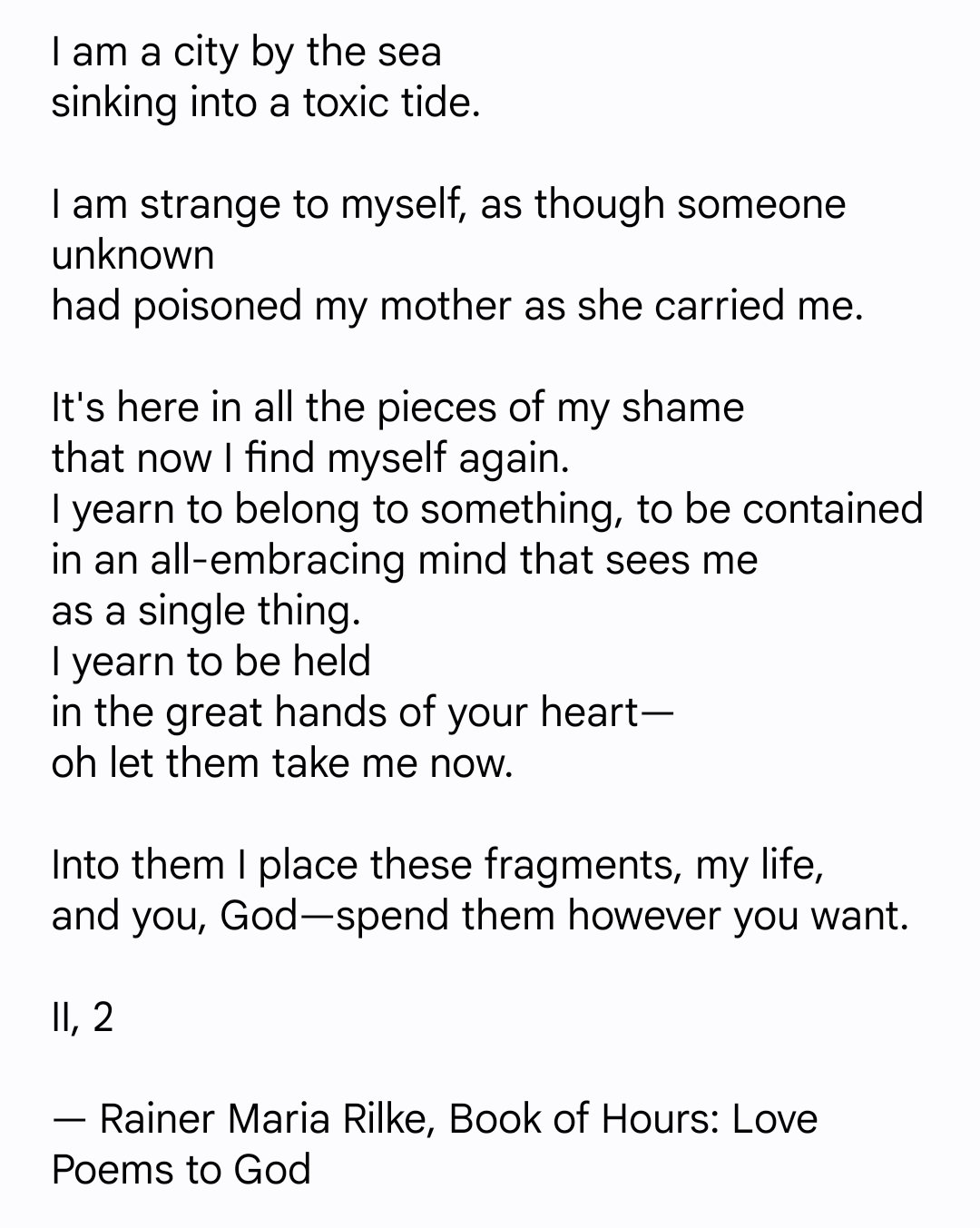
ALT I am a city by the sea sinking into a toxic tide. I am strange to myself, as though someone unknown had poisoned my mother as she carried me. It's here in all the pieces of my shame that now I find myself again. I yearn to belong to something, to be contained in an all-embracing mind that sees me as a single thing. I yearn to be held in the great hands of your heart— oh let them take me now. Into them I place these fragments, my life, and you, God—spend them however you want. II, 2 — Rainer Maria Rilke, Book of Hours: Love Poems to God

ALT At each stage of psychological development, the Self demands some sacrifice. It is no longer a case of "Thy will be done—my way". Sometimes we may rationally or idealistically decide to make a sacrifice, but unless the time is right, sacrifice is self-dramatisation. The dreams make clear the real sacrifice that is demanded. Sometimes we are called upon to give up the part of our life that we hold most dear, and the fear and loneliness involved in that inner decision dare not be underestimated. At the same time as we are making the sacrifice, we are also required to meet the challenge of the new life. This is a time of darkness; it requires time and patience, space and meditation. So long as our psychological heritage is sound, we can trust that the Self will not demand more of us than we are able to give. We can't get away with offering the starving calf; it has to be the fatted one. — Marion Woodman, Addiction to Perfection


