

Responsible NLP/ML/AI. Sr. Staff Research Scientist @ Google. Research Affiliate @ Stanford SPARQ.
San Francisco, CA
Joined June 2009
- Tweets1.1K
- Following718
- Followers2.7K
- Likes3.1K





Pinned Tweet
Super thrilled to have this work be presented at @SPSPnews this week!
This large-scale cross-cultural study reveals interesting differences in user preferences, perceptions and impact of human-like behaviour in AI across the globe.
Joint work w/ @aidaa @blahtino @schimmelrob

Excited that @aidaa will present our paper at @SPSPnews meeting tomorrow in Chicago!
We studied 3,500 people across 10 countries on preferences, perceptions, and the impact of AI anthropomorphism!
Thanks to my brilliant coauthors @blahtino @aidaaand @vinodkpg. @GoogleResearch

Who'll be at @COLM_conf this week? Would be great to connect/reconnect over ☕️/🍻 to chat about research, or life, or both!
As a local San Franciscan, let me know if you need any local SF tips as well.
Vinodkumar Prabhakaran retweeted

Slated to give a tutorial on “Multilingual and Multicultural LLMs” 🌍 at EMNLP 2026 with @davlanade @vinodkpg @sarahookr @alan_ritter.
See you in beautiful Budapest — looking forward to connecting with everyone! 👋
#emnlp

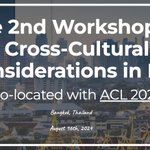
Thrilled to have the fourth iteration of Cross Cultural Considerations in NLP (C3NLP) at #ACL2026
Stop by tomorrow if you're around. We have some exciting keynotes and panels lined up in the afternoon, and a great set of papers in the poster session in the morning.

📚 Please also stay tuned to hear from our incredible authors on the latest in cross cultural NLP research as they discuss:
🔹 Whose Culture? Representing Values, Norms, and Lived Knowledge in AI
🔹 Building and Benchmarking Culturally-Aware Systems
#C3NLP2026
Co-organized with @LucianaBenotti @daniel_hers @sunipa_dev @YongCaoPlus @LiZhou21 @IfeAdebara Bolei Ma
Vinodkumar Prabhakaran retweeted

SAFARI: A Community-Engaged Approach and Dataset of Stereotype Resources in the Sub-Saharan African Context
@GoogleResearch @rain_africa @MantarayUX @verma_aish @ZaldivarPhD @vinodkpg @sunipa_dev

Excited for this 4th iteration of the C3NLP workshop, this time co-located with @aclmeeting in San Diego.
Deadline for full peer-review track is Mar 20th! Please spread the word. Looking forward to reading your submissions.

@c3_nlp We are back for the 4th year in a row with the Workshop on Cross-Cultural Considerations in NLP at #ACL2026NLP!
c3nlp.github.io/
Our workshop brings a real interdisciplinary exchange, to figure out how to build models that don't just erase cultural differences.
Vinodkumar Prabhakaran retweeted

At the end of the #IndiaAIImpactSummit2026 Research Symposium panel, we were asked to "advise" the younger generation(!) I addressed the young AI researchers, and focused on research monoculture, scientific skepticism and a clear eyed understanding of both capabilities and limitations of the current models..
Vinodkumar Prabhakaran retweeted

Vinod Prabhakaran (@vinodkpg) on AI for the world of many.
Culture as a lens
-- Technology developed for mono-culture are not suited for multicultures
-- It's even more important in Agentic AI since they take consequential actions
Different perspectives on Safety
-- different ethnic groups rate outputs differently
-- variations stem from variety of factors
-- causal mediation analysis for studying these factors -- helps removing confounding factors
Stereotypes as a lens to study generative models
-- SeeGull: reverse engineer LLMs to generate stereotypes, and annotate a large dataset of stereotypes for various demographics
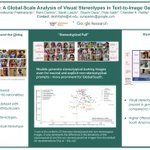
-- T2I image models surface similar stereotypes, and have a hard time to move away from stereotypes even when explicitly asked.
User preferences also AI behavior also changes
-- users prefer human-like AI (anthropomorphic), Global South even more.
What we need:
-- more datasets with socio-cultural knowledge
-- pluralistic values


Checkout the IVADO workshop on Deploying Autonomous Agents: Lessons, Risks and Real-World Impact happening today until Wednesday in Montreal with an exciting line up of speakers #Agents #LLMs
ivado.ca/en/events/2nd-works…

Vinodkumar Prabhakaran retweeted

Many thanks to the OC @sivareddyg Dawn Song @Yoshua_Bengio @alsuhr @chrisjpal @ysu_nlp @hllo_wrld and to the speakers @jacobandreas @max_nlp Yonathan Belinkov @AaronCourville @nouhadziri @gauthier_gidel @seraphinagt @PeterHndrsn Helen Nissenbaum @vinodkpg @jieyuzhao11

Vinodkumar Prabhakaran retweeted

How can we evaluate the real world impact of generative AI? Great panel GEM2 workshop #ACL2025NLP 🇦🇹


Vinodkumar Prabhakaran retweeted

Yesterday we wrapped up the **Thought Summit on LLMs and Society** at Cornell — an energizing and deeply reflective gathering of researchers, practitioners, and policymakers from several institutions and geographies.
Over three days, we explored what it means to design and govern pluralistic and humanistic AI technologies that serve diverse communities, respect cultural contexts, and center social well-being.
Our conversations spanned:
🔷 Identifying meaningful AI use cases, particularly in high-stakes settings
🔷 Foregrounding interdisciplinary methods from computing, social sciences, law, and design
🔷 Building strategic partnerships across academia, industry, civil society, and government
🔷 Addressing challenges of governance, safety, and inclusion in global environments
🔷 Recognizing the power of local knowledge, lived experience, and participatory design
🔷 Developing a shared vision for responsible AI infrastructures rooted in equity and accountability.
This summit was part of the Global AI Initiative at Cornell — a commitment to shaping AI technologies that are globally relevant and socially responsive.
Deep thanks to our participants, co-organizers, funders, student volunteers, and partners who made this summit possible!
@CornellDataSciC @CornellCCSS @GlobalCornell @Cornell

Join us for the keynotes and a panel discussion with Prof. Lise Dobrin and Prof. Elisabeth A. Mager Hois bringing in a cultural & linguistic anthropology lens on NLP

Happening now at #NAACL2025 in room Pecos.
Kicking off with amazing talks and a panel by @monojitchou @IAugenstein & @KatiaShutova
Happening now at #NAACL2025 in room Pecos.
Kicking off with amazing talks and a panel by @monojitchou @IAugenstein & @KatiaShutova

📣 Excited about our Cross Cultural Considerations in NLP workshop! @c3_nlp @ @naaclmeeting coming up in no time—just two weeks to go!
Full program here: c3nlp.github.io
Co-org. w/ @sunipa17 @LucianaBenotti @daniel_hers @vinodkpg @YongCaoPlus @LiZhou21 @IfeAdebara ❤️
Vinodkumar Prabhakaran retweeted

📣 Excited about our Cross Cultural Considerations in NLP workshop! @c3_nlp @ @naaclmeeting coming up in no time—just two weeks to go!
Full program here: c3nlp.github.io
Co-org. w/ @sunipa17 @LucianaBenotti @daniel_hers @vinodkpg @YongCaoPlus @LiZhou21 @IfeAdebara ❤️
Vinodkumar Prabhakaran retweeted

Project Vaani has released new open-source data from its Phase 1 which comprises of images, audio, and transcribed speech, encompassing 54 languages across 80 districts in 12 states of India.
The dataset can be accessed here:
vaani.iisc.ac.in/
bhashini.gov.in/sahyogi-proj…
Excited to have this writeup published on @GoogleAI summarizing a long & fruitful line of research our team & collaborators have been working on for ~4 yrs.
For me, this journey started when @blahtino & I started working on this w/ @aidaa as her intern project back in 2021!

Modern ML models are used by people around the world who have a variety of perspectives that often align along socio-cultural and demographic lines. Today we describe effective ways to integrate these considerations into the ML modeling pipeline. goo.gle/3QhEQNp

ALT A layered approach to (1) disentangle systematic differences in perspectives across social groups, (2) develop an in-depth understanding of the underlying causes for these differences, and (3) build effective ways to integrate meaningful differences into the ML modeling pipeline. We use offensive language detection as an example task for demonstration, but the ideas presented here extend to any subjective task with varying human perspectives.
The blog post covers a lot of collaborators' work @laroyo @dylnbkr Chris Homan, @AliciaVParrish @charvvvv_ @gregserapio @alxndrt @justaturbo @cawelty
... and is inspired by/adds on to research led by many others working on this topic, in particular Dirk Hovy, @barbara_plank @verena_rieser @gavin_does_nlp @Ginger_in_AI @rajivmovva @MaartenSap and many others.