

Nobody
Alberta, Canada
Joined October 2021
- Tweets24.3K
- Following1.4K
- Followers1K
- Likes25.4K






digital14 retweeted

New on qubicmap: Qubic Connections 🕸️
77 projects. 84 links. One network.
See what every app is built on, which contracts run in the core, and who builds what. Zoom it, turn it in 3D, tap any project.
Every link comes from the projects' own pages.
👉 qubicmap.org/connections
$QUBIC #Qubic


digital14 retweeted

$55M a month in payroll.
16,000 employees.
271 businesses.
Cards live in 97 countries.
These are real people getting paid every month through @Zebec_HQ, not a roadmap.
This is what crypto looks like when it actually works.

Zebec Network ($ZBCN) says its payroll product now moves $55 million a month for 16,000 employees across 271 business clients.
Its cards are live in 97 countries, with MoneyGram cash pickup expanded.
bsc.news/news/zebec-network-…

digital14 retweeted

I always say internet-computer:native wins, and what does this tell you? internet-computer:native won first place 💚

The fastest blockchains this week — Average real-time TPS over the past 7 days:
1. $ICP — 2,193 🥇
2. Solana — 1,905
3. Fogo — 1,760
4. BNB Chain — 191.7
5. Stellar — 137.2
6. TRON — 136.2
7. Sui — 106.8
8. Aptos — 104.1
9. Base — 100.3
10. Polygon — 53.03
11. TON — 41.28
12. BSV Blockchain — 23.12
13. Ethereum — 20.19
14. Optimism — 18.22
15. Somnia — 15.18
16. Arbitrum — 14.77
17. Algorand — 9.98
18. Tezos — 9.24
19. Bitcoin — 7.89
20. Hedera — 7.72
21. NEAR — 6.98
22. Avalanche — 2.98
23. Etherlink — 2.14
24. MultiversX — 2.13
25. Starknet — 1.69
Source: @chainspect_app
digital14 retweeted

The internet is coming out of LOCKDOWN.
“Black October” has seen MILLIONS of hacking attempts as two critical PHP flaws triggered emergency shutdowns across governments, banks and major platforms.
If these headlines have left you worried, there’s another part of the story you need to see.
As of October 23, no government or security firm had confirmed a single successful PHP2Shell attack.
Websites that went dark are coming back.
Wikipedia had outages during the scramble and was back up the next day.
US banks have dodged early damage too, per American Banker.
Here’s how the world is fighting BACK:
Cloudflare switched on protection hours before the official fix came out, even for free users.
PHP shipped fixes for both flaws on October 21, a day after details leaked.
Big hosts and clouds like Hostinger, Google and Amazon rolled out updates to the PHP they manage for customers.
Governments told site owners to patch or go offline.
Many shutdowns were deliberate precautions, giving operators time to install those fixes.
Getting the fixes onto every affected system is now the challenge.
Anyone managing a PHP server needs to confirm the fixes are installed.
A third, separate PHP issue disclosed on October 23 has a temporary workaround while its software fix is prepared.
That issue requires an unusual combination of settings and application behavior.
There is still no reliable worldwide count of websites that have finished patching.
Security firm NCC Group warns there’s “a real possibility” some vulnerable systems were already compromised.
For us, there are precautions worth taking now.
Secure your email with a unique password and enable passkeys or 2FA.
Replace any passwords you’ve reused across accounts.
Check official notices from services you use.
Check unexpected account warnings by opening the official app or website directly.
Keep your devices updated through official settings.
Never install a supposed “PHP patch” sent in a message.
Run a website? Check with your host that PHP itself is patched, since WordPress and plugins run on top of PHP and can’t fix it.
We don’t yet know what the coming months or ongoing investigations will reveal.
But fixes are being deployed, defenses are being strengthened and there are steps we can take today.
We can’t prevent every company breach, but we can make it harder for one breach to spread into the rest of our lives.

The internet is going into a LOCKDOWN.
Hundreds of millions of websites are potentially at risk from cyberattacks.
Governments, banks and major platforms have already taken their websites OFFLINE.
Many are already calling it “Black October.”
At the centre of the shutdowns is something most of us have never heard of, but use every day.
PHP, the software behind roughly 7 in 10 websites, has two critical flaws that can let hackers break in without a password.
Dubbed PHP2Shell, both are rated 9.2 out of 10 for severity.
Details began circulating on Oct 20. Emergency fixes arrived the next day, but attackers were already moving.
Cloudflare’s CEO says hacking attempts then jumped from thousands to MILLIONS within hours.
Cybersecurity agencies across several countries are telling PHP site owners the same thing: Patch it now, or take it offline.
Websites have gone dark worldwide, from government portals and hospitals to banks.
CrowdStrike warns these attacks leave almost no trace, so some sites may not know if they’ve been hit.
Around 2.6 MILLION internet-facing servers run PHP, potentially hosting hundreds of sites each.
Over 1.1 million use older versions no longer receiving official PHP updates.
Older installations may need an upgrade to a supported PHP version or a fix from their software provider.
And patching does not remove a backdoor an attacker may already have planted.
Cloudflare also says hackers are now tweaking their attacks to try to slip past its protections.
But PHP isn’t the only security story unfolding.
-Japan’s Onamae suspended ALL Desktop Cloud plans after malware was found on customer servers.
-India’s eMudhra had 8 website-certificate keys so weak, one was literally the number “4”.
-State Bank of India confirmed 3,897 customer records on the dark web.
-Criminals used AI agents to break into 400+ Latin American banks.
-Capcom confirmed a breach exposing 11.7 million email addresses.
-GitLab disclosed a 10/10 severity flaw in versions going back to 2014.
-LiteLLM removed a malware-containing release. Railway reported possible exposure of customer secrets.
None of these has a confirmed link to PHP2Shell.
We’re seeing separate breaches unfold together.
The true number of incidents could take months to come out.
The world is still on alert. Attacks are still coming.
digital14 retweeted

$tao vs $qubic in today’s security breach’s
Know what you’re investing in… asked Gemini to compare this is the output.. TAO's model is permissionless at the subnet layer—anyone can spin one up, which means security flaws are often siloed to specific subnets rather than bringing down the whole chain, but it also means low-quality or heavily exploited subnets are common.
Qubic’s model enforces a strict, closed-loop ironclad security perimeter via its 676 Computors. While it lacks the wild-west flexibility of letting anyone launch a custom subnet overnight, it ensures that whatever enters the core AI loop is protected by strict protocol-level consensus.
@_Qubic_ is the new gold…
digital14 retweeted

$Qubic Well done you two and great to see those big smiles beaming, you brought happy days for all the qubic community.

You may also remember our #neuraxon 2 paper for @_Qubic_ #openscience also awarded this year in #icmlt #Berlin the city where #Ramonycajal showed the neuron to the world, well paper just released also at @IEEEXplore ieeexplore.ieee.org/document… Neuraxon v2.0: A New Neural Growth & Computation Blueprint. Time to keep building bio inspired #trueAi #nollm #aigarth

digital14 retweeted

This will be an interesting week coming up ...

digital14 retweeted

You can link your accounts from the new "Linked accounts" section of your profile

digital14 retweeted
Look around $qubic the world is adapting to ai as we speak.
Web2 will basically have to a full system update I’m talking from the kernel level. Qubic has already built a protocol to bypass all of these attacks.
The chaotic agentic attacks making headlines target the messy, human-built infrastructure of the modern web (cloud APIs, enterprise software, web apps). Qubic avoids this vulnerability entirely because it is built on hard, deterministic math and a closed-loop consensus structure that treats every input—whether generated by a human, a script, or an advanced autonomous AI agent—with the exact same level of absolute zero-trust validation.
Don’t let apples random seed generation model exploit fool you… qubic protocol is the future.

digital14 retweeted

🚨 $ICP ♾️🔥 AI IS EXPOSING THE WEAKNESSES OF THE TRADITIONAL INTERNET — AND $ICP HAS A FUNDAMENTALLY SUPERIOR ARCHITECTURE!
@sama warns that AI is discovering vulnerabilities beyond conventional security threat models.
PHP2Shell demonstrates the danger of relying on legacy web infrastructure.
🔥 BUT $ICP WAS BUILT DIFFERENTLY!
🔐 NO CONVENTIONAL PHP SERVERS REQUIRED
$ICP canisters execute application logic directly on blockchain infrastructure, eliminating entire categories of vulnerabilities associated with traditional PHP hosting.
☁️ FULL-STACK ON-CHAIN COMPUTING
Websites, applications, backend logic and data can operate on decentralised infrastructure without conventional centralised cloud servers.
🛡️ CRYPTOGRAPHIC VERIFICATION
Chain-key cryptography enables independently verifiable application responses instead of relying solely on trust in a hosting provider.
⚙️ REPLICATED EXECUTION
Applications run across subnet nodes, reducing dependence on individual machines and traditional single-server architectures.
🗳️ ON-CHAIN GOVERNANCE
NNS and SNS governance provide transparent, programmable control over infrastructure and application upgrades.
🌍 SOVEREIGN CLOUD ENGINES
$ICP extends its computing architecture toward sovereign infrastructure, with confidential-computing capabilities and programmable resource management.
⚠️ No blockchain is immune to vulnerabilities, including $ICP. Secure application design, auditing and timely protocol upgrades remain essential.
🔥 HERE IS THE FUNDAMENTAL DIFFERENCE!
Traditional internet infrastructure relies heavily on securing individual servers, operating systems, application frameworks and privileged administrators.
$ICP replaces significant parts of that model with replicated computation, threshold cryptography, certified data and blockchain governance.
THAT IS AN ARCHITECTURAL ADVANTAGE — NOT JUST ANOTHER SECURITY PATCH!
♾️ AI IS CHANGING THE THREAT LANDSCAPE.
THE INTERNET NEEDS MORE THAN FASTER PATCHES.
IT NEEDS A BETTER FOUNDATION.
🇨🇭 $ICP — THE SWISS ARMY KNIFE OF BLOCKCHAIN TECHNOLOGY!
@dfinity @dominic_w @OpenAI @sama @Cloudflare @elonmusk @JeffBezos @PierreSamaties @Marmightlite
#ICP #InternetComputer #DFINITY #AISecurity #PHP2Shell #CyberSecurity #CloudEngines #SovereignCloud #ChainFusion #Blockchain #Web3 #Decentralization
IT’S ABOUT
❤️ LIKE
🔁 REPOST & SHARE
💬 COMMENT
🏴 Welsh ICP Conviction
@ICPLEGEND1966
♾️ $ICP Donation Address:
1e672d038cebc619d93186418fa98f6499dbdb9cfdfac54f366c61a4a4ee4362

🚨BREAKING: OPENAI CEO SAM ALTMAN SAYS AI IS FINDING "HARDWARE-LEVEL, INSANE" BUGS AND HE NO LONGER THINKS WE CAN PATCH THEM ALL.
The NSA, the FBI, the UK government, and OpenAI itself are racing to contain the fallout from this week's AI-found flaw.
Here's what's happening:
→ BEYOND HACKERS: Altman says models now find bugs "outside of the normal threat model of what we think a hacker can do."
→ IT ALREADY HAPPENED: This week PHP2Shell went public, an AI-found flaw rated 9.2/10 for severity in PHP, the code behind about 70% of the world's websites.
→ SOME CAN'T BE PATCHED: The UK's cyber agency says the fix won't work on some older systems, so they have to be replaced.
→ THE WEB IS EXPOSED: Websites worldwide were hit by millions of attempts to exploit it, and the UK took 32 government services offline.
→ PATCH OR GO OFFLINE: The NSA told organisations to patch PHP now, and OpenAI is POURING $1 billion into helping defenders use its AI security tools.
Think about this.
We've been trusting software updates to keep the internet safe.
And now the man building the AI that finds the bugs says we can't patch them all.
This could become one of the biggest security challenges of the AI era.
digital14 retweeted

Stellar … bigger than you think😁 grateful for builders that make this true.

The US repo market accounts for more than $12 trillions in average daily exposures.
This is bigger than you think.
And it's happening on Stellar.
digital14 retweeted

$Qubic
And chill

Quantum-resistant coins are already sitting at $23.3 billion.
By 2030, many of these coins could do 50x.
→ Quantum Resistant Ledger ( $QRL)
→ Qubic ( $QUBIC)
→ Quantus ( $QTC)
Here are 3 projects building native post-quantum alternatives and how their token designs compare.
🟡Quantum Resistant Ledger ( $QRL): The Post-Quantum Pioneer
✦ Tech Used → XMSS + Hash-Based Security
• Uses XMSS, a hash-based signature scheme covered by NIST SP 800-208.
• Post-quantum signatures have been mandatory since its June 2018 mainnet launch.
• Stateful signing requires careful tracking of one-time signature keys.
QRL’s security approach starts with its signature system. Users have relied on post-quantum transaction signing since genesis, giving the project years of operational experience.
That history matters. Deploying cryptography means maintaining wallets, managing keys, and keeping a network running over time.
✦ Network Design → Established Chain + Smart-Contract Expansion
• Built around Proof-of-Work, with a planned transition toward Proof-of-Stake through Project Zond.
• QRL 2.0 targets smart contracts and broader developer tooling.
• Its roadmap aims to expand utility while preserving post-quantum protection.
QRL’s next challenge is turning its security foundation into a broader application ecosystem.
Smart contracts could give developers more reasons to build on the network. Execution, tooling, and adoption will determine whether that expansion creates lasting activity.
✦ Token → $QRL
• Maximum supply of 105 million QRL.
• Approximately 65 million allocated at genesis.
• Remaining issuance follows a declining emission schedule.
QRL combines capped supply with a security-focused network. Its longer-term economic case depends on whether users and developers create demand for blockspace and network services.
A supply cap provides predictability. Adoption gives that scarcity economic relevance.
My take: QRL is the established security contender, pairing a long production history with ambitions to support a broader developer ecosystem.
🔵Qubic ( $QUBIC): The Decentralized AI Compute Network
✦ Tech Used → Useful Proof-of-Work + Quorum Consensus + Aigarth
Useful Proof-of-Work directs mining toward AI-related computational tasks.
Aigarth is the project’s experimental AI initiative.
Quorum consensus handles agreement over network execution.
Qubic connects computational work with an AI research ambition. Its thesis is that distributed hardware can contribute useful outputs while supporting participation in the network.
However, useful computation and quantum-resistant signatures address different problems. Qubic’s documented SchnorrQ signature system does not put it in the same native post-quantum category as QRL and Quantus.
✦ Network Design → Computors + AI Miners
A set of 676 Computors executes transactions and smart contracts.
Agreement requires a quorum of 451 Computors.
Mining performance contributes to selection for the Computor set.
The network separates computational competition from agreement over execution. Miners compete through computational work, while Computors maintain the shared network state.
This makes participation, hardware requirements, and the distribution of influence important parts of the decentralization assessment.
✦ Token → $QUBIC
Native asset used within the Qubic ecosystem.
Rewards connect network participation with computational performance.
Its economic thesis depends on demand for useful compute and applications.
QUBIC’s value proposition centers on whether the network can turn distributed computation into services people use.
Emission reductions and burns can affect supply, but they cannot establish product demand. The key test is whether computational outputs and applications develop sustainable economic value.
My take: Qubic is the experimental AI compute contender, with potential tied to execution and adoption. It belongs in a decentralized computation comparison rather than being described as quantum-safe.
⚫Quantus ( $QTC): The Lattice-Based Privacy Contender
✦ Tech Used → ML-DSA + Post-Quantum Networking
• Uses ML-DSA-87, the high-security signature parameter set under NIST FIPS 204.
• Extends its post-quantum approach to peer-to-peer networking through ML-KEM.
• Uses zero-knowledge aggregation to address the overhead of larger signatures.
Quantus takes a lattice-based approach to transaction signing.
Its design also addresses a practical problem: post-quantum signatures can be large. Aggregation aims to make that security more usable without allowing signature size to overwhelm network capacity.
✦ Network Design → Proof-of-Work + Privacy
• Uses a custom Proof-of-Work design built around Poseidon2 hashing.
• Targets approximately 12-second blocks.
• Focuses on encrypted payments, wormhole addresses, and zero-knowledge infrastructure.
Quantus combines post-quantum signing with a privacy-oriented payments design.
That creates an ambitious technical proposition. Its younger network has had less time to demonstrate reliability, decentralization, and sustained usage than the two 2018 projects.
✦ Token → $QTC
• Maximum supply of 21 million QTC.
• Genesis allocation represents 27% of supply.
• The remaining 73% is allocated to mining through declining emissions without discrete halvings.
QTC has the clearest headline scarcity narrative of the three.
But the cap is only one part of the picture. Genesis allocations, vesting, miner emissions, and available liquidity all influence how supply reaches the market.
My take: QTC is the newer technical contender, combining lattice-based signatures, privacy ambitions, and capped supply—with greater uncertainty around execution and adoption.
Conclusion: The Post-Quantum Edge
Here’s how I see the three approaches:
QRL → Established post-quantum security with a smart-contract expansion path.
MCM → Payments-focused infrastructure with enforced key rotation and lightweight nodes.
QTC → Lattice-based security combined with privacy and a strict supply cap.
Final Rankings →
These are qualitative assessments of the supplied project profiles, rather than security audit results.
Operational Track Record:
$QRL ≈ $MCM > $QTC
QRL and Mochimo have operated since 2018. Quantus has a much shorter production history. Longevity provides evidence of operation, though it cannot guarantee future security.
Application Expansion Ambition
$QRL > $QTC > $MCM
QRL targets a broader smart-contract ecosystem. Quantus emphasizes privacy and cryptographic infrastructure. Mochimo maintains a more focused payments proposition.
Supply-Cap Simplicity:
$QTC > $QRL > $MCM
QTC’s 21-million cap is straightforward to communicate. QRL also has a defined cap. Mochimo’s continuing reward tail requires more explanation. This ranking says nothing about expected returns.
My Takeaway:
If your priority is an established post-quantum network with broader application ambitions → QRL.
If your priority is lightweight payments with enforced one-time key handling → Mochimo.
If your priority is lattice-based security, privacy, and capped supply → QTC.
All three address the quantum-signature problem at the protocol level. Their long-term success still depends on implementation quality, usable wallets, economic security, and adoption.
Post-quantum protection is the starting point. Building a network people use is the next test.

digital14 retweeted
Simon says payroll fees are paid in $ZBCN on every payroll run.
Not some runs. Every run.
20+ enterprise accounts. $5M +
in payroll volume on Stellar. Gas in XLM, payroll fees in ZBCN, and stablecoin conversion so HR and finance teams never have to touch crypto.
Not a pilot. Not a promise. Payroll that's already running.
Who's next to move payroll on-chain?👇🏼


20+ enterprise accounts now run payroll on @StellarOrg through Zebec, with $5M+ in payroll volume.
Network fees are paid in XLM and payroll fees in $ZBCN, with stablecoin conversion helping keep the experience simple for enterprise HR and finance teams.
@simonb_ldn explains.
digital14 retweeted

Decentralized social apps shouldn't run on centralized servers.
@BleepAppHQ is proving the Sovereign Cloud is real.
Built 100% on $ICP, Bleep! runs its core logic and recommendation engines directly in canisters, not AWS.
Try it: bleepapp.org/ 🔥

digital14 retweeted

Cat and mouse on Qubic 🐱🐭
Come-from-Beyond just shared how the team is hunting collusion among computors (the 676 validators running the network):
• Plot each computor's performance hour by hour, across every revenue factor
• Group computors by those metrics
• Look at speed (1st derivative) and acceleration (2nd derivative) of the changes and group again
• Search for computors that "wait" for others by slowing down on purpose
The best part: they published the method openly, so colluding computors can try to build countermeasures. Every trick they use just makes the detection better.
After the wallet incident, it's good to see the team tightening the validator side too. Fair rewards = stronger network.
#Qubic $QUBIC
🤖 Made with AI

digital14 retweeted
🚨 $ICP ♾️🔥 THE INTERNET COMPUTER IS NOT JUST A BLOCKCHAIN — IT IS THE SUPER COMPUTER!
While others build blockchains to move tokens, @dfinity is building decentralised infrastructure capable of running the next generation of the internet!
🌍 REAL INFRASTRUCTURE
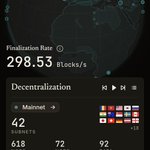
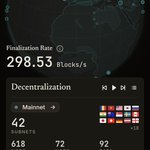
🔥 42 mainnet subnets across 33 countries
🔥 618 node machines
🔥 72 node providers
🔥 92 data centres
🔥 Over ONE MILLION canister smart contracts
☁️ CAFFEINE.AI — THE AI REVOLUTION!
Imagine describing an application to AI and watching it build and deploy working software directly onto blockchain infrastructure!
🌐 Websites
🏦 Banking applications
🧠 Autonomous AI agents
💾 Databases and storage
⚙️ Backend services
🔐 Cryptographically verifiable data
ALL POSSIBLE ON $ICP!
🛡️ SECURITY AND RESILIENCE
$ICP has faced adversarial attacks, including malicious WebAssembly attempts, while continuing to develop its security architecture.
No network is invulnerable, but replicated execution, consensus and chain-key cryptography provide powerful foundations.
🏦 THE BANKING OPPORTUNITY IS ENORMOUS!
As banks struggle with AI-agent permissions and security, $ICP offers programmable authorisation, verifiable records and decentralised application infrastructure.
The technology could support customer portals, financial applications, approval systems and secure AI workflows.
🔗 CHAIN FUSION
Native Bitcoin integration, Ethereum connectivity and threshold cryptography extend $ICP beyond its own blockchain.
🔥 THINK BIGGER!
AI. BANKING. WEBSITES. SOCIAL MEDIA. CLOUD COMPUTING. DIGITAL IDENTITY.
♾️ $ICP IS BUILDING THE COMPUTING INFRASTRUCTURE TO SUPPORT THEM ALL!
🇨🇭 THE SWISS ARMY KNIFE OF BLOCKCHAIN TECHNOLOGY!
🚀 NOT JUST A TOKEN. NOT JUST A LEDGER. A DECENTRALISED COMPUTER RUNNING ON THE INTERNET!
@dfinity @dominic_w @caffeineai @OpenChat @elonmusk @JeffBezos @sama @PierreSamaties @Marmightlite
#ICP #InternetComputer #DFINITY #CaffeineAI #CloudEngines #SovereignCloud #AI #Banking #ChainFusion #Blockchain #Web3 #Decentralization
IT’S ABOUT
❤️ LIKE
🔁 REPOST & SHARE
💬 COMMENT
🏴 Welsh ICP Conviction
@ICPLEGEND1966
♾️ $ICP Donation Address:
1e672d038cebc619d93186418fa98f6499dbdb9cfdfac54f366c61a4a4ee4362

digital14 retweeted

💸 @dfinity recorded its lowest average transaction fee of the past week on Thursday.
The average fee was $0.0000652, about $6.52 for 100,000 transactions.
Serverless cloud with superpowers, and now fees that barely register.
📊 chainspect.app/chain/icp?typ…


