

CEO of Mindmax Labs. Co-creator of Sonic Sphere, Memrise. Memory champion, student of parties, imagination and consciousness.
The internet
Joined February 2009
- Tweets7.8K
- Following2.7K
- Followers10.1K
- Likes5.7K




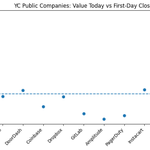

I think is roughly right.
Another way of saying it is that the difficulty of discovering something new is on an exponential as are the resources, and they cancel out to produce roughly linear progress.

The real world abounds with recursively self-improving systems, but one in particular deserves attention: Science, modeled as a system (perhaps even as an agent, with goals and resources). If you want to really understand AI RSI, science should be your reference point.
Science is an intelligent system, and it is obviously recursively self-improving:
1. Scientific discoveries unlock new technology that helps build better experimental tools. This is a top driver of progress in nearly all fields.
2. They unlock new conceptual advances (ideas, theories) that help solve more problems.
3. They increase society's economic output, leading to more resources flowing into science.
4. They unlock better faster tooling (e.g. more compute via better chip & networking technology).
As a result, many measures of scientific *input* grow exponentially:
1. Headcount (doubles every ~15 years)
2. Global R&D spending (doubles a bit faster, every ~13 years)
3. Papers and patents (technically this is a measure of headcount)
4. Compute dedicated to science (doubles every ~2 years)
But is scientific progress exponential? Historically, the rate of scientific impact over time has remained roughly constant since the start of the industrial revolution (i.e. scientific progress is *linear*). 1850-1900 was about as dramatic as 1900-1950 or 1950-2000.
1850–1900: Evolution, germ theory & antiseptic surgery, thermodynamics, electromagnetic field equations, the periodic table, pharmaceuticals, electricity, telegraph and telephone, internal combustion engine, skyscrapers, mechanized agriculture...
1900–1950: special and general relativity, quantum mechanics, nuclear fission & atomic energy, antibiotics, genetic theory, electronic computers, information theory, synthetic polymers and plastics, the transistor, aviation...
1950–2000: DNA, genetic engineering, integrated circuits, microprocessors & personal computing, the Internet, crewed spaceflight, moon landing, satellite communications & GPS, standard model of particle physics...
In real terms, like life expectancy, which has increased in a remarkably linear fashion of roughly 3 months per year since 1840, progress is a straight line. This is especially apparent for fields where impact is easy to measure, like biology, medicine, and agriculture.
I first wrote about this phenomenon and its causes in 2012, and a steady stream of research has confirmed it in the years since. Examples include the 2018 paper by Nielsen and Collison, "Science Is Getting Less Bang for Its Buck," and the 2020 economic paper, "Are Ideas Getting Harder to Find?" (In fact, I believe the Nielsen paper stemmed from a conversation I had with him about this exact idea six months earlier)
In short, the primary cause is that research solves the highest-impact, easiest problems first, and every subsequent problem is either harder or lower-impact. Exponentially so. The paper that presented information theory wasn't very hard to write (single author!) but you'd have a hard time ever writing a CS paper that beats it in impact.
This is why science as a system requires exponential resources (input) to produce linear impact (output). It gets exponentially harder over time.
Worth thinking about if you're pondering RSI for AI. I fully believe AI RSI is already happening and will accelerate in the future. But I do not believe this leads to an "intelligence explosion" -- that would fly in the face of everything I know about intelligence and everything I know about recursively self-improving systems.


Human mind is infinite, there's nothing we won't be able to understand.

This is going to be controversial. I hate it myself. But I am beginning to fear that if I think things through to their logical conclusion, the only solution is to outlaw AI globally.
With AI, the best case long term outcome is that we become "pets" of the AI. We eat, we sleep, we (maybe) procreate. AI takes care of everything. UBI to the max.
That's the best case! The much more likely case is obviously far far worse.
If there is a better realistic long term scenario, I would like to hear it. I really hope there is one.
For those interested in the student riots in Paris I was chatting earlier to a schoolgirl when five five vans carrying masked policeman rolled past
She explained that she was there to support those unjustly injured in other protests
The French love for education and distaste for oppression is unmatched ❤️
Why do we say "scrambled jets" the same way we say "scrambled eggs"?
I never though to ask till today. You're welcome.
Ed Cooke retweeted

It’s OpenAI DevDay. Seems like a good moment to tell you what we’re building, too. 😘
Five AI devices. Made for you... and your agent.
An excitable timer. A calendar that never forgets. A locked-in context bar. An agent console. And... an oracle.
These are the archetypes - the five starting points - we’ve chosen for WORKS at @inanimate_tech.
WORKS? Yep. Our limited release, fast-to-market AI devices - Promptable Products that do what you mean. Shipping later this year.
Our bet: form matters. A clock gives you different ideas from a calendar. It also gives an agent different ways to act in the world. What you and your agent make of those possibilities is where things get interesting.
Filmed on a stroll through the @BarbicanCentre. Slightly smaller production budget than DevDay.
This is WORKS in Progress EP4: Decision Made - Five AI Devices We're Building
Yes, very good book, and very timely.
Pieper observed the mechanisation of time and humans in nazi germany, the problem 10x more widespread now
In Christianity every day of the year is a feast day. Celebration and leisure should be the default not the exception.

Everyone should read this book.
In Leisure: The Basis of Culture, Pieper dismantles modernity's obsession with productivity and its misunderstanding of leisure.
Moderns think of "leisure" as a break from work: a way to recharge to make you a better worker.
Pieper argues beautifully that, instead, leisure is the foundation of all culture. And rather than passive relaxation, leisure is really a state of active receptivity: not the absence of activity but the presence of depth.
In the High Middle Ages, idleness wasn't understood as "doing nothing." Being idle was refusing to engage deeply with existence. Ironically, the modern workaholic is the true idler: "the restlessness of work-for-work's-sake arises from nothing other than idleness."
Engaging in true leisure isn't easy. You must learn to be at leisure, with intention and willingness to cultivate stillness. Pieper:
"The condition of utmost exertion is more easily realized than the condition of relaxation and detachment, even though the latter is effortless."
It's a paradoxical discipline, in the sense that it requires effort to relax in a way that truly restores you. But it is through leisure that you encounter truth, beauty, and meaning.
Pieper writes much about the role of the festival. If creation is good, we ought to celebrate it:
"And just as Holy Scripture tells us that God rested on the seventh day and beheld that ‘the work which he had made’ was ‘very good’—so too it is leisure which leads man to accept the reality of creation and thus to celebrate it, resting on the inner vision that accompanies it."
In our work-obsessed world, many use parties to drug or otherwise distract themselves from life. But in Pieper's conception, a true party is a heightening and celebration of life, a specific and time-bound event that points to the timeless and universal.
"Feast days and holy-days are the inner source of leisure. It is because leisure takes its origin from ‘celebration’ that it is not only effortless but the direct contrary of effort; not just the negative in the sense of being no effort, but the positive counterpart."
However, the biggest revelation comes when you realize that you can actually reverse-engineer this process and turn even "ordinary" moments into moments of leisure.
No matter where you are, leisure can be found when you let reality wash over you, pierce through the veil of mundanity to see its hidden beauty, and take a moment to express your gratitude.

“Treat people as they ought to be and you help them become what they are capable of being.”
- Goethe
Ed Cooke retweeted

this is a great list and I'm humbled aka proud to be on it
many mutuals and great accounts to follow.
someone turned this into an X list: xitter.cf/i/lists/21033292773871…


Every so often I recall my certainty in 2003 that Wifi would never catch on.
"Who can't be bothered to plug in a laptop to the internet. What a joke"
Never underestimate human laziness or your own stupidity.
Surprising research showing that AI chat bots can durably reduce belief in conspiracy theories: science.org/doi/10.1126/scie…

Excited that developers are meeting my call to radically increase the rate of AI progress

After co-inventing ChatGPT, I kept asking myself: why have superhuman chat models not led to AGI?
I’ve spent the last 2 years in stealth building a new way to train models (RLCD), and a new type of frontier AI model that we are releasing today: Jev
• 20-200x faster
• 40-400x cheaper (w/ output tokens free)
• Frontier composable intelligence optimized for decisions
AFAICT the shortest path to AI-based economic revolution
Who's the best person to read on why everyone is so afraid on the Chinese getting ahead in AI?
Seems like a minor worry in the grand scheme of things to me.
Generally, I quite like the Chinese, they don't make a huge amount of sense as the bogie man of an ideological justification for risking human existcne.
For example, they're better behaved in international affairs than, for example, the British: not especially war-mongering, quite intenal-looking.
They're also quite good philosophers, excellent artists, probably quite well suited temperamentally to a life of post-AGI leisure...
A likeable conclusion - that weird wins
Curious why - better at finding and persisting with ideas that are (to others) unobvious perhaps
Or perhaps less willing to endure mediocrity

After 15 years of investing, we realised that truly exceptional founders have something impossible to fake; deeply unconventional lives.
We analysed 15,000 founders using five binary signals to measure this: quirky hobbies, early-life signs of exceptionalism, extreme life pivots, unusual geographies, non-linear careers. These sum to give a 0-5 score per founder. Whether someone started coding at age 10, speaks five languages, climbed Everest or quit a safe job to live in Chile, the signal we wanted was deviation from the mean.
Rather than focusing on IQ or EQ, we call this metric the Outlier Quotient, or “OQ”. When forecasting founder success, it turns out that OQ was the single most predictive variable in our entire classification model, trained on ~70 different factors.
Our OQ score had zero correlation with having worked at a top-tier company or attending an elite university. The signals most VCs rely on are noise without signal. The best founders don’t signal like everyone else, don’t think like everyone else and certainly don’t build like everyone else.
Ed Cooke retweeted

I've got some big news to share: ma.tt/2026/09/mirene/

A new book by Richard Holmes is always a treasure to be savoured, and this biography of the *young* Lord Tennyson looks absolutely spectacular and quite well suited to our moment
amazon.com/Boundless-Deep-ST…
"Tennyson’s imagination and intellect were haunted by the eruption of three new fundamentally transformative scientific ideas – biological evolution, the notion of a godless, unpitying universe and of planetary extinction. These were as terrifying to Tennyson as climate catastrophe is to us today. Their impact brought him into contact with the life and scientific work of William Whewell (originally his university tutor), the astronomer John Herschel, the geologist Charles Lyell, the mathematician Mary Somerville, the computer pioneer Charles Babbage, and the brilliant science populariser Robert Chambers. He also shared his visions and anxieties with contemporary writers and social commentators like Thomas Carlyle and Charles Dickens, and poets like Elizabeth Barrett Browning and Edgar Allan Poe.Tennyson’s work during these ‘vagrant years’ is suffused with an unsuspected and strangely modern magic."