
原谅我这一生不羁放纵爱自由

Joined May 2020
Andy J Yang retweeted
🤖🧠NEW PAPER🧠🤖 What is the relationship between neural networks & symbolic systems? Based on evidence from mechanistic interpretability, we argue for a quasi-symbolic view of cognition: Neural nets implement symbols but only approximately Link: sciencedirect.com/science/ar… 1/n
4
33
1
148
6,351
Andy J Yang retweeted
蝙蝠 设计折叠:本人 教程会在@XiaoYao707的微信公众号(波波奶茶的折纸快乐屋)中发布哦。 #折纸 #折り紙作品 #ORIGAMI
2
32
232
2,717
Andy J Yang retweeted
The most profound paper of my PhD so far. We truly did something special to make LMs play/explain chess, needing both architectural & algorithmic innovation (natural-language analogue of the Alphazero algorithm) + applicable to many other domains. Please read on and share! 1/10
61
174
28
1,550
110,215
Andy J Yang retweeted
Can Transformer LLMs hide their reasoning from CoT monitors? tl;dr: Transformers cannot hide complex reasoning, but they might cryptographically obfuscate their CoTs, making it extremely difficult to extract hidden goals.
3
28
1
126
6,203
Andy J Yang retweeted
🚨 [Token][ization] Paper Alert 🚨 Tokenization is a wildly understudied area of language modeling despite it having effects across all of NLP. Over the past ~8 months, 32 (!) tokenizer researchers put together the most comprehensive survey of the field. Check it out!
6
82
24
346
40,402
Andy J Yang retweeted
Bend 2 is here! It is a new programming language that blocks AI mistakes via *proof checking* - the same technique big AI labs used to solve open math problems, like Navier-Stokes. It is also very fast, and runs on GPUs. Watch the video. Link in the comments.
RELEASE DAY After almost 10 years of hard work, tireless research, and a dive deep into the kernels of computer science, I finally realized a dream: running a high-level language on GPUs. And I'm giving it to the world! Bend compiles modern programming features, including: - Lambdas with full closure support - Unrestricted recursion and loops - Fast object allocations of all kinds - Folds, ADTs, continuations and much more To HVM2, a new runtime capable of spreading that workload across 1000's of cores, in a thread-safe, low-overhead fashion. As a result, we finally have a true high-level language that runs natively on GPUs! Here's a quick demo:
656
1,299
342
11,435
2,137,152
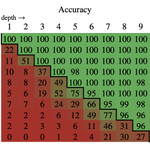
💥 The multiplication saga continues! It turns out, some frontier LLMs do struggle with simple multiplications. Unlike GPT-6-Astra, Fable 5.1 with low reasoning has a blind spot where the accuracy of, say, 5x6 multiplications drops to ~0%! The failure mode is very interesting: the 0% zone corresponds to a failure of adaptive thinking. The model decides that it shouldn't produce any reasoning and outputs the (wrong) answer directly. For larger multiplications, however, the model realizes it should produce a CoT first and then it gets the answer correctly. For very large multiplications (close to 20x20), the accuracy degrades again. How many such simple blind spots do frontier LLMs still have? This is why slowing down and carefully studying generalization and safety is the top priority... 1/2
30
48
14
735
80,218
Andy J Yang retweeted
🤖🧠NEW PAPER🧠🤖 (The result of an 8-year project!) LLMs seem very different from symbolic systems. Yet LLMs excel in symbolic domains (e.g., language/code/math). How do they do it? Our finding: LLM representations have implicit symbolic structure! Link in thread ⬇️ 1/n
45
271
40
1,375
212,482
Tonight @icmlconf: predict LLM scaling without even training. #ICML2026 We derive the data-limited scaling exponent from measurable language statistics (token correlations and next-token entropy) and test it across models. 📅 Thu Jul 9, 5:00 PM, #1404
1
6
44
3,117
(re: OpenAI and Anthropic IPO news, a preprint) Scaling up training reliably improves LLMs, but it also increases training and inference costs, leading to massive capital expenditure by AI firms. How can we understand what level of LLM scaling is justified economically? 🧵⬇️
1
13
2
127
14,771
Given black-box access to a Transformer's output, can we efficiently recover its parameters? We analyse the learnability of attention-based models with query access in our new work. Accepted at #ICML2026 🎉 Work done with @shahkulin98, @mhahn29 and Varun Kanade. 🧵
9
23
5
168
28,855
Andy J Yang retweeted
Can syntax begin to emerge from speech alone? In our new paper, we show that unsupervised neural networks trained only on individual spoken words can spontaneously generate two- and even three-word sequences — without ever seeing multi-word examples during training. We call this phenomenon spontaneous concatenation. It can help model an early step in both language acquisition and the evolution of syntax. We also propose a possible neural mechanism behind this behavior: disinhibition, which offers a pathway from raw speech representations toward compositional structure. Using AI interpretability techniques, we can begin to identify neural mechanisms behind operations that resemble basic symbolic processes such as concatenation — a precursor to operations like Merge.
6
18
5
114
12,563
Andy J Yang retweeted
Now out in TiCS: "Whither symbols?" Neural networks can now do many things long thought to require symbols. What does this mean for the role of symbols in CogSci? Read the paper for our answer!
Whither symbols in the era of advanced neural networks? Opinion by Thomas L. Griffiths, Brenden M. Lake (@LakeBrenden), R. Thomas McCoy, Ellie Pavlick, & Taylor W. Webb Free access before June 5: tinyurl.com/37msbyhx
6
37
2,925
Will be presenting this at the Latent & Implicit Thinking Workshop (latent-implicit-thinking.git…) at #ICLR2026 Come by our poster! Always happy to chat :)
Can we rewrite Transformers as a human-readable code? In this paper, we decompile Transformers trained on algorithmic and formal language tasks into D-RASP – a programming language that mirrors Transformer architecture. 🧵
9
1
32
3,982
Andy J Yang retweeted
New work! Introduces a parallel RASP variant highly suited for SIMD architectures. I implement a VM bytecode and lower a heapless array language onto it, demonstrating significant speedups over serial evaluation on a massive multitenancy benchmark with millions of concurrent VMs.
1
2
1
10
5,114
Andy J Yang retweeted
I will be presenting this paper at ICLR next week! 🇧🇷 Come chat about Kolmogorov complexity, the MDL principle, and what this all means for training better models! 🧵
Excited to share a new paper that aims to narrow the conceptual gap between the idealized notion of Kolmogorov complexity and practical complexity measures for neural networks.
3
11
1
107
10,587
Andy J Yang retweeted
We have 1-2 more extra spots due to new funding -- apply by end of April!
We’re hiring PhD students and postdocs on LLM theory and interpretability! Topics: 1️⃣ abilities & limitations of transformers and other architectures; 2️⃣ LLM interpretability; 3️⃣ foundations of LLM reasoning; 4️⃣ foundations of AI safety.
5
31
161
28,769
Given access to a language model, can we extract an interpretable object like a DFA that captures which strings a language model is likely to generate? Our new work on automata learning theory studies this question. To be presented at ##ICLR2026 🎉
1
15
4
85
11,156
Andy J Yang retweeted
Most work on Transformer length generalization assumes a fixed vocabulary. But in real tasks, longer inputs may have new symbols (e.g. more objects in planning). Our new paper introduces C-RASP* to study this and explains the inconsistent performance of Transformers in planning.
1
11
2
56
11,893
Can we rewrite Transformers as a human-readable code? In this paper, we decompile Transformers trained on algorithmic and formal language tasks into D-RASP – a programming language that mirrors Transformer architecture. 🧵
2
39
9
240
30,052