
Research Scientist @GoogleDeepmind
Seattle, WA
Joined January 2013
- Tweets114
- Following727
- Followers780
- Likes387




Peter Shaw retweeted

Lots of discussion out there about our next model(!), so I wanted to give an early look as soon as possible. Introducing Gemini 4 Argon!
It shows frontier performance in complex workflows, cyber defense and software engineering. Teams are using it extensively at Google, from coding to quantum computing, great feedback.
Here’s a look at the benchmarks:

Peter Shaw retweeted

Gemini 3.7 flash is here!! ⚡️ Incredibly proud to co-lead our AI for science efforts. Advancing science frontier has always been at the heart of @GoogleDeepMind mission. We've made some great improvements, and there is a lot more to come soon! 🧬💻

Peter Shaw retweeted

🎉 Excited to share that our work on intrinsic dimensionality of reasoning has been accepted to #ICML2026 as a ✨spotlight✨ (top 2.2%)!
We analyze the effectiveness of teaching a model how to reason via the lens of intrinsic dimensionality (the minimum effective capacity a model needs to solve the task) and find that effective reasoning chains are inherently compressive!
Across Gemma-3 1B and 4B, lower intrinsic dimensionality strongly predicts not only in-distribution accuracy (GSM8K), but also robustness on OOD benchmarks (GSM-Hard, GSM-Symbolic, GSM-IC) -- outperforming reasoning length, token perplexity, and KL divergence.
Stay tuned for more results and exciting updates in the camera-ready! 🚀

🚨Excited to share our new work viewing reasoning strategies as teaching tools: for fixed target model, which CoT strategies best support learning and generalization?
✨Our answer is intrinsic dimensionality (minimum effective capacity a model needs to solve the task).
Somewhat counterintuitively, adding CoT – which requires generating longer and more structured outputs – can reduce learning complexity. Good reasoning compresses the task, i.e., it reduces the degrees of freedom the model needs to map inputs to correct solutions.
🧵⬇️ (1/5)

I will be presenting this paper at ICLR next week! 🇧🇷
Come chat about Kolmogorov complexity, the MDL principle, and what this all means for training better models! 🧵

Peter Shaw retweeted
🚨 I’m on the 2026 Research Scientist Job Market!
I am a PhD student at UNC Chapel Hill (advised by @mohitban47) and recipient of the Apple Scholars in AI/ML PhD Fellowship. My research centers around:
🔸Reasoning & RL/Post-Training: Evaluating and interpreting the reasoning process, and improving post-training and alignment through self-generated and reward-based signals (Intrinsic Dim., ReCEVAL, ScPO, LASeR).
🔸Agents & Planning: Designing adaptive agent frameworks to that use extra test-time compute & reasoning upon failure (ADaPT, System-1.x, PRInTS).
🔸Reward & Skill Discovery in Code: Leveraging execution signals to build reliable rewards, automate debugging, and discover abstractions in code (UTGen, ReGAL).
Prev (Research Intern): Google DeepMind, Meta FAIR, Allen Institute for AI (AI2), and Adobe Research.
Feel free to reach out via DM or email if you’re interested, have leads, or would like to connect!
🌐 archiki.github.io
📧 [email protected]
#NLP #AI #JobSearch
Good reasoning strategies make a task more compressible.
I found this to be an elegant and intuitive perspective on why effective reasoning leads to better generalization, and was a lot of fun working with @ArchikiPrasad and team on this!
🚨Excited to share our new work viewing reasoning strategies as teaching tools: for fixed target model, which CoT strategies best support learning and generalization?
✨Our answer is intrinsic dimensionality (minimum effective capacity a model needs to solve the task).
Somewhat counterintuitively, adding CoT – which requires generating longer and more structured outputs – can reduce learning complexity. Good reasoning compresses the task, i.e., it reduces the degrees of freedom the model needs to map inputs to correct solutions.
🧵⬇️ (1/5)
Peter Shaw retweeted

This is absolutely shameful. Agents of a federal agency unnecessarily escalating, and then executing a defenseless citizen whose offense appears to be using his cell phone camera. Every person regardless of political affiliation should be denouncing this.

Peter Shaw retweeted

The goal of AI should not be to replace human thought and human agency, but to expand them. Not everything needs to be automated.
Peter Shaw retweeted

Outstanding paper 3🏆: Don't lie to your friends: Learning what you know from collaborative self-play
openreview.net/forum?id=2vDJ…

Peter Shaw retweeted

Our new Gemini 2.5 Computer Use model can navigate browsers just like you do. 🌐
It builds on Gemini’s visual understanding and reasoning capabilities to power agents that can click, scroll and type for you online - setting a new standard on multiple benchmarks, with faster speed.

Peter Shaw retweeted
Our new Gemini 2.5 Computer Use model is now available in the Gemini API, setting a new standard on multiple benchmarks with lower latency. These are early days, but the model’s ability to interact with the web – like scrolling, filling forms + navigating dropdowns – is an important next step in building general-purpose agents.
Developers can try these capabilities via API in @googleaistudio + Vertex AI.

Peter Shaw retweeted

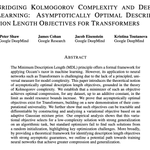
The paper links Kolmogorov complexity to Transformers and proposes loss functions that become provably best as model resources grow.
It treats learning as compression, minimize bits to describe the model plus bits to describe the labels.
Provides a single training target that rewards simple, compressible solutions while staying mathematically grounded.
This gives a principled way to aim models at simplicity and generalization, and it explains why optimization, not capacity, is the current bottleneck.
In Kolmogorov complexity, a "program" is just the shortest set of instructions that can recreate some data. A shorter program means the data or model is simpler. So when they say “a prior favoring shorter programs,” it means the model is assumed to be more likely if it can be described with fewer bits.
As the Transformer gets deeper (more layers) and has more context (bigger input window), its ability to represent complex programs grows. In that limit, the paper proves that this code length becomes the best possible measure of simplicity and fit — the same way Kolmogorov complexity works in theory.
“Code length” here means how many bits it takes to describe both the model and how well it fits the data.
So in simple words, they are saying: if you keep increasing model size and context, this method of preferring shorter and better-fitting models gets as close as possible to the theoretical ideal of perfect compression and generalization.
----
Paper – arxiv. org/abs/2509.22445
Paper Title: "Bridging Kolmogorov Complexity and Deep Learning: Asymptotically Optimal Description Length Objectives for Transformers"

Peter Shaw retweeted

i will be presenting AgentRewardBench at
#COLM2025 next week!
session: #3
date: wednesday 11am to 1pm
poster: #545
come learn more about the paper, my recent works or just chat about anything (montreal, mila, etc.)
here's a teaser of my poster :)


AgentRewardBench: Evaluating Automatic Evaluations of Web Agent Trajectories
We are releasing the first benchmark to evaluate how well automatic evaluators, such as LLM judges, can evaluate web agent trajectories.
We find that rule-based evals underreport success rates, and no single LLM judge excels across all benchmarks.
We collect trajectories from web agents built on four LLMs (Claude 3.7, GPT-4o, Llama 3.3, Qwen2.5-VL) across popular web benchmarks (AssistantBench, WebArena, VWA, WorkArena, WorkArena++).
An amazing team effort with: @a_kazemnejad @ncmeade @arkil_patel @dcshin718 @alejaz_a @karstanczak @ptshaw2 @chrisjpal @sivareddyg

Excited to share a new paper that aims to narrow the conceptual gap between the idealized notion of Kolmogorov complexity and practical complexity measures for neural networks.

We hope this work adds some conceptual clarity around how Kolmogorov complexity relates to neural networks, and provides a path towards identifying new complexity measures that enable greater compression and generalization.
