
原谅我这一生不羁放纵爱自由

Joined May 2020
Include

Only show posts containing:

Exclude

Hide posts containing:

Time range
-
Minimum likes
Andy J Yang retweeted
🤖🧠NEW PAPER🧠🤖 What is the relationship between neural networks & symbolic systems? Based on evidence from mechanistic interpretability, we argue for a quasi-symbolic view of cognition: Neural nets implement symbols but only approximately Link: sciencedirect.com/science/ar… 1/n
4
33
1
148
6,348
Andy J Yang retweeted
蝙蝠 设计折叠:本人 教程会在@XiaoYao707的微信公众号(波波奶茶的折纸快乐屋)中发布哦。 #折纸 #折り紙作品 #ORIGAMI
2
32
232
2,709
Looks like it will be a very interesting workshop!
We'd love your opinion! The quick poll below decides what our @MOSS_workshop panel will debate. Please vote and share! 🌱
7
506
Andy J Yang retweeted
The most profound paper of my PhD so far. We truly did something special to make LMs play/explain chess, needing both architectural & algorithmic innovation (natural-language analogue of the Alphazero algorithm) + applicable to many other domains. Please read on and share! 1/10
61
174
28
1,550
110,174
Blerta and I will be presenting this at COLM on Oct 6! Find the location here: colm.cc/virtual/2026/poster/…
Which state-tracking problems can transformers length generalize on? Transformers' performance on different finite-state tasks varies drastically, even when the tasks are structurally similar. Now, for the first time, we can precisely predict when length generalization occurs.
4
24
825
Andy J Yang retweeted
Can Transformer LLMs hide their reasoning from CoT monitors? tl;dr: Transformers cannot hide complex reasoning, but they might cryptographically obfuscate their CoTs, making it extremely difficult to extract hidden goals.
3
28
1
126
6,197
Andy J Yang retweeted
🚨 [Token][ization] Paper Alert 🚨 Tokenization is a wildly understudied area of language modeling despite it having effects across all of NLP. Over the past ~8 months, 32 (!) tokenizer researchers put together the most comprehensive survey of the field. Check it out!
6
82
24
346
40,389
Andy J Yang retweeted
Bend 2 is here! It is a new programming language that blocks AI mistakes via *proof checking* - the same technique big AI labs used to solve open math problems, like Navier-Stokes. It is also very fast, and runs on GPUs. Watch the video. Link in the comments.
RELEASE DAY After almost 10 years of hard work, tireless research, and a dive deep into the kernels of computer science, I finally realized a dream: running a high-level language on GPUs. And I'm giving it to the world! Bend compiles modern programming features, including: - Lambdas with full closure support - Unrestricted recursion and loops - Fast object allocations of all kinds - Folds, ADTs, continuations and much more To HVM2, a new runtime capable of spreading that workload across 1000's of cores, in a thread-safe, low-overhead fashion. As a result, we finally have a true high-level language that runs natively on GPUs! Here's a quick demo:
656
1,299
342
11,431
2,136,653
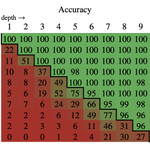
💥 The multiplication saga continues! It turns out, some frontier LLMs do struggle with simple multiplications. Unlike GPT-6-Astra, Fable 5.1 with low reasoning has a blind spot where the accuracy of, say, 5x6 multiplications drops to ~0%! The failure mode is very interesting: the 0% zone corresponds to a failure of adaptive thinking. The model decides that it shouldn't produce any reasoning and outputs the (wrong) answer directly. For larger multiplications, however, the model realizes it should produce a CoT first and then it gets the answer correctly. For very large multiplications (close to 20x20), the accuracy degrades again. How many such simple blind spots do frontier LLMs still have? This is why slowing down and carefully studying generalization and safety is the top priority... 1/2
30
48
14
735
80,215
Andy J Yang retweeted
🤖🧠NEW PAPER🧠🤖 (The result of an 8-year project!) LLMs seem very different from symbolic systems. Yet LLMs excel in symbolic domains (e.g., language/code/math). How do they do it? Our finding: LLM representations have implicit symbolic structure! Link in thread ⬇️ 1/n
45
271
40
1,375
212,473
Very excited to be sharing this on behalf of the amazing team: Blerta Veseli Corentin Barloy Michaël Cadilhac Andreas Krebs Charles Paperman Howard Straubing @mhahn29
19
1,586
The practical payoff of this theory is a fast algorithm, which can decide whether or not a transformer will length generalize on any given regular language. Evaluation on >100 randomly sampled regular languages demonstrates the theory accurately predicts length generalization!
3
2
1
46
2,593
Our second main contribution is to use this decomposition theory to derive a polynomial time decision procedure for regular language membership in C-RASP. This is formalized using the Derived Category Theorem (Tilson 1987) -- which explains how to "divide" one monoid by another.
1
2
1
32
1,776
Our first main contribution is to create a decomposition theory for C-RASP built upon the additive group of the integers. This is formalized using wreath products of typed monoids (Krebs 2008) -- a framework that extends classical algebraic language theory to infinite monoids.
1
2
27
1,799
Firstly, C-RASP contains non-regular languages, while Krohn-Rhodes only covers regular ones. Secondly, Krohn-Rhodes is built upon the flip-flop unit and simple groups as atoms, but neither of these are expressible in C-RASP.
1
2
22
1,925
This is a challenging question because the classical decomposition theory for regular languages (Krohn-Rhodes Theory) is doubly insufficient for C-RASP:
1
1
28
2,044
Previous work (@huangxt233 2025) suggests transformers length generalize whenever the task is expressible in C-RASP. However, C-RASP sits orthogonally to classical measures of regular language complexity, so understanding the regular languages of C-RASP requires new ideas.
1
4
42
2,601
A fundamental question one can ask about a model of computation is, what finite-state languages can it recognize? Kleene invented regular expressions in the 1950s to characterize McCulloch-Pitts nerve nets. 75 years later, we ask the analogous question for transformers.
1
13
6
118
25,096
Which state-tracking problems can transformers length generalize on? Transformers' performance on different finite-state tasks varies drastically, even when the tasks are structurally similar. Now, for the first time, we can precisely predict when length generalization occurs.
7
67
8
476
64,139