
Neuroscientist studying motor control and the physiology of the motor system.
beer sheva, israel
Joined January 2011
- Tweets2.5K
- Following338
- Followers709
- Likes1.8K




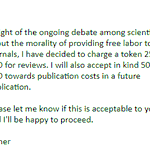


I made the @StatModeling blog!

Frequentism for Bayesians: He wants to teach frequentist methods to engineering students with a strong Bayesian background
statmodeling.stat.columbia.e…
Many people don't understand the global geopolitical implications. Increases in the demand for As in the US make it vulnerable to bad actors applying strategic pressure on the global supply!

“In 712 Harvard course offerings last year, every enrolled undergraduate received an A.”
“In another 532, A’s were common enough that the class would have violated the…newly approved grade cap.”
“Together, those courses made up more than half of all undergraduate course[s].”
thecrimson.com/article/2026/…


Opher Donchin retweeted

The Life Sciences Department at BGU (@LsBgu) has an open Tenure Track Position in Systems Neuroscience! Your lab can be somewhere in this building :-)
For more details: bgu-academic-recruitment.my.…

Opher Donchin retweeted

We're hiring! Tenure-track faculty position in Systems Neuroscience @bengurionu (BME, all ranks).
Areas: neuroimaging, neural prosthetics, electrophysiology, translational neuroengineering & more.
Apply:
bgu-academic-recruitment.my.…
#Neuroengineering #AcademicJobs #Neuroscience
Opher Donchin retweeted

New article published in Communications Psychology!
Large reaching datasets quantify the impact of age, sex/gender, and experience on motor control.
nature.com/articles/s44271-0…

As we age, we move slower and less precisely—but how much, exactly?
We analyzed one of the largest datasets on motor control to date.
Findings:
Reaction time: –1.2 ms/year
Movement time: –2.3 ms/year
Precision: –0.02°/year
tinyurl.com/f9v66jut
Opher Donchin retweeted

excellent new paper breaking a long-standing impasse by the identification of specific behavioral conditions under which CINs are recruited to augment DA release in vivo : Cholinergic modulation of dopamine release drives effortful behaviour nature.com/articles/s41586-0…

Opher Donchin retweeted

Let’s bring science back to X.
Not influencers. Not grifters.
Just scientists.
Who’s worth following? 👇
This looks like a great book and if I wasn't R-osagnostic, I would use it in my course. Is AI good enough to make it all Python/PyMC for me?

Our Introduction to Bayesian Data Analysis for Cognitive Science (with Nicenboim and Schad) is now in production with CRC Press. It will remain freely available here:
bruno.nicenboim.me/bayescogs…
Opher Donchin retweeted
I am excited to share our latest study, led by Svetlana Volotsky, reveals that archerfish can categorize objects using a small population of neurons in their optic tectum—an early visual processing stage nature.com/articles/s41598-0…. (1/4)


So Bayesians: I'm giving one lecture on Bayes in a full course on advanced regression. What is your go-to example of easy to do with Bayesian stats but hard or impossible in frequentist?
Opher Donchin retweeted

1/🚀 Excited to share our new research! 🎉
This study, led by the talented Hanna Kossowsky Lev, explores the fascinating interplay between perception and action in haptics.
🔗 Read more: eneuro.org/content/early/202…

Opher Donchin retweeted

Spontaneous recovery is a fundamental feature of motor adaptation, implying at least two timescales of learning.
A new paper from @AliGhazizadeh11 finds that reward learning also exhibits spontaneous recovery, and links it to the prefrontal cortex.
biorxiv.org/content/10.1101/…

Scientists (rightly) trust their eyes more than statistical tests. That's because NHST doesn't actually work. It is empty ritual.


