

Find me on bluesky @mycomile.bsky.social
Madison, USA
Joined November 2015
- Tweets706
- Following689
- Followers1.2K
- Likes2.6K





Pinned Tweet
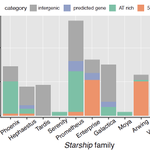
Do fungal Starships 🚀 matter for human health? We dive into the pathogen Aspergillus fumigatus and connect the dots between these unusual transposons and strain variability. Spoiler alert: biofilms, secondary metabolites and intra-strain variation, oh my! biorxiv.org/cgi/content/shor…
Emile Gluck-Thaler retweeted

Lesson 1: Plant pathogens are in constant coevolutionary conflict with their hosts
Lesson 2: Plant pathogen genomes are highly diverse
Lesson 3: Plant pathogen genomes are non-randomly organised
Lesson 4: Diverse mechanisms drive genomic diversity in plant-pathogen populations

Emile Gluck-Thaler retweeted

Fungal genomes are 🤯🤯🤯
We wrote this review to summarise some lessons we learned in the last 20 years of fungal genomics.
Excited to see where our field is going in the next 20 years to come!
Thanks a lot to all co-authors @YuSengHuang @ThorstenLangner and Sophia
🧵👇

From lesions to lessons:
2025 marks the 20th anniversary of filamentous plant pathogen genomics. In our new review, we present lessons we learned over the past 2 decades and discuss the future of plant pathogen genomics. Take a first look!
apsjournals.apsnet.org/doi/e…
Emile Gluck-Thaler retweeted

Dive into the massive genomes of plant pathogenic rust fungi! 🌿🍄
Our study reveals how ancestral & recent bursts of transposition have shaped these remarkable genomes.
👏 Congrats to @Emma______C on her 1st PhD paper!
🙌 @SebbyRust, Emmanuelle Morin
biorxiv.org/content/10.1101/…

Emile Gluck-Thaler retweeted
Excited to share the published version of our paper: Thermal Adaptation in Worldwide Collections of a Major Fungal Pathogen 🌍🔥 Congrats to @MinanaPosada and @AliceFeurtey for leading this great work! 🎉 Read it here: apsjournals.apsnet.org/doi/1…

have you ever gazed out at some fungus and wondered what else could be in there?✨ Check out our new @TrendsGenetics review on fungal #Starships 101: what we know so far and where we think the field is headed. Great job Andrew and @Hulk_Vogan 🍄🚀 authors.elsevier.com/a/1jnz5…

Emile Gluck-Thaler retweeted

NEW publication out in @NatureMicrobiol!🥳
The conidial surfaceome (surface proteins) of #Aspergillus fumigatus contains unique proteins absent in non-pathogenic relatives. KOs revealed 33 genes affect #pathogenesis and related traits, indicating the surfaceome impacts virulence

Emile Gluck-Thaler retweeted

Zach Konkel built CLOCI to detect gene clusters based on the signatures of their evolutionary processes. Not just secondary metabolite clusters...all kinds of clusters.
And of course we present fun new horizontal gene cluster transfers.
academic.oup.com/nar/advance…

Emile Gluck-Thaler retweeted

Come join us! Our institute @LeibnizHKI is looking for a Post-Doc who will work on therapeutic microbes with the perspective to establish an own research group! Please spread the word 📣
jobs.hki-jena.de/jobs/Postdo…
Thanks to @adrian_forsythe Charlie Puerner @hyphaltip @danielcroll Robb Cramer and @Hulk_Vogan for a great team effort 🤩🥳🙌
Emile Gluck-Thaler retweeted

Just did a podcast with @mycomile and Horacio Lopez-Nicora. Really cool stuff! We discussed massive mobile elements (starships) and what role they might be playing in fungal genomes:
sites.libsyn.com/416264/s3e2…
@CropNetwork @ncipmc @OSUPlantPath @UWMadisonExt @dsmuelle @alabamaED @travisfaske @swhitham49 @MartinChilvers1 @badgercropdoc @DTelenko @DylanMangel @tjcksn @febina_m @baldpathologist @UtaMcKelvy @MizzouIPM @KStateRE @PlantPathISU @ISU_IPM @alisonrISU @ImperfectFunGuy @cropdoc08 @cropdisease @AlbertTenuta @yrkandel @ISUcropscout @phytopoetry @plantdisease @ISUCropNews @ISUExtension

Emile Gluck-Thaler retweeted

FBR has just published our commentary that we have compiled on suggestion of the editors. This will hopefully help to clarify why the search for complex plant metabolites in cultures of fungal endophytes is not an attractive research goal but more related to phantom hunting.

Bringing Starships 🚀 to the people: our new workflow for finding giant transposons is out! We used starfish on a kingdom wide 🍄database and found 100s of Starships in 100s of species.. and that's just scratching the surface: doi.org/10.1093/nar/gkae327 @Hulk_Vogan

Emile Gluck-Thaler retweeted
NEW preprint: #PhyKIT is a command-line tool for analyzing multiple sequence alignments and phylogenies.
Here, we detail #protocols for using PhyKIT to build #phylogenomic supermatrices, quantifying biases/#errors therein, identifying putative radiations & so much more.

Emile Gluck-Thaler retweeted

Phylogenomics of 710 fungal genomes from the biomedically and technologically important genus Aspergillus reveal that ~8% are misidentified - population-level sampling is important.
@jlsteenwyk @JosHoubraken @RokasLab & many amazing collaborators journals.asm.org/doi/10.1128…

Emile Gluck-Thaler retweeted

I have debated if/how to share this, because this paper is both exciting but also the hardest I have ever written because of *waves hands in all directions*. It also would NOT be in-print without two amazing Masters students @ahbucknell and Hannah Wilson who did the work 1/2

Sanctuary: A Starship transposon facilitating the movement of the virulence factor ToxA in fungal wheat pathogens biorxiv.org/cgi/content/shor… #biorxiv_genomic


Emile Gluck-Thaler retweeted

I told you my poster has a cow on it! It was the busiest poster day I ever experienced and even lost my voice after talking (shouting😲) 3 hours nonstop 😬#Fungal24

Emile Gluck-Thaler retweeted

Somehow we managed to time the release of our new Starship preprint on the same day. doi.org/10.1101/2023.11.22.5… We demonstrate that recurrent HGT of adaptive genes are mediated by Starships across fungi. This elevates HGT to a major mode of evolution and adaptation in fungi!

ALT A phylogeny of Starship captain proteins from elements with the putative formaldehyde resistance cluster and close relatives.(D) BLAST-all genome comparisons between genomes containing copies of the Starships. Red dots are genes within the Starships.

Emile Gluck-Thaler retweeted

AMF genomes can be "jam-packed" with Transposable elements (TE) that drive genome biology and regulation in many organisms.
The talented @jordana_olive now determines TE diversity and regulation in multiple 9 model strains using curated datasets.
biorxiv.org/content/10.1101/…