

I am a Thinker, Doer, Builder, Artist, Dreamer, Gamer, digital dude , prankster& spreading happiness..do you need more!
Mumbai
Joined July 2009
- Tweets2.8K
- Following1.5K
- Followers624
- Likes2.3K





Manish Malik retweeted

A startup just raised $21M to buy small CPA firms from retiring owners and run them on AI. $500k-$5Mil.
Their claim: margins at their first firm went from 37% to 52% in two months. "Projected" to hit 70%.
Honestly this one scares me a bit. It's also not proven yet. Two months at one firm isn't a trend, and my QoE brain has questions 🧐
But the opportunity is real. A huge share of CPA firm owners are at or near retirement with no one lined up to take over. Someone's going to buy those practices.
fortune.com/2026/11/05/numic…


Manish Malik retweeted

This is f*cking insane. Michael Dell, the billionaire who built Dell from his college dorm room, just told investors who actually wins the AI jobs race:
"We're in an acute shortage. Maybe 100,000, maybe 200,000 people on planet earth are truly using AI agentically
Jeff Clark and I are building a fleet of agents that help us run the company. One by one, then 10 by 10, then a thousand by a thousand"
In 19 minutes, he explains why most companies use the least valuable part of AI and where the real money is
Chatbots → Tools → Agents Running The Company → 200,000 People Nobody Can Hire Fast Enough
The ones who learn to run agents this year get hired first
This 19-minute talk beats most $2,000 AI bootcamps
Send it to the friend still using ChatGPT like a search bar
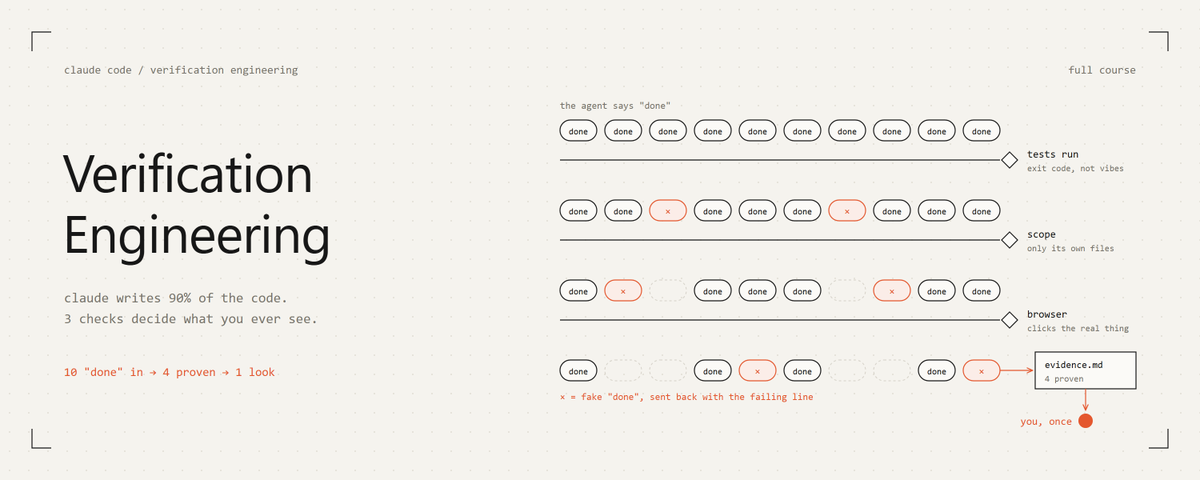
Then pick up the skill almost nobody has in the Verification Engineering guide below ↓

Manish Malik retweeted

兄弟们,这事儿真的太狠了。执掌 3 万亿美金帝国的微软掌门人纳德拉(Satya Nadella),刚刚亲手给全天下所有企业敲响了丧钟——你们每个月乖乖掏钱续费的商业软件,马上就要彻底死掉了。
他在镜头前一点弯子没绕,直接把整个软件行业的底裤给扒了个精光:
“所有的业务逻辑,正在全面向 AI 智能体(Agent)迁移。一旦核心逻辑全都掌握在 AI 手里,人们就会开始动手替换掉原来的后端系统。说到底,商业软件本质上就是‘数据库加一堆业务逻辑’——在智能体时代,这正是它们全线崩塌的死穴。”
短短 2 分钟,他直接把传统软件的终局扒得明明白白:以后你电脑屏幕上那些死贵的 SaaS 工具,全都会彻底沦为一个毫无灵魂的“储物箱”,只配乖乖躺在后台,等着智能体把数据往里写。
你仔细看他拆解出来的这条演化链路,每一步都在把传统软件往坟墓里推:
传统软件(Apps) → 副驾驶(Copilots) → 智能体(Agents) → 后端被彻底替换 → 自我运转的软件。
这里面的降维打击到底有多残酷?
传统软件是怎么折磨你的?它逼着你点穿 40 个菜单页面,还得老老实实按它定死的死规矩一步步填表走流程。
而智能体是怎么干活的?它压根不看你那些花里胡哨的界面,直接跨过所有屏幕,一口气把所有关联系统同步更新完,顺手把最值钱的业务逻辑全攥进了自己手里。
这就好比以前你开公司,得花大价钱供着十几个死板的大管家,每人守着一本账本、各定各的规矩,办一件事你得跑断腿挨个窗口排队签字盖章;结果现在空降了一位全能超级大脑,把所有业务规矩和算账的活全揽自己身上,原来那帮高薪大管家瞬间全被架空,只剩下墙角几个冷冰冰的铁皮文件柜,用来给大脑随手塞单据。
时代换剧本从来不会提前打招呼,最后这句大实话才最扎心:
那些天天守在电脑前、点着软件干活的人,正在被飞速淘汰;而站在后面指挥智能体干活的人,正是亲手淘汰他们的那批人。


Manish Malik retweeted

This is f*cking insane. Anthropic CFO Krishna Rao, the man who just took Anthropic public in the biggest IPO in history:
"When I joined, the run rate was about $250 million. In October it was $81 billion, up over 320 times in two and a half years
We think we're at the beginning of this, and that sounds crazy to say based on where we are"
In 77 seconds, he explains why he calls a $1.3 trillion debut "one stop on the train"
The average Anthropic employee is now worth $44M on paper. This is what the people building it learn from, free:
Anthropic Academy, every course free
anthropic.skilljar.com/
AI Fluency: Framework and Foundations
anthropic.skilljar.com/ai-fl…
Anthropic's free courses on GitHub
github.com/anthropics/course…
Interactive prompt engineering tutorial
github.com/anthropics/prompt…
Prompt engineering guide
platform.claude.com/docs/en/…
How they built their multi-agent research system
anthropic.com/research/multi…
Writing tools for agents
anthropic.com/research/writi…
Agent Skills, the official repo
github.com/anthropics/skills
Agent Skills docs
platform.claude.com/docs/en/…
Model Context Protocol
modelcontextprotocol.io/
All of this costs $0
Then read the article below ↓


Manish Malik retweeted

We’re looking for a founder to build and lead Notion India. DM me if you’re interested or know someone exceptional.


Manish Malik retweeted

fucking hell, dude. everything i'm going through rn feels so insignificant compared to what he's been through and what he's done to change his family's life. nothing but massive respect. 🫡

Most people start their careers with some privilege, and many start from zero. I started from minus ₹1 crore, and I did not even know it until my second year at IIT Delhi.
Over the years, that debt took me from a failed placement day to Google, to a ₹2 crore side business, and finally to the startup I had always wanted to build. This is that story.
My father ran a real estate business, and he had invested in under-construction flats from builders like Jaypee and Wave, paying most of the price up front through home loans.
Years went by without the flats being delivered, but the banks still wanted their EMIs on time. So my parents borrowed from friends and relatives, and when that was not enough, from credit cards.
My parents carried all of this debt quietly and tried to shield me from it. I knew we owed money, but never how much.
Then in my second year, collection agents started coming to our house and sitting there, asking for payments we could not make. It stressed my mother a lot, and I could see it on her face every day.
𝗧𝗵𝗲 𝗹𝗶𝘀𝘁
One day, I sat my parents down and asked them a simple question: who exactly do we owe, and how much?
Then I took a sheet of paper and started writing down how much we owed, to every bank, every friend, every relative and every credit card.
The list kept getting longer, and by the time I finished, the principal alone was more than ₹1 crore.
I still remember how heavy it felt while writing each line. That day, I knew I had to grow up quickly and get my parents out of this situation.
I had joined IIT knowing exactly what I wanted to do after college, which was to build a startup. But that sheet of paper changed everything, and the dream would have to wait.
The new plan was to get a high-paying job, pay off everything on that list within two years so that my parents could finally breathe again, and only then pursue my dream of starting up.
𝗠𝘂𝗿𝗽𝗵𝘆'𝘀 𝗹𝗮𝘄
From my third year, everything I did was aimed at that one goal: getting a job at an HFT, which paid ₹50 lakh+ a year.
I was ranked 2nd in my department and had a CGPA of 9.7/10, so I genuinely believed I could get in.
Then day one of campus placements came. I prioritized Tower Research over the other companies, cleared three rounds, and was rejected in the final one.
I was so crushed that I could not perform at the others that had shortlisted me, and by evening, they were all gone.
That evening was really hard. Every rupee I was not going to earn meant my parents would have to carry that weight for longer.
On day two, I took an offer from Cohesity at ₹18 lakh a year. It was a good job, but nowhere near the number we needed.
In July 2019, I moved to Bangalore, stayed in a PG, kept my monthly expenses to under ₹20,000, ate meals at the office, and rarely went out with friends. Everything else, I sent back home.
My friends would talk about investing and going on trips, but I did none of that.
I soon realized that this salary would never be enough. So I set a new target: Google US. Whatever time I could find outside work went into competitive programming, and I soon became a Master on Codeforces.
In January 2020, I started applying to Google and other companies in the US and UK. A few weeks later, COVID hit, and overnight, companies stopped hiring overseas candidates.
The way out I had been working towards for months disappeared.
𝗪𝗵𝗲𝗿𝗲 𝗱𝗶𝗱 𝗮𝗹𝗹 𝘁𝗵𝗲 𝗺𝗼𝗻𝗲𝘆 𝗴𝗼?
Around the same time, I got an offer and joined Spotnana as a founding engineer. I really liked their vision, and I believed that growing with a young startup and holding equity in it could be the big break I needed.
About a year after I had started sending money home, I sat down to see where it had gone.
Almost my entire salary had been spent on interest for our credit card loans. We had not reduced the principal and had not saved anything either. After a full year of hard work and sacrifice, the list was exactly as long as the day I had written it.
That was one of the lowest points of my life. It felt like I was running as hard as I could, just to stay in the exact same place.
Meanwhile, I was giving Spotnana everything, working on weekdays and weekends, and was one of the top performers there.
But when appraisal season came, the raise was still not as high as I was hoping for. I was really disappointed. My equity, though promising, could not help us pay off the debt anytime soon.
I told my manager I would need something on the side to make up the difference. I created a programming YouTube channel and later learned Android development, but neither brought in any money.
𝗜 𝗰𝗼𝘂𝗹𝗱𝗻'𝘁 𝘀𝗹𝗲𝗲𝗽 𝘁𝗵𝗮𝘁 𝗻𝗶𝗴𝗵𝘁
During that time, I was talking to one of my college seniors who had joined Google. I told him everything, about the list, my plan and my belief that I could clear it all in two years.
He listened patiently and then told me the truth. If I stayed at Spotnana, it would not take two years, it would take more than four.
He said that instead of being emotional about the company, I needed to be tactical if I really wanted to solve my family's problem. He then referred me to Google.
The next four months were the most focused of my life, and every spare hour went into preparing for Google. When I got rejected from Uber and Coinbase, I was terrified about what would happen next.
But then, Google said yes.
The day the recruiter told me I had been selected for the Google Search team is still one of the best days of my life. That night, I couldn't sleep at all. I lay awake, too happy to close my eyes, thinking about how this would finally change things for my family.
For the first time since I wrote that list, I could actually see a way to clear it.
𝗧𝗵𝗲 ₹𝟮.𝟭 𝗹𝗮𝗸𝗵 𝗯𝗲𝘁
When I joined Google, the list still had ₹80 lakh left on it, and salary alone would take years to clear it.
But Google also gave me something I had not had before: time. So with Google's permission, I started a mobile apps business with my father, working nights and weekends.
In the first three months, we built a bunch of Android apps and games, but could not make any revenue. Then I analyzed iOS versus Android and decided we should build for iOS instead.
So we took the bet. I bought a MacBook Pro for a hefty ₹2.1 lakh, picked our most downloaded game on Android, built its Swift version in six days, and launched it on iOS.
Installs were high from day one, and within a couple of days we turned on monetization. I kept refreshing the dashboard as paying users came in, and within just a few days the game had paid back the cost of the laptop.
And that was just the beginning. Our revenue grew from ₹6 lakh in the first month to ₹24 lakh in the fourth, as we added more games.
I was working close to 100 hours a week between Google and our apps. Over a year and a half, our games crossed 200K downloads, with players mostly from the US, and brought in more than ₹2 crore in revenue.
𝗖𝗿𝗼𝘀𝘀𝗶𝗻𝗴 𝗼𝗳𝗳 𝘁𝗵𝗲 𝗹𝗶𝘀𝘁
With that revenue and my Google salary, we finally started crossing lines off the list. This time we were not just paying interest, we were paying back the principal, one line after another.
With every line we crossed off, the stress at home got a little lighter.
In June 2023, we paid off the last one.
The list I had written in my second year of college was finally empty. My parents were free, and after years of waiting, so was I.
As soon as the last loan was cleared, I put in my papers at Google. The apps had left me with enough savings to finally start my own company.
My last day at Google was the day before my 25th birthday, and on 21 July 2023, I woke up with no debt, no job, and for the first time in years, nothing standing between me and the thing I had always wanted to do.
𝗦𝗵𝗼𝘂𝗹𝗱 𝗜 𝗴𝗼 𝗯𝗮𝗰𝗸 𝘁𝗼 𝗮 𝗷𝗼𝗯?
Over the next four months, I built 12 new games, but month after month, none of them worked. And it was not just me. Apple's iOS privacy changes had broken the economics of hyper-casual games.
That November, I remember walking on my terrace, thinking about whether leaving my job had even been the right choice. My parents had started telling me to get a job again. But I had waited far too long for this chance to give it up.
I decided to shut the games business down and hard pivot into SaaS. I started with Shopify apps, only to realize a month later that I had no unique idea and the competition was intense.
I then analyzed around 70 B2B SaaS marketplaces to find the next Shopify app store, found monday, the project management platform, and started Super Workday, building apps for teams using it.
My first app there failed too, because it was too niche. For the next one, I went through the platform's feature requests and picked the biggest unsolved problem.
That one worked. In April 2024, after eight months without any revenue since leaving Google, I got my first paying customer.
I was so happy that day that I emailed him just to tell him he was my first customer. I still remember his name.
After that, I kept launching one new app every month, and the revenue grew sharply. Today, the business runs on autopilot, has 300+ paying customers, mostly in the US, and is close to $100K in ARR.
It also paid for my sister's wedding, and being able to do that for my family made me very happy and proud.
𝗧𝗵𝗲 𝘀𝘁𝗮𝗿𝘁𝘂𝗽
With that income stable, I finally felt ready to go after a venture-scale idea and started building an AI executive assistant.
In January 2025, South Park Commons, a Silicon Valley VC, invested $400K at a $5.7M valuation. I cannot explain what I felt the day their offer came. All those years of waiting finally made sense.
My startup journey is still early. Since then, there have been many more ups and downs, and there are still many things to figure out.
But for the first time, I am building the startup I always wanted to build, and I am ready for whatever comes next.


Manish Malik retweeted

Be Ashton Kutcher:
- Works construction with his dad at 10
- Janitor, butcher and factory hand in high school
- Sweeps Cheerios dust at General Mills for $12 an hour
- Studies biochemical engineering at Iowa
- Wins a modeling contest. Drops out
- Gets cast as Kelso. Plays dumb for eight seasons
- Creates Punk'd
- Watches 50 Cent make $100M on Vitaminwater equity
- Realizes he's been taking endorsement checks
- "I've got to figure out how to get in the equity game"
- Hires someone from TechCrunch to introduce him around
- "I spent 90% of my time just listening"
- Puts $1M into Skype in 2009
- Microsoft buys it 18 months later. 4x
- First to 1 million Twitter followers. Beats CNN by 29 minutes
- Starts a fund in 2010. Puts in $1M of his own
- $500K into Uber
- $2.5M into Airbnb
- $3M into Spotify
- Loses money on an "Uber for planes"
- Watches Fab go from $1B on paper to a $15M sale
- Keeps investing
- Turns $30M into $250M in 6 years
- Marc Andreessen: "He started doing it when it really wasn't cool"
- Gets $100M from Liberty Media to start Sound Ventures
- Raises a $240M AI fund in about five weeks
- Already owns OpenAI
- Meets Dario Amodei at his partner's house in Beverly Hills
- Asks Sam Altman first if he minds
- Writes a $35M check at about a $5B valuation
- Gets asked on TV why he paid so much
- Says every company will be an AI company
- Keeps writing checks. $435M in total
- Steps back from the firm months before the IPO to start over at the early stage
- Anthropic goes public at $1.5T
- The stake: about $7B. Roughly 16x
- Most of it belongs to his investors but nearly $2B in carry goes to him and his firm
- His take: "Kind of cool when that works out"
"It's years of work, micro victories and failures stacked on top of one another."

In 2023, Aston Kutcher was asked about why he invested Anthropic at a ‘HIGH’ valuation of $4 Billion.
Ashton: "I think these models look lot like web 1 models like Yahoo, Google and none of these AI companies have really even started reporting their revenues yet."
"I think every company will be AI company, like 10 years ago if you were in commerce and didn't invest in E-Commerce, you aren't even a company anymore."
"And if there 2-3 companies at the foundational layer, the TAM is so large that marking value of a company based on anything other than the potential would be wrong."
Today, Anthropic is valued at a whopping 2 Trillion Dollars.🔥
Manish Malik retweeted

Firstly, from @AdaniOnline congrats to @AnthropicAI
Second,
Cross-Regime Category Error: Why Legacy Bankers Can’t Price Synthetic GDP
Comparing Anthropic’s $1.5T valuation to India’s top 10 corporates as "undervaluation"vs. "catching up" is a textbook category error in asset pricing. It benchmarks a convex call option on synthetic Labor in a new economic substrate against discounted cash flow (DCF) claims on a human-constrained economy.
1. The Ceiling of Human-Economy Equities
Traditional blue chips (banking, energy, staples) are linear yield vehicles anchored to biological human GDP. Growth is capped by demographics, credit penetration, physical consumption, and waking hours—priced via mean-reverting multiples (P/E, EV/EBITDA).
Calling them "undervalued" next to frontier AI is like calling Mumbai real-estate undervalued next to the discovery of thermodynamics.
2. Anthropic as a Call Option on Synthetic GDP (Yₛ)
Cognitive labor is decoupling from human population growth. Frontier models aren't SaaS tools; they are the "infrastructure of intelligence" for a parallel synthetic workforce (Yₛ) operating above human output (Y_Total = Yₕ + Yₛ). At $1.5T, markets aren't capitalizing EBITDA. Using Black-Scholes intiution Wall Street is pricing implied volatility and right-tail convexity of a 24/7 digital workforce scaling at the marginal cost of compute.
@AdaniOnline , we are already operationalizing this reality through our cobotic workforce model—a dual-track organizational architecture weaving human creativity with autonomous AI agents and robotics across our utilities, ports, and operations, upskilling 11000+ professionals annually to lead a ybrid industrial paradigm.
3. The 1999–2020 Precedent: Euphoria Still Underprices Regime Shifts
In 1999, Mary Meeker and Dow 36,000 were mocked as peak-bubble delusion when global e-commerce was ~$150B, internet penetration was 5% (277M users), and $1T tech firms seemed impossible. When the NASDAQ peaked at 5,048 in March 2000 and crashed 78% (wiping out ~$5T and bankrupting Pets.com and Webvan), legacy finance declared the thesis dead.
Yet by 2020, reality crushed 1999’s wildest models: 4.5B+ internet users (57% of humanity), $4.2T+ in annual e-commerce, >60% digital ad share, and core winners (Apple, Microsoft, Amazon, Alphabet) compounding into a $16T+ asset class. Legacy allocators mistook the 2000 clearing event for a ceiling, missing a new digital GDP layer.
4. The Epistemological Blind Spot of Legacy Bankers & Capital
This is classic lender-mindset orthodoxy: mistaking backward-looking accounting ratios for capital creation. Allocators trained in capital-scarce banking worship trailing multiples, static book value, and incremental yield—dismissing any paradigm-building capex cycle that breaks 20th-century spreadsheet as a "bubble."
While legacy finance debates scoreboards in the rear-view mirror, we have laid out our $100B+ (₹10 lakh crore) roadmap for the "Infrastructure of Intelligence"—mastering the full physical-to-digital stack from Port to Power to Metals to Processor, integrating gigawatt-scale renewable energy, grid transmission, and hyperscale liquid-cooled AI data centers (scaling toward 5 GW). Because intelligence is written in code, but it runs on electrons and sovereign infrastructure.
India’s blue chips are neither undervalued nor "behind"—they are yield vehicles monetizing the physical human economy, while those building the energy-and-compute backbone are underwriting the new substrate of an add-on synthetic economy. You cannot measure a non-linear dimension with a static ruler built for the old world ( much like 2000, clearing out will occur here too). Scientifically, Ai is a bigger shift, akin to development of scientific method in 16th century thus an order of magnitude a greater opportunity.

Manish Malik retweeted

Descubre la evolución más ambiciosa e inmersiva de la saga hasta la fecha, ya disponible en PlayStation 5.
Manish Malik retweeted

@AmexIndia @AmexBusiness the website & app is down today.
I have to make the Amex payment & since Amex India is very weird now a days I am afraid if I miss today for payment,how much penalty or charges I have to pay despite the problem from Amex.
No one listens in Amex now a days
Manish Malik retweeted

@AmexIndia @AmericanExpress I am unable to log into the Amex App, neither are any of our India customer care numbers functioning since 2 days! I cannot download the statement also. I will not be responsible for any delay in statement payment. This is unacceptable! #AmexIndia #Amexnotworking
Manish Malik retweeted

American Express @AmericanExpress: What a fall from the top! Absolutely horrendous!
American Express India has spent the last few years quietly eroding what used to set it apart, and the last two weeks have been particularly bad.
On November 9, the first bomb was dropped. Thousands of cardholders woke up to large “Points Adjustment” deductions in their Membership Rewards balances, sometimes running into millions of points and even negative balances.
- Amex cited a technical glitch that had left points from previously cancelled cards visible past the 30-day forfeiture window, even though points had been pooled with no card-wise visibility or prior clear warning.
- After widespread complaints (including threats to approach the RBI Ombudsman), the company reversed course and promised to restore balances to 8 November levels.
As if the last week horror stories weren’t enough, today (November 15) marks the big platform upgrade: points are no longer pooled across cards, several benefits continue to be watered down, and the new app/portal has gone live.
- Users are already reporting OTP delivery failures on both the app and website, leaving people unable to log in.
- App issues over ioS and Android.
- Disabled logins.
- Points not tallying
All this follows two months of limited or disrupted digital services and customer care that has frequently been unreachable or unhelpful during the transition.
- Even the transition was delayed. Initially it was mailed that no service available between September 7 - October 10.
- It was unilaterally extended to November 15.
Over the past couple of years we have also seen progressive benefit reductions (fee waivers ending, renewal benefits watered down, milestone changes, Reward Multiplier shutdown, lounge and partner adjustments) alongside declining service quality.
A premium brand @AmexIndia once known for strong support is increasingly delivering the opposite:
1. Unilateral Disruptions
2. Tech Glitches
3. Watered down benefits
4. No direct customer support even for Centurion card holders
5. Multiple failures in the renowned Centurion concierge even for simplest of the requirements
Above all: Eroded Trust!
If you hold Amex India cards, check your points activity carefully, screenshot everything, and escalate in writing.
Premium pricing should come with reliable systems and accountable service.
What next Amex India?
1. Start with questioning your Tech transition team or the Tech vendor you hired
- This is the worst migration and horrendously handled so-called upgrade anywhere seen from a card issuer in India.
2. What was the Amex India senior management team doing?
- Amex has always sold itself on service. This week, it delivered the opposite.
3. What about the customer’s bad experience?
#AmexIndia #MembershipRewards #CustomerService #ccgeeks #AmericanExpress #Centurion
Manish Malik retweeted

@AmexIndia why have I recieved emi cancellation requests successfully completed mails when i have not requested any such thing?I can't login your helpline is not working?
Manish Malik retweeted

#1 app in entertainment category (free app category) in the India Playstore is @rigi_app! 1.7M DAU and over Rs100 Cr revenue run rate. Fully Ad driven revenue model - No UPI Autopay here. 100% AI driven content creation - cost of production down 90% with AI! @swapnilsauravv @ananyasinghal and team are taking an Ad driven monetization approach to microdrama in India and are just getting started! @peakxvpartners @pushpakkedia

Manish Malik retweeted

Several people encouraged me to share a post I made on LinkedIn, here on X
I wrote this from the heart, about someone I had the privilege of working closely with for years.
No agenda. Just a side of Jensen I hope doesn’t get lost in the noise.
As the days pass, my heart grows heavier.
I have worked at NVIDIA for nearly eight years. I have never worked for anyone quite like @JensenHuang , and I doubt I ever will.
Much has been written about his extraordinary vision and the company he built. But there is another side to Jensen that I have had the privilege of witnessing. And I am only speaking to what I have personally witnessed.
I have watched him stand behind researchers, founders, and startups when few others would. Companies struggling to survive, ideas that seemed too early, people whose ambitions exceeded their resources. He saw possibilities most of us could not yet comprehend. And he committed his time, attention, and NVIDIA’s resources to helping them succeed. Some of these companies might not exist today without him.
His capacity for long-term thinking is extraordinary. Sometimes it took me years to appreciate the implications of something he had recognized almost immediately. Few could match his ability to connect technology, markets, and people.
My own journey at NVIDIA has not always been easy. Through difficult organizational transitions and moments of uncertainty, Jensen’s guidance and willingness to stand behind my work helped me persevere.
But what I will remember most is his humanity.
My sister, has been fighting an unforgiving battle with brain cancer. When her condition deteriorated during her visit to California, our family faced unimaginable circumstances: devastating medical decisions, overwhelming hospital expenses, and the possibility of losing her far from home.
Despite everything on his shoulders, Jensen found the time to care. He helped my family through circumstances that seemed impossible. And he took the time to meet my sister.
The photograph here is one I will treasure for the rest of my life.
When he told me, “I am proud of you. Treasure this time together,” I understood something about leadership that no professional experience could have taught me.
What I will miss most professionally is the extraordinary combination of vision, conviction, curiosity, and personal commitment he brought to everything. His ability to see around corners, to challenge conventional thinking, and to bring an entire ecosystem along with him.
Organizations evolve, leadership changes, and new chapters begin. But the influence of someone who has shaped so many people, ideas, and possibilities endures far beyond any role or title.
Jensen built far more than NVIDIA. He helped build an ecosystem of researchers, entrepreneurs, engineers, and companies whose futures became intertwined with his vision.
I do not know what comes next. I only know how grateful I am to have worked with him, learned from him, and experienced his kindness when my family needed it most.
Thank you, Jensen. For your guidance, for believing in people and ideas long before the rest of us understood them, and above all, for your extraordinary humanity.
