




Lezagacy retweeted

Another drop (PRJEB105378), another demonstration of what I spoke about earlier. The samples neatly fall along an Italic-Etruscan IA to Imperial Anatolian cline. I agree with Tabin that local Italic IA admixture increased after the Imperial period, into the Early Medieval era.


16 new genomes from Abruzzo show the pattern seen in other parts of Italy:
Relatively high amounts of Near Eastern related ancestry in the Imperial period with a shift towards Northern Europe in the Early Medieval period thats maintained through today
cell.com/iscience/fulltext/S…


Lezagacy retweeted
The shift is pretty blatant, by the Roman era Magna Graecian profiles are pulled hard toward a Cypriot/West Anatolian pole. Marathon, Tenea (n=4) and Isola Sacra (n=4) all show it, with varying amounts of Republic IA ancestry forming the core of Imperial Roman profiles.


Lezagacy retweeted
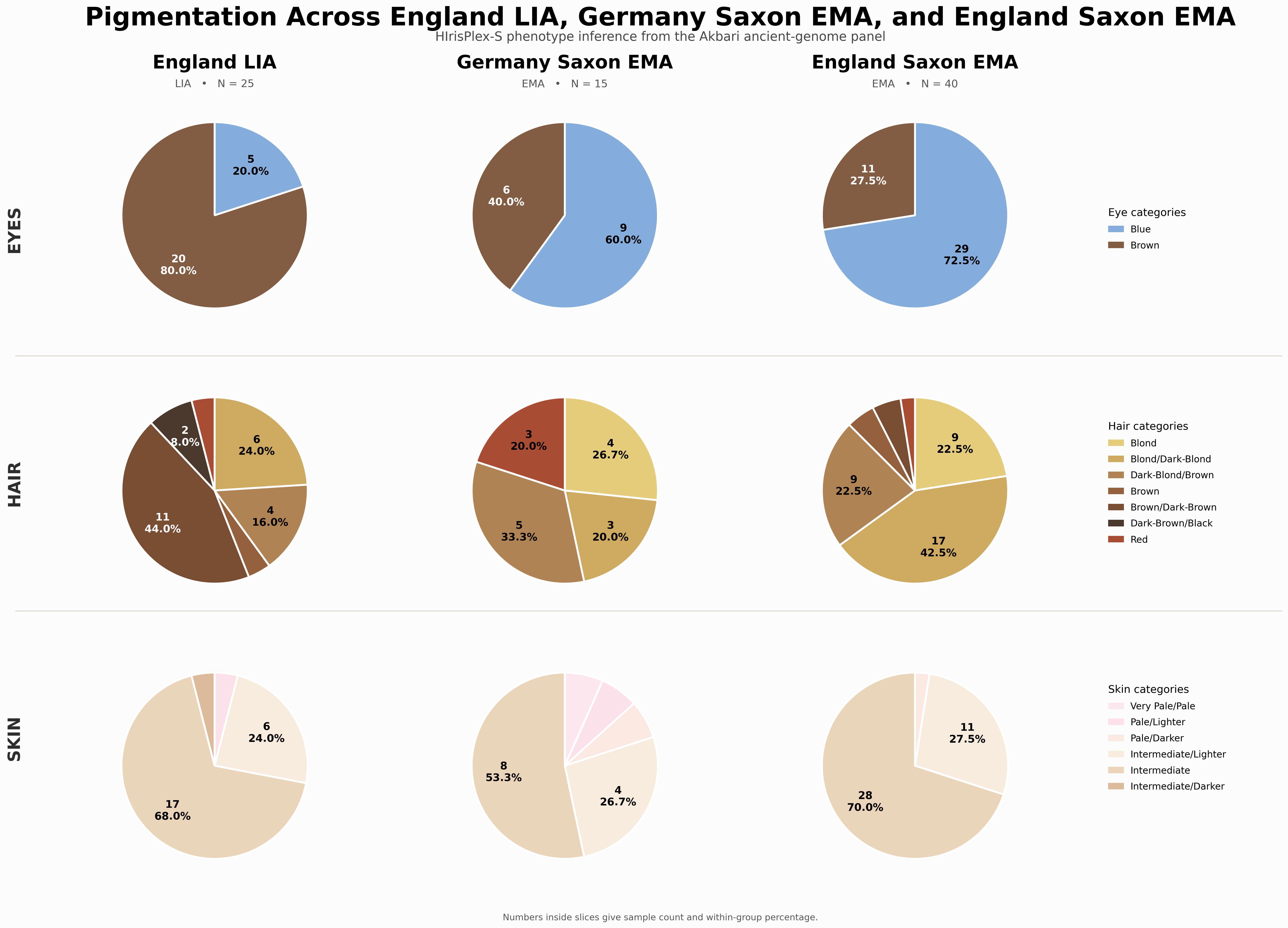
Skin, eye and hair color in 80 England LIA, Germany Saxon EMA and England Saxon EMA genomes, inferred with HIrisPlex-S. Pastebin with sample IDs, population labels, phenotype calls, probabilities, and full classifications:
pastebin.com/22eJRFNE
Lezagacy retweeted
Skin, eye and hair color in 63 Illyrian, Thracian and Mycenaean BA/IA genomes, inferred with HIrisPlex-S. Pastebin with sample IDs, cultural labels, phenotype calls, probabilities, and full classifications:
pastebin.com/DYnjFrSd

Lezagacy retweeted

Very excited to present a preprint of the first chapter of my thesis, which focuses the end of the LGM (Ice age / Last Glacial maximum) in Europe, and specifically the post-LGM Balkans.


Lezagacy retweeted

🧬 qpAdm Static model of the Modern Serbian individuals from Olalde et al. 2023
Outgroup and Raw runs listed here:
pastebin.com/Z3Ted21y

Lezagacy retweeted

NK4 segregated quite blatantly from IBM in Pinhasi's and in absolute distance Aterians ones approach IBM closer, but still closer to Jebel Sehaba. This is likely obscures due to the Robusticity of Taforalt and the mixed Nature of the North African Paleolithic samples.


Lezagacy retweeted
Inspired by Davide Piffer’s post, I replicated a West Eurasian PCA including my sample(Dot in red). I plot on the westernmost end of the Albanian genetic spectrum (shifted towards Northern Italy), between Albanians and Emilian Italians, consistent West Balkanic IA/BA enrichment.


Lezagacy retweeted

Admixture table on Balto-Slavic speakers from Northeastern Europe.
Raw outputs: imgur.com/a/7JpU5hs
Model used: pastebin.com/raw/RywT7VYy

Lezagacy retweeted
🧬 Tracing U5a1a1: A Yamnaya maternal lineage:
The mitochondrial haplogroup U5a1a1 appears only in Yamnaya and related Steppe cultures, from Usatove in the west to Afanasievo in the east, marking a genetically unified network behind the earliest Indo-European expansions.

Lezagacy retweeted
The possible autosomal DNA of Dacians.
To begin with the samples mentioned here are in no way connected culturally to anything that could be considered Dacian (like Basarabi or Babadag) but they seem to be aligned with a trend of Y-DNA change we see in the Carpathian.
According to Schütz 2025, E-V13 the most common marker of Thracian (and possible Dacian) only appears amongst samples during the IA with no prior presence during the BA or Eneolithic, pointing to the idea that Dacians assuming they are an extension of South Thracians expanded into the Carpathian some time between the LBA and IA.
Simultaneously Central Asian Iranic groups would slowly begin moving west and slowly reaching the Carpathian basin, coming into contact with the inhabitants of the region.
Based on the auDNA of the Glinoe Scythian site in Moldova we see that they are slightly majorly Southern Thracians derived with quite a high amount of Ukraine Scythian ancestry. Paternally speaking the samples fall under R-Z2103 branches followed by E-V13 and I-L701. Interesting to note is that these are all clades that weren’t present in any Scythian or Iranic groups in general possibly meaning that these samples were mostly paternally descendant from their Thracian ancestry.
Whilst the genotyping of Romania is pretty poor we can still identify this very same profile within places like Hungary where their auDNA is not only alike but slightly higher in Thracian. Paternally the Avar samples collected are different from Glinoe, this time R1a is present in the form of clades under R-Z93 such as R-YP1455. However in total E-V13 is the most common one with clades such as E-BY5022 (Daco-Thracian possible marker).

