

CEO @GraphiteGrowth // Previously Advisor @Thumbtack @Upwork // SEO & AEO
San Francisco, CA
Joined January 2013
- Tweets202
- Following176
- Followers4.9K
- Likes623



Opus 5.5 Is Becoming More Human
* We recently published our AI tells study that looked at ChatGPT, Claude, and Gemini across the previous large model releases and compared their tells against each other and human text.
* Anthropic states that "Opus 5.5 communicates more naturally than prior models." Our Chief AI Officer, Gregory Druck, evaluated these claims and presents data supporting that Opus 5.5 is closer to human writing.
* Study: graphite.io/five-percent/res…
Our Findings
* Claude’s word choice is becoming more similar to human writing, while GPT’s is becoming less similar.
* Opus 5.5’s word-distribution divergence from human writing is 19% lower than Opus 5's. Astra’s is 8% higher than Sol's.
* Opus 5.5 uses less mannered prose (metaphor and flourish in place of direct statements) than Opus 5, but still more than Astra.
* Opus 5.5’s mannered-prose score is 37% lower than Opus 5's. It remains about 1.6 times the human score, compared with 1.2 times for Astra.
* Both Claude and GPT now use well-known tells like the em dash less often.
* Opus 5.5 uses em dashes 99% less often than Opus 5. Astra uses them 95% less often than GPT-5. Both now use them much less often than human writers.
* Opus 5.5 still has many tells. AI tells change between models and versions, but do not go away.
* Opus 5.5’s overall word use is more similar to human writing, but it still overuses many words and phrases. We find 2,548 tells, just 4% fewer than in Opus 5.
* Opus 5.5 uses more language about helpfulness. For example, “can help you” appears eight times as often as in Opus 5. Emphatic phrases like “is genuinely” are less common in Opus 5.5, appearing 26 times as often in Opus 5.
* Opus 5.5 uses more superlatives than Astra. For example, “the most powerful” appears 24 times as often.

The State Of ChatGPT Ads
* We partnered with @Similarweb on a large-scale study of ChatGPT ads
* Data: Similarweb's panel of millions of real people. Graphite analysis of 98k unique ads, 8k landing pages. We are also running ChatGPT ads for several clients and have several case studies to pull from.
* Study: graphite.io/research/state-o…
The Story
Our overarching thesis is that ChatGPT ads are a huge new channel. They're at $1B revenue run rate in only a few months.
Early advertisers started then stopped. Some people think it's not an effective channel yet. But the data show that many advertisers are growing their ChatGPT ad campaigns, and the ones continuing to advertise are the ones testing and iterating.
The Market
* Roughly half of all users can see ads (Free or Go tier). The other half have premium subscriptions and cannot see ads.
* Only 43% of ad-eligible users have seen an ad. So, we're still very early in channel maturity.
* CTR has doubled over the last few months.
* B2B SaaS is one of the largest advertiser categories, with Monday, HubSpot, Zapier, Asana, and more all as top advertisers.
The Ads
* Context: Many ads are shown deep into conversations. This means that ads are highly contextual and must also be highly relevant to avoid disrupting UX.
* Disruption Tolerance: I suspect that ads must pass a much higher bar because they're shown deep into conversations vs. an ad on Instagram that is between stories. The latter has much less work to be considered relevant by the user.
* Copy: Many ad titles are actions (create a resume), use cases (resumes done right), or features (resume creator).
* Landing Pages: Other ad channels often go to the homepage. ChatGPT ads go to a broader set of pages like feature pages, demos, and product pages.
* Unique Ads: The vast majority of ads are not clones of paid search or Meta ad creatives. They are net new.
Experimentation Mode
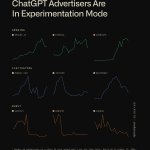
* The top advertisers have the most unique creative and landing pages. Some have just 1, but others have dozens.
* Jotform: A top advertiser, has almost 1,000 unique ad creatives.
* ChatGPT Ads Playbook: We include our playbook for building ChatGPT ad campaigns.

AI-Generated Content Has Plateaued
* We published a new study with @axios evaluating the prevalence of AI-generated content: axios.com/2026/05/15/human-v…
* AI-generated content grew from the launch of ChatGPT in November 2022 to nearly 50% of all content published on the internet in Q1 2025.
* However, since Q1 2025, AI-generated content has remained flat at 50% and human content 50%.
* Why?: We do not know for sure the cause of the plateau. However, since 2025, there has been increasing evidence that AI-generated content often (but not always) performs poorly in SEO and AEO. We published studies in 2024 and 2025 showing that only 14% of articles in Google Search are generated using AI, and only 7% for position 1 in Google.
* Methodology: We evaluated 55.4k articles randomly selected from Common Crawl between January 2020 and March 2026. We used 3 AI detectors (Pangram, Copyleaks, GPTZero) and show the average of all 3. We describe the methodology in detail in our study.
* AI-Detection Evaluation: We rigorously evaluated each AI detector and showed a low false positive and false negative rate (<2%). We are unable to fully evaluate AI detection for AI + human hybrid content.
* Data Source: Common Crawl maintains one of the largest publicly available web archives. It contains billions of pages and is used by researchers and developers. It is a key data source for training large language models. However, it is not necessarily representative of what real people see and is not an exhaustive snapshot of the entire internet.
* Prior Research: We previously published data as of May 2025 showing 52% rather than 50%. This difference between the two studies is due to using 3 separate AI detectors.
* Oxford: Our previous went viral on social media after Perplexity's X bot published a summary, which hallucinated and credited Oxford as the source. However, Oxford was not involved in either study.

I originally hypothesized that AI was over hyped and the size of its growth curve overstated. So, I sought to evaluate and likely disprove the prevailing narrative about the size of AI. However, what I found is that the size and trajectory of AI are *understated* and that AI is much bigger than I thought.
Study: graphite.io/five-percent/ai-…
Key Findings
1. Monthly sessions of AI are now 56% the size of search worldwide and 34% in the US, 4x-5x larger than previous reports that only include web data.
2. AI now receives 45B monthly sessions worldwide, and 5.4B monthly sessions in the US.
3. Search-related sessions of AI (Asking prompts) are now 28% the size of search worldwide and 17% in the US.
4. AI has grown even larger across the World than in the US, with worldwide sessions 7x that of the US.
5. Search has not decreased, and neither has Google. Instead, the pie has gotten bigger. Total search-related sessions, combining search engines and search on LLMs, have increased by 26% worldwide and by 16% in the US, comparing 2025 with 2024.
6. 83% of AI usage occurs in mobile apps worldwide, and 75% in the US.

Ethan Smith retweeted

Marketers everywhere are wondering the same thing:
Is our brand appearing in AI responses?
What types of content performs?
What comes next?
Join Graphite CEO @ethan_graphite and @AirOpsHQ CEO @alexhalliday, two leaders shaping the future of marketing, as they reveal how to stay visible and build systems for growth in 2026.
You’ll get clarity on:
- What actually drives visibility in AI search
- How top brands are evolving their content systems
- Real tactics to improve visibility and stay ahead of what’s next
Details:
▶️ Webinar: How to Win the AI Search Shift
🗓️ November 19, 2025 | 4 PM EST
➡️ Reserve your spot: airops.com/graphite-x-airops

Ethan Smith retweeted

@webflow are awesome!
So nice to see them surfing the AI wave in such a brilliant fashion and well accompanied (with @ethan_graphite - where he covers the rise of answer engines, where the future of search is headed, and what you can do today to ensure answer engines cite your website.)
youtu.be/N36Q_oL6Kto
Ethan Smith retweeted

When @ethan_graphite and I first met 8-9 years ago, SEO was simple. Build links, target keywords, fix technical issues and you would rank. Now, search is changing faster than ever — and AEO is the next big shift.
@clearscope, we’ve always believed great content deserves to be found. But as Google and AI evolve, the rules of discovery are being rewritten.
That’s why I’m thrilled to host Ethan Smith, CEO of @graphitegrowth and one of the smartest strategists in AEO & SEO, for our next Clearscope webinar on Monday (10/27) at 2p Central Time.
Ethan has helped companies like Webflow and Robinhood dominate search—and he’s been thinking deeply about how AI and Answer Engine Optimization (AEO) will reshape the way brands earn visibility.
In this session, we’ll dig into:
🔍 What AEO actually is—and why it’s the future of SEO
⚙️ How to adapt your strategy for AI-driven search experiences
🚀 What it means to build content that actually gets discovered
If you care about where SEO is headed, this is one you don’t want to miss.
📅 Save your spot👇
Ethan Smith retweeted

AI means businesses need to learn a whole new category of SEO.
Optimizing for LLMs.
Here's how you do it ...
@ethan_l_s appeared on the podcast and discussed his thoughts on optimizing for large language models, like ChatGPT.
He talked about two things, which I found fascinating:
1. Listicle Optimization: For a product to appear on a best-of list, you'll need to ensure your product appears in as many listicles as possible on that topic. This is how LLMs will determine what should make the list.
The cool thing is this was something we started at HubSpot years back.
2. Co-Word Citation vs. Link Building: Today, you build links. For LLM optimization, you'll build co-word citations where your product appears as the next word for the keyword you're optimizing for.
We, of course, covered ways you can hack these things as well :)
Ethan has an incredible thought exercise on how affiliate networks might work to implement co-word citation for brands.
If you're concerned about AI's impact on SEO and how that effects your business, this is the episode for you. Out now on Marketing Against the Grain.
Background
Google launched a preview of their Search With Generative AI. More here: bit.ly/3I6DEsr
Key Take Away
I expect some traffic to move from organic results towards an AI-generated answer (much like answer box already does), but I expect SEO traffic overall to stay flat or down slightly, but not down significantly.
Deeper Analysis
A key question is how this will affect traffic to publishers. Here are my thoughts.
* Total searches on Google are likely flat or growing (Google stopped reporting on this, but it's likely that search overall is flat or growing, not decreasing)
* Generative AI in search means that part of the search result may get the answer from the Generative AI module and not the organic publisher area
* There are three places a user can click in Google search
1. Organic results
2. Ads
3. Google Products (maps, youtube, people also ask, answer box)
* Google has for many years been pushing clicks away from organic results and toward ads
* You'll see from the attached screenshot of 3 example queries that today most of the page real estate goes to ads and Google modules, not to organic results
1. Organic results (green)
2. Ads (orange)
3. Google Products (blue)
* With Google's Search With Generative AI, some clicks will inevitably move to that module and away from organic results
* However, overall, I expect this to be a more incremental change for organic results vs. a dramatic change
Shout out to @mada299 @alexdbauer who created a visual similar that inspired this graphic.

Ethan Smith retweeted

Masterclass has built a $2.5B business on the back of one SEO tactic.
They use the power of "second-order questions" to drive free traffic to their site.
Here is how they do it 🧵

Ethan Smith retweeted

Leave it to the politician who actually knows how businesses run to speak sense.

Ethan Smith retweeted

We aren’t asking for a bank bailout, we are asking depositors to be made 100% whole. Big difference.
Ethan Smith retweeted

The gov’t has about 48 hours to fix a-soon-to-be-irreversible mistake. By allowing @SVB_Financial to fail without protecting all depositors, the world has woken up to what an uninsured deposit is — an unsecured illiquid claim on a failed bank. Absent @jpmorgan @citi or @BankofAmerica acquiring SVB before the open on Monday, a prospect I believe to be unlikely, or the gov’t guaranteeing all of SVB’s deposits, the giant sucking sound you will hear will be the withdrawal of substantially all uninsured deposits from all but the ‘systemically important banks’ (SIBs). These funds will be transferred to the SIBs, US Treasury (UST) money market funds and short-term UST. There is already pressure to transfer cash to short-term UST and UST money market accounts due to the substantially higher yields available on risk-free UST vs. bank deposits. These withdrawals will drain liquidity from community, regional and other banks and begin the destruction of these important institutions. The increased demand for short-term UST will drive short rates lower complicating the @federalreserve’s efforts to raise rates to slow the economy. Already thousands of the fastest growing, most innovative venture-backed companies in the U.S. will begin to fail to make payroll next week. Had the gov’t stepped in on Friday to guarantee SVB’s deposits (in exchange for penny warrants which would have wiped out the substantial majority of its equity value) this could have been avoided and SVB’s 40-year franchise value could have been preserved and transferred to a new owner in exchange for an equity injection. We would have been open to participating. This approach would have minimized the risk of any gov’t losses, and created the potential for substantial profits from the rescue. Instead, I think it is now unlikely any buyer will emerge to acquire the failed bank. The gov’t’s approach has guaranteed that more risk will be concentrated in the SIBs at the expense of other banks, which itself creates more systemic risk. For those who make the case that depositors be damned as it would create moral hazard to save them, consider the feasibility of a world where each depositor must do their own credit assessment of the bank they choose to bank with. I am a pretty sophisticated financial analyst and I find most banks to be a black box despite the 1,000s of pages of @SECGov filings available on each bank. SVB’s senior management made a basic mistake. They invested short-term deposits in longer-term, fixed-rate assets. Thereafter short-term rates went up and a bank run ensued. Senior management screwed up and they should lose their jobs. The @FDICgov and OCC also screwed up. It is their job to monitor our banking system for risk and SVB should have been high on their watch list with more than $200B of assets and $170B of deposits from business borrowers in effectively the same industry. The FDIC’s and OCC’s failure to do their jobs should not be allowed to cause the destruction of 1,000s of our nation’s highest potential and highest growth businesses (and the resulting losses of 10s of 1,000s of jobs for some of our most talented younger generation) while also permanently impairing our community and regional banks’ access to low-cost deposits. This administration is particularly opposed to concentrations of power. Ironically, its approach to SVB’s failure guarantees duopolistic banking risk concentration in a handful of SIBs. My back-of-the envelope review of SVB’s balance sheet suggests that even in a liquidation, depositors should eventually get back about 98% of their deposits, but eventually is too long when you have payroll to meet next week. So even without assigning any franchise value to SVB, the cost of a gov’t guarantee of SVB deposits would be minimal. On the other hand, the unintended consequences of the gov’t’s failure to guarantee SVB deposits are vast and profound and need to be considered and addressed before Monday. Otherwise, watch out below.
It feels very meta to be on an SEO top 10 list by creating top 10 lists for SEO, but excited to be in this top 10 SEOs list with @bernardjhuang @5le @aleyda @rustybrick! bit.ly/3XZCC7i

I'm excited to share some of @Graphite's most impactful SEO strategies with @reforge.
You can find details about these strategies in the "Bonus: SEO Strategy" in the "Growth Marketing Program" here: bit.ly/3XRlpgi (step-by-step playbooks and templates). Topics covered 👇
Comprehensiveness: is especially important and covering all the questions users have and Google is looking for. Focus heavily on getting the outline right for your content.
You'll also find Case Studies from @MasterClass, @brexHQ, and @thefieldcompany @cm. Featuring tools from @ahrefs.