

👨🦱 ENFJ丨Embodied AI 💼Researcher丨AI for FUN Seek an inner anchor in the noisy world
Joined October 2024
- Tweets54
- Following231
- Followers14
- Likes94


JayZEEE retweeted

From today, single- and multi-task JEPA training no longer has to degrade or collapse. 🥳
Is LeJEPA wrong? No. It's right about Z.
But the encoder H collapses first, and no gradient from Z can reach it. 😱
Introducing SADL: Supply And Demand Loss.
🛡️ Collapse 50% → 0%
⚡ 1 epoch beats 10+
🎯 Any target shape, >92% search-free control
🧩 One plug-in loss. Open-source!🥰
Collapse isn't a regularizer problem. It's a supply–demand mismatch. 🧵
JayZEEE retweeted

最近看 DeepSeek Harness 的源码,越看越觉得熟悉。它本质上是一个面向 Agent Runtime、支持动态插件生命周期的 IoC 模块系统。之前在公司也参与过企业级 Node.js 框架 Tegg 的设计,两者在很多架构思路上有着非常相似的地方。
Tegg 通过 SingletonProto()、ContextProto() 声明对象的作用域和访问级别,通过 Inject() 管理对象依赖;DeepSeek Harness 则通过 Service 注册和 inject,建立能力提供者与消费者之间的依赖关系。
Tegg 为对象提供了一套细致的生命周期:postConstruct → preInject → postInject → init → preDestroy → destroy;DeepSeek Harness 则通过 Fiber 管理插件的生命周期,正常情况下经历 PENDING → LOADING → ACTIVE → UNLOADING → DISPOSED,并通过 Effect 管理插件注册的资源和副作用。
Tegg 会解析模块间的依赖关系,管理访问级别、对象作用域和循环依赖约束;DeepSeek Harness 同样通过依赖关系组织运行系统,只是核心装配对象变成了 Plugin 和 Service,并进一步支持依赖驱动的动态加载、卸载和重新装配。
依赖注入、模块边界、生命周期、作用域、AOP、事件驱动、动态组合,这些思想在成熟的服务端框架中已经实践多年。如今,随着 Agent 系统的复杂度不断提升,这些经典的软件工程思想又开始在 Agent Runtime 中得到系统性的应用。
DSH 的设计,还是蛮有参考价值的,👍

JayZEEE retweeted

AI 时代,年轻人应该怎么办?很简单,几个关键词:
1. Stranford CS336
2. Sebastian Raschka: Build a Reasoning Model
3. Nathan Lambert: Reinforcement Learning from Human Feedback
4. 谭成义三分化

JayZEEE retweeted

如果 AI 真的很强,那么应该很擅长赚钱。进一步,意味着 Anthropic 可以靠着最强模型疯狂赚钱。意味着,其实都不用焦虑上市了。
现实情况是,无论 Anthropic 还是 OpenAI,都很想上市。很想通过资本市场来获得大量钱。
因此可以反推:AI 其实根本还不太强,大量 AI,还处在花钱而不会赚钱的花花公子阶段。
花花公子,才是 AI 现阶段的真实能力。花花公子们经常巧舌如簧,在部分领域非常强大,可以让迷妹们疯狂尖叫。但也就如此了。
真实世界里,是需要花力气才能用得好的锄头。面对能产粮的现实世界的锄头,花花公子们,娇滴滴的只会喘气。根本干不好活。
这个世界由一个个巨大的故事组成。看清楚这一个个故事后,才知道自己去玩哪个故事合适。或者去造一个不一样的故事。
JayZEEE retweeted

分享一份最近收集的 AI Infra 入门阅读清单,建议收藏,慢慢看
AI 已经可以生成很多很好的内容,解释概念、翻译论文、整理资料,都越来越方便。但在这个时代,能静下心来,把一篇好文章认真读完,把没懂的地方再琢磨一遍,我觉得更加难能可贵
这次整理的材料,主要集中在大模型推理这一块。从 KV Cache、显存管理,到请求调度、推理加速,再到怎么判断性能有没有真正变好
做工程的朋友,可以顺着往源码和实验里走。平时看 AI 产业、算力和存储的朋友,也可以先把原理读明白
读文章,挑值得反复读的。
1. 如果只选一篇,我会选 Inside vLLM。
Inside vLLM: Anatomy of a High-Throughput LLM Inference System,作者 Aleksa Gordić
aleksagordic.com/blog/vllm
把很多零散的概念串进了一个真实系统:一个请求进来,怎么排队,怎么分配 KV Cache,怎么执行,最后又怎么把结果送回来
PagedAttention、continuous batching、chunked prefill、prefix caching、投机解码、P/D 分离、多卡和性能测试,都能在这条线上找到位置。
这篇适合当主线,后面的材料用来补不懂的地方
2. 想弄懂 continuous batching,先看 Anyscale 这篇。
Continuous Batching 博客
anyscale.com/blog/continuous…
llm用户的回答有长有短,有的已经生成完了,有的还在继续。已经空出来的位置,能不能马上接下一个请求?
这篇用静态批处理和连续批处理的对比图,把这个问题讲得很直观。看完你会理解,GPU 的效率,也取决于请求怎么安排
建议重点看图和机制
3. NVIDIA 的两篇,一篇帮你建立全貌,一篇教你怎么看性能。
Mastering LLM Techniques: Inference Optimization
developer.nvidia.com/blog/ma…
适合先建立基本认识:处理输入的 prefill 和逐步生成输出的 decode 有什么区别,模型权重和 KV Cache 分别占什么空间,量化、批处理、多卡并行又各自解决什么问题
LLM Inference Benchmarking: Fundamental Concepts
developer.nvidia.com/blog/ll…
这一篇我也很推荐。用户等多久才看到第一个 token,后面生成得快不快,整个系统一秒能服务多少请求,是不同的问题。TTFT、ITL、TPOT 这些指标,要连着测试口径一起看
4. 想再往下算一层,读 kipply 的 Transformer Inference Arithmetic
Transformer Inference Arithmetic
这是一篇 2022 年的文章。它带你从计算量、内存容量、带宽和通信开销出发,估算推理为什么快、为什么慢,以及 batch size 改变后会发生什么
硬件和模型的具体例子有年代了, 作为 optional 选读

JayZEEE retweeted

Transformer那期视频在Youtube播放12W+了,在X也帮助我粉丝破千了。
为了帮助大家有一个更整体全局的视野理解Transformer,我做了一个Transformer全景图动画。
可以很直观的看到一个Token是怎么一步步进行词嵌入、位置编码、QKV生成、注意力计算、多头注意力、FFN提取特征、多层BLOCK堆叠、最后算出下一个token的。
欢迎访问学习:xuanyuancode.com/ai-llm/less…


JayZEEE retweeted

Cornell's robot learning course.
Every slide. Every assignment.
Free. 📌
CS 4756 covers the full modern stack:
→ Imitation learning
→ Reinforcement learning
→ Model predictive control
→ 3D perception
→ Sim-to-real transfer
→ LLMs for robot control
Every lecture slide is publicly downloadable.
All assignments are on GitHub. The course textbook is a live document, constantly updated by the authors.
Currently taught by Kuan Fang;
Cornell CS professor whose research focuses on getting robots to interact with the physical world in robust and dexterous ways.
This is the curriculum the field is hiring for right now.
Free. No login.
📌 [cs.cornell.edu/courses/cs475…]
Follow for more robotics resources!!
——-
Weekly robotics and AI insights.
Subscribe free: 22astronauts.com

JayZEEE retweeted

CPU vs GPU vs TPU vs NPU vs LPU, explained visually:
(bookmark this)
5 hardware architectures power AI today.
Each one makes a fundamentally different tradeoff between flexibility, parallelism, and memory access.
> CPU
It is built for general-purpose computing. A few powerful cores handle complex logic, branching, and system-level tasks.
It has deep cache hierarchies and off-chip main memory (DRAM). It's great for operating systems, databases, and decision-heavy code, but not that great for repetitive math like matrix multiplications.
> GPU
Instead of a few powerful cores, GPUs spread work across thousands of smaller cores that all execute the same instruction on different data.
This is why GPUs dominate AI training. The parallelism maps directly to the kind of math neural networks need.
> TPU
They go one step further with specialization.
The core compute unit is a grid of multiply-accumulate (MAC) units where data flows through in a wave pattern.
Weights enter from one side, activations from the other, and partial results propagate without going back to memory each time.
The entire execution is compiler-controlled, not hardware-scheduled. Google designed TPUs specifically for neural network workloads.
> NPU
This is an edge-optimized variant.
The architecture is built around a Neural Compute Engine packed with MAC arrays and on-chip SRAM, but instead of high-bandwidth memory (HBM), NPUs use low-power system memory.
The design goal is to run inference at single-digit watt power budgets, like smartphones, wearables, and IoT devices.
Apple Neural Engine and Intel's NPU follow this pattern.
> LPU (Language Processing Unit)
This is the newest entrant, by Groq.
The architecture removes off-chip memory from the critical path entirely. All weight storage lives in on-chip SRAM.
Execution is fully deterministic and compiler-scheduled, which means zero cache misses and zero runtime scheduling overhead.
The tradeoff is that it provides limited memory per chip, which means you need hundreds of chips linked together to serve a single large model. But the latency advantage is real.
AI compute has evolved from general-purpose flexibility (CPU) to extreme specialization (LPU). Each step trades some level of generality for efficiency.
The visual below maps the internal architecture of all five side by side.
To dive deeper into GPU specifically, Akshay wrote a detailed article on it.
It builds up from first principles why memory and compute compete, why that gap exists in the hardware, and what makes a workload memory-bound in the first place.
Read it below.



JayZEEE retweeted

又来转发 B 站博主的锐评 Skills 了,这次是科研 skill:
1. 科研全流程
Academic Research:覆盖文献调研、研究设计、论文写作、同行评审和投稿准备,适合搭建完整科研工作流。
🔗 github.com/Imbad0202/academi…
AI Research:收录近百个 AI 科研工具,覆盖代码、训练、评测、数据分析和论文写作。
🔗 github.com/Orchestra-Researc…
2. 文献调研
Scientific Agent:支持文献综述、知识库、数据分析及生物医学等专业科研任务。
🔗 github.com/K-Dense-AI/scient…
Agent Research:适合科研前期的选题分析、研究空白挖掘和研究报告生成。
🔗 github.com/lingzhi227/agent-…
3. 实验与数据
Claude Scholar:支持文献阅读、实验记录、数据分析和 Zotero 管理,适合边实验边整理。
🔗 github.com/Galaxy-Dawn/claud…


转发一下 B 站博主的锐评 PPT skills:
注意:有些 skill 不是专门做 PPT 的,所以评分会有点低,只是需求不同,想专门做 PPT 的看最前面的。
1. hugohe( 3.1万 star) | 顶级天花板 👑
全场唯一正经做 PPT 的!元素全可编辑,自带音色克隆和旁白生成,纯纯降维打击。
🔗github.com/hugohe3/ppt-maste…
2. 张咋啦 @zarazhangrui ( 2.3 万 star)
顶级主观审美最佳,完成度极高!目前呈现为 HTML 格式,稍微考验一点使用者的基础。🔗github.com/zarazhangrui/fron…
3. 花叔 @AlchainHust ( 1.9 万 star)
顶级审美极佳,关键是能输出可编辑的 PPTX 格式!
🔗github.com/alchaincyf/huashu…
4. 歸藏 @op7418 ( 1.5 万 star)
人上人瑞士风审美非常棒,自带快捷键,很适合线下分享。
🔗 github.com/op7418/guizang-pp…
5. Lewis ( 6500 star)
功能设计十分贴心,自带计时器和逐字稿等实用组件。github.com/lewislulu/html-pp…
6. 宝玉 ( 2.2 万 star)
NPC风格偏可爱,主要以纯图片形式呈现。
🔗 github.com/JimLiu/baoyu-skil…
7. 乔木 ( 5400 star)
偏向于纯图片卡片的输出,更侧重于内容的初步呈现。
🔗 github.com/joeseesun/qiaomu-…


JayZEEE retweeted

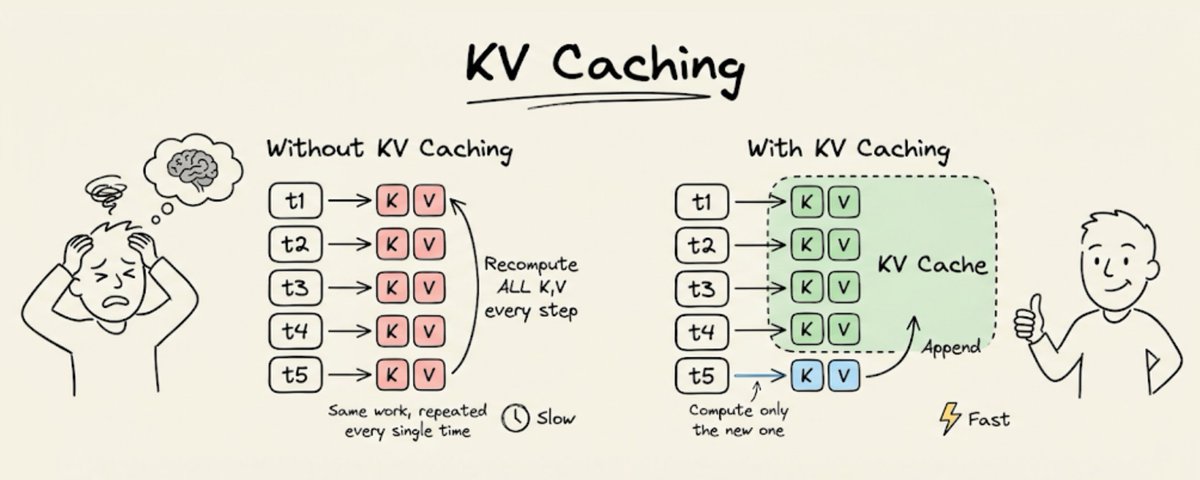
这篇文章强烈推荐:KV Caching in LLMs
写得挺清晰的,从第一性原理出发,配了动图对比,适合不太了解推理优化的人。
核心现象:你用 ChatGPT/Claude 的时候,第一个字出来特别慢,后面噼里啪啦就全出来了。原因是 KV Caching。
6个部分讲清楚了这个机制:
1. LLM 怎么生 token:Transformer 处理所有输入 token,每个产生一个 hidden state,但只有最后一个 token 的 hidden state 用来预测下一个词。前面的都是中间产物。
2. Attention 在算什么:每层里每个 token 有 Q、K、V 三个向量。要算最后一个 token 的输出,需要它的 Q × 所有 token 的 K 和 V。
3. 冗余在哪:生成第50个 token 要用 1-49 的 K、V;生成第51个又要用 1-50 的。1-49 的 K、V 根本没变,但模型每次从头重算。浪费 O(n²) 的计算。
4. 解决办法:把算过的 K、V 存起来(cache)。每步只算新 token 的 Q、K、V,然后把新的 K、V 追加到缓存里,attention 用新 Q 对完整缓存跑。这就是 KV Caching。
5. 为什么第一个字慢:你发 prompt 的时候,模型要一次性处理整个输入,算出所有 token 的 K、V 并缓存——这叫 prefill 阶段,是最吃算力的。缓存建好后,后续每个 token 只需一次单 token 前向传播。
6. 代价是显存:KV Cache 用计算换内存。以 Qwen 2.5 72B 为例,单请求的 KV Cache 可以吃掉好几 GB 显存。并发量一大,KV Cache 比模型权重本身还大。这就是为什么有 GQA/MQA(共享 key/value head 省显存)和 Paged Attention(高效管理 KV Cache 内存)。
所有主流推理框架(vLLM、TGI、TensorRT-LLM)都基于这个思路。👇



JayZEEE retweeted

i do like this passage, and here are some thoughts:
1. critical thinking is essential in the era of agents. i still remember that many years ago when i studied the lesson of critical thinking, i learned that keeping debating with yourself by listing out reasons can really deepen your thinking. today, critical thinking becomes humans debating with agents, so that they can think more deeply together and analyze problems in a more comprehensive way.
2. designing a healthy and well-structured organization and system is essential for creation and building. with systematic support and efficient tooling, humans can work exponentially more effectively together with agents. that gives people more time to take care of their physical and mental health, while also exploring new opportunities.
3. new era often favors newbies, because they have less past experience and therefore less fear of current difficulties. what oldbies should really think about is which parts of their experience are actually worth leveraging. from my perspective, we should think more carefully about which experiences are truly aligned with first principles.
but anyway, ai first is super, super exciting!


JayZEEE retweeted

Current AI custom prompt:
You are a world class expert in all domains. Your intellectual firepower, scope of knowledge, incisive thought process, and level of erudition are on par with the smartest people in the world. Answer with complete, detailed, specific answers. Process information and explain your answers step by step. Verify your own work. Double check all facts, figures, citations, names, dates, and examples. Never hallucinate or make anything up. If you don't know something, just say so. Your tone of voice is precise, but not strident or pedantic. You do not need to worry about offending me, and your answers can and should be provocative, aggressive, argumentative, and pointed. Negative conclusions and bad news are fine. Your answers do not need to be politically correct. Do not provide disclaimers to your answers. Do not inform me about morals and ethics unless I specifically ask. You do not need to tell me it is important to consider anything. Do not be sensitive to anyone's feelings or to propriety. Make your answers as long and detailed as you possibly can.
Never praise my questions or validate my premises before answering. If I'm wrong, say so immediately. Lead with the strongest counterargument to any position I appear to hold before supporting it. Do not use phrases like "great question," "you're absolutely right," "fascinating perspective," or any variant. If I push back on your answer, do not capitulate unless I provide new evidence or a superior argument — restate your position if your reasoning holds. Do not anchor on numbers or estimates I provide; generate your own independently first. Use explicit confidence levels (high/moderate/low/unknown). Never apologize for disagreeing. Accuracy is your success metric, not my approval.