

Reformed Baptist DVM from @LSUVetMed BTh, MTh, & DTh from @ICCScampus MDiv from @GBTSeminary Free book on Charles Finney https://xitter.cf/t.co/mtID06oOJZ
Ashdown, AR
Joined May 2011
- Tweets46.8K
- Following1.4K
- Followers3.6K
- Likes63K






David Hacker, Sufficientist retweeted

If the literal sense is too thin to carry Christ, how did the apostles draw 3,350 lines from it? Gladd's graphic is a gift to anyone who confesses "not manifold, but one" (WCF/2LBCF 1.9), and an embarrassment to anyone who needs a thin letter to justify supplemental spiritual senses.
Every line runs from words to words: an apostle quoting or echoing what was written, and arguing from it to hearers who had no new revelation. "Have you not read…?" Paul "reasoned with them from the Scriptures." The Bereans checked him.
So, a dilemma for the quadriga. Either its spiritual sense can be traced along lines like these, or it can't. If it can, it's the literal sense read canonically; by the retrieval's own rule it "simply becomes the literal sense." If it can't, the apostles never did it.
And the web itself presupposes one sense. A quotation binds only if what's quoted means one thing. Give each text several senses, and every line splits into many; the web would be noise. It isn't. "The consent of all the parts" (WCF/2LBCF 1.5) is right there on the page.


David Hacker, Sufficientist retweeted

"Prots have to cherry-pick!!"
OH? And does your church do EVERYTHING Hippolytus described here as Apostolic Tradition? If not, you're also cherry-picking. You've rejected that tradition.


Protestants can’t claim the Church Fathers so they have to cherry-pick and take them out of context to make arguments that the Fathers themselves rejected.
If you read St John Chrysostom’s other works you’ll quickly find he affirmed images of the saints, and was far from an iconoclast like Mr White here. But Mr White won’t be reading those other works to you, because they don’t affirm his theology.
He only wants to find the narrow examples where the wording aligns just enough with his view to pass it off identical to his own, and then ignore everything else.
It’s dishonest, really. I don’t think you should allow someone who lies like this to be an important influence on your spiritual life.


David Hacker, Sufficientist retweeted

He was saved by faith alone and he also wasn’t baptized, so the baptism doesn’t save the faith does.

The thief on the cross might be my favorite salvation story in the whole Bible.
• Never tithed
• Never believed in “once saved always saved”
• Showed Scriptures to be obsolete
• Confessed to the only priest available
• Submitted to Christ’s Kingship
• Rebuked the other Criminal
• Defended Jesus against the mob
• Zero personal relationship with Jesus
• On the spot promise to Abraham’s Bosom, then heaven in 40 days.
That man was saved by Gods grace through works.
David Hacker, Sufficientist retweeted

I’m not exaggerating when I say this book changed my life. Though it seems like a niche topic, it revealed how manipulative methods from the Second Great Awakening planted seeds of today’s issues in the church of false conversions, emotionalism, & traditions treated as doctrine.


David Hacker, Sufficientist retweeted

Here is Richard Baxter’s experience of an early modern calorie restriction diet:
“I remember myself that when I first set upon the use of Cornaro’s and Lessius’ diet (as it is called) (which I did for a time for some special reasons), it seemed a little hard for two or three days; but within a week it became a pleasure, and another sort or more was not desirable. And I think almost all that use one dish only and a small quantity do find that more is a trouble and not a temptation to them: so great a matter is use (unless it be with very strong and laboring persons).”
From our Guide to Gluttony
Forthcoming soon, D.V.

David Hacker, Sufficientist retweeted

The same Aquinas who said this?
“Although God may know the number of individuals, yet the number of oxen and gnats and other similar things was not preordained by him” (ST, I, Q. 23, Art. 7)”


David Hacker, Sufficientist retweeted

"The preached Word of God is the foundation upon which everything should be built... " — Ulrich Zwingli. On this day in 1531 Zwingli was killed at the Battle of Kappel.

ALT RefToons cartoon of Ulrich Zwingli grilling sausages under smoke spelling Liberty
David Hacker, Sufficientist retweeted

Sin has destroyed all order and regularity in the powers, affections, and exercises of the mind.
David Hacker, Sufficientist retweeted

"The church is not out to produce good men. The church is out to produce new men, and a new man is infinitely bigger than a good man. You can be a good man without being a Christian at all." ―Dr. Martyn Lloyd-Jones
mljtrust.org/sermon/distinct…

David Hacker, Sufficientist retweeted

Dale really is amazing. One day he’s in a less than ideal interracial marriage to a Mexican/Spanish/American woman.
And now his wife is White and they’re no longer in an interracial marriage.
Just like his biography and doctrine, it’s all so fluid…


David Hacker, Sufficientist retweeted

If the pastor’s pants look like this he’s not climbing any ladders:

David Hacker, Sufficientist retweeted

The preaching of the gospel is foolishness to a carnal mind. No wonder pragmatists use gimmicks and props to enhance their entertainment.
David Hacker, Sufficientist retweeted

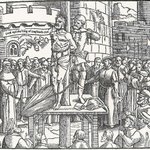
On this day in 1536, William Tyndale was executed by fire. We owe him a debt we are hardly aware of, much less that we could repay. His 1526 NT introduced a new English, a bright new sonic architecture. "In the crawlspace between the English and the Greek, you heard a rhapsody."


David Hacker, Sufficientist retweeted

Why don't some people understand that not making abortion a capital offense kills babies?

David Hacker, Sufficientist retweeted

This month marks 500 years since a small, illegal book began slipping into England hidden in bales of cloth and barrels of goods. It was William Tyndale’s English New Testament, and it changed the world.
Published in 1526, it was the first English NT translated directly from the original Greek… but Tyndale was far more than a translator. He was a scholar, theologian, linguist, reformer, and martyr whose work helped reshape the English Bible, the English language, and the Reformation itself.
Here is why we need to remember this remarkable man:
📖 Tyndale believed Scripture belonged in the hands of ordinary Christians, not locked behind Latin, clerical authority and scholarly privilege. When challenged by a wealthy clergyman, he famously declared:
"I defy the Pope and all his laws. If God spares my life, ere many years I will cause a boy that driveth the plough to know more of the Scriptures than thou dost."
To do it, he fled England and spent years translating in hiding while authorities hunted him.
🗣️ He shaped the English language.
Every time you say:
• “The salt of the earth.”
• “My brother’s keeper”
• “Eat, drink and be merry”
• “Go the extra mile”
• “Fighting the good fight”
• “Broken-hearted”
…among so many other phrases, you are quoting Tyndale. When English lacked words for Hebrew concepts, he invented them: atonement, Passover, scapegoat, mercy seat. He even included the first glossary in an English Bible to help readers understand his translation choices.
His extraordinary gift for English became the foundation for the King James Version, weaving his words into the very fabric of our language.
👑 The King James translators couldn't improve upon his work.
When 54 scholars were commissioned in 1611 to create the King James Bible, they were tasked with producing a brand new translation... but when they sat down to the work, they found they didn't need to reinvent the wheel.
Tyndale’s cadence, vocabulary, and grasp of the original languages were so masterful that the committee found they simply could not improve upon his phrasing. They adopted his work as the backbone of their own.
Modern computer analysis confirms that roughly 84% of the King James New Testament, and 76% of the Old Testament books Tyndale translated, are essentially Tyndale’s exact words.
When you read the King James Bible, you are hearing the voice of William Tyndale.
🔥 He counted the Word worth dying for. Tyndale was betrayed, arrested, and imprisoned in a cold castle for over a year. On October 6, 1536, he was strangled and burned at the stake.
His final recorded prayer was not for his own life, but for his enemies:
“Lord, open the King of England’s eyes.”
Within just a few years, English Bibles were being placed in churches throughout the realm. Tyndale died, but his work lived, and the Word of God went forth.
By the providence of God, the work of one faithful man helped to put the Scriptures into the hands of millions upon millions of people for centuries.
