




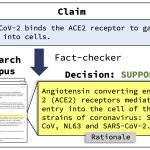


ALT Graphic describing HALoGEN: Fantastic LLM Hallucinations and Where to Find Them. The graphic shows the dataset consists of prompts, decomposers and verifiers. The graphic also shows that we categorize hallucination errors based on their origin in training data.


ALT Example SciRIFF tasks. Given an input context from a research paper, the text instructs an LLM to perform an operation on the input—e.g. determine whether the ab entails a scientific claim, extract information over the full_text, answer a question, etc. The model’s output must conform to a task-specific, user-specified structure. SciRIFF unifies 54 scientific literature understanding tasks under a common input / output format, enabling the development of LLMs that can flexibly generalize to novel scientific use cases.


ALT An overview of tasks and examples in SciRIFF, including task prompts, format specification, structured output, and datasets under 5 task categories: entailment, information extraction, summarization, question answering, and classification.


ALT This graph shows OLMo 7Bv1.7's MMLU score of 52 when measured relative to the amount of compute used to train it, on the x axis.


ALT Our team of HCI + NLP researchers is hiring: Postdoctoral Researchers: Define & lead your own projects, Collaborate and publish freely, Mentor PhD research interns! Applying to PhD programs in 1-3 years? Join us as a Pre-doctoral Researcher and work with a research mentor!





ALT A plot: the x axis is baseline score of rankers, in ndcg@10. y axis is delta of model score after an expansion is applied. There are three sets of results, one dataset for each shift type: TrecDL (no shift), FiQA (domain shift), ArguAna (query shift). For each set of result, the chart shows a scatter plot with a trend line. We observe the same trend for all: as the baseline score increases, the delta when using expansion decreases. On TREC DL, worst models have a base score of ~40, and improve by 10 points w/expansion. the best models have a score of >70, and their performance decreases by -5 points w/expansion. On FiQA, worse models have a base score of ~15, and improve by 5 points w/expansion. the best models have a score of ~45, and their performance decreases by -3 point w/expansion. On ArguAna, worst models have a base score of ~25, and improve by >20 points w/expansion. the best models have a score of >55, and their performance decreases by -1 point w/expansion.


ALT Overview of our approach (a) We consider the task of reframing negative thoughts with different, more hopeful thoughts using LMs. Given a situation "I submitted a research paper and it got rejected" and a thought "I'll never succeed as a researcher", one way of reframing it is to say "It is normal to feel disappointed when a paper gets rejected. I can use this experience to learn and grow" (b) Different perspectives on a situation may result in different reframes. Here, we propose a framework of seven reframing attributes. Given a reframed thought, we control each attribute (e.g., actionability) to generate reframes that score higher or lower on that attribute (e.g., more or less actionable). (c) We deploy this model on Mental Health America, and conduct a randomized field study with 2,067 participants. We suggest LM-generated reframes to MHA visitors and assess which reframing attributes are desirable and what constitutes a relatable, helpful and memorable reframe

