
Health Policy and Health Economics
Joined June 2009
- Tweets229
- Following630
- Followers578
- Likes519






Pinned Tweet
Do GLP-1 medications pay for themselves by reducing other health care spending?
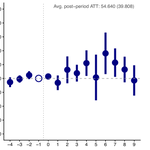
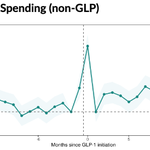
New NBER WP (claims data + stacked DID): GLP-1 initiation does not reduce non-GLP health spending. Non-GLP spending is higher at 1 year and 5 years. @KosaliSimon @sacksdaniel @STingCai

Coady Wing retweeted

Since 2011, our Indiana University health policy workshop has met Thursdays to discuss research in progress in health econ, health policy, and population health.
Now @CoadyWing @seth_freedman @AlbertoOrtegaJ, and I are opening up the chats: Subscribe
franklythecounterfactual.sub…


Coady Wing retweeted

Studying how state Medicaid coverage of GLP-1s for weight management affects prescribing and spending, using staggered adoption across states, from @coady_wing, @weilun_lo, Maddie Potter, Tarik Yuce, @berto_econ, @cawley_john, @thuynguyen_dieu, and @KosaliSimon nber.org/papers/w34949

New NBER working paper: Medicaid Coverage for Obesity Medications"
Coverage for obesity GLP-1s is discretionary. 9 quarters out, coverage increases spending by $752 per 100 enrollee-months. @KosaliSimon @cawley_john @berto_econ @thuynguyen_dieu @STingCai @TarikYuceMD


Medicaid coverage for GLP-1s does not seem to have a large effect on consumer spending at these firms, although the direction of the effect is negative.

Coady Wing retweeted
Affordable Care Act expansion increased federal transfers by $361 per capita to counties—showing health policy doubles as federal-to-local fiscal smoothing, from Laura Montenovo, @KosaliSimon, and @coady_wing nber.org/papers/w34758

Coady Wing retweeted
Examining whether GLP-1 medications pay for themselves finds no spending offsets through 5 years; savings, if any, may arise later or outside healthcare, from @coady_wing, @stingcai, @sacksdaniel, and @KosaliSimon nber.org/papers/w34678

Coady Wing retweeted

Two brand-new preprints on the effects of GLP-1s just dropped.
They use different populations, data, and research designs. And they focus on different outcomes.
But they come to the same conclusion on one point:
GLP-1s do not generate meaningful short- to medium-run reductions in non-GLP-1 medical spending, despite clear health benefits.
In other words, both papers reject the idea that GLP-1s "pay for themselves" through downstream medical cost offsets: at least, not yet.
GLP-1s clearly improve health. Medical cost savings just aren’t where those benefits show up.
If GLP-1s are cost-effective, it's likely through:
-longer-run health effects beyond current data horizons
-non-medical channels (e.g., labor supply, quality of life, disability, longevity)


Coady Wing retweeted

"If GLP-1 therapies ultimately yield cost savings, they are likely to occur only over longer horizons or through non-medical channels."
by @coady_wing, @stingcai, @sacksdaniel, and @KosaliSimon
nber.org/papers/w34678
Coady Wing retweeted

🚨Do GLP-1s “pay for themselves”? We study real-world impacts at scale. An estimated 1 in 8 Americans have tried GLP-1s. But beyond clinical trials, we know surprisingly little about their real-world effects.
Paper: nber.org/papers/w34667 (w/@JasminMoshfegh & Sam Bock)
🧵1/10

GLP-1s are already a big slice of pharmacy spending: 8% of Medicare Part D, 7% in Medicaid, 13% in employer-sponsored plans—creating real budget pressure even before broader expansion.

Independent but related work studies GLP-1s in the VHA system. EMR data shows substantial weight loss and improved glycemic control, but they also find no reductions in other health spending.
@jzhangecon @JasminMoshfegh
nber.org/papers/w34667
Coady Wing retweeted

New paper looks at Indiana Covid vaccine effects. Six month gap between 11 & 12-yr-old eligibility gives us our natural experiment. Result: Large spillover protections among households, but not for schools.
🔗 in 🧵
@seth_freedman @sacksdaniel @KosaliSimon @coady_wing
Coady Wing retweeted
Workers appear to undervalue COVID-19 risks compared to traditional physical hazards, from @CongGian, @DrSumedhaGupta, @KosaliSimon, @RyanSul03070993, and @coady_wing nber.org/papers/w33031
