
Max Planck research group leader at @MPI_EvolBio, interested in math, game theory, and cooperation
Plön, Germany
Joined March 2018
- Tweets696
- Following720
- Followers875
- Likes2.1K



Christian Hilbe retweeted

We are happy to announce the 3rd Workshop on Evolutionary Dynamics in social, cooperative and hybrid AI #EDAI2025 🤩
📍 Bologna, Italy at #ECAI2025
📆 October 25 or 26, 2025
🗞️ Submission deadline: 17 July 2025 23:59 CET
🔔 Workshop website: edai-workshop.github.io/2025…

Christian Hilbe retweeted

We are recruiting two PhD students on polygenic adaptation! evolbio.mpg.de/3811254/job_f…
Christian Hilbe retweeted

I updated the rb_call library, which allows you to call Ruby methods from Python code. It now works with the latest version of Python.
github.com/yohm/rb_call

Christian Hilbe retweeted

A new round of the Lise Meitner Excellence Program for #tenuretrack group leaders opened today - please consider applying! The program aims to recruit and promote exceptionally qualified female scientists. mpg.de/lise-meitner-excellen… #LiseMeitnerGroups #WomeninScience #ScienceCareer

ALT Pictures of Lise Meitner Group leaders: Sofie Valk, Flore Kunst, Anna-Maria Meister, Maria Sokolova, Heidi Colleran, Nathalie Feiner und Ulrike Kraft.
Christian Hilbe retweeted

I’m looking for a new PhD student with a curious and interdisciplinary mindset to work on integrating multimodal data to better understand trajectories of mental and brain health disorders!
Deadline of applications: Feb 16!
Please spread the word.
jobs.ac.uk/job/DLO680/fully-…
Christian Hilbe retweeted

Nine PhD positions are open at Max Planck Institute. Come to work with me on modeling of the origins of organismic complexity at the onset of multicellular life. Application deadline is January 26.
This Post is from an account that no longer exists. Learn more
Christian Hilbe retweeted

Let me take a moment to advertise our recent paper again on @PLOSCompBiol!
It was published on December 27th, and understandably, many people didn't get a chance to read it during their holidays 😅
This Post is from an account that no longer exists. Learn more
Christian Hilbe retweeted
I am genuinely very excited to announce that I am officially a Research Scientist at the RIKEN Center for Computational Science in the Discrete Event Simulation team, led by Nobuyasu Ito! 🇯🇵🗾🗻 @RIKEN_RCCS


Christian Hilbe retweeted

🚨 Job alert! 🚨
IT:U is hiring 5 professors (open rank) in Data Science, very broadly defined!
Focuses include (among others):
1. Theoretical Foundations of Data Science
2. Data Science in Biological Systems
3. Data Science in Human Mobility
it-u.at/en/careers/professor… 1/2
Christian Hilbe retweeted

This afternoon we have another keynote talk by @mariakleshnina on Resilience in the evolution of cooperation and measuring the effect of inequality! 📜🏛️
#EvoGamesPlus


A very nice journey with a great ending: In a new paper, @NikoletaGlyn describes how longer memory allows people to sustain reciprocal cooperation. For details, see 🧵 below 👇
Paper: pnas.org/doi/10.1073/pnas.24…


🚨Together with Ethan Akin, @DrMANowak & @chilbe3 our new paper published in @PNASNews characterizes partner strategies (Nash strategies that sustain cooperation) for reactive-n strategies in repeated games 🧵
📜pnas.org/doi/10.1073/pnas.24…

Christian Hilbe retweeted

We are accepting expression of interest for @LeverhulmeTrust Early Career Fellowships at @TeessideUni
I would love to support applications related to prosocial behaviours in humans and in hybrid human-AI systems. Pls get in touch if interested
jobs.ac.uk/job/DKT857/call-f…
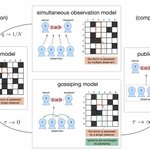
In a new paper published today in @PNASNews, @yohm13 and I discuss a general framework to make sense of social norms and different indirect reciprocity models. Below is a 🧵, here is the paper:
pnas.org/doi/10.1073/pnas.24…

These correlations depend on the structure of social interactions, but also on the social norm in place. We find that a norm can only sustain cooperation if the resulting opinions of different community members become sufficiently correlated.
Opinions tend to become strongly correlated, for example, when social interactions are widely observable. Alternatively, they become correlated when individuals use gossip to synchronize their views. Here is an open version of the paper:
arxiv.org/abs/2409.05551