
Hardware design automation, 3D vision & geometric ML
Joined April 2016
- Tweets52
- Following724
- Followers78
- Likes924


Anushrut Jignasu retweeted

At Xcelsa, our thesis from day one has been simple: AI needs two things to improve chip designs. Search, to find better designs, and formal verification, to prove every change preserves behavior. Without verification, hallucinations and reward hacking end up in silicon.
In September, we announced double-digit gains on a production design with MIPS, a @GlobalFoundries company, all formally verified.
Last week, @OpenAI shared improvements to @AMD designs, with changes checked to preserve behavior. We’re glad to see others putting verification at the center of AI-driven chip design.
Open-source Ibex has become a common benchmark, including in @OpenAI recent post. We ran our framework on Ibex in Nangate45, using a low-cost model in a continuous run, with our search algorithm and custom formal tools working together. This is what we achieved:
- Fmax: 377 → 511 MHz (+35%)
- Average formal verification time: approximately 10 seconds per candidate
- No commercial EDA tools used
To our knowledge, this is an industry-leading formally verified gain reported on the open-source Ibex design. We’d love to see it beaten!
When every change must be formally verified, verification speed sets how far the AI can explore. Our search points it at the most promising candidates, and our fast formal tools check each one in seconds.
Want better results on your designs? Reach out at info@xcelsa.ai

Anushrut Jignasu retweeted
1/ Today, we're excited to announce our partnership with @mips_riscv (a @GlobalFoundries company) to help accelerate the development of custom silicon. 🧵
Anushrut Jignasu retweeted

Building an Artificial Mechanical Engineer:
All of the "AI CAD" demos you've seen have been essentially the same thing, a frontier lab LLM writing code that is translated by an existing geometry kernel into a 3d B-rep model.
I think this approach is fine, but generally lossy, and lacks true spatial understanding and geometric reasoning that humans naturally posses and apply when encoding their designs in a CAD system.
So I attempted to do something unique in the generative design space, building off of other generative 3d research, and trained my own (two tiny, 16M Parameter) AI models on a hyper specific set of data.
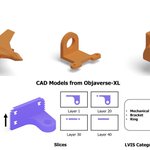
Introducing FieldGeo - a set of models that encode geometry, physics (FEA, Stress) and DFM into the same latent space, and reproduces (assisted with an additional design agent) geometries to meet the stated cases. Today, it's just for L shaped brackets.
Anushrut Jignasu retweeted

I'm proud to share the launch of Xcelsa Labs.
The world is bottlenecked on compute. In order for the promise of AI to be delivered widely to the world, we need vastly better chips. (And we needed them yesterday).
Siddharth Garg, Srikanth Jagabathula and I spent much of the last several months poring over how to make this happen. This is what we are doing at Xcelsa Labs (xcelsa.ai/); reach out if this is of interest!
Anushrut Jignasu retweeted

here's my conversation with Carl Bass. we talked about CAD, engineering software, AI, Autodesk and organizations
i hope you enjoy it as much as i did
Anushrut Jignasu retweeted

Presenting ZeroForge: A text-to-3D model which doesn’t require training data while avoiding inference-time optimization.
Paper and code below:
nyu-dice-lab.github.io/ZeroF…