
Hardware design automation, 3D vision & geometric ML
Joined April 2016
- Tweets52
- Following724
- Followers78
- Likes924


Anushrut Jignasu retweeted

At Xcelsa, our thesis from day one has been simple: AI needs two things to improve chip designs. Search, to find better designs, and formal verification, to prove every change preserves behavior. Without verification, hallucinations and reward hacking end up in silicon.
In September, we announced double-digit gains on a production design with MIPS, a @GlobalFoundries company, all formally verified.
Last week, @OpenAI shared improvements to @AMD designs, with changes checked to preserve behavior. We’re glad to see others putting verification at the center of AI-driven chip design.
Open-source Ibex has become a common benchmark, including in @OpenAI recent post. We ran our framework on Ibex in Nangate45, using a low-cost model in a continuous run, with our search algorithm and custom formal tools working together. This is what we achieved:
- Fmax: 377 → 511 MHz (+35%)
- Average formal verification time: approximately 10 seconds per candidate
- No commercial EDA tools used
To our knowledge, this is an industry-leading formally verified gain reported on the open-source Ibex design. We’d love to see it beaten!
When every change must be formally verified, verification speed sets how far the AI can explore. Our search points it at the most promising candidates, and our fast formal tools check each one in seconds.
Want better results on your designs? Reach out at info@xcelsa.ai

Anushrut Jignasu retweeted
1/ Today, we're excited to announce our partnership with @mips_riscv (a @GlobalFoundries company) to help accelerate the development of custom silicon. 🧵
Anushrut Jignasu retweeted

Building an Artificial Mechanical Engineer:
All of the "AI CAD" demos you've seen have been essentially the same thing, a frontier lab LLM writing code that is translated by an existing geometry kernel into a 3d B-rep model.
I think this approach is fine, but generally lossy, and lacks true spatial understanding and geometric reasoning that humans naturally posses and apply when encoding their designs in a CAD system.
So I attempted to do something unique in the generative design space, building off of other generative 3d research, and trained my own (two tiny, 16M Parameter) AI models on a hyper specific set of data.
Introducing FieldGeo - a set of models that encode geometry, physics (FEA, Stress) and DFM into the same latent space, and reproduces (assisted with an additional design agent) geometries to meet the stated cases. Today, it's just for L shaped brackets.
Anushrut Jignasu retweeted

I'm proud to share the launch of Xcelsa Labs.
The world is bottlenecked on compute. In order for the promise of AI to be delivered widely to the world, we need vastly better chips. (And we needed them yesterday).
Siddharth Garg, Srikanth Jagabathula and I spent much of the last several months poring over how to make this happen. This is what we are doing at Xcelsa Labs (xcelsa.ai/); reach out if this is of interest!
Our paper, "Linkify: Learning from Interface-Augmented Assembly Graphs" is now out in the CAD special issue on AI for Geometric and Physical Modeling in Design and Manufacturing!
We recomputed high-fidelity interface geometry for the Fusion 360 Gallery Assembly dataset, correcting missing and erroneous contacts. We then show that this interface geometry (without relying on joint types) provides meaningful signal for understanding how parts function together. Using these interfaces we study context-aware part-retrieval in mechanical assemblies using GNNs.
1
5
612
Huge thanks to Daniele Grandi for his mentorship and collaboration. This work grew out of my internship at @autodesk.
Paper: sciencedirect.com/science/ar…
arXiv: arxiv.org/abs/2607.01205
Code + dataset: github.com/ajignasu/linkify
1
438
Anushrut Jignasu retweeted

here's my conversation with Carl Bass. we talked about CAD, engineering software, AI, Autodesk and organizations
i hope you enjoy it as much as i did
Connor’s solving some interesting geometry/physics problems with metal casting! Highly recommend reaching out

im hiring again. MechE/Builders
who you are:
> obsessed with how things are made
> going to build something before the CAD is complete
> interested in reindustrializing America
what you get:
> highly competitive salary
> equity
> radical ownership over a problem, and the autonomy to solve it
Shoot me a dm with a link to your favorite project you've built, or reach out over email with the same.
2,399
Excited to share that I’ll be presenting our work, “Slice-100K: A Multimodal Dataset for Extrusion-based 3D Printing,” at #NeurIPS2024
Session details:
West Ballroom A-D, #5301
Wed, Dec 11 | 4.30 - 7.30 pm PT
Feel free to reach out!

Delighted that Slice-100K was accepted to #NeurIPS2024 D&B track! 🎉
Website: slice-100k.github.io/
Github: github.com/idealab-isu/SLICE…
Read here: arxiv.org/abs/2407.04180
Grateful for my co-authors and the @NeurIPSConf reviewers!
3
4,835
Delighted that Slice-100K was accepted to #NeurIPS2024 D&B track! 🎉
Website: slice-100k.github.io/
Github: github.com/idealab-isu/SLICE…
Read here: arxiv.org/abs/2407.04180
Grateful for my co-authors and the @NeurIPSConf reviewers!
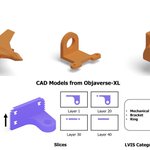
🚨📢 Excited to announce SLICE-100K, a first-of-its-kind dataset of over 100,000 G-code files, along with their tessellated CAD model, LVIS (Large Vocabulary Instance Segmentation) categories, geometric properties, and renderings.
1/n

To demonstrate its usefulness, we finetune GPT-2 on the task of G-code translation from a legacy format (Sailfish) to a modern and widely used format (Marlin).
4/n
1
145
We believe SLICE-100K will be the first step in building multi-modal foundational models for digital manufacturing and beyond.
This is a joint effort with @kellym11111 , @M17409753Ankush, Lucas Nerone Rillo, @baskinscience, Aditya Balu, @chegday, and @adarshk
5/n
1
161
Excited to share that I’ll be at #CVPR 2024 in Seattle!
I’ll be presenting “SDFConnect: Connected Neural Implicit Surface Reconstruction with Topological Constraints” at the Deep Learning for Geometric Computing (DLGC) Workshop on June 18th.
Feel free to reach out!
2
1
309
For this work, I’m grateful to collaborate with Aditya Balu, @BabuaSpeaks , @chegday , Baskar Ganapathysubramanian, and @adarshk
Also, check out @JaydeepRadeJD- “3D Reconstruction of Protein Structures from Multi-view AFM Images using Neural Radiance Fields (NeRFs)" at DLGC.
🚨 Excited to announce our new paper "NURBS-based Path Planning for Aerosol Jet Printing of Conformal Electronics"
Paper link - authors.elsevier.com/c/1invr…
Collaboration with - Jeremy Rurup, Ethan Secor, and @adarshk