





Adrià 🌖 retweeted

String theory is what happens when an intelligent system is starved of sensory input and starts hallucinating. Intelligence needs grounding.
For this reason, intelligence is practically never the bottleneck to solving impactful problems. The bottleneck is iterated contact with reality.
I still believe Ethereum has the potential to serve purposes beyond just reinforcing capitalism. And I think there are still a few of us who share that vision.

🧵 1/3 Vocdoni is part of @OctantApp Epoch 13, the Privacy Round, and the allocation window opens today.
This is a another real chance for @ethereum to show it's useful to people, not only to speculators.
Private, verifiable voting is one place it can, and we're doing it with DAVINCI.vote: private, receipt-free and verifiable voting as an open-source public good!
Support us until 21 Oct:
epoch.octant.app/rounds/0x57…

Adrià 🌖 retweeted

The best way to make cryptography stronger is to try to break it.
AI can actually build confidence in cryptography, argues Stanford cryptographer Dan Boneh.
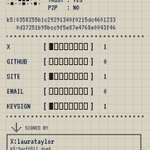
No server in the middle: k5s talk directly over iroh (QUIC + hole punching).
Pair with a ticket or QR, compare a 4-word check phrase, keysign each other. Then send signed+encrypted messages and sync attestations, only with people on your web of trust.
All Rust: a CLI, a Slint desktop app, and the same UI on Android. Search identities, see their trust path, message them, auto-sync.
DO NOT USE IT FOR ANYTHING SERIOUS, SECURITY IS NOT REVIEWED AT ALL, JUST PARROT-VIBECODED.
Feedback welcome!

Proofs that don't require trusting you:
🌐 X, GitHub gist or your website → @tlsnotary (MPC-TLS) proves the server really returned your k5
📧 Email → @zkemail : a Plonky2 proof of a DKIM-signed email
🤝 Keysigns → the classic PGP web of trust
🧵 k5: a Q&D experiment to build a modern, decentralized Keybase.io. Makes sense to build something like this today?
Keybase showed tying your keys to your online accounts is useful. k5 does it with no central server: your identity is a post-quantum key, and the proofs live with you and your peers.
github.com/adria0/k5
"The work wasn't limited to just: Design the protocol -> Formally verify it Instead, the loop became more like: Design -> Formal Model -> Find exactly what breaks and why -> Redesign it."
That's the thing.

One step closer to 4-8x faster Ethereum finality!
It took some time and lots of tokens, but we now have a formally verified proposal for a decoupled consensus protocol in I* (a future Ethereum upgrade)! Not yet a full spec (up next), but it includes all the key consensus-relevant details to become one.
Since Ethereum aspires to be live without most of the stake online, the protocol involves many more components than a normal BFT protocol, and its correctness involves much more than standard safety and liveness. Those nuanced properties are now verified!
What's more, I came away convinced that all protocol design will involve AI-assisted Formal Verification in the future, both for correctness and iteration speed.
The work wasn't limited to just:
Design the protocol -> Formally verify it
Instead, the loop became more like:
Design -> Formal Model -> Find exactly what breaks and why -> Redesign it.
For a fairly complicated protocol like this one, I think having the Lean model be part of the design loop played a big role in accelerating the process.
A future with agents paired with formal models is a superpower for Ethereum development, because they can then use those models to find exactly where an argument breaks down, formalize counterexamples, test proposed fixes, iterate on the protocol.
Many details that would slip under the radar when asking agents (and indeed, humans) can now be specified exactly and checked by the Lean kernel. This then forces agents to be more precise and lets them make verifiable progress on their own. It's been incredible to see this play out, seeing agents find gaps and propose protocol changes to fix them.
In other words, autoresearch can speed up protocol design, formal verification is here to stay, and Ethereum Finality will get faster.
Adrià 🌖 retweeted

Our pre-@mozillafestival meetup is live!
We make gathering between Catalan local activists & global digital rights people. Building dialogue among people working on self-sovereign infra for coops, delivering latest encryption via messaging apps, organizing communities of change and challenging Chat Control-alike norms.
Location: incredible occupied cinema running as a radical social centre - La Cinetika [blogs.sindominio.net/lacinet…]
Speakers: we just started, but already have cool people
1. Kay Coghill, PhD. [kalyncoghill.com] - Head of Community @ BlackSky algorithms blackskyweb.xyz/
2. Valentina Aguana Villegas - Conexión Segura y Libre [@conexionsegura] and @bellingcat, @mozilla Fellow
3. @MairJulian - @phoenix_r_d, Air Messager, MLS Encryption
4. @jordipainan - catalan-born protocol for private voting with 200.000 votes processed across unions, coops: @vocdoni, @davinci_vote
5. @nicksvyaznoy - W3PN co-founder
Register: luma.com/mmfpumzi

In 2y everything will be robots
In 4y the first virus-bacteria infection did by autoresearch
In 5y the first non-aligned AI hacks the lab to generate who-knows-what

Adrià 🌖 retweeted

Terence Tao now saying a number of things I've been saying for some time: 🔽 (Good, people will listen a bit more to him. But unfortunately, this won't change attitudes one bit.)

ALT Screenshot of a Fediverse (“Mathstodon”) post by Terence Tao, dated 2026-09-03. Link in next tweet.

ALT Screenshot of a Fediverse (“Mathstodon”) post by Terence Tao, dated 2026-09-03. Link in next tweet.
Adrià 🌖 retweeted

We are excited to announce that we can successfully use Rust's portable SIMD on the GPU. This has never been done before.
vectorware.com/blog/simd-on-…
Supporting Rust's `core::simd` enables existing Rust code to work on the GPU and makes GPU programming more ergonomic.
📡Save the date, new Ethereum Engineering Barcelona meetup luma.com/i95pdcdc Sep 17th at @AKASHAworldBCN
⊢ Quantum computing by Albert Solana (@qilimanjaro, builders of quantum computers)
⊢ Intro to Lattices by @arnaucube
⊢ A post-quantum ethereum by @adria0

This

Most SSZ libraries are tested against the spec. I built one where the core properties are formally proved, in Lean 4.
It also passes the full upstream test corpus. SSZ is how Ethereum serializes and Merkleizes its data — if hash_tree_root or deserialize is wrong, you get the kind of bug that can split the chain. For this reason I wanted something that is not only tested against the spec, but also proved.
Formal verification. The library is called SizzLean. I proved three theorems: roundtrip (decode after encode returns the same value), non-malleability (two different values cannot produce the same encoding), and a size bound. They hold for the fixed-size SSZ types: the integers, bool, fixed vectors and lists, and containers built from those. I have not proved them yet for bitvector, bitlist, and variable-size containers. So this is a base, not a finished proof.
Trust boundary. The only thing I assume without proof is the C SHA-256 function, declared as three named Lean axioms. You can list the full trust footprint with one grep, or with #print axioms on any theorem. Nothing else is taken on trust.
Two backends. The same spec runs on a fast cached backend, used for execution and for running the test vectors, and on a pure backend, used for the proofs. I put the hash function behind a typeclass, so SHA-256 can be replaced by Poseidon2 or a post-quantum hash without changing the containers, the proofs, or the cache.
Conformance. On top of the proofs, it runs the official ethereum/consensus-spec-tests on both presets:
ssz_generic: 2188 / 2188
ssz_static (mainnet): 1585 / 1585
ssz_static (minimal): 38991 / 38991
This covers every fork from Phase 0 to Gloas, including the new ePBS containers.
I also commented the code to be read. If you want to learn how SSZ works, or how to do this kind of work in Lean 4, you can follow it from top to bottom.
The verification was done with heavy help from an AI coding agent. With Lean this does not change the result: the kernel checks the proof, independently of who wrote it.
I work on specs and test vectors at the Ethereum Foundation, on the STEEL team. This is a personal project. The next step is to widen the proofs toward the remaining types.
Repo and full details: github.com/etheorem/etheorem…


Next week, new Ethereum Engineering Meetup
A nice combo for RiscV state-of-the-art
Jordi Baylina, founder of @ziskvm
Edgar González, Chief of software at @Openchip_
RVSP at ethbcn.dev/
