

Sociogenomics, Behavioral Genetics, Statistical Genetics @herasight
Joined September 2018
- Tweets1.2K
- Following1.5K
- Followers1.8K
- Likes59K






Tobias Wolfram retweeted

interpretability might be the most important scientific problem in the world right now, as I don't think we can solve alignment if we don't know what we're building. I think I have good news about it. I co-authored early work in mechanistic interpretability at OpenAI and came away pessimistic, because neural networks appeared to fold into arbitrary tangled knots. years later, I started openai's first large-scale automated interpretability project, finding about 2% of neurons legible with the primitive tools we had
with modern agentic tools and a much closer look, the picture looks totally different. the vast majority in models up to trillions of parameters are legible, and their circuits beautiful. many famous examples of tangled neurons turned out to be misunderstood. The roadblocks I expected mostly aren't there. I now think ambitious interpretability will be solved by the time we need it most, and possibly quite soon, as automated scientists keep improving. it may be a bitter lesson for interpretability: the simple thing, at absurd scale, works
already-clean.goodfire.com/

Tobias Wolfram retweeted

It can be useful for decisions about when to screen for certain cancers, for how much cardiovascular risk you have, and for drug metabolism.
But genetic information is most useful before you're born - when all the other health data an adult has is not available.
This has been neglected by mainstream academia and medicine for primarily ideological reasons, missing a huge amount of the potential of human genomics.
At least companies like @herasight are going to deliver on this for future generations.


Tobias Wolfram retweeted
Tao doesn't seem to understand how many current medicines have unknown or poorly understood mechanisms.
The AI math debate has been a good reminder that research mathematics is a game with very different rules to most of science and technology.


Tobias Wolfram retweeted

My review of Kathryn Paige Harden's new book Original Sin is out in Quillette. Harden disavows the quasi-religious conception of free will that underpinned The Genetic Lottery only to embrace a new brand of mysticism that licenses her to reaffirm the same social-justice ideology.

Can your genes excuse a crime?
@DamienMorris reviews @kph3k 's Original Sin and argues that its answer amounts to a kind of secular Calvinism.
quillette.com/2026/10/10/the…

Tobias Wolfram retweeted

... angekündigt wars ja, aber gedruckt ist schon was anderes noch. Ein mehr als aufschlussreicher Ausflug in die Wissenschaftssoziologie, der länger gedauert hat als gedacht. Es reichte jetzt aber auch. In jeder Hinsicht. Jetzt kommt was anderes dran.

Tobias Wolfram retweeted

Another angle to this is that dogs effectively stumbled onto what is for them the equivalent of artificial superintelligence 20,000 years ago. The Singularity already happened for dogs. They live in a world they cannot understand, surrounded by miraculous wonders they take entirely for granted, their every need seen to by entities whose thoughts they cannot begin to fathom.
The result is that there are about a billion dogs on the planet now. Most of them are pretty happy. Almost none of them need to work. It worked out pretty well for them.


Tobias Wolfram retweeted

Trikafta is one of the most inspiring medical advances in decades.
Approved in 2019, the drug at first makes cystic fibrosis patients vomit up mucus for about a week.
They lose that week and then they gain a lifetime–a healthy, *normal length* lifetime.
Pharma brings miracles!


Tobias Wolfram retweeted

The vast majority of people have never been able to get good at anything or make a contribution. The cognitive elite is now starting to get a glimpse of what this feels like and wants to preserve their innate privilege by outlawing utopia.

Tobias Wolfram retweeted

Tomorrow with @JonathanAnomaly from @herasight
We discuss the tech behind embryo selection, how to reduce suffering, and the liberterian ethics underlying it all
Tobias Wolfram retweeted

Genomic testing is allowing parents to have healthier, happier kids with lower risks of devastating mental illnesses.
@herasight is at the forefront of this massive development. Here's a thread about their latest advances.

Today we launch NeuroRisk, the first embryo test for autism and schizophrenia that looks for mutations in evolutionarily important genes.
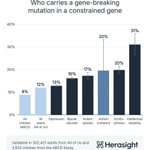
These mutations are individually rare but over 10% of people carry at least one mutation in this class.

@rborkows Rob, you work at Natera? Afaict you screen for 22q11.2 deletions, which according to your guys' work occur in 1 in 1,500 pregnancies, and you argue that's common enough for routine screening (natera.com/company/news/smar…).
I fully agree with that! But that's 0.07%. In iPSYCH the deletion roughly triples autism risk and turns up in 0.1% of autism cases. Try to plot that nicely.
Now compare how many cases each one catches:
• 12% of adults carry a truncating variant in a constrained gene. They make up 31% of intellectual disability, 20% of schizophrenia and 17-20% of autism cases.
• That's an attributable fraction of 21% for ID, 9% for schizophrenia and 6% for autism, against 0.1–0.3% for 22q11.2.
• In the most constrained genes, ID goes from 0.14% to 1.31%, above the Down syndrome risk at maternal age 40.
• These cohorts largely miss severe cases, so the numbers are likely underestimates.
Screening is for rare, serious outcomes. In the end, a steep tail is simply what such a test looks like.

In response to xitter.cf/rborkows/status/210838…


Tobias Wolfram retweeted

I used NeuroRisk for genetic screening for myself, and found that I have a mutation in six3. This likely caused my brother's death shortly after birth, and gives ~25% risk of my own kids suffering the same.
I'll be using this info in my embryo selection!
Tobias Wolfram retweeted

Autism risk is one of the highest priority concerns when it comes to embryo selection. This methodology helps to address it.
Tobias Wolfram retweeted

Great to see the launch of NeuroRisk, a new genetic predictor of neurodevelopmental risk for embryo screening. Really proud of our work. Another major milestone for the Herasight team.
Tobias Wolfram retweeted

Herasight is pioneering a new kind of embryo screening.
NeuroRisk screens for rare inherited damaging variants so couples can reduce the risk of having a child with severe autism or intellectual disability.
Tobias Wolfram retweeted
An important new innovation from Herasight: NeuroRisk.
NeuroRisk identifies embryos carrying damaging mutations in evolutionarily conserved genes, which increase risk for autism, schizophrenia, and other disorders - finding cases missed by polygenic scores and known genes.
Tobias Wolfram retweeted

This is remarkable: We've developed the technology to help couples select embryos with lowest risk of neurodevelopmental disorders.