




Pinned Tweet
Under-the-hood look at #GPU architecture and performance that Machine Learning people might find interesting.
I originally gave this talk at Unity's internal ML Workshop in Seattle.
slideshare.net/RenaldasZioma…
Please share, if you find it useful.

ReJ 𓀨 Renaldas Zioma retweeted

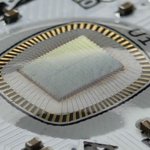
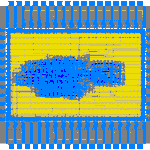
Wow! There is a @tinytapeout SKY26b project which draws a logo on screen by scanning physically matching arrangement of transistors! Like a scanning microscope inside a tiny circuit! tinytapeout.com/chips/ttsky2…
ReJ 𓀨 Renaldas Zioma retweeted

CPUs suck. We're building a new general-purpose chip that scales to thousands of cores while being more energy-efficient.
We're hiring hardware design engineers, consider joining us tendrils.co/jobs
What we do differently ...


Boarding ticket. New service levels unlocked! On the way to Revision2026 @revision_party


ReJ 𓀨 Renaldas Zioma retweeted
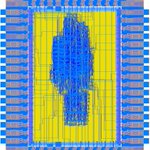
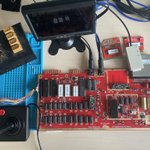
Working on the new simulator. I just wanted to see what Atari2600 fetching data from ROM looks like at CMOS FET level
(@tinytapeout TT09 Atari circuit by @__ReJ__)
ReJ 𓀨 Renaldas Zioma retweeted

1968: "This flat pattern graphic was generated by applying a periodically repeating order to a Markov chain of unit color planes (5 colors).
The computer analyzed three existing artworks as data, captured the connective relationships of four unit color planes within them as a transition probability matrix, and generated random numbers reflecting this probabilistic formal grammar to draw a fourth-order approximation image. (Created using the OKITAC 5090A)."





ReJ 𓀨 Renaldas Zioma retweeted
Working on the big update to @tinytapeout circuit simulator (znah.net/tt09/). Full py->c++ parser rewrite, zero deps. Sim is ~10x slower, but every FET counts! @__ReJ__'s Atari 2600 with ROM macros seems to work. Never underestimate power of ~2000 C++ lines)


ReJ 𓀨 Renaldas Zioma retweeted

I made my RISC-V ASIC/FPGA KIAN-V implementations open and free for everyone.
github.com/splinedrive/kianR…


ReJ 𓀨 Renaldas Zioma retweeted

A cubic millimeter of mouse brain with 75,000 neurons, vizualized by @quorumetrix :
youtu.be/blaS5fBJdsE
Watching the way the signals propagate through the layers, with pyramidal cells integrating and processing 11,061 inputs at a time is mindbending.
ReJ 𓀨 Renaldas Zioma retweeted

“Floating-Gate FPAA Now Commercially Available! (Field Programmable Analog Array from Okika Devices)”
youtu.be/TWW0Q8sEGEA?si=VNUa…

ReJ 𓀨 Renaldas Zioma retweeted

How does an embryo reliably "compute" its form - "cell by cell" - using only local interactions and mechanics, yet produce a precise global body plan? I’m excited to share our Nature Methods paper "MultiCell: geometric learning in multicellular development", presenting #AIxBiology research led by @HaiqianYang and the result of a great collaboration with Ming Guo, George Roy, Tomer Stern, Anh Nguyen and Dapeng Bi.
A long-standing challenge in developmental biology is to predict how thousands of cells collectively self-organize as tissues fold, divide, and rearrange. In MultiCell, we represent a developing embryo as a dual graph that unifies two complementary views of tissue mechanics with single-cell resolution: cells as moving points (granular) and cells as a connected foam (junction network). This lets the model learn dynamics from both geometry and cell–cell connectivity.
On whole-embryo 4D light-sheet movies of Drosophila gastrulation (~5,000 cells), our model predicts key cell behaviors and the timing of events, including junction loss, rearrangements, and divisions with high accuracy, at single-cell resolution. Beyond prediction, the same representation supports robust time alignment across embryos and offers interpretable activation maps that highlight the morphogenetic "drivers" of development. The broader goal is a foundation for cell-by-cell forecasting in more complex tissues, and eventually for detecting subtle dynamical signatures of disease.
Kudos to the team for this inspiring collaboration with brilliant researchers to push the boundary of AI for biology!
Citation: Yang, H., Roy, G., Nguyen, A.Q., Buehler, M.J., et al. MultiCell: geometric learning in multicellular development. Nature Methods (2025), DOI: 10.1038/s41592-025-02983-x
Code/data links are in the manuscript.

