

#MYC_Cancer #systemsbiology at @Uni_WUE with @NevenkaDudvars1 @MV4_11 @_BikashAdhikari @J_Hofstetter1 @ashwin_narain @PranjScripts @EingLorenz
Kiel, Germany
Joined March 2019
- Tweets299
- Following124
- Followers426
- Likes322





We are recruiting: ERC- and DFG-funded PhD positions in Tumor Biology (Kiel, Germany). We look forward to your application!

Our latest paper describing a role for SCAF1 in promoting RNAPII elongation is online at Nucleic Acids Research @NAR_Open! Check it out here: doi.org/10.1093/nar/gkae1219. Big thanks to collaborators @erhard_lab, @MYCGyvers and AG Schlosser!

Our new manuscript has been published in eLife. We describe a new method for identifying suitable E3 ligases for PROTACs. Many thanks to everyone involved. pubmed.ncbi.nlm.nih.gov/3964…

Wolf Lab for Tumor Biochemistry retweeted

Out now: Our collaborative #Golgi #glycotime story, which shows (i) that B4GALT5, a Golgi enzyme, is subject to M6P tagging and (ii) that GOLPH3/GOLPH3L stabilize LYSET and the GlcNAc-phosphotranferase complex and thus are crucial to cellular M6P tagging. tinyurl.com/jkv26nhh
Our new paper on TTK/Aurora PROTACs is out: pubmed.ncbi.nlm.nih.gov/3953… Great collaboration with the Sarli lab. Thanks to all involved!"

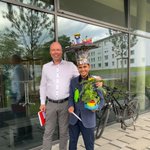
Congratulations @_MarkusVogt for delivering a superb PhD defense!!!🍾🥂

Wolf Lab for Tumor Biochemistry retweeted

I have written a concise review on chromatin transcription as part of the @JMolBiol special issue on transcription elongation. Check it out!
authors.elsevier.com/sd/arti…

ALT Mechanisms of nucleosome retention and/or transfer during transcription elongation.
We congratulate Michaela Reissland and the whole team in Markus Diefenbacher's lab on their new paper in Oncogene. In the study, they were able to demonstrate the role of USP10 in Wnt signalling in colorectal cancer models. Thank you for the opportunity to contribute.

USP10 emerges as a unique therapeutic target in APC-truncated #ColorectalCancer
🔬nature.com/articles/s41388-0…
@DiefenbacherL
#OpenAccess

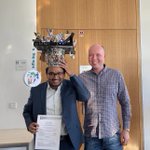
Congratulations, Lorenz!

PhDone ✅
@EingLorenz finally defended his defense. After his PhD in the @_WolfLab he is now working as a Postdoc in our Lab! Fantastic defense and as always a good party afterwards!


Wolf Lab for Tumor Biochemistry retweeted

#GUTAbstract by @_MarkusVogt @_WolfLab et al on
"Targeting MYC effector functions in pancreatic cancer by inhibiting the ATPase RUVBL1/2" via bit.ly/3SNQbX0
Paper: bit.ly/3M5SqkW
@DiefenbacherL @NevenkaDudvars1 #Pancreas #PancreaticCancer

Graduate students and postdocs interested in PROTACs and Glues: Register for the AEK workshop November 4-6 in Berlin with outstanding international speakers: aek-conferences.org/autumnsc…

Many thanks to the press office of Kiel University for the press release about our new paper in GUT: uni-kiel.de/de/detailansicht…

Wolf Lab for Tumor Biochemistry retweeted

Congratulations to the amazing team at @Nurix_Tx for the continued success of their brain-penetrant BTK degrader in the clinic!
ir.nurixtx.com/news-releases…
We are recruiting: ERC- and DFG-funded PhD positions in Tumor Biology (Kiel, Germany).
We look forward to your application!

Congratulations to all the authors on their great work!

More than happy to finally see our paper out in @NatureCellBio! We de-orphanized MFSD1 as a lysosomal dipeptide uniporter. Fantastic work of @Kathaschnatta, @OceaneGuelle,
@AllUNeedIsLoew and Bruno Gasnier: nature.com/articles/s41556-0… so nice to see the structure of MFSD1&GLMP!

Acute degradation of RUVBL1 in transplanted PDAC tumors via the auxin-inducible degron (AID) system resulted in complete tumor regression in immunocompetent mice which was preceded by infiltration with CD3-positive immune cells.
Thereby, targeting of RUVBL1/2 transforms PDAC into an immunologically “hot” tumor, responsive to immunotherapy. In summary, our work identified the MYC-RUVBL1/2 axis as a druggable vulnerability of MYC-driven cancer.
Congratulations to @MV4_11, @NevenkaDudvars1 and the other contributing members of @_WolfLab and many thanks to our collaborators @MYCGyvers, @seyvos, @WiegeringLab, @DiefenbacherL, @GeorgGasteiger, Florian Erhard, Stefan Knapp and Dieter Saur.
We investigated the possibility of targeting the prominent oncogene MYC via its binding partners. We prioritized MYC binding partners by genetic screens in PDAC cells in culture and in immunocompetent mice.
While PDAC dependencies in cell culture followed public essentiality data of the @CancerDepMap portal, dependencies on MYC binding partners were reduced in vivo. Among the most essential MYC binding partners in vivo were RUVBL1 and RUVBL2 which form a AAA ATPase complex.