

Anesthesiologist, neuroscientist, amateur psychiatrist. I know where the most powerful psychotropic drugs in the hospital are.
Stanford, CA
Joined November 2018
- Tweets2.7K
- Following1.2K
- Followers3.5K
- Likes6.5K




Pinned Tweet
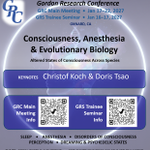
Applications are open! We have an *incredible* lineup of speakers at the 2027 GRC/GRS on Consciousness, Anesthesia and Evolutionary Biology - January 17-22, 2027 SoCal. Keynotes by Christof Koch, @doristsao (GRC) and @mattlark (GRS). see link below for the prelim program -

Boris D Heifets retweeted
Is AI conscious? I have no idea. But I'm excited to spend a week talking about problems in consciousness, disorders of consciousness, dreaming, delirium, perception that may actually be experimentally tractable 😅
Apply now - space is limited! Links below

Boris D Heifets retweeted

Peer experts: we would be extremely grateful for your timely feedback (e.g., through the bioRxiv comment function). As you can see, the interest is immense, and we will be building on this work at Astera. If you see a critical shortcoming, we want to know asap.

To be clear, since this has sparked a number of threads in my feed and DMs, this work pre-dated @doristsao joining us at @AsteraInstitute with many academics involved. So it will follow its own course with or without journals -- up to the authors involved.
But I invite any and all scientists to offer technical input in public NOW since this is garnering a lot of attention. It need not wait 6-12 months for a journal process. And it obviously is part of the scientific corpus that will influence not only our ongoing work at Astera, but also the field in general. So now would be the time to weigh in since research doesn't stop, especially given the importance and incredibly multi-disciplinary nature of the work.
Given that the team is building upon this work, technical input will be a useful but singular dimension of its rigor. Whether the work can be replicated or built upon will be (and IMO should always be) the bar for any programmatic effort that gets expanded at Astera. And that type of empirical evaluation is already in motion. Any of that work funded by @AsteraInstitute will be released without delay or paywalls.
Boris D Heifets retweeted
The outpouring of interest in our paper has been … a bit insane.
May I make four points?
1. We have not shown that “consciousness has a frame rate.”
I can see why people draw this conclusion: we report that inferotemporal and prefrontal cortex alternate between conscious and suppressed states roughly every 60 ms during binocular rivalry.
Consciousness depends on many brain areas, and our paper reports results from only a few select nodes.
We still don’t know how conscious access works--the actual recipe for generating conscious experience. What we have shown is that deep in the brain there is an extremely strong signal, rich enough to reconstruct a high-dimensional face in detail, that is inaccessible to consciousness. As I argued in the original tweet, this makes the problem of conscious access a lot more experimentally tractable. But to claim “consciousness has a frame rate,” one would need to have actually solved the mechanism for conscious access and shown that this mechanism operates at a frame rate.
While we currently don’t know conclusively one way or the other (see VanRullen & Koch, 2003 for a review of positive evidence), I personally am skeptical that consciousness has a frame rate. I believe the brain, within posterior parietal cortex, has continuous tracking mechanisms that actively represent the persistence of matter, including ourselves as physical bodies. The coupling between these persistent tracking processes and feature representations across the brain (like those in face patches) is, I think, the essential mechanism of conscious access.
This coupling need not happen at the rate of inferotemporal alternations (and inferotemporal cortex itself may not even alternate outside of the artificial situation of binocular rivalry). As an analogy: imagine the area crucial for conscious access holding a steady drone note, while inferotemporal cortex alternates between two notes, one in harmony and one dissonant. Inferotemporal content might couple to the drone only at moments of harmony, yet experience would still be continuous, because the drone itself (the tracking process that I believe is at the core of conscious perception) never stops. And areas without conflicting content, like auditory cortex during visual rivalry, could stay in continuous harmony with the drone.
In sum, there is no reason to conclude from our study that consciousness is discrete, with a "frame rate."
2. Our results resemble Jezek et al. 2011 (as @jjsakon notes).
Jezek et al. trained rats in two boxes that were identical except for their lighting cues, so that hippocampal place cells formed two distinct maps, one per box. They then “teleported” the rat by abruptly switching the lights. For a few seconds afterwards, CA3 place-cell activity flickered between the two maps, synced to the theta cycle (~125 ms).
@StanDehaene first pointed this paper out to me, and reading it blew me away. To my mind it is the strongest evidence for a bistable attractor in the brain, because the competing maps are stored within the hippocampus itself.
I think the phenomenon we see may be very similar at the circuit level: a bistable attractor network within inferotemporal cortex that alternately converges to one of two patterns, as cells in face patches work together to build a coherent representation of the input. In our case, both images are present in the input, so the competition could arise within IT or be inherited from earlier areas such as V1--recording there is an important next step. (It also still puzzles me that we didn’t see strong coherence between face patches ML and AM.)
More broadly, what’s different about our paper is the brain area (inferotemporal cortex, often modeled as a feedforward DNN) and the ability to relate the two competing patterns to consciousness, with one granted conscious access and the other not.
3. Please comment on bioRxiv!
The Twitter attention has been cool, but I really hope colleagues will be generous enough to post detailed commentary on bioRxiv, where there are currently 0 comments. As @seemaychou points out, peer review doesn’t have to come from just three anonymous reviewers. We would be truly grateful for your critical feedback.
4. Stay tuned
This work was done at Caltech, Berkeley, in collaboration with @EngelTatiana at Princeton, funded by NIH and HHMI.
I hope to share our vision soon for how we can solve consciousness @AsteraInstitute

1/ We discovered something totally unexpected about the neural structure of consciousness that overturns decades of thinking on its biological basis and brings us significantly closer to the recipe for generating conscious awareness.
New preprint: biorxiv.org/content/10.64898… (led by @HesseJanis, with @FrankLanfranchi, @_conor_mcgrory, @Yuelin_Shi, and @EngelTatiana)

Boris D Heifets retweeted

Very excited to share the most important discovery of my career yet: your brain switches between a conscious and an unconscious mode ~15 times every second. Consciousness may depend not on where in the brain activity occurs but when.
Find out more below.
bit.ly/3WvA6di
1/ We discovered something totally unexpected about the neural structure of consciousness that overturns decades of thinking on its biological basis and brings us significantly closer to the recipe for generating conscious awareness.
New preprint: biorxiv.org/content/10.64898… (led by @HesseJanis, with @FrankLanfranchi, @_conor_mcgrory, @Yuelin_Shi, and @EngelTatiana)
Boris D Heifets retweeted

In a recent opinion piece, researchers explore whether new masking approaches and study designs could help improve the interpretability of psychedelic clinical trials while protecting participant trust and safety.
Read on: bit.ly/4i0KAZr
@TheBorisLab

Boris D Heifets retweeted

Are psychedelics anti-inflammatory!?
I am beyond excited to present the first systematic review and meta-analysis of the immunomodulatory effects of serotonergic psychedelics!
sciencedirect.com/science/ar…
Boris D Heifets retweeted
Congratulations and many thanks to my co-1st author, @anna_skovgaard @geraldbillac @MichaelBenros Ellen Bradley, MD @TheBorisLab @thebandlab @kristen_nishimi, @thethrivelab
Boris D Heifets retweeted
Congratulations and many thanks to my co-1st author, @anna_skovgaard , and our incredible team @geraldbillac @kristen_nishimi @MichaelBenros @TheBorisLab @thebandlab !!!!
Boris D Heifets retweeted

Out now in NPP: bsky.app/profile/bsevchik.bs…

🍄 Our second installment of sypres.io, a living systematic review and meta-analysis on MDMA for PTSD is now live on medRxiv. Here's what we found and how we built upon our open science infrastructure to support it 🧵
medrxiv.org/content/10.64898…
Boris D Heifets retweeted

When it comes to psychedelics, reimbursement will dictate access.
And skimping on aftercare and integration is not the answer.
Group models are.
Boris D Heifets retweeted

A growing body of bioethical work has examined ethical issues related to the use of psychedelics in clinical research. With @eddietalksdrugs and @ExistWell, we try to take stock in our state-of-the-field review, published in JME Practical Bioethics.

Boris D Heifets retweeted

This fundamental resource from the @AllenInstitute is also easy to use

MapMyCells is one of our most popular #OpenScience tools and for good reason!
Scientists anywhere can discover what cell types their transcriptomics and spatial data corresponds with by comparing their data to massive, high-quality reference datasets.
🔗 bit.ly/4uZDDgm

Stanford’s neuroanesthesia team is hiring! Great opportunity for an anesthesiologist- we do all kinds of interesting cases, teach residents & students and have ongoing research collabs across the university careers.asahq.org/jobs/view/…

Great opportunity for grad students, postdocs and early stage faculty to get your work in front of a great group of scientific peers - applications are closing soon!

The deadline to be considered for a talk at the next iteration of the Gordon Research Seminar in Consciousness, Anesthesia, and Evolutionary Biology is coming up fast -- Sunday, October 11! The accompanying GRC has a fantastic lineup. Check it out and apply here: grc.org/consciousness-anesth…

Boris D Heifets retweeted

The deadline to be considered for a talk at the next iteration of the Gordon Research Seminar in Consciousness, Anesthesia, and Evolutionary Biology is coming up fast -- Sunday, October 11! The accompanying GRC has a fantastic lineup. Check it out and apply here: grc.org/consciousness-anesth…
Keynotes by Christof Koch, @doristsao (GRC) and @mattlark (GRS).
GRC here: grc.org/consciousness-anesth… dedicated 2 day pre-meeting
GRS: grc.org/consciousness-anesth…
Is AI conscious? I have no idea. But I'm excited to spend a week talking about problems in consciousness, disorders of consciousness, dreaming, delirium, perception that may actually be experimentally tractable 😅
Apply now - space is limited! Links below
Boris D Heifets retweeted

Wonderful to see the joyful celebrations and outpouring of support and appreciation for @KarlDeisseroth yesterday! He is pioneering scientist, caring psychiatrist, and a generous colleague and mentor to so many of us - glad to see so many smiling faces!! A special day for science

Huge buzz on campus today thanks to @KarlDeisseroth! Congratulations to all who contributed to developing optogenetics 🤩!! the Nobel write up is worth reading to really seen how far an idea had to go to revolutionize neuroscience
nobelprize.org/uploads/2026/…