

Professor of Neurosurgery, @PennNSG, UPenn, neurosurgeon, scientist, innovator, advancing clinical trials to meet unmet needs in neuro-oncology
- Tweets1.9K
- Following5.6K
- Followers3.5K
- Likes3.4K
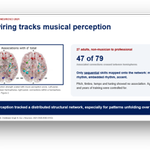








ALT Rajan et al. studied 27 adults with a wide range of musical experience. Diffusion MRI was used to reconstruct each participant's structural connectome. The result was not a single "music pathway"; rather, a distributed network of 79 connections, 47 of which crossed the hemispheres. The strongest structural signal appeared related to musical relationships unfolding over time, rather than simply detecting an isolated sound feature. Network organization mattered: whole-brain modularity and connectivity of the right posterior cingulate were associated with performance. The takeaway is that musical perception was associated with the organization of a distributed structural network, particularly for tracking musical patterns over time.

ALT Papadaki et al (Human Brain Mapp, 2025) changed the musical input, tracked functional connectivity across the brain over time and identified two recurring network states. State 1 had higher modularity- regions were more segregated into communities. State 2 had higher global efficiency- the network was more integrated with shorter paths for communication across regions. According to Siji Osunkoya, the data suggest that greater expertise is associated with greater flexibility in reorganizing the network when the musical demands change.

ALT Sihvonen et al (J Clin Med, 2022) examined 25 patients moderate to severe TBI and measured quantitative anisotropy, or QA, as an index of white matter connectivity. During the first treatment period, music therapy group showed greater QA increases than standard of care (SOC) across several right-sided pathways, including the arcuate fasciculus and SLF, frontal aslant tract, thalamic radiations and corticostriatal tact, with a significant statistical difference. This is clinically relevant because diffuse axonal injury disrupts long-range pathways needed for executive control and executive dysfunction is a major persistent disability after moderate to severe TBI. So repeated musical intervention can be associated with structural change over months. But clinically relevant responses to music can also occur on a much shorter timescale.

ALT The MUSYC trial (Kappen et al, BMJ Open 2023) recruited 189 patients who underwent craniotomy, randomized to either standard care or patient preferred, recorded music before, during, and after surgery. The main outcome was post-op delirium measured by the Delirium Observation Screening Scale (DOSS). The music group had a statistically significant lower score of 11.6% compared to the control, 22.3%. Interestingly, the RMSSD, a beat-to-beat metric of Heart Rate Variability (HRV), a surrogate for vagal tone, was significantly higher in the music group, suggesting that parasympathetic activation could be due to a vagal, anti-inflammatory pathway, potentially related to delirium. However, cytokines were not measured and HRV was not altered to affect the clinical outcome. In summary, So music produced a measurable autonomic effect within minutes, alongside a lower rate of positive delirium screens.


ALT Figures created using MS PowerPoint and assistance of Claude AI (Anthropic)


