

Always be bayesian Build, baby, build
Joined September 2010
- Tweets505
- Following383
- Followers101
- Likes526






Pinned Tweet
What a great legislative session for attainable housing Texas just had!
SB 785, which ensures most TX cities zone at least one district for by-right manufactured housing, is headed to the Governor's desk. 🧵


Rob Ripperda retweeted

If we don’t build enough housing it really does make the economy more zero sum. One man’s income growth becomes another man’s less affordable first home

Rob Ripperda retweeted

Some interesting things I learned this year:
• 33% of the world’s population (= about 2.2 billion people) have never used the internet.
• 38% of Stanford students are registered as having a disability (likely many of these are gaming the system to get extra time on exams).
• HIV began spreading in the early 1900s in Africa but went largely unnoticed until the 1980s, as its deaths resembled other infectious diseases common in rural areas.
• Manhattan today has about 650,000 fewer residents than it did in 1910.
• Humans and octopuses evolved eyes independently, but in humans the optic nerve attaches in front of the retina, creating a blind spot, while in octopuses it attaches behind the retina, so they don’t have one.
• Global suicide rates have declined by about 36% since 2000.
• India is a major leather exporter, despite cows being considered sacred. Most hides come from water buffalo, which are not considered holy.
• About 82% of dogs used by South Korea’s quarantine agency are cloned. Training costs are less than half those of randomly selected dogs, since only top performers are cloned.
• Roughly 1% of the U.S. workforce is laid off each month, whereas in Germany it’s less than 0.1%.
• Light pollution is causing birds worldwide to sing longer each day, extending their vocalizations by an average of 50 minutes.
• Until the late 1980s, doctors often performed surgery on babies without anesthesia, due to the belief that infants did not feel pain.
• People with Down syndrome have about half the rate of solid cancers compared to the general population, likely due to anti-cancer genes on chromosome 21.
• At launch, SpaceX’s Starship produces instantaneous power equivalent to roughly 10% of the entire U.S. electricity grid.
• China has built, on average, roughly one large dam per day since 1949.
Rob Ripperda retweeted

'The question is whether we continue walling off opportunity behind million-dollar homes—or welcome the next generation of families into our neighborhoods.' @TobiasPeterAEI @AEI
aei.org/op-eds/austins-simpl…

This was a huge shift that the pandemic pushed on our kids and we need to give it more attention.

The more time students spend on screens, the less they learn.
Ed tech does not belong in schools (until it is thoroughly tested & proven to help).
Excerpt from Jared Cooney Horvath's excellent new book, The Digital Delusion, in @TheFP
thefp.com/p/we-gave-students…

Rob Ripperda retweeted

How higher fuel economy standards made the most fuel efficient cars unprofitable. marginalrevolution.com/margi…

Rob Ripperda retweeted

I am unreasonably excited about self-driving. It will be the first technology in many decades to visibly terraform outdoor physical spaces and way of life. Less parked cars. Less parking lots. Much greater safety for people in and out of cars. Less noise pollution. More space reclaimed for humans. Human brain cycles and attention capital freed up from “lane following” to other pursuits. Cheaper, faster, programmable delivery of physical items and goods. It won’t happen overnight but there will be the era before and the era after.
Rob Ripperda retweeted

Headline says it all: EVs are booming in South America -- especially in the countries that permit Chinese imports. Yet another market US automakers are boxing themselves out of
reuters.com/sustainability/c…
Rob Ripperda retweeted

Person who just retired: "If you think about it, taxing income is more fair than taxing property."
Rob Ripperda retweeted

SUPPLY & DEMAND WORKS 👇

Here's something fascinating happening in the apartment market right now.
The cheapest, oldest apartments (Class C) are getting crushed right now.
But ONLY in cities that just delivered tons of new apartments.
Let me show you the numbers:
Denver: Class C rents down 13.9%
Naples: Class C rents down 13.5%
Austin: Class C rents down 13.3%
Phoenix: Class C rents down 10.5%
San Antonio: Class C rents down 7.2%
Dallas: Class C rents down 6.5%
What do all these cities have in common?
They just absorbed a massive wave of new apartments.
But here's the twist...
In cities that DIDN'T get a big supply wave?
Class C rents are actually RISING.
20 cities saw Class C rents go UP more than 3%.
19 of those 20 cities had supply BELOW the national average.
So what's going on?
It's basically musical chairs.
When a brand new luxury apartment opens up, where do those renters come from?
They don't appear out of thin air.
They move from slightly older apartments.
Those apartments now have vacancies. So they drop their rents to compete.
That pulls in renters from even older apartments.
And down the chain it goes.
Eventually it hits the oldest, cheapest apartments at the bottom.
And here's why they get hit the hardest:
People living in Class C apartments are already spending a huge chunk of their paycheck on rent.
To fill empty units, landlords have to cut prices A LOT.
Sometimes enough to attract people who couldn't afford market-rate apartments before.
It's like a waterfall effect.
The water (new supply) at the top pushes everything down.
But here's the important part:
This proves that building new apartments - even "luxury" ones - reduces rents all the way down the spectrum.
If it was just an affordability crisis, you'd see Class C rents falling everywhere.
In high-supply cities AND low-supply cities.
But we're not seeing that.
We're seeing a perfect split:
Lots of new apartments = falling Class C rents
Few new apartments = rising Class C rents
New supply at the top creates relief at the bottom.
Also: wages have been growing faster than rents for 3 straight years.
More people can afford apartments today than before.
The bottom line?
This is what happens when you actually build housing.
Supply works.
(Chart and analysis from Jay Parsons - one of the sharpest real estate economists out there)

Rob Ripperda retweeted

Manufactured homes are a high-quality, low-cost housing option.
Making them easier for people to buy could cut costs for *everyone.*
Federal and state policy should treat them that way but often doesn't.
Our Rachel Siegel breaks down the issue.
Rob Ripperda retweeted

Let me put it a different way. Housing construction has been so low that homes are filtering up in most of the country.
That LITERALLY means that the housing market clears in every city through the marginal family moving away because they can’t afford to stay.
2/


Rob Ripperda retweeted

End the property tax in Texas... and replace it with a Land Value Tax?
That's right. The @HoustonChron is publishing Georgist op-eds. We're going there. Let's do it.
houstonchronicle.com/opinion…
Rob Ripperda retweeted

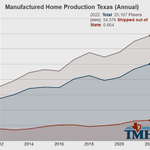
Grateful to @TexasMHA for inviting me to share results from the Texas Manufactured Housing Survey. This year was about uncertainty, but manufacturers are optimistic heading into 2026:
✅ Stable input prices
✅ Fewer labor shortages
✅ Capacity ready for a demand rebound

Rob Ripperda retweeted
To address its housing shortage, the U.S. needs 4 million to 7 million more homes.
Manufactured housing is gaining steam as an affordable solution.
Unfortunately, zoning rules based outdated views often prevent communities from using them. pewtrsts.org/4n6mYn0
Rob Ripperda retweeted

For the first time since the Great Financial Crisis, U.S. apartment rents declined over the summer months (June, July, August).
And yet every data provider is still reporting strong demand for apartments.
What happened? YIMBY theory proved true. We built more apartments than at any point in nearly a half century. Property managers had to compete more for leases, and cut rents to do so.
While a 0.23% reduction may not seem like much, that cut came at a season when rents normally rise >1%. Furthermore, the declines are far sharper in the most heavily supplied markets, including Austin, Denver and Phoenix.
