
Trying to build wealth and learn something investing in listed real estate
Joined October 2011
- Tweets3.9K
- Following1.1K
- Followers4.2K
- Likes4.9K






Real Assets Value retweeted

If you ever wonder why buying $CPT at a 4.4% dividend is likely better than the 10-year US Treasury at 5.3%. I have a free write up for you
The simple answer, AFFO/sh (REIT FCF) CAGR of 4.4% over 10 years and current AFFO yield of around 6%
hardassetmemo.substack.com/p…
Can't believe I just came around to writing this one!!!
Also insane AFFO/Sh growth in SoCal Warehouse in the past decade, just unbelievable!!


Real Assets Value retweeted

Do you think the Magnificent 7 is too dominant commanding a third of the S&P 500? Here’s the Majestic 8 in REITs: The top 8 (Welltower $WELL, Prologis $PLD, Equinix EQIX, American Tower AMT, Simon Property SPG, Realty Income O, Digital Realty DLR, Public Storage PSA) now command ~44% of the entire US-listed REIT market cap! The other ~187 REITs share 56%. Concentration hits real estate hard too.
#REIT #Majestic8

Real Assets Value retweeted

Another $6.75/share $NLOP dividend, not an awesome price on KBR, takes my liquidation value down another ~$1/share. Best guess is ~$25/share from here

Real Assets Value retweeted
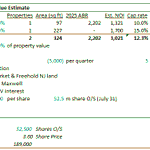
These are a few of the top positions
Key assumptions for MF REITs are 5.0% exit cap rate which is what apartments are trading for in private deals. 1% 26 NOI growth followed by 3% and 3% in 27/28
We update models at least once a month
Names withheld for now, 3rd/4th are not apartment REITs
IRR est includes dividend receives, 3 year hold period
OFC the actual results will not exactly match this, could be down 10% from here or up 40% in 12 months on these names
From large cap REIT perspective, these are fat pitches for real estate investments once 3 yr IRR goes over 20%
People will argue that these REITs will never to a 5.0% cap rate, blah blah, that's what makes a market

Real Assets Value retweeted

Imho the size of private markets today and the associated structural incentive differences between it and public REIT markets make them two distinct markets with less overlap than people think despite owning basically similar assets.
Also reit mgmt reluctance to (dramatically) sell into private markets and shrink when cap rate differences become acute.
Also impacted by having a much smaller natural buyer base than before with a lot of long term holders gone or shifted to the private side, and doesn’t benefit much from passive flows, so some flows prob come back but anyone’s guess when and how much.
So all that generally makes me put low weighting on “closing the cap rate spread” which remains to me as get lucky one day upside.
The rest of your math generally on board with other than macro softness and faster time now for new supply to meet demand (from a capital readiness standpoint) and the REITs have now come down a lot to the point where you can be happy clipping the dividend and let everything else fall into place, but fwiw I think 5 cap exist assumption on MF is aggressive despite that being where private markets are buying today because I think that’s also going to creep higher over time as both debt and equity dry powder winds down with slower continued private fundraising and less forced deployment capital
will still make fun of you or anyone anytime in any direction


Real Assets Value retweeted

The Q3'25 apartment data is in. Bottom line:
It's not the big rebound investors hoped to see.
It's also not the big plunge doomsday-ers hoped to see.
Highlights:
-- Demand (absorption) is moderating from crazy highs, but that was widely expected due to a) supply slowing, and absorption correlates with supply; and b) off-the-charts numbers are never sustainable.
Notably: There's more dis-alignment than usual among data providers on Q3 absorption. Won't go too deep into the weeds here, but a lot of that likely traces to methodology differences around how lease-up absorption gets calc'd, and should balance out over time.
-- Overall occupancy is improving a bit as the big wave of supply works through initial lease-up, BUT stabilized occupancy (which excludes new lease-ups not yet stabilized) ticked down a bit in Q3 -- reflecting a hyper competitive leasing environment where renters have a ton of options thanks to the highest levels of new supply in nearly a half century.
-- Rents continue to slump as operators compete for leases. Rents almost always fall a bit in September (fell MoM in all but one of the last 10 years... the exception being 2021), but the Sept 2025 cut (-0.6%) was a tick more than last year, and more than typical.
And yet... also some signals of a healthy market and healthy renter base:
-- Renters continue to renew leases at unusually high levels. Retention went up again in Q3. That is not something we'd see in a typical demand-side slowdown. No signs of mass move-outs or of renters doubling up to save cash.
-- Renewal rents continue to climb at a normal-ish rate of 3.7% nationally.
-- Renter households signing a new lease in a market-rate apartment came in with rent-to-income ratios of 21.9%, which was a 6-year low. Good sign that affordability not an issue for the market-rate market of mid/upper income renters. (Note: Affordability remains far more of a challenge at lower end of market.)
-- Renters continue to sign longer-than-normal lease terms, which you wouldn't expect to see if a lot of renters were uncertain about their near future. Also a sign operators are likely incentivizing longer lease terms to protect occupancy.
-- Also of note: Total construction fell to a 10+ year low, and likely to trend down further.
Bottom line: Lots of mixed signals. But overall it appears the apartment market and its renters are in relatively healthy shape, with the primary headwind for investors (and tailwind for renters) being the generational high in apartment supply. Certainly weak consumer confidence and a soft labor market likely contributing factors to some degree, and if sustained, that will of course delay the eventual rebound.
Given we're now in the seasonally slower months, we may not get a clearer direction on the apartment sector until the spring leasing season kicks into gear in March/April.





Real Assets Value retweeted

On the surface, America's office real estate slump looks about as bad as it's ever been. Real-terms prices for office floorspace are where they were during the depths of the global financial crisis. Delinquencies on office MBS are even higher than they were after the GFC.


Real Assets Value retweeted
Allegedly a 4.8% cap rate multifamily deal hits the tape
$101mm or $360k/unit 280 units @jayparsons

Real Assets Value retweeted

REPE in the #REIT space $PLYM edition:
Step 1. Fleece mgmt & get them to issue warrants representing 25% of company to your fund for nothing.
Step 2. REIT tanks as market loses faith in mgmt.
Step 3. Buy out company on the cheap.


Commentary from SerenityAlts on this fustercluck of a transaction by $PLYM #mismanagement. Now trades at nearly a 9 cap, $50/ft. Of course they could destroy more value going forward.
#ValueDestruction $VNQ $STAG $PLD $FR $EGP $REXR $ILPT $LXP $BX #Industrial #REITs

Real Assets Value retweeted
One big theme in apartment REIT calls this quarter: There's more of a "flight to quality" than a "flight to affordability" among mid/upper income renters.
Demand is going UP market to pricier new construction and to renovated units.
MAA, as example, said their renovated units are leasing 9.5 days faster (on average) than non-renovated unit -- and renters are willing and able to pay ~$100/month more for it. MAA said they'll do 6k unit renovations this year.
At same time, rent-to-income ratios continue to decline. Camden (doing 3k unit renovations this year) said their rent-to-income ratios for new renters are now down below 19%. Good signs on renter financial heath.
Reminder: None of this is to suggest there aren't lower-income renters needing affordable housing. We obviously have a severe shortage of quality, affordable, available affordable housing. But at the same time, we also have very robust demand from mid/upper income households willing/able to spend on high-quality apartments.

