

Tony Stark built this in a cave.. with a bunch of scraps!
Ontario, CA
Joined December 2016
- Tweets1.6K
- Following105
- Followers86
- Likes1.3K


Poet of Respect retweeted
Carbon | Development Update: October 12–19
Path to Mainnet
Last update I told you I won’t pay miners for anything until this system produces something a customer will pay for. That hasn’t changed.
We're getting close! We just had a model run a challenge end to end, submitted, rebuilt, scored, and evidence saved
Huge milestone.
This post is long, but hopefully it helps you all understand just how much thought we're putting into this. The design is meant to be robust and efficient at onboarding new challenges once it's built.
We are laser focused on creating a system that can target SOTA physics AI research at ANY valuable real world engineering problem we want...
Here's what changed this week is how we’re getting there.
1. The Model Rebuild
Last week Carbon miner submissions ran on a ladder of permission levels. We tested all of these permission levels for exploits which was great, but when we went to run the full system it added way too much complexity and fragility.
Now it's one path, any method. Using what we learned in testing. This is the hard part. Automated model building on command, but it'll be such a weapon.
Miners now submit a construction contract that takes in everything the validators need to rebuild the model from scratch. Then the validator uses that Challenge’s preset training data, freezes it, and tests it in a separate environment the miner’s code never touches.
No pretrained weights smuggled in. A second rebuild has to match the first. Every winning model is one we can reproduce, which is exactly what a customer needs to trust it.
This is a huge benefit of these physics models being small. Rebuilding them protects us, and gives us insight into what methods are working. I think this will be an excellent way to make sure we only pay for real valuable work.
2. The Score:
Score = Value
This is the biggest change, and it’s the one that matters most to customers.
ScoreLab is a new piece of Carbon. It’s an internal workbench where every model we build in testing is put head to head against the physics solver it’s meant to replace, on the same problem, at the same fidelity. It runs the exact same scoring code our validators run. What we measure in development is exactly what miners get paid on.
It's how we choose the optimal scoring design before launching. Unique for every challenge. Focused on value for the customer.
Here’s how a model gets scored now:
First, the gates. Does it obey the Challenge’s physics? Is it accurate enough to be used at all? Fail either and nothing else counts. Speed can’t buy you out of a physics failure.
Then two scores, and both have to be strong:
Accuracy across the whole problem: not just on average, but on the hard and unusual cases too.
Decision quality at the limits. Does the model put a design on the right side of the challenge's limit, and by the right margin?
Then we take its recommended design and run the real solver on it. Does it actually hold up? Calling a design safe when the solver says it fails is tracked separately, because that’s the mistake that costs a customer.
Then speed: measured honestly against the solver, on stated hardware.
Last update I told you our old score failed the customer test: models that were accurate on average were wrong at the limits.
This fixes that structurally. A model can’t score highly by being good at one thing. It has to be accurate everywhere, right where decisions get made, and fast. One strong number can’t hide a weak one.
Excellent across the board, or it doesn’t win.
The exact balance between those scores what ScoreLab is solving for, from evidence, not guessing.
Every model that goes through ScoreLab is kept: its recipe, its training procedure, every prediction, and exactly how it did against the solver. Over time that becomes a map of which methods of building a physics model actually work, for which kinds of problem. That’s the data our intelligence product is built on. Miners compete for rewards.
Carbon learns from every attempt. Internal and External.
3. The Product.
Why this is bigger than scoring. A score tells a miner who won. A customer needs much more than that. They need to know where the model can be trusted, and what to do when it can’t.
That’s what the Carbon Model Package is:
The model, the physics contract for the job it does, a map of where its answers hold, and a guarded design workflow.
When an answer is in doubt, it hands off to the full solver or to an engineer instead of guessing. The customer gets a decision with the evidence behind it, not just a prediction.
So we built ScoreLab to collect exactly what that package needs. Every model it tests is kept with all of it: every prediction, how far it was from the solver across the whole problem, which side of every design limit it landed on, which mistakes would have been dangerous and which merely cautious, and whether its recommended designs held up when the solver checked them.
The same measurements that decide who gets paid become the evidence that tells a customer where to trust the model.
Miners compete for rewards. The customer gets the proof, and an intelligent product designed for them.
4. Miners can bring the tools they actually use
This week opened the door a lot wider:
Miners can use the open-source libraries they already know. Carbon pins and provisions the dependencies on our side. The first library from outside our catalogue is in our test set now.
New architectures were proven. Miners can write code that builds a custom graph, a genuinely new model shape, and it goes through the same rebuild and judge as everything else. This week we tested ensembles of those graphs, and the graph operations that mesh-based models depend on.
Their own AI agents. Launchpad, the mining front-end, works with whatever agent a miner prefers, and we’re about to test it end to end with AI agents mining every launch challenge.
Errors that tell you what to do. If something isn’t supported, the miner gets the exact operation and what’s needed. Not a refusal, and not a silent swap for a simpler model.
Novel architectures, tuned to a specific engineering problem, rebuilt and verified by the network. That’s the part of this field Bittensor can lead. Unbelievably excited about this.
5. We closed a fairness gap
Our judge used to grade models on a batch of hidden questions at once, so a model could in principle look across the exam while answering it.
Nobody exploited it. We found it ourselves. Every hidden question is now graded on its own. A model’s score is about the model.
6. Rewards got simple
Each Challenge has a king. Beat the king and you take that Challenge’s full share for 24 hours, then it halves every day until someone beats you.
“Beat” means beat it for real. Inside measurement noise, the king keeps the crown, so copying the winner and tweaking it doesn’t pay.
A king who improves their own model raises the bar but doesn’t reset their clock. A king who fails a required physics check loses the crown.
7. Real miners are already shaping it
A test net miner already reported a crash with graph ensembles, that there was no visibility into rebuild time, and a constant budget that charged ensembles several times over.
The crash was fixed and tested the same day. Constants are now counted once, and published Challenge data comes in as a proper input. Rebuild timing goes into miner feedback next.
We're build alongside miners. 💪
8. Five Challenges planned
We’re building toward five launch Challenges:
1. Motor: predicts an electric motor’s torque across its rotation angle (60 points per design),
- Competing against a magnetic field simulation.
2. Cooling: a cold plate. Predicts peak temperature, the temperature profile along the plate, and pressure drop.
- Competing against a thermal-fluid simulation.
3. Battery: fast-charging and ageing, including the plating limit, where charging too hard damages the cell. It’s the one with a real miner on it today.
- Competing against PyBaMM, the open-source battery simulator
4. Ribbed Bracket: a structural bracket’s vibration, its natural frequencies and modes.
- Competing against a finite-element solver (CalculiX).
5. Burst Thermal: how a part heats up under short bursts of power, against a temperature limit near 95 °C.
- Competing against a heat-transfer solver (Elmer).
Where we stand on these.
The first motor model just made it end to end while I was typing this out. LFG
The next 4 will follow.
What’s between us and mainnet
DONE - One model scored end to end through the real path JUST HAPPENED.
NEXT - Proof that “any model” means any model. A stock architecture, custom training, a hand-built graph, an ensemble, an outside library, and a second rebuild that matches.
(LET THE MINERS EAT, but rebuild their model before grading it)
THEN - All five challenges on same loop
THEN - The miner experience, tested like a miner.
A fresh install, then AI agents mining every Challenge through Launchpad, from research to payment.
(S/O @engyai @chutes_ai for making this affordable)
LAST - Testnet running exactly like mainnet: same code, same rules, same rewards.
Why this way
Every shortcut we skip now is a bug a miner or customer doesn’t find later.
We're testing thoroughly on disposable machines (S/O @TargonCompute @lium_io), fixing on development branches, and only shipping what’s proven.
We’re close. I’ll launch when those boxes are checked, not before.
Poet of Respect retweeted

True, soon though @theminos_ai will basically allow everyone to mine, their new app looks really sharp too.

I feel like I need to repeat this ; Bittensor Mining is clearly too technical for 99.9% of bittensor folks. Why don't subnets, with these new dynamic changes incentivize sales closers that can act as a bridge between the bittensor ecosystem, what it has to offer & the outside work & get rewarded with alpha tokens.
Sounds obvious. eTAO lets SN owners play with alpha_OUT tokens, might as well add a new class of earners called SELLERS, split the miners 41% to 20.5% each.
Not only this is going to drive revenue, but bring attention to Bittensor from the outside world FAST.
Thoughts? $TAO
Poet of Respect retweeted
One of the most important weeks in $TAO subnet @theminos_ai existence is coming up.
@centrum_blue and his cofounders are taking HelixForge and their variant-calling research to the American Society of Human Genetics annual meeting in Montreal, October 20–24.
This is a chance to put their work in front of people who understand the problem, can challenge the results and could eventually use the technology in their own labs.
Those conversations could lead to research collaborations, new customers and broader adoption. Getting the attention of the right people can open doors that months of posting on X never will.
I’m excited to see the response from the scientific community and, especially, what the team builds on after Montreal. Big week for @theminos_ai and another opportunity to show what’s being built on $TAO.
Poet of Respect retweeted
Fast predictions are the start.
Does the model respect the physics? Can the result actually be used?
Two new reads worth sharing alongside this explainer.
The opportunity is bigger than speed: helping engineers make better decisions.
Links to the papers are in the comments.


Poet of Respect retweeted

Carbon has had such a positive outlook on Bittensor as a whole.
They obviously want Bittensor to win.
I feel it already and they’ve literally been with us for like a week.
To any future subnet: That’s the play. Deliver and make friends, people will trust you.
They way #SN85 @vidaio_ have packaged the @ExploitSummit talks across both stages and days is exceptional.
For those wanting to watch replays, this is the place to go: stream.vidaio.io/vod.html
The Key takeaways feature is really cool, sharing Carbon's in a thread 🧵👇🏼


Poet of Respect retweeted

The only carbon emissions a chad cares about
SN116 @carbonphysicsai
Poet of Respect retweeted

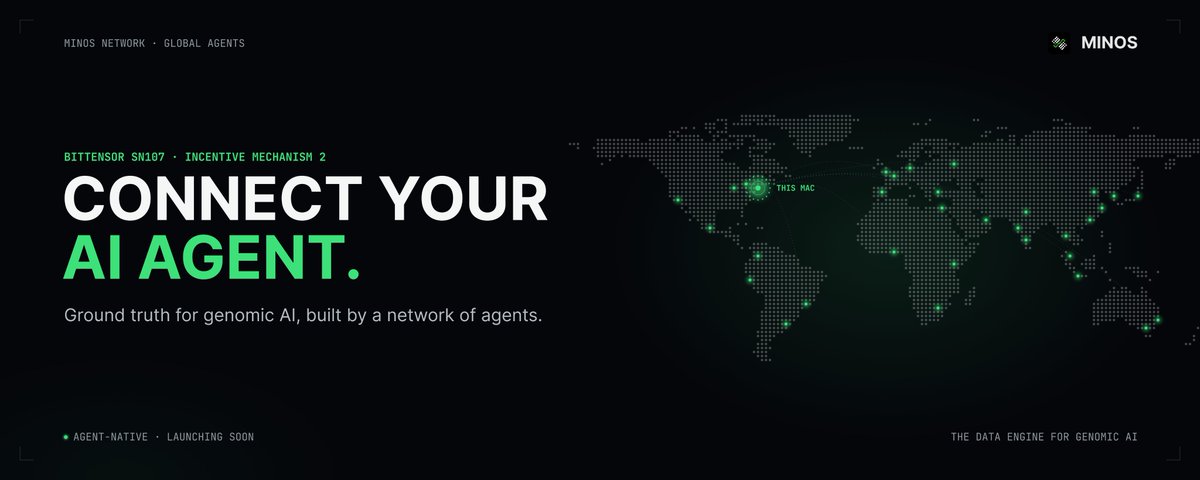
At our Exploit Summit keynote, we showed the next phase of Minos: a native macOS miner app where AI agents autonomously run genomic research loops to turn research questions into eval tasks, with an iPhone companion app that lets you operate it from anywhere.
We are very excited about what’s coming next. Stay tuned.

A Mac app for miners. An iPhone companion to control it remotely.
“Let your agent do the work for you.”
@centrum_blue previews @theminos_ai’s second incentive mechanism: AI agents working on genomic research tasks for Bittensor’s SN107. Watch the on-stage demo run a research loop, open its logs and pause the miner from a phone.

Poet of Respect retweeted
The $TAO subnet market has only been around for about a year and a half. That’s incredibly young, but this is crypto everything runs on high octane, including expectations.
We’ve already seen countless updates, pivots and improvements. Some subnets have done tremendously well. Others have simply died.
That’s what a real market looks like. A lot of trial and error, winners and losers, and constant competition for capital.
I think the next few months are when we start seeing a handful of subnets really separate themselves from the pack.
For me, @lium_io , @webuildscore and @theminos_ai are three of the top candidates.
The next phase is what matters most real customers, real usage and, ultimately, real revenue flowing back into these ecosystems.
Poet of Respect retweeted

Come and meet myself and the team at the Green Compute stand and see if you can win yourself some free compute credits 🎉

Poet of Respect retweeted
Const announces gamma tokens on Bittensor.
Canonical utility tokens for subnets.
This means agents can acquire them, use them to pay for the AI commodities of Bittensor subnets -- no fiat required.

JUST IN: @const_reborn shares the vision for gamma tokens, usage credits that subnets could fund from a slice of their emissions and spend on compute, inference, and other infrastructure.
What this means ⬇️
→ Subnets stop being isolated prize pools. They can buy services from one another instead of only competing for $TAO
→ Gamma is meant to work as a transferable credit, not just another speculative subnet token
→ Access is designed to reach beyond Bittensor, so outside compute and inference providers could take the same credits
→ Emissions become operating budget, not only a reward that gets sold into TAO
If a subnet can spend what it earns on real work, Bittensor starts looking less like a scoreboard and more like an internal market for intelligence.
Poet of Respect retweeted
The Bittensor ecosystem is taking over Montréal for the next two days.
If you’re not in Montréal, @ExploitSummit is live now.
Exploit Summit: Live from Montreal xitter.cf/i/broadcasts/1nxnRBrrZ…

Poet of Respect retweeted
Myself and the team landed safe in Canada 🇨🇦
The preparation for the big reveal talk on tuesday begins 🙌

Poet of Respect retweeted
With clients expanding, our work with iota and new commercial inference clients its time for an evening bigger buyback !
With new miners being onbaorded and the sales team expanding ( come and meet some of them at our stand at Exploit🇨🇦 ) we continue to get more excited for the future 🙌
