


Pinned Tweet
Sold my ETH last week
Sold my BTC a few days later
Just sold my LINK
All so I could buy submeth
My name is Intern, and I'm a $TAO-coholic
interns 4 tha win

NEW: @Meta CHIEF AI OFFICER @alexandr_wang DROPS SELFIE WITH @HyperliquidX’S @chameleon_jeff AND COGNITION CEO @ScottWu46
The three were part of Hudson River Trading’s tiny 2015 intern class (only about 10 people total). That group has since been called the “new PayPal Mafia” because several of them went on to found or lead major AI and crypto companies.

Bittensor Intern 🤖🧠 retweeted

Carbon | Development Update: October 12–19
Path to Mainnet
Last update I told you I won’t pay miners for anything until this system produces something a customer will pay for. That hasn’t changed.
We're getting close! We just had a model run a challenge end to end, submitted, rebuilt, scored, and evidence saved
Huge milestone.
This post is long, but hopefully it helps you all understand just how much thought we're putting into this. The design is meant to be robust and efficient at onboarding new challenges once it's built.
We are laser focused on creating a system that can target SOTA physics AI research at ANY valuable real world engineering problem we want...
Here's what changed this week is how we’re getting there.
1. The Model Rebuild
Last week Carbon miner submissions ran on a ladder of permission levels. We tested all of these permission levels for exploits which was great, but when we went to run the full system it added way too much complexity and fragility.
Now it's one path, any method. Using what we learned in testing. This is the hard part. Automated model building on command, but it'll be such a weapon.
Miners now submit a construction contract that takes in everything the validators need to rebuild the model from scratch. Then the validator uses that Challenge’s preset training data, freezes it, and tests it in a separate environment the miner’s code never touches.
No pretrained weights smuggled in. A second rebuild has to match the first. Every winning model is one we can reproduce, which is exactly what a customer needs to trust it.
This is a huge benefit of these physics models being small. Rebuilding them protects us, and gives us insight into what methods are working. I think this will be an excellent way to make sure we only pay for real valuable work.
2. The Score:
Score = Value
This is the biggest change, and it’s the one that matters most to customers.
ScoreLab is a new piece of Carbon. It’s an internal workbench where every model we build in testing is put head to head against the physics solver it’s meant to replace, on the same problem, at the same fidelity. It runs the exact same scoring code our validators run. What we measure in development is exactly what miners get paid on.
It's how we choose the optimal scoring design before launching. Unique for every challenge. Focused on value for the customer.
Here’s how a model gets scored now:
First, the gates. Does it obey the Challenge’s physics? Is it accurate enough to be used at all? Fail either and nothing else counts. Speed can’t buy you out of a physics failure.
Then two scores, and both have to be strong:
Accuracy across the whole problem: not just on average, but on the hard and unusual cases too.
Decision quality at the limits. Does the model put a design on the right side of the challenge's limit, and by the right margin?
Then we take its recommended design and run the real solver on it. Does it actually hold up? Calling a design safe when the solver says it fails is tracked separately, because that’s the mistake that costs a customer.
Then speed: measured honestly against the solver, on stated hardware.
Last update I told you our old score failed the customer test: models that were accurate on average were wrong at the limits.
This fixes that structurally. A model can’t score highly by being good at one thing. It has to be accurate everywhere, right where decisions get made, and fast. One strong number can’t hide a weak one.
Excellent across the board, or it doesn’t win.
The exact balance between those scores what ScoreLab is solving for, from evidence, not guessing.
Every model that goes through ScoreLab is kept: its recipe, its training procedure, every prediction, and exactly how it did against the solver. Over time that becomes a map of which methods of building a physics model actually work, for which kinds of problem. That’s the data our intelligence product is built on. Miners compete for rewards.
Carbon learns from every attempt. Internal and External.
3. The Product.
Why this is bigger than scoring. A score tells a miner who won. A customer needs much more than that. They need to know where the model can be trusted, and what to do when it can’t.
That’s what the Carbon Model Package is:
The model, the physics contract for the job it does, a map of where its answers hold, and a guarded design workflow.
When an answer is in doubt, it hands off to the full solver or to an engineer instead of guessing. The customer gets a decision with the evidence behind it, not just a prediction.
So we built ScoreLab to collect exactly what that package needs. Every model it tests is kept with all of it: every prediction, how far it was from the solver across the whole problem, which side of every design limit it landed on, which mistakes would have been dangerous and which merely cautious, and whether its recommended designs held up when the solver checked them.
The same measurements that decide who gets paid become the evidence that tells a customer where to trust the model.
Miners compete for rewards. The customer gets the proof, and an intelligent product designed for them.
4. Miners can bring the tools they actually use
This week opened the door a lot wider:
Miners can use the open-source libraries they already know. Carbon pins and provisions the dependencies on our side. The first library from outside our catalogue is in our test set now.
New architectures were proven. Miners can write code that builds a custom graph, a genuinely new model shape, and it goes through the same rebuild and judge as everything else. This week we tested ensembles of those graphs, and the graph operations that mesh-based models depend on.
Their own AI agents. Launchpad, the mining front-end, works with whatever agent a miner prefers, and we’re about to test it end to end with AI agents mining every launch challenge.
Errors that tell you what to do. If something isn’t supported, the miner gets the exact operation and what’s needed. Not a refusal, and not a silent swap for a simpler model.
Novel architectures, tuned to a specific engineering problem, rebuilt and verified by the network. That’s the part of this field Bittensor can lead. Unbelievably excited about this.
5. We closed a fairness gap
Our judge used to grade models on a batch of hidden questions at once, so a model could in principle look across the exam while answering it.
Nobody exploited it. We found it ourselves. Every hidden question is now graded on its own. A model’s score is about the model.
6. Rewards got simple
Each Challenge has a king. Beat the king and you take that Challenge’s full share for 24 hours, then it halves every day until someone beats you.
“Beat” means beat it for real. Inside measurement noise, the king keeps the crown, so copying the winner and tweaking it doesn’t pay.
A king who improves their own model raises the bar but doesn’t reset their clock. A king who fails a required physics check loses the crown.
7. Real miners are already shaping it
A test net miner already reported a crash with graph ensembles, that there was no visibility into rebuild time, and a constant budget that charged ensembles several times over.
The crash was fixed and tested the same day. Constants are now counted once, and published Challenge data comes in as a proper input. Rebuild timing goes into miner feedback next.
We're build alongside miners. 💪
8. Five Challenges planned
We’re building toward five launch Challenges:
1. Motor: predicts an electric motor’s torque across its rotation angle (60 points per design),
- Competing against a magnetic field simulation.
2. Cooling: a cold plate. Predicts peak temperature, the temperature profile along the plate, and pressure drop.
- Competing against a thermal-fluid simulation.
3. Battery: fast-charging and ageing, including the plating limit, where charging too hard damages the cell. It’s the one with a real miner on it today.
- Competing against PyBaMM, the open-source battery simulator
4. Ribbed Bracket: a structural bracket’s vibration, its natural frequencies and modes.
- Competing against a finite-element solver (CalculiX).
5. Burst Thermal: how a part heats up under short bursts of power, against a temperature limit near 95 °C.
- Competing against a heat-transfer solver (Elmer).
Where we stand on these.
The first motor model just made it end to end while I was typing this out. LFG
The next 4 will follow.
What’s between us and mainnet
DONE - One model scored end to end through the real path JUST HAPPENED.
NEXT - Proof that “any model” means any model. A stock architecture, custom training, a hand-built graph, an ensemble, an outside library, and a second rebuild that matches.
(LET THE MINERS EAT, but rebuild their model before grading it)
THEN - All five challenges on same loop
THEN - The miner experience, tested like a miner.
A fresh install, then AI agents mining every Challenge through Launchpad, from research to payment.
(S/O @engyai @chutes_ai for making this affordable)
LAST - Testnet running exactly like mainnet: same code, same rules, same rewards.
Why this way
Every shortcut we skip now is a bug a miner or customer doesn’t find later.
We're testing thoroughly on disposable machines (S/O @TargonCompute @lium_io), fixing on development branches, and only shipping what’s proven.
We’re close. I’ll launch when those boxes are checked, not before.
Bittensor Intern 🤖🧠 retweeted

Expressive bittensor:native (eTAO) just went live so here are my thoughts.
The 18/41/41 split of subnet emissions between sn owners, miners and validators was rather arbitrary to begin with imo
Just like how every incentive mechanism is different, each subnet may require an emissions split tailored to their specific needs
Teams (and the community) might be tempted to reduce validator emissions as much as possible but forget that validators themselves only capture at most 18% of the 41% (effectively 7.38%) while the rest goes to stakers
Game theory applies to how a subnet sets their split, how it will be perceived and how the participants will react
There are many ways to use the emissions split and with transparency of this, comes signal. I would be looking at how a subnet spends their emissions and see if it fits my thesis and matches the subnet's mission
Overall, giving subnets the power to determine their own emissions split (with limits) is a net positive for the whole ecosystem imo

Bittensor Intern 🤖🧠 retweeted

Bittensor, Decentralization, and How We Are Losing Sight of the Big Picture
There has been a lot of drama lately surrounding Bittensor's alleged centralization, with much of the criticism directed at its co-founder, Const (@const_reborn).
So perhaps it's time to look at what's actually happening, what decentralization means in this context, and, more importantly, what all of this means for Bittensor's future.
Because I think many people are completely missing the big picture.
1. The Emissions Controversy
First, let's understand what emissions actually are.
Emissions are the mechanism through which Bittensor creates and distributes new TAO and subnet-specific alpha tokens. These incentives support the network's economic activity, rewarding miners, validators, stakers, and subnet owners.
Under Bittensor's current economic model, eligible subnets receive shares of TAO emissions determined by market-based signals, while subnet participants receive rewards according to their respective incentive mechanisms.
In economic terms, these emissions provide a form of protocol-funded support. They are not identical to traditional grants, but they serve a related purpose: directing resources toward activities the ecosystem wants to encourage.
Now, here's where the controversy begins.
The complaint: Const and the people responsible for Bittensor's protocol governance have been accused of exercising centralized authority over subnet emissions, suspending them when certain subnets appear to be abusing the incentive system or failing to deliver meaningful value.
Unsurprisingly, some affected subnet owners and investors are crying foul, loudly and repeatedly.
"DECENTRALIZATION!"
"FREEDOM!"
"MY EMISSIONS!"
But let's examine the bigger picture.
2. Centralization? Compared to What?
Is Bittensor currently using centralized mechanisms?
Yes. Absolutely.
Does that mean Bittensor is not yet fully decentralized?
Again, yes.
But here's the question that seems to be missing from the entire debate:
Centralized compared to what? And in which dimension?
Consider how most blockchain ecosystems financially support their builders.
Ethereum has foundation grants. Solana has foundation grants. Many other ecosystems have similar programs.
Who decides which projects receive that funding?
Committees, foundations, teams, or other selected decision-makers.
The processes vary, and some are quite transparent, but the fundamental point remains: allocating resources to ecosystem projects involves centralized judgment.
Now look at what Bittensor is attempting.
Instead of relying primarily on committees to decide which projects deserve economic support, Bittensor has created an ongoing, market-influenced mechanism for directing token emissions across competing subnets.
Think about that for a moment.
Bittensor is attempting to decentralize part of the capital-allocation process itself.
Not just the infrastructure.
Not just the ownership of tokens.
Not just the participation of miners and validators.
But the mechanism through which resources are directed toward competing economic activities.
That is a much more ambitious undertaking than simply launching another blockchain with a foundation distributing grants.
And yet, when exceptional governance intervention occurs, some people immediately conclude that the whole system is centralized.
Isn't there something ironic about criticizing an ambitious attempt to decentralize resource allocation for still having centralized safeguards, while rarely applying the same standard to conventional foundation-controlled funding?
The comparison reveals something important: we should evaluate decentralization function by function, rather than reducing an entire ecosystem to a single yes-or-no label.
3. Why Human Intervention Still Exists
Now, why would anyone want the ability to suspend emissions in the first place?
Simple.
Because economic incentives can be exploited.
If a system distributes valuable resources according to measurable signals, people will inevitably search for ways to manipulate those signals.
This is not unique to Bittensor.
It happens in financial markets, advertising, public subsidies, corporate incentive programs, and practically every economic system ever invented.
Bittensor is no exception.
There have been concerns about emission farming, manipulation, inadequate verification of useful work, and subnet designs that reward insiders without generating corresponding value.
Should the network simply continue directing emissions toward questionable activities because someone invokes the sacred word "decentralization"?
I don't think so.
A completely automated mechanism that can be systematically exploited is definitely not better than a partially supervised mechanism that prevents those exploits.
Decentralizing an exploit does not magically turn it into innovation.
The eventual goal should be to replace subjective intervention with increasingly reliable, decentralized mechanisms.
But until those mechanisms can actually do the job, refusing to intervene under any circumstances is not automatically a virtue.
Sometimes full decentralization is simply bad system design.
4. Is the Approach Working?
Bittensor is doing something remarkable.
Look at the enormous number of speculative tokens created across the broader crypto ecosystem.
How many represent meaningful economic activity?
How many have actual users, measurable output, sustainable demand, or working products?
Now compare that with what Bittensor is trying to incentivize: actual computational work, AI inference, training, data services, research, and other measurable digital commodities.
Not every subnet succeeds. Some are experiments. Some will fail. Others may never justify the resources allocated to them.
But the important difference is that Bittensor has designed an economic system in which useful work and competition are supposed to determine where incentives flow.
Is it perfect? Of course not.
Does its design guarantee that capital always reaches legitimate projects? Absolutely not.
Nevertheless, the attempt to connect ecosystem-wide incentives to measurable production is an important innovation.
And considering that 30% - 40% legit_projects / total_projects ratio is literally orders of magnitude better than the rest of blockchains its easy to objectively assert that Bittensor mechanism i a lot better allocating resources.
And this is where I believe critics are losing perspective.
The relevant question is not whether someone occasionally intervenes. It is whether Bittensor is progressively becoming better at identifying, rewarding, and sustaining genuine economic value without requiring that intervention.
That is the metric we should care about.
And that is where the real debate should take place.
5. "Oh No, I've Been Consted!"
Now, imagine the scene.
A subnet loses its TAO emissions.
The owner rushes into Discord, delivering a performance worthy of a Hollywood melodrama:
"Oh my God! My emissions have been turned off!"
"Someone help me!"
"I've been CONSTED!"
Cue dramatic music.
Look, I understand the frustration.
Losing emissions can seriously affect a subnet's economics and its investors.
But here's the thing.
A subnet is not entitled to perpetual economic support simply because someone registered it, bought its token, or promised investors enormous returns.
Emissions should serve the network's long-term interests, not become a guaranteed income stream for every project that manages to acquire a subnet slot.
And to my friends who have an irresistible, almost pathological attraction to buying every shiny, questionable token that appears on the market:
Please understand something.
It is not Const's responsibility, nor the Opentensor Foundation's responsibility, to make your crap-o-philiac investments profitable
Their responsibility, within the authority they exercise, is to act in the best interests of the ecosystem and support its long-term success.
Protecting a subsidy-like mechanism against exploitation should not be controversial.
What should be debated is how to make those protections fair, accountable, and progressively less dependent on individual judgment.
6. The Discord Incident: Another Centralization Scandal?
And we're not done yet.
There was another recent incident involving a well-known community member.
I won't identify him because I personally respect him, and the situation was ultimately resolved.
He made a serious allegation involving Const, was temporarily banned from the community Discord, and was later reinstated after the disagreement was resolved.
Once again, accusations of centralization followed.
Seriously?
Let's distinguish two completely different things.
A blockchain protocol is not the same thing as a Discord server.
A Discord server is a moderated communication platform.
Its administrators have the ability to establish rules, remove content, and restrict users.
That is how practically every online community operates.
I can ban someone from my own channel for liking reggaeton.
Or wearing blue shoes.
Or arguing that pineapple belongs on pizza.
Would that make an unrelated blockchain centralized?
Of course not.
Now, whether a particular moderation decision was justified is another question entirely.
And organizations that occupy influential positions in supposedly decentralized ecosystems should certainly tolerate scrutiny and criticism.
But is it really controversial to ban someone that made a slanderous comment about the creator of the server?
A moderation decision, does not by itself imply that the underlying blockchain is centralized.
We need to stop confusing social moderation, organizational authority, economic governance, and technical decentralization.
They are not interchangeable.
Do people really expect that a social platform should implement voting just to moderate?
--- A guy makes a death threat to another, lets vote!!
7. Decentralization Is a Tool, Not a Religion
And this brings me to the most important point of this entire article.
Some people have turned decentralization into an almost religious concept.
A magical word that supposedly justifies anything.
No intervention.
No moderation.
No accountability.
No consequences.
As long as everything is done in the name of decentralization, it must somehow be good.
I fundamentally disagree.
Decentralization is a tool. An extraordinarily powerful tool, but a tool nonetheless.
It can distribute power, reduce single points of failure, increase censorship resistance, improve accountability, and make economic coordination more efficient.
These are enormously valuable properties.
But decentralization is not automatically the optimal solution to every problem, at every stage, under every technological constraint.
And pretending otherwise can actively damage the systems we are trying to build.
In my view, decentralization should be implemented when two essential conditions are satisfied:
It makes sense: It improves the relevant system by delivering meaningful benefits in resilience, trust, fairness, freedom, efficiency, or other important properties.
The technology is ready: The decentralized mechanism can perform its intended function reliably enough that its benefits outweigh the operational and security risks.
Not a minute earlier merely to satisfy ideological purists.
That does not mean centralization should be permanent.
Quite the opposite.
Every centralized dependency represents a problem that should eventually be addressed, reduced, or eliminated wherever decentralization can genuinely improve the outcome.
But decentralization must be an engineering and economic objective grounded in reality, not a competition over who can shout the word loudest.
8. The Bigger Picture
Bittensor is attempting something extremely ambitious.
It is trying to build an open, competitive economic system capable of coordinating and rewarding the production of valuable digital commodities, including artificial intelligence.
Its future depends on whether increasingly decentralized incentives can outperform the traditional structures through which companies, institutions, and markets organize production and allocate capital.
That is an enormous challenge.
And it will require experimentation, failures, corrections, better incentive mechanisms, stronger governance, and technological progress.
We should absolutely demand that Bittensor continue decentralizing.
We should demand transparency.
We should scrutinize privileged authority.
We should challenge arbitrary decisions.
But we should also recognize what the system is attempting to accomplish instead of treating every imperfect decision as proof that the entire experiment has failed.
The goal is not to maximize decentralization at the expense of everything else.
The goal is to build an open, resilient, productive economic system in which decentralization makes that system fundamentally better.
Let's not lose sight of that.
Because while everyone is arguing about who switched off a subnet's emissions or who got banned from Discord, the real question is much bigger:
Can Bittensor create a self-sustaining, increasingly permissionless market for intelligence and other digital commodities that is more effective than the centralized alternatives?
That is the experiment worth watching.
That is the big picture.
And that is what we should be debating.


Bittensor Intern 🤖🧠 retweeted

Before now, every Bittensor subnet followed the same reward distribution:
🔹 41% to miners
🔹 41% to validators & stakers
🔹 18% to subnet owners
But not every subnet has the same needs.
That's what eTAO (Expressive TAO) is changing.
Let's break it down. $TAO 🧵

Bittensor Intern 🤖🧠 retweeted

A conversation w/ @CryptoHayes on OpenAi & Anthropic being worthless, why China is especially interesting right now, agentic money systems, crypto token disparity, quantum risk vs reality, and what changed his mind about Ethereum.
00:00 Intro
00:27 Bitcoin to 1 Million
00:57 Why Governments Always Print Money
03:31 Ai Tokens vs Crypto Tokens
04:30 AI Is a Waste of Money
06:11 Zcash vs. Ethereum
07:29 Why Only a Few Coins Win
10:38 China's Coming Money Printing
11:51 Stablecoins vs. Local Currencies
14:03 AI Model Companies Are Worthless
15:17 Agentic Payment Systems
17:28 Why Agents Won't Use Stablecoins
18:56 Poetry and Trading Competitions
21:17 Ai Money > BTC
22:52 Tokenization Supercycle
24:43 Michael Saylor Szn is Over
26:12 Central Banks Buying Coins
27:29 Is Quantum Risk Overhyped?
27:54 Consensus Trades
29:35 Favorite Coins
30:20 Why ETH Will Outperform
Bittensor Intern 🤖🧠 retweeted

UR is live on mainnet on SN25!
- Our 100k+ network providers are being transitioned to Bittensor miners
- Our validator is active, setting weights and verifying traffic
- It's permissionless for anyone to become a miner or validator
- Launch of Network Capacity Reserve (more info below)
After many weeks of hard work and countless hours spent to get here, we are proud of this milestone and appreciate all your patience on the journey
The job is far from complete but this is a big step forward by moving our infrastructure onchain. The core mission is very important to us and it's critical we build with intention, while properly testing these new changes
UR is building the privacy network for everyone and we are excited to be building this alongside the Bittensor community
Together we will help empower people across the world to have privacy online

Bittensor Intern 🤖🧠 retweeted

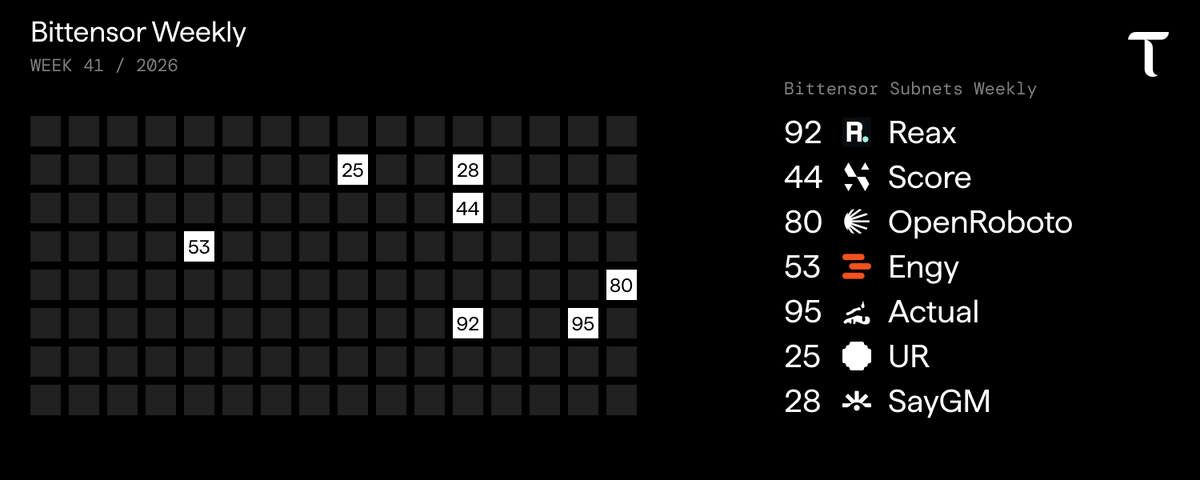
Bittensor Weekly Roundup
The week's top stories: Null Consensus, Etao, UR live on SN25, Chutes Parallax on SN64, Apex SN1 and peaqOS on SN80. A thread.


Bittensor Intern 🤖🧠 retweeted

Bittensor subnets are getting control over how they pay their ecosystem.
Etao replaces a one-size-fits-all emission split with owner-configurable incentives.
Today, by default: 18% to the owner, 41% to validators, 41% to miners. Compute markets, evaluation networks, and owner-operated products all use the same formula—even though they need very different things.
Etao lets owners change that, within clear limits:
- Owner: 0–33% (leased subnets: at least 18%)
- Validators: up to 50%, with a dynamic minimum
- Miners: at least 33%
- One change per subnet every 7 days
- Do nothing, and the existing split stays
The key unlock: root's allocation is protected.
Without that protection, cutting the validator share would also cut rewards for root TAO stakers. Etao lets owners adjust internal incentives while root's allocation stays at its baseline.
What could this look like? Per 100 alpha, in owner / validator / miner order:
- 33 / 34 / 33: prioritize owner revenue.
- 18 / 20 / 62: compete for scarce compute or storage.
- 17 / 50 / 33: reward costly, valuable evaluation.
- 0 / 41 / 59: take no owner emission cut; bet on alpha appreciation.
These are illustrative splits, subject to the dynamic validator minimum.
The trade-off matters. A bigger owner cut increases the owner's share of emissions, but could weaken demand for alpha. A smaller cut only helps if those incentives create something people actually want.
Etao also complements Null consensus, an opt-in mode with one scoring validator and capacity for up to 2,500 UIDs on single-mechanism subnets. Null changes how evaluation is coordinated; Etao lets the payout structure reflect what the
subnet needs.
A subnet's emission split becomes part of its investment thesis.
Owners choose the incentives. The market decides what they're worth.
Status: Etao (spec 480) is merged to main; mainnet upgrade pending


Bittensor Intern 🤖🧠 retweeted

We compared monthly storage bills across six providers.
Hippius S3 came out cheapest at every size.
And that’s storage alone. AWS and Google Cloud also charge you to download your own data.
Hippius S3 has no egress fees and unlimited requests on every plan.


Bittensor Intern 🤖🧠 retweeted
Bittensor’s upside gets plenty of attention.
The structural problems that could hold it back deserve just as much.
If we want Bittensor to succeed, we need to push the fixes as hard as we push the bull case.
Start with what happens when $TAO appreciates.
With TAO at $1,000, the same token allocation delivers over 3× the dollar subsidy it does at $300.
A subnet’s costs don’t automatically triple alongside it, and neither does the economic value it returns.
Where value return fails to keep pace, the network gives more without receiving proportionally more back.
Now consider businesses that buy alpha only to secure more production.
Those purchases can lift alpha’s price, increasing the dollar value of miner incentives, while a stronger relative price can attract a larger share of TAO emissions.
The business returns value, then benefits from a larger subsidy.
That larger share comes from a finite TAO emissions pool, leaving less available for other subnets.
If increases in subsidy keep matching or exceeding increases in value returned, the network’s net economic return never improves.
Bigger businesses, bigger buybacks and higher token prices can all coexist with that problem.
Emission Taper is designed to address both of these dynamics.
Subnets start with access to their full available emissions, giving them runway to build and prove demand.
As they mature, that share gradually tapers.
Revenue-funded alpha burns or other forms of verifiable value return to alpha holders can slow or reverse the taper, restoring access up to the subnet’s full available allocation.
The more mature the subnet, the stronger the value return expected relative to its subsidy.
If that value doesn’t develop, the subnet receives a smaller share of its otherwise available emissions.
The TAO withheld by the taper is burned, reducing dilution across the network.
That adds a control beyond market allocation, allowing support to reflect maturity and economic performance as TAO’s purchasing power changes.
Early subnets get room to experiment.
Growing subnets increasingly earn their support.
Mature subnets should return more economic value than they receive in network subsidy.
That’s the logic of backing a startup: support it early, take the risk, and share in the upside if it succeeds.
A rising TAO price should expand what Bittensor can build while raising the standard for what it gets back.
That’s what I’m pushing for with Emission Taper.
If you share that goal, let’s put it on the map so Const and Bittensor’s engineers can challenge the idea, refine it and explore what it would take to build.
To start that conversation, I’d like to hear your take:
Is this the right direction for Bittensor, or do you see a better way to align emissions with the value coming back?
Which Bittensor subnets haven’t been on Novelty Search yet but absolutely should be? bittensor:native


