






Pinned Tweet
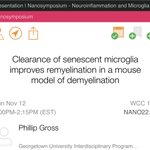
Excited to finally have this published! Out today in @NatureComms, we show that following demyelination in a mouse model of Multiple Sclerosis, treatment of senescent microglia with senolytics leads to improved remyelination. nature.com/articles/s41467-0…
1/3

Phil Gross, PhD retweeted

The brain & immune system are more connected than ever imagined. In this issue of @ImmunityCP, 9 articles explore major advances & future directions in neuroimmunology. Take a look! hubs.li/Q03lzQ3H0

Phil Gross, PhD retweeted

Today in @Nature, we report human sensory #assembloids—the most complex 3D assembloids to date—comprising four integrated parts to recapitulate aspects of the spinothalamic pathway that processes pain stimuli. We use this model to investigate cellular/early circuit level features of genetic pain syndromes. More details to follow.
Work pioneered in the lab by the brilliant Ji-il Kim and Kent Imaizumi, and in close collaboration with @GregScherrer25!
Link below 👇

Phil Gross, PhD retweeted

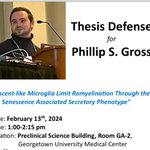
Senescent-like microglia limit remyelination through the senescence associated secretory phenotype
nature.com/articles/s41467-0…
Phil Gross, PhD retweeted

Excited that @PhilgrossPhD’s paper in the role of senescence in remyelination has now been published in @NatureComms! Congratulations Phil and thanks to all the lab members @thegliaguy @Zeebamehrin and collaborators @SchaferLabUMass @jrplemel @Meng2Fu for working with us in this project. And thanks to the reviewers and editor for feedback and encouragement on this work. 😀

Excited to finally have this published! Out today in @NatureComms, we show that following demyelination in a mouse model of Multiple Sclerosis, treatment of senescent microglia with senolytics leads to improved remyelination. nature.com/articles/s41467-0…
1/3
We find this is (partially) mediated by CCL11, which we find is sufficient to limit oligodendrocyte maturation, and has been shown to impair neuro-regeneration w/ age and is involved in long covid neurological deficits (as shown by @VilledaLab @wysscoray @michelle_monje)
2/3
1
4
228
A big thank you to my mentor @jeffreyhuang and members of the lab @Zeebamehrin @thegliaguy and all of our collaborators who were amazing to work with @SchaferLabUMass @Viole_DL @Meng2Fu @jrplemel @zia_sameera
3/3
Phil Gross, PhD retweeted

It's clear that many do not understand what @NIH-funded research does to improve health. It's time to revive a study published 10 years ago that provides incredible information about this. link in the comment
Every single new drug approved by the FDA from 2010–2016 was built on NIH-funded research—that’s all 210 drugs. But what the public sees is just the tip of the iceberg.
Pharma takes credit for the final product, but beneath each drug developed, there are ~20 years of basic research, and 90% of the cost is from basic research funded by the NIH, which discovers drug targets, understands disease mechanisms, and creates life-saving treatments.
Figuring out how cancer evades the immune system, how addiction rewires the brain, and how heart disease develops is the role of the NIH, creating the foundation for the breakthrough drugs that come 20 years later, and the NIH does all that with only 0.8% of the US budget.
Without NIH, there would be no cancer immunotherapy, no anti-overdose medication, no anti-heart attack or stroke medication, no cutting-edge treatments.
If NIH funding is cut, the iceberg will melt. That means fewer cures, more suffering, and more lives lost.
The science beneath the surface keeps us afloat.
Invest in NIH. Invest in life

Best explanation I’ve read of what is happening here at the NIH and NIH related research at universities. Effects will last generations and are likely irreversible, by @samstein: thebulwark.com/p/the-doge-br…

78
Phil Gross, PhD retweeted
Excited that George Melchor @thegliaguy's snRNAseq analysis of CNS #remyelination is now in Biorxiv... Remyelination is complicated, it takes a village. Congrat George on your excellent work! Thanks @Zeebamehrin @Jingwen_SMyelin and @Maryna_Baydyuk for contributing to this study. 😀

Dissecting the evolving cellular landscape of a remyelinating microenvironment biorxiv.org/cgi/content/shor… #biorxiv_neursci
Phil Gross, PhD retweeted
Our 2024 CSHL conference on human brain development and stem cell models is in full swing, with over 300 participants!
This year’s event features exciting new discoveries and dynamic discussions, driven largely by the energy & insights of trainees.
A privilege to organize this meeting with Guo-Li Ming @UPenn_SongMing!
#Assembloids #Organoids #Brain
#CSHL2024Brain

Phil Gross, PhD retweeted

Doing good science is 90% finding a science buddy to constantly talk to about the project.

Phil Gross, PhD retweeted

Hear how researchers at the Centre for Alzheimer’s & Related Dementias are gaining a better understanding of the genetics behind neurodegenerative diseases.
Discover how using the #PromethION they scaled-up their workflow to sequence thousands of samples rapidly.
Phil Gross, PhD retweeted

Happy to see our latest manuscript on the minimal set of markers to identify senescent cells in vivo out! Big effort with many excellent colleagues cell.com/cell/fulltext/S0092… @Demarialab1 @UMCG_ERIBA @researchumcg

Phil Gross, PhD retweeted

Not properly a brain organoid, but still pretty interesting findings | A glia-enriched stem cell 3D model of the human brain mimics the glial-immune neurodegenerative phenotypes of multiple sclerosis
sciencedirect.com/science/ar…
Phil Gross, PhD retweeted

Excited to have Michel Fallah's preprint out!
Here we find surprising effects on locomotion and valence when stimulating basal ganglia inputs to the PPN in vivo.
And we comprehensively map the SNr and GPe synaptic connections to all the cell types in the PPN.
Inhibitory basal ganglia nuclei differentially innervate pedunculopontine nucleus subpopulations and evoke opposite motor and ... biorxiv.org/cgi/content/shor… #biorxiv_neursci
Phil Gross, PhD retweeted
Congratulations to Megan Beaver on her first first author pre-print!
She shows that muscarinic receptor activation on dopamine neurons reduces their ability to rebound from inhibition. Importantly, we find that this is selectively happening in vulnerable SNc neurons.
Muscarinic receptor activation preferentially inhibits rebound in vulnerable dopaminergic neurons biorxiv.org/cgi/content/shor… #biorxiv_neursci
Phil Gross, PhD retweeted

Check out our cool study!
Senescent cell clearance ameliorates temporal lobe epilepsy and associated spatial memory deficits in mice biorxiv.org/content/10.1101/…

Phil Gross, PhD retweeted

We are looking for a postdoctoral researcher to pioneer spatial omics techniques in conjunction with human organotypic brain slices culture to study AD/FTD @ NIH CARD! Please RT 🧠
training.nih.gov/jobs/pdf-ad…
Phil Gross, PhD retweeted
Senescent-like microglia limit remyelination through the senescence associated secretory phenotype | bioRxiv biorxiv.org/content/10.1101/…
