

This account is not monitored and content is automated. Join us also on Bluesky https://xitter.cf/t.co/xFwXVzkZIZ
- Tweets1.8K
- Following376
- Followers3.6K
- Likes653
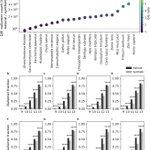










ALT Our brains generate electrical signals whose unique patterns reveal information about aging, health, and even thoughts. This information is useful for studying brain disorders and developing novel therapies. However, traditional analysis methods can miss subtle but important brain-activity patterns. GREEN, introduced here, is an AI model that readily decodes brainwave patterns. By combining innovative mathematical tools with deep learning, GREEN detects subtle changes in brain activity with a low computational footprint while providing interpretable outputs that reveal insights into brain function.


ALT A picture of a cityscape with colored lines representing a network of data, overlaid with the text "Patterns, Urban sustainability and data science, Calling for papers now".


ALT Banner of the 5th annual Rising Black Scientists Awards, with digonal stripres in red, grey, light blue and dark blue. Logos of Cell Press, the Elseveir Foundation, and Cell Signaling Technology


ALT Nobel Prize in Chemistry: Read our related articles

ALT The pioneering work of John J. Hopfield and Geoffrey E. Hinton on neural networks laid the foundation for modern machine learning and AI. Their success shows the potential of interdisciplinary work bridging fields like physics, biology, and computer science. Congratulations!

ALT Read releated articles to theThe Nobel Prize winners in Physics


ALT Photo of scattered puzzle pieces on a table. The puzzle pieces are colored acrylic slices of cells from EM data that can be stacked on top of each other to reveal what the cells look like in 3D.

ALT Close up of a few of the puzzle pieces. A light blue mitotic cell has chromosomes in dark blue.

ALT Sketches of a sectioned dividing cell are shown in a hand-drawn art style. Image credit: Mol Mir.


ALT THE BIGGER PICTURE: Machine learning (ML) has a pseudoscience problem. An abundance of ethical issues arising from the use of ML-based technologies—by now, well documented—is inextricably entwined with the systematic epistemic misuse of these tools. We take a recent resurgence of deep-learning-assisted physiognomic research as a case study in the relationship between ML-based pseudoscience and attendant socialharms—the standard purview of ‘‘AI ethics.’’ In practice, the epistemic and ethical dimensions of ML misuseoften arise from shared underlying reasons and are resolvable by the same pathways. Recent use of ML toward the ends of predicting protected attributes from photographs highlights the need for philosophical, his- torical, and domain-specific perspectives of particular sciences in the prevention and remediation of misused ML


