Willie Aaron Lewis retweeted
#PPOD: The First Look at Venus
On October 22, 1975, the Soviet Union's Venera 9 spacecraft made history by transmitting the first photograph from another planet's surface. Landing on Venus at about 32° south latitude, the spacecraft survived for 53 minutes in crushing atmospheric pressure and temperatures hot enough to melt lead.
The black-and-white panorama reveals a rocky landscape dominated by angular, partially weathered stones roughly 30–40 centimeters across, many partly buried in soil. The bright white shape at the bottom is part of the lander, while the scene's curved appearance results from the camera's imaging system. Although Venera 9 returned only this single view, it gave humanity its first direct glimpse of Venus's surface, transforming a world hidden beneath thick clouds into a place we could finally see.
Credit: Soviet Academy of Sciences
#otd #planetaryscience
Willie Aaron Lewis retweeted
Eight Expedition 75 crew members gather inside the International Space Station’s Destiny laboratory module for a daily planning conference at the end of their shift.
📸 NASA
Willie Aaron Lewis retweeted

The Space Tech Guy@ThespacetechguyOct 22
Saudi Arabia!
Saudi ArabiaConnected via Saudi Arabia App StoreLocation may be affected by a proxy or VPN.Account-level information, not a live location or per-post device.
Sunrise today from Stonehenge 🌅 ☀
Willie Aaron Lewis retweeted
The Trifid Nebula (M20) is a rare fusion of phenomena: newborn stars in a loose cluster, ionized gas glowing red, blue starlight scattered by dust, and dark filaments dividing the scene.
(Credit: RubinObs/NOIRLab/SLAC/NSF/DOE/AURA)
Willie Aaron Lewis retweeted
🌕 Could the Moon be a billion-year archive of ancient alien technology?
Unlike Earth, the Moon has no atmosphere, oceans, or plate tectonics to continually erase its geological history. That makes lunar regolith a promising place to search for microscopic technosignatures that may have traveled across interstellar space.
On #SETILive, SETI Institute Affiliate Scientist Lewis Pinault explains why the Moon could preserve evidence of technological civilizations from billions of years ago.
🔬 Watch the full conversation with host Simon Steel: youtube.com/live/dBAUleB7SJs
Willie Aaron Lewis retweeted
IC410 - The Tadpoles Nebula!
The Tadpoles Nebula, also known as IC410, is a captivating dusty emission nebula situated in the constellation of Auriga, approximately 12,000 light-years away from Earth.
I took this image in late December, my longest integration time yet! 19hrs
Willie Aaron Lewis retweeted
I imaged The Great Orion Nebula for the 1st time in 15yrs!! More details on my website blog! (In Profile) Hope you enjoy this one, it was a challenge!!
#Astrophotography #Space #Nebula #Stellarvue #Orion #RASC
Willie Aaron Lewis retweeted
Apply for time to the CHEOPS Running Call ! Only this month (October) and in April you will be able to apply for Large proposals of up to 500 CHEOPS orbits (800 hours)! Monthly you can apply for regular proposals of up to 120 CHEOPS orbits and for our HST/JWST Fast Track!
cosmos.esa.int/web/cheops-gu…
Willie Aaron Lewis retweeted
🚀 Want to help discover new planets? 🪐
Explore 9,000 real stellar light curves from ESA’s CHEOPS space telescope and help spot exoplanetary transits, stellar flares & more! 🔎✨
🎬 See it in action & join us!
👉 zooniverse.org/projects/bmer…
#CitizenScience #Exoplanets
Willie Aaron Lewis retweeted
A Hydrogen Atmosphere Could Keep Exomoons Habitable For Billions Of Years
astrobiology.com/2026/10/17/… #astrobiology #exoplanet #exomoon
Willie Aaron Lewis retweeted
Six New Planets, Including One Planetary Toddler👶
At less than a million years old, Elias 2-24 b may have broken a record for the youngest known exoplanet.
Fun Fact: @keckobservatory data confirmed it!
exoplanetarchive.ipac.caltec…

ALT Artist’s concept depicting Elias 2-24 b, the youngest exoplanet detected to date, still growing within the disk of gas and dust surrounding its young host star. Material from the disk is actively accreting onto the Jupiter-mass planet, which sits within a prominent gap in the disk, supporting the leading theory of giant planet formation. W. M. Keck Observatory/Adam Makarenko
Willie Aaron Lewis retweeted
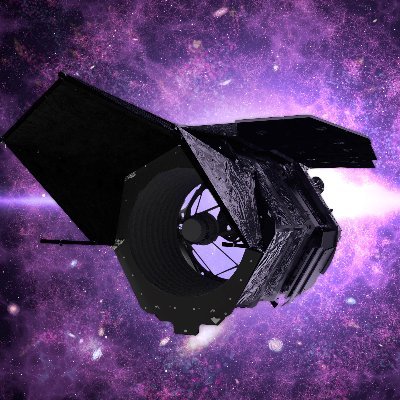
The Nancy Grace Roman Space Telescope has been named one of TIME's Best Inventions of 2026.
Roman continues its journey in space to its final orbit, completing critical milestones along the way. We expect first images by early 2027.
go.nasa.gov/4yQuwkb
Willie Aaron Lewis retweeted
Deadline Alert: Last Chance to Apply! 🚀
Applications for both #ExoExplorers and #ExoGuides close tomorrow, Oct. 15, at 6 pm PST. Learn about the program and submit your application today:
science.nasa.gov/astrophysic…
🙌NASA's Exoplanet Explorers Program is back!🙌
Elevate your career with NASA #ExoExplorers! Ten early-career exoplanet researchers will unlock world-class mentorship, high-impact professional growth, and $1,200 for delivering a featured science talk.
science.nasa.gov/astrophysic…

ALT This graphic contains information about the 2027 Exoplanet Explorers Call for Applications. The program is open to early-career researchers from U.S. and international institutions. Applications are due by 6 p.m. PST October 15, 2026. The image in this graphic illustrates a solo explorer in a spacesuit walking on the surface of a rocky exoplanet with two suns.
Willie Aaron Lewis retweeted
The Nobel Prize in Physics celebrates the study of cosmic neutrinos, but self-styled neutrino hunters aren’t content to wait for the leptons to naturally occur. We’re on a Collision Course on @bipisci.
Listen here: bigpicturescience.org/episod…
#podcast
Willie Aaron Lewis retweeted
How do scientists measure nitrogen disappearing from an ecosystem?
A new @ScienceMagazine study co-authored by SETI Institute Senior Research Scientist @daleandersen shows that the natural abundance of a rare form of nitrogen gas, ¹⁵N¹⁵N, can directly trace biological nitrogen loss.
By distinguishing biologically produced N₂ from atmospheric nitrogen, the method revealed nitrogen loss that can be missed by traditional approaches across environments ranging from aquifers and lakes to coastal basins, oxygen minimum zones, and marine sediments.
The work offers scientists a new way to better understand the nitrogen cycle — one of the fundamental processes that supports life on Earth.
🔗 Read the study: science.org/doi/10.1126/scie…
1/2
Historic view of Jupiter’s volcanic moon Io from New Horizons, at 2.3 million km.
The red dot is glowing magma at the Tvashtar eruption site; the blue plume is fine dust particles lofted hundreds of km high and catching sunlight.
A rare, detailed look at Io’s extreme activity from New Horizons’ Jupiter flyby.
Io is the Solar System’s most volcanically active body, heated by intense tidal forces from Jupiter.
This crescent image captures Tvashtar volcano in full eruption.
The blue color comes from sunlight scattering off tiny ejected particles, much like blue smoke.
Only the blue (~480 nm) & methane (~890 nm) channels of MVIC were usable: the red and near-IR filters overexposed on Io’s dayside because the instrument was designed for much dimmer Pluto.
The high-resolution LORRI grayscale supplied the sharp detail that was then colorized with those two bands.
Taken during New Horizons’ Jupiter flyby (closest approach 28 Feb. 2007; this view from the outbound leg on 1 March).
The spacecraft obtained multiple views of Tvashtar’s large, structured plume, including the first-ever movie of an Io volcanic plume in motion.
A key early result of the mission.
At this range the LORRI resolution was roughly 11–12 km per pixel.
Merging its sharp panchromatic data with the lower-resolution color information reveals both surface texture and the striking red-hot lava / blue dust contrast—an enduring image of Io’s violent geology.