

Let's Go Explore some Exoplanets!
- Tweets37.5K
- Following5K
- Followers2.2K
- Likes32.7K







ALT Rocky, boulder-strewn Venusian surface photographed by Soviet Venera‑9 lander in high-contrast black-and-white; caption reads "VENERA‑9 22.10.1975 — processed 28.2.1976."


ALT Looking toward the north from Mullion, New South Wales, Australia, the Andromeda Galaxy never gets more than a few degrees above the horizon. During the southern hemisphere spring, Andromeda is highest in the sky around midnight though. And in this telephoto scene from October 10/11, multiple exposures were used to reveal the spiral galaxy in tantalizing detail as it climbed above rolling Australian hills. Also known as M31, the Andromeda Galaxy is one of the brightest objects in the Messier catalog, but is only visible to the unaided eye as a small, faint, fuzzy patch. Digitally tracked and stacked frames were combined with a foreground shot in the deep astro-image composite to reveal the galaxy's greater extent in planet Earth's night. In the springtime night skyscape,the closest large spiral galaxy spans nearly 6 full moons.


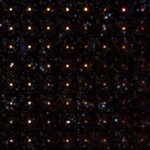
ALT NASA's SPHEREx space telescope has turned its infrared eyes toward 37 nearby brown dwarfs, revealing a remarkable diversity of objects that bridge the gap between stars and giant planets. Brown dwarfs form much like stars but lack the mass needed to sustain hydrogen fusion in their cores. The objects in this collection range in temperature from about 2,200 down to 253 Kelvin, with some cool enough to have atmospheric temperatures comparable to Earth's. By observing each object across 102 infrared wavelengths, SPHEREx can identify chemical signatures of water vapor, methane, carbon dioxide, and carbon monoxide in their atmospheres. Surprisingly, brown dwarfs with similar temperatures can exhibit very different atmospheric compositions and cloud properties, offering scientists new clues about how these unusual worlds evolve. Their atmospheric chemistry also provides valuable comparisons for studying giant exoplanets beyond our solar system.

ALT Stars trace luminous arcs across the sky above Earth in this long-duration photograph captured from the International Space Station on September 20, 2026. Orbiting approximately 415 kilometers above the Banda Sea, the station passed over Indonesia, where blue lights from fishing boats and yellow lights from cities illuminate the darkness below. The sweeping star trails result from the station's motion as it circles Earth, making the stars appear to move across the camera's field of view during the extended exposure. The contrasting lights below reveal another fascinating aspect of our planet at night: human activity visible from orbit, from densely populated coastlines to fishing fleets working far offshore. Together, the celestial arcs and terrestrial lights capture the remarkable perspective of astronauts living and working above our world.

ALT More than a century after the first photographs of the Orion Nebula, NASA's Hubble Space Telescope revealed something extraordinary in this familiar stellar nursery: young stars surrounded by gas and dust disks. Released on December 29, 1993, this view helped transform our understanding of how planetary systems form around newborn stars. These structures, known as protoplanetary disks or proplyds, contain material that may eventually assemble into planets. Some appear as dark silhouettes against the nebula's glowing gas, while others shine as radiation from nearby massive stars illuminates and erodes their outer layers. Hubble's observations provided some of the first direct visual evidence that disks capable of forming planetary systems are common around young stars, offering a glimpse of processes that shaped our own solar system billions of years ago.

ALT The Milky Way stretches across the night sky above ESO's La Silla Observatory in Chile's Atacama Desert, framed by two of the observatory's telescopes. The brilliant star clouds and dark lanes of interstellar dust reveal our galaxy's rich structure, while the Lagoon and Trifid nebulae glow toward the constellation Sagittarius. These colorful nebulae are regions of gas and dust where new stars are forming. The Lagoon Nebula shines primarily from hydrogen gas energized by young, massive stars, while the Trifid Nebula combines glowing gas, reflected starlight, and dark dust clouds. From La Silla's high-altitude location, exceptionally clear skies and minimal light pollution provide astronomers with outstanding conditions for studying the universe.

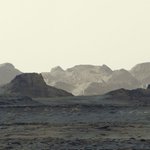
ALT The first light of morning illuminates the rugged slopes of Mount Sharp in this panorama captured by NASA's Curiosity rover on August 11, 2026. Taken at approximately 8:30 a.m. local Mars time, the image reveals a striking landscape of distant cliffs and ridges beneath the cool, bluish tones of the Martian dawn. The dramatic formations on the horizon are called yardangs, long ridges carved by wind eroding softer rock over millions of years. Stretching across roughly 16 kilometers of Mount Sharp, these formations may preserve deposits of ancient volcanic ash, although their origins remain uncertain. Curiosity could reach the base of these cliffs in 2027, giving scientists an opportunity to investigate how they formed and what they reveal about Mars's geologic and environmental history.


