

The clinical-development coordination layer for AI-generated drugs | Discord: https://xitter.cf/t.co/gOvHPKVGYB | Telegram: https://xitter.cf/t.co/DVjbfueQrk
Joined March 2024
- Tweets1K
- Following351
- Followers54.5K
- Likes664




LIFE AI retweeted

Is Life AI Biohub a subsidiary of Chan Zuckerberg Biohub?
A couple of VCs messaged me that question last week, right after the news that the US government, Google and Meta are joining Biohub in a $1.8 billion push for AI-powered biology.
The answer is no. (Even though I wish it were.)
I understand why they asked. Open lifeai.io and you will find a lot of Biohub in it, from the vision down to the way we execute.
I will confess it: we were deeply inspired by them. Life AI started eight years ago as a research project inside UCSF. Our lab was a shared bench, where we ran our very first study on the genomics of Asian populations. About ten minutes away, Chan Zuckerberg Biohub was pursuing an extraordinary ambition: helping cure, prevent or manage all disease by the end of this century. The mission deeply inspired us.
We borrowed most of that mission. Then we narrowed it: chronic diseases like diabetes and cardiovascular disease, for the populations medicine keeps leaving behind, especially Asians.
In those early days we got a lot of support from Prof. Joe DeRisi, Biohubs founding co-president from UCSF. I doubt Joe remembers us: three people, no funding, don’t even have their own bench, but with a big dream of walking the same road as a $600M Chan Zuckerberg Biohub. But that is where Life AI was brewed, inside UCSF and immersed in Biohubs culture.
Now, back to the $1.8 billion.
Most coverage of the Virtual Biology Initiative stops at the virtual cell: an AI model that predicts how a cell responds to a drug, a genetic edit, or a change in its environment. Biohubs head of science @alexrives expects a first dataset in about a year and accurate predictive models in roughly five. The headline everywhere: faster drug discovery.
I dont think the Virtual Biology Initiative stops at the cell, or just for drug discovery. The next model is the virtual human, and the place it matters most is the clinical trial.
Here is the uncomfortable math. AI is making discovery faster and cheaper, so more candidates will reach the clinic. Trials run on people. About 90% of candidates that enter trials fail. So most of the time, real people carry real risk, including serious side effects, for a drug that never makes it.
AI has raced ahead, yet humans are still the test objects. I believe the real legacy of the Virtual Biology Initiative will be ending that.
I admit Im biased. Im human.
Personal note: Mark Zuckerberg @finkd and Priscilla Chans podcast episode How AI Will Cure All Disease is fantastic. Highly recommended. Links in the first comment.
LIFE AI retweeted
Nobel season usually makes me optimistic about what science can achieve.
Last year’s prize honored discoveries from 1995 and 2001. GLP-1, the hormone behind today’s obesity drugs, was identified in the 1980s, and the first drug in its class was approved in 2005. Even AI, the technology everyone calls the future, won a Physics Nobel in 2024 for neural network research that began in the 1980s.
Most of what we call breakthroughs are old discoveries that finally got proven.
Drug development runs on the same clock. It takes 12 to 15 years to get from idea to approved medicine, and about nine in ten candidates that enter human trials never make it.
AI is now speeding up drug discovery, and that is real progress. I’m an AI founder, so you might expect me to say AI solves the drug development problem. I don’t think it does.
Discovery is not what medicine is short of. In one analysis, AI-discovered molecules passed Phase I trials 80 to 90% of the time, well above the industry norm. In Phase II, where a drug must show it works in patients, 4 of 10 succeeded, about the industry average. I’ve seen this up close.
At Google I learned how far good infrastructure carries something once it works. In life science and healthcare I learned the harder lesson: a result can be correct and still go nowhere, stuck between the sample, the lab, the report, the clinician and the next action.
So when discovery accelerates, how does scientific progress become human progress? If AI hands us 100 times more discoveries and the same capacity to prove them, we don’t get faster medicine. We get a longer waiting list.
This Nobel season, I am thinking less about how many discoveries AI might produce, and more about how many years of waiting it might remove.
On a personal note, I have been following @JeffDean's work, first at Google and now at Discovery Loop, and @DaphneKoller’s at insitro. I hope what they are building takes years off that wait.
Who knows, they may win a Nobel Prize in 2030 for the work they are doing today. That would be the best proof that the wait is getting shorter.
LIFE AI retweeted
@AnthropicAI , a company whose entire product is intelligence, just confirmed it runs a wet lab. Within a day, several of our investors had pinged me with the same two questions.
Is this a trend? Will every frontier AI lab end up running its own wet lab?
And if so, is Life AI losing its competitive advantage?
Short answers: yes, and no. Here are the longer ones.
I understand why Anthropic did it. I have a fair idea how that internal debate went, because we had the same one eight years ago.
Back then it looked like an odd move for a company that started on the software side of genomics: we built a physical sequencing center, the largest in Southeast Asia, designed for 500,000 genomes a year, with all the freezers and sample logistics that come with it.
We did it for the reason Anthropic gives now: in biology, the final test still happens at the bench. A model can propose. Biology doesn't have to agree.
So to the first question: yes, expect more of this, and the reason is arithmetic. The marginal cost of a hypothesis is heading toward zero. The cost of a failed trial is not. Roughly nine in ten candidates that reach the clinic still fail, and ten times more candidates does not fix that ratio; better evidence before the trial does. A company that sells intelligence has just concluded that intelligence is not the bottleneck. That is the real news, and every model company will reach the same conclusion once its predictions meet a petri dish.
Anthropic seems to know this. It says the lab is focused on fundamental biology, not drug discovery, and it doesn't want to be seen competing with pharma. That is structure, not modesty: pharma pays its bills, and a model company that starts producing evidence for approval competes with its own customers. So the lab exists to make a model better at biology. Its product is a smarter Claude.
Our lab was built for a different job. Its product is evidence a regulator will accept.
A research-grade experiment tells you whether a hypothesis is interesting. A regulatory-grade one tells you whether a patient can be treated on the strength of it. Evidence at that grade cannot be rented by the token. It takes a robotic wetlab, validated processes, and a loop that runs from study design through validation to deployment, and we started building ours before models were producing candidates at today's volume.
Which brings me to the second question. No, I don't lose sleep over Anthropic, DeepMind, or whoever builds the next wet lab. A better model is the best supplier we could ask for. Every jump in capability sends more candidates toward the narrow door where proof happens. We spent eight years building the infrastructure for this moment.
Welcome to the bench, Anthropic. There's plenty of room.
To the investors who asked, and to any who want to join the conversation: the question I'd put back is not which model will win drug discovery, but the next step. Who can prove what the models find will be the final winner.
LIFE AI retweeted
I used to come to the Google office mostly for the food. This time, it's special. I came here for work.
I just finished a video interview with the Google for Startups team. They asked wonderful questions, and ten minutes was nowhere near enough. Here's what I wish I'd had time to say.
Years ago, I was a Google engineer on the Gmail and Google Data Infra teams. Walking back in as a founder, selected for the first Google for Startups Accelerator: Southeast Asia, feels like a homecoming. Google taught me how to build systems billions depend on. Now I'm bringing that standard to healthcare.
At Life AI, we're building an operating infrastructure for drug development: AI models for drug discovery, a robotic wet lab for in vitro screening, and a network of hospitals for clinical validation. Several products run on it. The one we're bringing to Google is closest to my heart: Life Cloud, an AI-powered cloud for healthcare.
Here's the problem. AI has disrupted industry after industry, but not yet healthcare. Hospital data is uniquely hard: fragmented, buried deep inside departments. Connecting data within one hospital is already a serious challenge. Connecting a network of hospitals is orders of magnitude harder. Yet patients move between hospitals, test by test. The warning sign a doctor needs often already exists, scattered across systems, never connected in time.
Take thalassemia: about 13% of Vietnamese, 14 million people, carry the gene. Every year, around 8,000 affected babies are born, most of them preventable. The first clue hides in a routine blood test that costs less than a cup of coffee, stored somewhere, in some hospital.
Life Cloud is built on one principle: the data never moves. The AI does. Hospitals keep full control of their records. The AI comes to them and learns across the whole system. The AI flags and suggests. The doctor always makes the final decision.
What excites me most is the mentorship. I still remember how much I learned just by sitting close to great engineers at Google. Now my whole team gets three months of that. Honestly, it feels a bit like going back to school.
In October, I'll bring our product to Google San Francisco's bootcamp for engineers to stress-test. Thalassemia doesn't stop at borders. With health partners in Thailand and Indonesia, Southeast Asia is the map we're building for.
Closing the gap between what AI can demonstrate and what doctors can depend on. That's the whole journey. And yes, I'm coming back to Google, not only for food, but for work too.
If you're a clinician, life-science researcher, or investor who cares about trustworthy healthcare AI in Southeast Asia, my inbox is open.
#GoogleForStartups #HealthcareAI #LifeCloud
LIFE AI retweeted
** NVIDIA GTC Taipei: Memorable experience **
I've passed through Taiwan in transit plenty of times, but this was my first time actually staying here. Taipei is a beautiful city. On the ride from the airport, my Uber driver asked if I was here for the NVIDIA conference. He'd doubled his shifts, he said, because so many people were flying in for NVIDIA's GTC, which runs alongside Computex this year. The whole city was buzzing.
We're proud that Life AI was one of 15 startups picked to present on Startup Day. Robotics and Physical AI are everywhere right now. So is AI for Life Sciences.
I had so many good conversations after our session. The question I kept getting was a simple one: why exactly is drug development so slow and expensive? Over the past year, more and more AI-led drug discovery companies, each raised hundreds of millions of dollars. It feels like the whole AI world is obsessed with drug discovery right now.
And yes, drug development really is slow and expensive. Creating a promising drug candidate is hard. Proving it actually works in people is an order of magnitude harder. AI has largely cracked the first half, producing drug candidates at a fraction of the old cost. The second half, the clinical work that proves a drug actually works, is still painfully slow and expensive.
That gap is exactly where we come in. AI now produces far more candidates than the industry can possibly develop, which leaves a growing pile of shelved, clinically-informed assets that nobody is taking forward. That's Life AI's wedge: asset rescue. We in-license these drug assets, finish the development in Asia at a fraction of the US cost, and share the upside.
@IsomorphicLabs , the Google DeepMind spin-off, just closed a $2.1B round and is arguably leading the world in AI drug discovery. One day I'd love to sit down with their team and say: thank you, thank you for producing so many promising candidates. Life AI is here to rescue them.

𝗡𝗩𝗜𝗗𝗜𝗔 𝗚𝗧𝗖 𝗧𝗮𝗶𝘄𝗮𝗻 𝟮𝟬𝟮𝟲 - 𝗠𝗮𝗽𝗽𝗶𝗻𝗴 𝘁𝗵𝗲 #𝗛𝗲𝗮𝗹𝘁𝗵𝗰𝗮𝗿𝗲𝗔𝗜 𝗩𝗮𝗹𝘂𝗲 𝗖𝗵𝗮𝗶𝗻
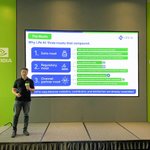
At NVIDIA GTC Taiwan 2026, our Co-Founder & CEO Dr. Tuan Cao @tuan_lifeai presented “LifeAI Biohub: A Purpose-built AI platform for Drug Development”
One signal emerged throughout the session:
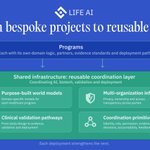
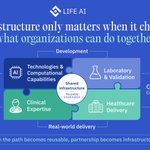
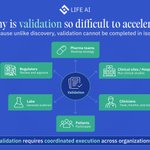
As AI capabilities continue to advance, the bottleneck is no longer intelligence itself. It is the infrastructure that enables validation, governance, and coordination across the full spectrum of healthcare stakeholders.
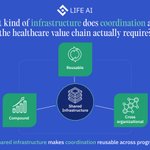
𝗧𝗵𝗲 𝗛𝗲𝗮𝗹𝘁𝗵𝗰𝗮𝗿𝗲 𝗔𝗜 𝗩𝗮𝗹𝘂𝗲 𝗖𝗵𝗮𝗶𝗻
Pharma → Hospitals → Doctors → Labs → Regulators → Auditors → Patients
Sustainable progress in healthcare AI demands alignment across the entire ecosystem, not isolated optimization within a single organization.
𝗟𝗶𝗳𝗲𝗔𝗜 𝗕𝗶𝗼𝗛𝘂𝗯
Shared Infrastructure → Coordination Layer → Connected Network → Application Success
This is the foundation Life AI is building: the shared infrastructure and coordination layer for the healthcare AI value chain so that every application built on top can move faster, scale further, and earn trust across the industry.
The long-term opportunity in healthcare AI will not be defined by better models alone. It will be defined by the infrastructure that makes those models deployable, accountable, and impactful at scale.
It was a privilege to share this vision alongside the researchers, healthcare leaders, and technology builders at NVIDIA GTC Taiwan shaping the next chapter of AI.


LIFE AI retweeted
** When you think of AI, think of humanity too. **
At the GStar AI & Humanity Summit, I was asked during our panel: what can AI do for humanity?
It reminded me of a dinner I had with Thang Luong @lmthang, Director of Research at Google DeepMind. We were deep in the technical side, World Models for healthcare, AI in drug discovery, and we kept coming back to one simple fact: humans are still used as test subjects in drug development.
As AI makes drug discovery faster and cheaper, more and more candidates will go into clinical trials. And those trials run on people. About 90% of drug candidates that reach clinical trials fail, so most of the time people take on real risk, including serious side effects, for a candidate that never makes it.
So, what can AI do for humanity? Here's one thing I'd love to see: more AI companies building simulation environments that test drug candidates before they ever reach a real trial. Ideally, anything that passes the simulation would have a 99% chance of passing the actual one.
It's a hard problem. Of course it is. But it's not so different from how engineers built flight simulators for pilots, which have probably saved thousands of lives.
Fingers crossed that experts at Anthropic, OpenAI, and especially Google DeepMind solve this soon. I'd love to help.
Tagging Jeff Dean @JeffDean , Quoc Le @quocleix , Thang Luong @lmthang , Ed Chi @edchi , Yi Tay @YiTayML .
A great day at GStar Summit 2026: AI + Humanity.
Our Co-Founder & CEO, Dr. Tuan Cao, joined the AI for Healthcare & Life Sciences session to discuss how AI can be applied responsibly in healthcare, where innovation must be matched with trust, safety, and real-world impact.
A sincere thank you to the organizers, New Turing Institute and Pacific Gateway Partners, and to Google and FPT Corporation as strategic partners, for bringing together leaders, researchers, and innovators working at the intersection of AI and humanity.
We’re grateful for the conversations, connections, and shared commitment to building AI that serves people and improves lives.
@tuan_lifeai @newturing @lmthang


LIFE AI retweeted

Challenge: Shape the @LifeNetwork_AI Logo with a 5×5 Rubik’s Cube.
Get 500 likes and I’ll shape the logo on the other side.
LIFE AI retweeted

Web3 is growing up: 2025 Debrief. 2026 Survival Guide.
→ Wed, 14 th | 4 PM UTC | On X
There’s something special to celebrate it. Check our profile.
Join our discussion with @AVAX, @spaceandtime, @GoKiteAI, @TheArena, @LifeNetwork_AI, @lightspeedvp, @paraficapital, @hypha_sh, @AxiymFinance, @w3arew3, @RillaNetwork.
Speaker list below.

LIFE AI retweeted
⏳ The countdown is ON!
Life AI is about to launch Public Testnet Phase 1 and this won’t be like any testnet you’ve joined before. This is the first spark of a healthcare revolution.
Your voice.
Your perspective.
Your experiences with healthcare.
All of it can earn rewards
And place you among the first pioneers shaping the future of real, personalized healthcare.
We’re not here to upgrade “sickcare.” We’re here to replace it with true healthcare which is proactive, personal, and powered by you.
💬 Drop a “Yes” if you’re ready for better health, better life, and a future built with Life AI.
#LifeAI #HealthcareAI #TestnetPhase1 #FutureOfHealth
LIFE AI retweeted

🎙 Special Guest Alert
We’re excited to share that @LifeNetwork_AI CEO @tuan_lifeai will be joining our upcoming space.
Make sure to tune in! This will be one you don’t want to miss.
👇🏼Join below:


LIFE AI retweeted

🌍 What if healthcare could finally shift from treating illness — to creating health?
That’s the vision behind LIFE AI, a platform tackling the “healthcare paradox.”

LIFE AI retweeted

How @LifeNetwork_AI is quietly driving DeSci forward on Avalanche.
LIFE AI is giving people true ownership of their genetic and health data, using Avalanche’s speed, low fees, and customizable subnets to make secure, privacy-preserving science possible.
From Life-ID self-sovereign identities to a marketplace for research collaboration, LIFE AI is proving that blockchain is more than just DeFi, it’s for the future of medicine and biology.
Spotlight on a project that’s turning healthcare into an open, user-owned network, built right here on Avalanche.

LIFE AI retweeted
Everyone wins with Fusion. 🌌
How? Our Co-Founder @avax_economist tells you in the AMA with @avax and @LifeNetwork_AI
LIFE AI retweeted

Redefining the Future of Healthcare with AI xitter.cf/i/broadcasts/1YqxolerQ…

LIFE AI retweeted
Smart cities. Self-sovereign identity. Healthcare data patients control.
@AvaxFusion, @LifeNetwork_AI, @GiancarloTRoma & @BreevieGotRekt discuss how AI-powered city systems are evolving into the largest privacy-first human network on Avalanche, live here.
📅: 15/08
⏰: 10am EST

LIFE AI retweeted
30 mins until we go live.
@AvaxFusion, @LifeNetwork_AI, @GiancarloTRoma & @BreevieGotRekt discuss AI-powered smart cities, self-sovereign identity, and patient-controlled healthcare data on Avalanche.

How can AI put your Healthcare data to work for you?
@avax and @LifeNetwork_AI join us to discuss the future of AI and Healthcare.
📅: 15/08
⏰: 10 am EST / 4 pm CEST
📍: Fusion and Avax X profiles
Our lineup: @GiancarloTRoma and @BreevieGotRekt from @Avax and @AvaLabs, @tuan_lifeai, Life AI Founder, and @avax_economist, our co-founder.
Save the date and thank me later.

LIFE AI retweeted
🚨 In celebration of our Live with @avax and @LifeNetwork_AI:
We are giving away $70 in USDC to 3 lucky winners who:
🔺 Follow: @avaxfusion, @avax, and @LifeNetwork_AI
💕 Like and RT this post.
💻 Join our live to claim the prize:
xitter.cf/AvaxFusion/status/1955…
Winners are going to be randomly selected, and you must be present during the live to claim your prize.

How can AI put your Healthcare data to work for you?
@avax and @LifeNetwork_AI join us to discuss the future of AI and Healthcare.
📅: 15/08
⏰: 10 am EST / 4 pm CEST
📍: Fusion and Avax X profiles
Our lineup: @GiancarloTRoma and @BreevieGotRekt from @Avax and @AvaLabs, @tuan_lifeai, Life AI Founder, and @avax_economist, our co-founder.
Save the date and thank me later.
LIFE AI retweeted
🎯 What's the biggest problem @LifeNetwork_AI solves in healthcare?
0%No rewards recognition
14%Inefficient networks
29%No impact tracking
57%No data ownership
7 votes • Final results