



Karl Harmenberg retweeted

While we celebrate chief architect Woodford, now is also a good time to remember the many people involved in building the New-Keynesian theory of business cycles and stabilization policy.
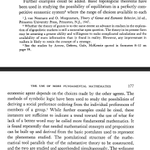
Below is a slide from my first-year Ph.D. macro class.

Karl Harmenberg retweeted
Yesterday, my sister Karin Öberg was awarded the Pius XI Medal, given to her by His Holiness Pope Leo XIV.
The medal is awarded every two years by the Pontifical Academy of Sciences to a scientist under the age of 45, selected “for his or her exceptional promise.”
The Pontifical Academy of Sciences consists of 81 members, 23 of whom are Nobel laureates.
The previous recipient of the Pius XI Medal was Demis Hassabis. The last astronomer to receive it was the late Stephen Hawking, in 1976.
Karin currently serves as the Thomas Dudley Cabot Professor of the Natural Sciences and Senior Vice Provost of Harvard University and Director of the Öberg Astrochemistry Laboratory at the Harvard-Smithsonian Center for Astrophysics.
I’m very proud of her.

Min inre @StefanFSchubert :
Med 48 lag så har gruppspelet i årets VM har 72 matcher, tidigare (hela) VM bestod av 64 matcher. Varför sträcka sig efter långsökta förklaringar när det räcker...?

Karl Harmenberg retweeted
This is an interesting model, which was also written down and its predictions spelled out in Dennery (2020). However, rigid wages and monopsony do not necessarily imply supply-determined hours work (as opposed to demand-determined hours worked in canonical rigid wages à la EHL).
I will talk about these things and present a model that features both monopsony, rigid wages and demand-determined hours worked at the SED next week.


Key questions, which I (and coauthors) have taken to heart.
Here is a (new-Keynesian) model of rigid wages with perfect competition in the labor market:


Sticky wages yes, but how? Sticky wages in most contemporary models assume that all workers belong to a union that has a labor monopoly and charges above market clearing wage. Reality, not many unions, and more worry about employer market power. Unreality of NK model assumptions at some point sticks in throat. So WHICH sticky wage model would you like us to use?
Here is ongoing work on an extension with monopsony power in the labor market, yet the traditional demand-determined output, which @ek_oberg presents in a few days at SED.

It is worth noting that the corrigendum, stating that this alleged fact is in fact not true, was published by the original authors more than a decade ago...


In the 1960s, doctors married nurses. Today doctors marry doctors. Economists ran the counterfactual and found that if Americans married randomly, the income Gini would drop from 0.43 to 0.34, exactly where it was in 1960. Who pairs with whom is now a top driver of national inequality.
Readers added context they thought people might want to know
The authors of the referenced study later discovered a serious coding error. As published in their correction, the claimed effect of assertive mating on income inequality essentially disappears.
jeremygreenwood.net/papers/ggksPan…
Karl Harmenberg retweeted
***Post-Doc Opportunity***
Join me, Mikael Carlsson, Oskar Nordström Skans and Karl Walentin in studying heterogeneity in consumption-savings behavior using high-quality Swedish admin data.
The position is 3 years, with little to no teaching, ample time for your own research, and we provide mentorship and support in all dimensions. The position is designed so to be a springboard for a research career (our outgoing Post-Doc Marco D'Amico on the program is now joining Reserve Bank of Australia as a tenured research economist).
Relevant both for macroeconomists with data skills and for applied economists with a macro interest.
Please apply, and please help me spread this widely!
Link in next tweet.

Karl Harmenberg retweeted

The International Economic Review has just published a wonderful paper by the late Marcus Hagedorn (with special thanks to Iourii Manovskii) on A Demand Theory of the Price Level. It is available through @WileyEconomics here: onlinelibrary.wiley.com/doi/…

Maybe Harvard should pay a visit to the University of Oslo. That's how our transcripts look already: a histogram of the grade distribution for the grade next to the student's grade.

Karl Harmenberg retweeted

I’m having a difficult time focusing on work given the vile and irresponsible comments coming from the President of the U.S. Sickening that he’d threaten to annihilate Iran. Where are the Republicans in Congress?
Karl Harmenberg retweeted
Exciting in many dimensions, and particularly happy about my longstanding coauthor and dear friend @KHarmenberg coming back to Sweden!

Exciting times in Stockholm and @IIES_Sthlm this fall
Four new hires for IIES: @KHarmenberg @RHelensdotter @caterina_vieira @ReichardtHugo
And @RustamJamilov coming to CeMoF (joint IIES/SU/SBS center) for a year
Karl Harmenberg retweeted

Exciting times in Stockholm and @IIES_Sthlm this fall
Four new hires for IIES: @KHarmenberg @RHelensdotter @caterina_vieira @ReichardtHugo
And @RustamJamilov coming to CeMoF (joint IIES/SU/SBS center) for a year
Karl Harmenberg retweeted
Macro job market candidates, see here!
Mikael Carlsson, Oskar Nordström Skans, Karl Walentin and I are looking for a post-doc to help us understand heterogeneity in consumption behavior and its implications for macroeconomic stabilization policy. Full focus on research (incl your own stuff), 2-3 years.
Please apply, share, and/or send me a DM if you have any questions!
uu.varbi.com/en/what:job/job…


Frisch 1933 is a fascinatingly early quant-macro paper. A dynamics model with resource constraints, studied using impulse response functions, and solved numerically. (1/4)


More Kydland-Prescott appreciation, this time of their 1991 SJE paper on the development of >econometrics<. Fascinating account of the relation between facts, statistical technique and economic theory, from the early critique by the "German historical school" to RBC-style macro.
jstor.org/stable/3440324?seq…
Especially interesting how the meaning of the term >econometrics< has changed over time. Now, I think many associate the word with the statistical machinery associated with estimating reduced-form models and causal effects. When Frisch introduced the term, it meant something closer to what we now call quantitative economic theory.
My own reflection: it seems to me like we have recently taken a step further in realizing Frisch’s vision of economics as a quantitative science, where statistical facts are interpreted through explicit quantitative models. Macro-model-style research have become more quantitatively credible through being increasingly disciplined by micro facts. Applied-micro-style research has become more relevant through increased recognition that we need to feed the reduced-form estimates through an explicit model for many interpretations and counterfactuals.
To facilitate further convergence, also check out the great blog post by Oliver Hanney and Ben Moll on the missing intercept problem that arises when scaling micro estimates without using an explicit model.
voxdev.org/topic/methods-mea…


Karl Harmenberg retweeted
In the light of recent discussions about central bank independence, I’ve read up on the ”time inconsistency problem” of macroeconomic policy making. I of course learned about this as an undergraduate but it was only now I came to appreciate that this must be one of the really deep results that came out of the rational expectations paradigm. It is very counterintuitive that committing to a simple unoptimized rule often outperforms even an all-knowing and god-like policymaker who tries her best to continuously adapt policy with the intent to maximize social welfare.
Three great readings led to this appreciation. First, Karl Harmenberg’s (UiO) treatment of the result in the attached teaching note, written so to be accessible to master-level students.
karlharmenberg.com/teaching/…
Second, Tabellinis celebration of the result in SJE 2005. Before reading the second piece, I did neither appreciate how important this result was for the development of modern political economy.
jstor.org/stable/3441102?sea…
And finally, of course, Kydland and Prescott’s original paper, which is real gem.
journals.uchicago.edu/doi/ab…
