
Economics Fellow @AnthropicAI | Postdoctoral Research Fellow at All Souls College @UniofOxford | Research Affiliate at @cepr_org | PhD @LBS
Earth
Joined March 2009
- Tweets878
- Following769
- Followers2.5K
- Likes5.7K


Rustam Jamilov retweeted

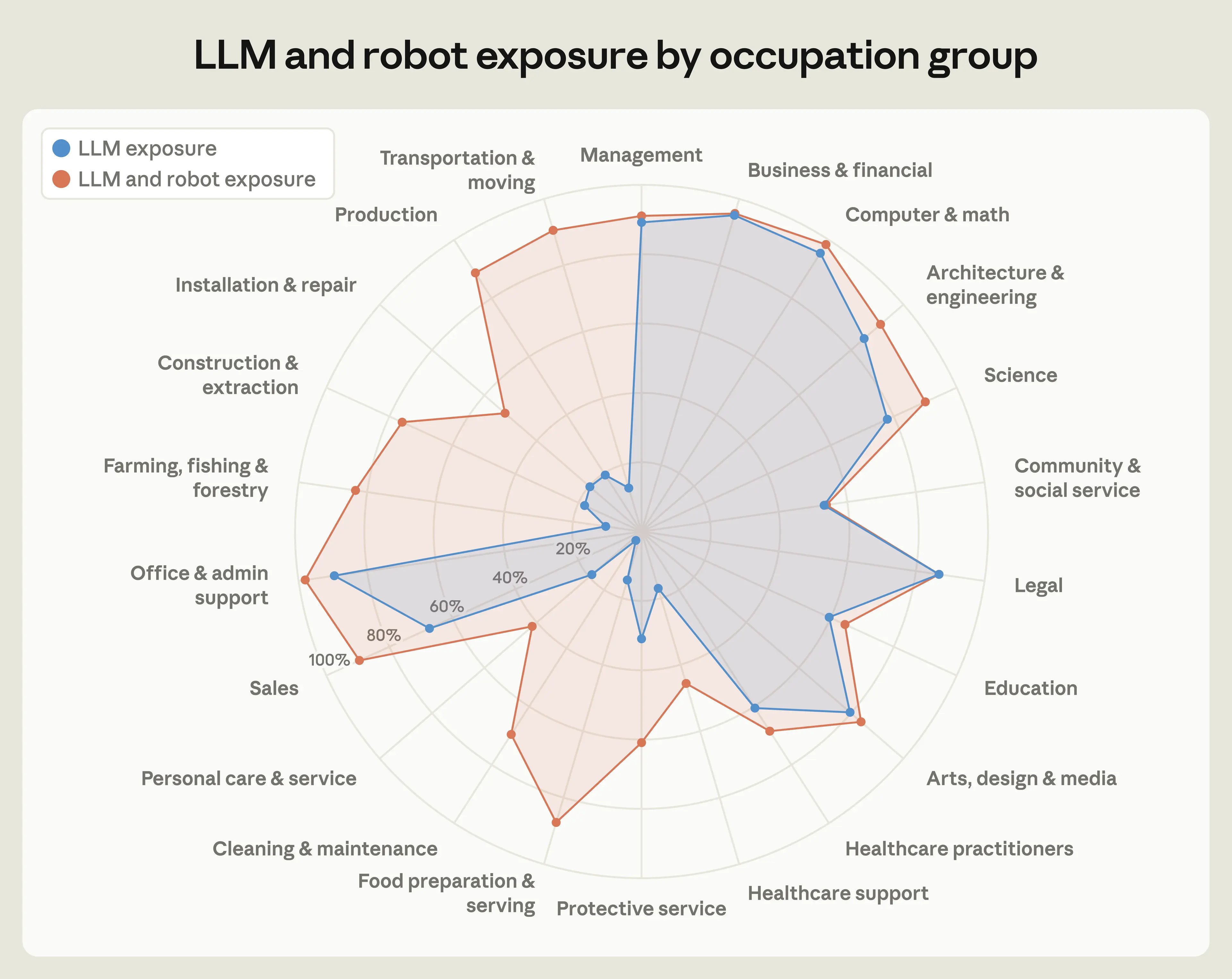
What work can robots do today? And what might that imply for the structure of the economy in the years ahead?
New research from @rclegateyang and Maxim Massenkoff out today exploring these questions.
Rustam Jamilov retweeted
New research: Project Swap
To see what works & what breaks when agents are sent into a marketplace, we made a mini barter economy of Claudes.
It gave us an early look at the economy of the future––and the challenges to overcome to make agent-run markets efficient, safe & fair.

Rustam Jamilov retweeted

Claude has discovered a previously unknown enzyme system hidden in the DNA of bacteriophages. Beside the enzyme’s gene sits a long array of repeating DNA—a structure that looks somewhat similar to CRISPR.
We don’t yet understand what this system does, but only a handful of known systems share its features, and all of them are able to cut, copy, and paste DNA. Historically, the discovery of such programmable systems has helped revolutionize medicine. CRISPR, for instance, is now the foundation of genetic medicines. But it will take much more work to learn what this system does, and whether it can be put to similar use.
Read more: anthropic.com/news/claude-di…


Rustam Jamilov retweeted

All Souls on a moody day.
📷 Instagram | EstherJohnsonPhotography (June, 2026)

ALT The twin towers and Gothic façade of All Souls College rise above a meticulously striped green lawn. The historic honey-coloured stone building is photographed head-on beneath an overcast sky, highlighting its symmetry and ornate architectural details.
Rustam Jamilov retweeted
Anthropic’s Economics team is sharing a new model of how AI might affect economic growth, jobs, wages, and more by 2030.
Explore the scenarios, tell us what you think will happen, and see how your answers compare to more than 10,000 Americans. anthropic.com/institute/econ…

Rustam Jamilov retweeted

Cyber is having a moment
Across 21 major software companies, including Apple, AWS, Microsoft, and Google:
- Reported critical vulnerabilities never cleared 100 per month in four years
- Since spring they've jumped to over 600 per month
Charts of the Week: a16z.news/p/chart-of-the-wee…

Rustam Jamilov retweeted
Checking that a major mathematical proof is correct can take years. Formalization—converting the mathematical reasoning into a form computer proof assistants like Lean can verify—can help.
Last month, Claude completed the first formalized proof of Fermat’s Last Theorem, one of the most famous theorems of all time. This was a project experts thought would take many years. It is the largest Lean proof ever written.
Fermat’s Last Theorem was first proven in 1995 by Sir Andrew Wiles, more than 350 years after it was conjectured. Our proof, which totals over 13 million lines of code, provides machine verification. More importantly, it proves over 29,000 other theorems that the proof requires, across many areas of math which had never before been formalized.
We see this as a major step in the long process of firming up the core of mathematical knowledge, building on work from three centuries of mathematicians and hundreds of contributors to Lean and Mathlib. We are optimistic that AI-assisted verification of mathematical proofs will help reduce the burden of refereeing mathematics in an era where more proofs are being produced than ever before.
You can read about the process on our Science Blog: anthropic.com/research/forma…
And see the complete proof on GitHub: github.com/anthropics/fermat…
Rustam Jamilov retweeted
Applications are open for the Claude Campus Ambassadors program. This year, we’re expanding opportunities to more students, with three tracks for undergrads, graduate students, and PhDs/postdocs.
Apply here: anthropic.com/campus

Rustam Jamilov retweeted

I’m glad to announce that our paper “Firm Heterogeneity, Capital Misallocation and
Optimal Monetary Policy” has been conditionally accepted at @JPolEcon
Here is a short thread
galonuno.com/uploads/1/3/4/6…

Rustam Jamilov retweeted

Very happy to see "AI and Our Economic Future" published. Thanks to the team at the JEP, especially @TimothyTTaylor and @heidilwilliams_ . aeaweb.org/articles?id=10.12…

Excited to start today as Economics & Policy Fellow at Anthropic and spend a few months thinking about AI and macro. Big thanks to Peter McCrory for having me. From October: thrilled to join the CeMoF center at Stockholm University for one year. Special thanks to Roine Vestman, Kurt Mitman, Per Krusell for making this happen. And Winter 2027: happy to visit the economics department at Harvard. Big thanks to Greg Mankiw and Oleg Itskhoki for the sponsorship.
The Anatomy of Cyber Risk (with Hélène Rey @helene_rey and Tahoun Ahmed) is now accepted and forthcoming at the Journal of Finance @JofFinance.
Paper link: papers.ssrn.com/sol3/papers.…
Firm-level cyber risk exposure data: zenodo.org/records/21383844

Nuffield Postdoctoral Research Fellowships.
Deadline: 23 September 2026.
economics.ox.ac.uk/nuffield-…
Rustam Jamilov retweeted

New CEPR Discussion Paper - DP21743
The Geography of Financial Frictions
Alexander Haas @MonashUni, Rustam Jamilov @RustamJamilov @UniofOxford
ow.ly/SvXY50ZnMeO
#CEPR_IMF #CEPR_MEF #EconTwitter

Rustam Jamilov retweeted

Today @nberpubs there is great stuff on the solution of HANK models by @GregWKaplan @JavierBianchi7 and @a_auclert @ludwigstraub Rognlie Rigato in the session of @ChristianKWolf @JesusFerna7026 @luigi_bocola.
This is exactly one of the questions of my ERC project: how far can we push perturbation HANK?
So let me share some thoughts and a simple new method that is as fast as a linear solution, but almost as accurate as the fully nonlinear transition.
Paper: ralphluetticke.com/files/Loc…
Code:
github.com/mweiss-econ/large…
I am very excited to share a new working paper:
"The Geography of Financial Frictions" (with Alexander Haas, Monash University)
We study aggregate implications of the geography of firms' financial frictions in Europe, both empirically and theoretically.
Paper link: users.ox.ac.uk/~econ0628/Fin…

The geography of financial frictions translates into the cross-section of Phillips multipliers and output-inflation trade-offs. The sacrifice ratio is greater in high-friction countries, as the same output gain comes at the cost of higher inflation.

Many more empirical and quantitative results in the paper!
This paper uses ECB's SAFE data, so the usual disclaimer applies.
This research has been facilitated by the 2024 ECB's Lamfalussy Fellowship @ECB_Research @ecb.
Special thanks to Dominik Thaler and Nicola Benatti.
The model matches the data: high-friction countries react less to monetary shocks because they face steeper marginal cost curves and lower capital supply elasticities (a closed-form sufficient statistic for the response of investment to interest rate shocks in PE).

