





Jean Nubert retweeted

The September global atmospheric angular momentum (GLAAM) index was the highest monthly value since at least 1950 (ERA5 data).
This illustrates the atmospheric component of the extreme El Niño: Pacific convection is transferring huge westerly momentum away from the equator


Jean Nubert retweeted

Intéressante étude d'EUMETSAT montrant qu'El Niño a probablement contribué à un été 2026 exceptionnellement chaud et sec sur une partie de l'Europe (en plus de la variabilité naturelle et du changement climatique)
user.eumetsat.int/resources/…

Jean Nubert retweeted

📚 Paper alert!
Our paper "The 2026 cold wave brought northern Fennoscandia its coldest two-week period since 1987" is out now in Weather.
🧵(1/14)

ALT (a) ERA5 2m temperature anomaly between 31 December 2025 and 13 January 2026, with the analysis domain (66°N–69°N, 20°E–30°E)indicated in red. (b) ERA5- based time series of the lowest 14-day mean temperature over the northern Fennoscandia analysis domain highlighted in (a) (land-only). Winter 2025/2026 is circled in red.
Jean Nubert retweeted

The record-strong El Niño in the Pacific is the reason the Atlantic has had its quietest hurricane season to date in recorded history.
It is not due to the other misinformation you are seeing circulating online.

Jean Nubert retweeted

Major 2025 Nature paper on drought was recently retracted for several reasons related to data and methodology.
nature.com/articles/s41586-0…
Another paper published today points out even more problems with their calculation of drought indices with PET
nature.com/articles/s43247-0…


Jean Nubert retweeted

If the rock appeared in 1616, 1718, 1811, 1830, 1842, 1868 and 1947, then it's not a new phenomenon.
In previous times it signalled starvation.
Today, it does not: the wheat price has ticked up only a little - because of world trade in food and good harvests elsewhere.

In Budapest, a rock has resurfaced in the Danube.
It's called the Rock of Starvation - Ínség-szikla. For centuries, its return has meant one thing: the river is so low the mills fall silent, crops fail, and hunger follows.
It surfaced in 1616. In 1718. In 1811, 1830, 1842, 1868. In 1947.
And now it's back, in 2026.
For the first time in 44 years, Hungary has shut down all but one of its Danube-cooled nuclear reactors.
A nearby farmer puts it plainly: "I've lost nearly 50% of my harvest, and it could hit 70%. Since I started farming after the end of communist rule, I've never seen a catastrophe like this."
The rock is a warning.
It's been delivering it for 400 years.
We know exactly what it says, but we haven't been listening.

Jean Nubert retweeted

Mythe n°5 : "La France manque d'eau : il faut réduire l'irrigation." Vraiment ? Comparons les chiffres européens.
• La France est le 2ᵉ pays d'Europe par l'abondance de ses ressources hydriques (après la Norvège). Ce n'est pas une opinion – c'est la géographie.
• Taux de mobilisation de l'eau en Europe :
🇫🇷 France : 20%
🇩🇪 Allemagne : 25%
🇪🇸 Espagne : 29%
🇮🇹 Italie : 32%
L'Italie utilise 60% de plus que la France. Personne ne dit que l'Italie "vole l'eau".
• L'eau que la France ne stocke pas en hiver part dans la mer. Ce n'est pas vertueux, c'est inefficace.
• La solution : stocker en hiver, recycler, dessaler là où c'est pertinent. Pas restreindre. Gérer.
#Eau #Agriculture #Irrigation
• Et côté pratique, même constat. Part de la SAU irriguée en 2016 : Grèce 23,6%, Italie 20,2%, France 6,8%. Moyenne UE : 5,9%. Surfaces équipées : Espagne 3,6 M ha, Italie 4,1 M ha, France 2,8 M ha. (Eurostat)
• Nos voisins irriguent 3 à 4 fois plus intensément que nous, sur des territoires plus secs et plus petits. Et ils prennent les marchés que nous abandonnons.
➡️ Et la comparaison la plus parlante, ce sont les ouvrages. En 25 ans : France 5 à 10 M de m³ de nouvelles réserves. Maroc : environ 2 Mds de m³. Espagne : environ 22 Mds d m³ de stockage.
➡️ Rapportée aux 500 Mds de m³ de pluie que reçoit la France chaque année, notre capacité de stockage agricole équivaut à quelques heures de précipitations. Ce ne sont pas nos ressources qui nous distinguent. Ce sont nos ouvrages.
#Eau #Irrigation
@AnnieGenevard @Agri_Gouv @Ecologie_Gouv @Irrigants_Fr
Jean Nubert retweeted
🌡️ En ce qui concerne l'anomalie de température des trois derniers mois (période MJJ 2026), la France est le pays qui présente l'anomalie la plus marquée au monde, avec +2,8 °C au-dessus de la moyenne 1991-2020 🥵‼️
Via Mika Rantanen


Jean Nubert retweeted

Across Africa’s Sahel region, groundwater reserves are recovering after decades of drought.
Aquifer reserves across Niger have risen by an estimated 15 percent, while Lake Chad reached more than 9,000 square miles in 2024, around 10 times its size in the mid-1980s.
One major reason is that rising temperatures in the North Atlantic have pulled the West African monsoon farther north, bringing more rainfall to the Sahel.


Jean Nubert retweeted

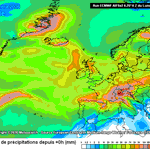
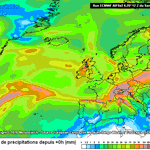
A striking example of the persistence of the hot air mass over southwestern Europe. 850 hPa temperatures from mid-June to mid-July 2026.
Maps: Meteociel - meteociel.fr/modeles/gfse_ca…


Jean Nubert retweeted

“A few years ago.”
Yeah, thanks for proving my point.
The Pacific Northwest heatwave in June 2021 hasn’t been repeated. So, no, we aren’t seeing intense, “unprecedented” heatwaves like that multiple times per year in the U.S., Canada, Mexico, etc. Only northwestern Europe seems to be getting them lately. In any case, the 2021 event was not as rare as previously thought; a similar heatwave occurred in 1941 (as well as in 1898).
🔗 sciencedirect.com/science/ar…
That isn’t consistent with *GLOBAL* warming; it’s consistent with either some sort of undiagnosed natural atmospheric circulation change or increased absorbed solar radiation from reduced cloud area fraction and/or particulate aerosol concentrations.


Jean Nubert retweeted

From 1995 to 2023, surface solar radiation (SSR) increased up to +17W/m² in Europe.
This is 6 times the total anthropogenic greenhouse forcing assumed by the IPCC (which is set too high anyway, since it's a clear-day estimate excluding clouds).
France, Benelux and Western Germany have experienced the biggest increase with up to +20W/m².
These effects have nothing to do with CO2 and are one order of magnitude bigger than anthropogenic GH forcings can be.
The data and observations tell the real story.
sciencedirect.com/science/ar…


