

Led by @Susan_Athey, @StanfordGSB Golub Capital Social Impact Lab uses technology and social science to improve the effectiveness of social sector organizations
Stanford, CA
Joined September 2019
- Tweets618
- Following151
- Followers1.5K
- Likes102
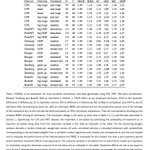


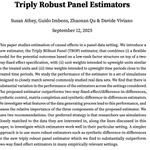


Parallel trends in doubt? The Triply Robust Panel (TROP) estimator relaxes it and now has official Python and Stata packages.
Python (pip install trop): github.com/zhaonanq/TROP-Est…
Stata: github.com/justinwaddy/TROP
Built by Zhaonan Qu, Xuelin Yang, Justin Waddy & Damian Clarke
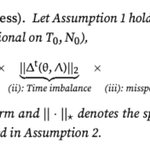
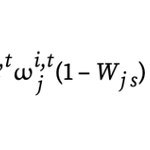
Why "triply robust": TROP combines unit weights, time weights and a regression adjustment based on a low-rank factor model. Its bias is bounded by the product of unit imbalance, time imbalance and misspecification of the regression adjustment, so it is asymptotically unbiased if any one of the three removes the underlying bias.
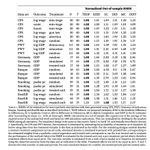
In 20 of 21 simulation designs calibrated to widely used datasets (CPS, Penn World Table, and case studies such as the Basque Country and German reunification), TROP had the lowest RMSE of six estimators, including DID, synthetic control and SDID. With few treated units and periods, other estimators become more competitive.
Both packages choose tuning parameters by cross-validation and report bootstrap standard errors and confidence intervals.
Paper by @Susan_Athey (our Faculty Director), @guido_imbens, Zhaonan Qu and @VivianoDavide , now in the Journal of Applied Econometrics: doi.org/10.1002/jae.70061
(arXiv version: arxiv.org/abs/2508.21536)

An economy is held back by its weakest links. That idea helps explain why AI’s promise for developing countries is large, why its gains will take time to arrive, and why some of its risks may not wait.
Watch @ChrisTonetti and our Faculty Director, @Susan_Athey, discuss AI as a general-purpose technology and what determines the pace of its impact, in this session from the World Development Report 2026: The Promise of Artificial Intelligence conference at Stanford. This is the first of four posts on takeaways from the conference.
The promise is large. Adapted to local needs, AI could help do in a decade what might otherwise take a century. If AI can strengthen an economy’s weakest link, the returns are high. In many developing countries, one weak link is expertise. With AI’s help, nurses, teachers and extension workers without specialist training can take on tasks that once required a specialist. The gaps are wide: Sub-Saharan Africa had 2.9 physicians per 10,000 people in 2019, against a global average of 16.7, and primary schools in low-income countries average about 40 students per teacher, compared with about 15 in high-income countries. But expertise is not the only weak link, and the others will determine how quickly that promise is realized.
AI is diffusing faster than earlier general-purpose technologies. Poorer countries adopted steam about 80 years after richer ones, electricity about 40 years, and the internet about 20 years. Within six months of ChatGPT’s launch, middle-income countries accounted for half its traffic. But fast diffusion is not deep use. By April 2025, nearly 25% of internet users in high-income countries had adopted ChatGPT, compared with 5.8% in upper-middle-income, 4.7% in lower-middle-income and 0.7% in low-income countries. AI’s benefits could remain concentrated in richer countries, at least at first.
This adoption gap reflects other weak links. AI depends on complements: electricity, connectivity and literacy. In rural Sub-Saharan Africa, 32% of schools lack regular electricity and 68% lack reliable internet access, and across the region, 89% of 10-year-olds cannot read a simple text. Fixing one weak link often exposes the next. In Thai clinics using an AI tool to screen for diabetic eye disease, the limiting factor shifted once the tool was in place. Poor lighting led it to reject over 20% of images, and slow connections stretched uploads that took seconds in testing to over a minute.
History points the same way. Electricity paid off only after factories were redesigned, and computers only after firms changed their workflows. In 19th-century France, gains from mechanized cotton spinning came only after a long period of trial and error in reorganizing production. AI faces similar limits: a drug company can use AI to find new medicines faster, but it may still be limited by its capacity to run human trials. Pockets of benefit can come quickly when a specific application meets a specific need. Fitting AI into complex institutions like schools and health systems takes years of tool selection, piloting, evaluation, and rollout.
Tonetti’s research with @ChadJonesEcon applies the same logic to the whole economy. In a working paper that uses a model built on US data since 1950, the authors find that most past productivity growth came from automation. Machines get better at their tasks much faster than people do, so each task moved to a machine keeps getting more productive. Looking ahead, AI accelerates growth, but slowly. Output depends on every task, so it remains constrained by the tasks people still perform. In their baseline scenario, US GDP per person in 2050 is only about 4% higher than it would have been if it had continued growing at its pre-AI pace. If AI’s aggregate gains build this slowly even in the US, the pace in developing countries will likely depend all the more on their weak links.
The paper ends with a warning. The same weak links that slow gains make the economy fragile: strengthening one link adds little, but breaking one can bring the chain down. AI that automates software engineering may do little for GDP, yet an AI that uses a computer as well as the best humans could, in the wrong hands, hack the power grid or the banking system. The dangers can arrive quickly even as the benefits arrive slowly.
The policy lesson: countries need a theory of where change from AI will be slow, where it may be fast, and why. For each use of AI, that means asking which link will bind: a device, a connection, literacy, or an institution willing to change how it works. Where the links are already in place, as with agricultural advice by text message on basic phones, gains can come quickly. Where they are not, public investment should go first to electricity, connectivity, and foundational skills.
Next up in this series: what new surveys of firms in six developing countries show about AI adoption and jobs.
Full session: youtube.com/watch?v=oq5Rwdnn…

Full report: worldbank.org/en/publication…
Jones and Tonetti paper: web.stanford.edu/~chadj/Jone…

An exciting week at the Golub Capital Social Impact Lab continues: Congratulations to our Faculty Director @Susan_Athey and to Hal Varian @halvarian named Clarivate Citation Laureates 2026 in Economics.
Also named in economics this year: Michael Woodford for the theory and practice of monetary policy, and Sidney Winter @sidwindc for evolutionary approaches to organizational behavior.


The breakthroughs we celebrate today began as scientific questions decades ago.
Meet the Citation Laureates 2026, 22 researchers whose work continues to shape science, medicine and society. 🌍🔬
ow.ly/NJnN50ZOiP7
#CitationLaureates
Development progress has dipped to its weakest pace in 75 years. Can AI change that for low- and middle-income economies, and what has to be true for it to?
Our Faculty Director @Susan_Athey is Co-Academic Lead of the World Development Report 2026: The Promise of Artificial Intelligence. Join us for an all-day event at Stanford GSB on Sep 24 as the writing team and experts present the findings.
Speakers include @Susan_Athey and @ufukakcigit , @Gaurav__Nayyar, @AndrewYNg, @IndermitGill, @jblumenstock, Christopher Tonetti, Anja Sautmann, Elwyn Davies, Somik Lall.
Program: gsb.stanford.edu/events/worl…
Reserve your spot: eventbrite.com/e/world-devel…
Livestream: youtube.com/watch?v=opvq4e0o…
The Word Development Report: worldbank.org/en/publication…
The program will present perspectives from the WDR 2026, the first comprehensive assessment of what AI means for the 6.8 billion people in low- and middle-income countries. Some themes:
1. The promise and the perils are both large. Adapted to local needs, AI could help do in a decade what might otherwise take a century. But what does it take to achieve the promise?
2. AI depends on complements: electricity, connectivity, literacy. Many countries are behind. In rural Sub-Saharan Africa, 32% of schools lack regular electricity and 68% lack reliable internet; 89% of 10-year-olds cannot read a simple text.
3. Yet AI can be adapted to reach people where they are. In Ghana, Rori delivers math tutoring by text message on basic phones and weak networks, producing nearly a year of learning for about $5 per student. Basic phones far outnumber smartphones in low-income countries.
4. AI can improve capabilities by supplementing scarce expertise. Sub-Saharan Africa has 2.9 physicians per 10,000 people; the global average is 16.7. Low-income countries have ~40 primary students per teacher vs 15 in rich countries. Farmers lack real-time information; most workers are generalists in tiny firms.
5. It is already happening. AI screening raised the number of patients checked for diabetic eye disease in Bangladesh by nearly 40% a day. Kenya's judiciary used AI to assign 10,000+ cases a year to 1,500+ mediators. AI weather forecasts in Telangana saved farmers up to $560 each.
6. AI is a general purpose technology, like steam, electricity and the internet. But AI is diffusing faster: poorer countries lagged 80 years on steam, 40 on electricity, 20 on the internet. Middle-income countries were half of ChatGPT traffic in 6 months.
7. But fast diffusion is not deep use. By April 2025, about 25% of internet users in high-income countries had adopted ChatGPT, vs 5.8% in upper-middle, 4.7% in lower-middle and 0.7% in low-income countries. Benefits could stay concentrated in richer countries at first.
8. Policy needs a theory of the pace of change. Change is a process with bottlenecks. Electricity paid off only after factories were redesigned; computers, only after workflows changed. Finding where and why change is slow is what lets you predict when impacts arrive.
9. Pockets of benefit can come fast when a specific application meets a specific need. Fitting AI into complex institutions like schools and health systems takes years: adoption runs from information to selection, piloting, evaluation and rollout, each needing scarce time and money.
10. For many developing countries, job disruption will likely be gradual. About 4.5% of jobs in low- and middle-income countries are amenable to automation by generative AI, vs 14.2% in high-income ones. Nearly 90% of workers in low and lower-middle income countries are in firms under 10, where augmentation with AI can improve decision-making and assist with administrative tasks.
11. Some effects are fast. Multinationals can pull back outsourced white-collar work quickly: one large freelance platform reported jobs outsourced to developing countries fell 39% in 2025 (the evidence is mixed). Fraud and cyberattacks face few bottlenecks for bad actors.
12. Concentration matters. Frontier models, chips and data centers are controlled by a few firms in a few countries, mostly the US and China. The largest US AI firms are expected to spend over $750 billion on AI infrastructure in 2026, more than the GDP of many developing countries.
13. Developing countries can build on existing models rather than train their own. GPT-3.5-level capability fell from ~$20 to $0.07 per million tokens in two years, and open-weight models (Llama, Qwen, Gemma, Mistral, DeepSeek) can be adapted locally and optimized for local languages or low-resource environments.
14. Dependence is the risk. The report argues against full AI sovereignty (very costly, and a local data center still runs on foreign chips) and for interoperability: source from many countries and keep layers swappable. India's UPI and Brazil's Pix show how shared rails do this.
15. The World Bank Enterprise Surveys on AI (India, Jordan, Kenya, Mexico, Nigeria, Thailand, plus the US) find that about 1 in 5 small firms in the six developing countries already use AI chatbots, vs 1 in 4 in the US. Use is shallow so far: search, writing, translation.
16. What holds firms back? Firms that do not use AI cite lack of knowledge first, then cost. Adopters are firms with better management, prior innovation and better market access. Roughly 90% of small firms already use messaging apps, so the entry point exists.
17. Governments shape AI in three roles: as enablers (building the complements), as users (buyers for locally adapted AI), and as regulators.
18. The report's country strategy framework: adapt AI to local languages, laws, infrastructure, and data, which makes adoption pay off; adopt off-the-shelf tools where they work; for a few countries, advance the frontier.
19. New survey of 57 governments on AI use: front-line barriers are skills and connectivity; the back-office barrier is data, often on paper or scattered across agencies. Many lack clear information on which tools to choose and how to buy and implement them.
20. An analysis of 6 million procurement contracts: government AI in low- and lower-middle-income countries is overwhelmingly predictive (decision support, geospatial, early warning), not generative.
21. Buying AI is hard for governments and funders because AI products improve through iteration, not one-time delivery. The report suggests buying against performance benchmarks (e.g. WHO's TB screening standard), procurement built for ongoing improvement, and independent evaluation.
22. Procurement can also pull local solutions into existence. The report proposes advance commitments to buy AI that meets a performance bar, modeled on vaccine purchase commitments, especially in health, education and justice, where poorly adapted AI can do real harm.
23. The "too many pilots" problem: AI coding tools make prototypes cheap, but evidence on what works is thin. Of 9,762 studies of AI health tools, under 1% were in low-resource settings and only 17 give causal evidence on outcomes. Funders can't choose; developers can't scale.
24. Preparation is uneven. 80+ countries have national AI strategies, but only 1 of 25 low-income countries (Rwanda). The countries with the most to gain look least prepared. The report's message: tune out both the hype and the hysteria, and start now.

The $10 vs. $200 Donation Button — and Why Nonprofits Need Both: A 400,000 PayPal study by former postdoc @ShanjuktaN & @Susan_Athey shows how personalizing donation defaults using machine learning can ease that trade-off. Read about it here: medium.com/@gsb_silab/shanju…

📺 Listen to our Faculty Director @Susan_Athey on whether the architecture behind LLMs can predict your next job. Check out the full video below!

Are you at #ICML2026 today? Don't miss our Faculty Director, @Susan_Athey, delivering an invited talk at 4:00 PM KST in Hall C. Learn more: icml.cc/virtual/2026/invited…
Golub Capital Social Impact Lab retweeted

As businesses race to adopt AI, the challenge isn’t just technological.
AI@Work: The Executive Forum for Frontline Workforce Innovation discussed how the biggest hurdles are organizational, regulatory, and ultimately, human. brnw.ch/21x3ypH


Golub Capital Social Impact Lab retweeted
What does AI mean for the future of research? At a recent campus workshop, social sciences faculty agreed: This may be the best moment in a generation to do empirical social science.
brnw.ch/21x3vMP

Golub Capital Social Impact Lab retweeted

Tune in at 2 p.m. (ET) to catch professor @Susan_Athey from @Stanford deliver our annual John Kuszczak Memorial Lecture with opening remarks by Deputy Governor Sharon Kozicki
bit.ly/4nSwSsE
#cdnecon

New paper: Triply Robust Panel Estimators (TROP) by @Susan_Athey @guido_imbens Zhanonan Qu @VivianoDavide. TROP estimates causal effects in panel models by combining a flexible outcome model (regularized low-rank factors + FE), unit weights, time weights arxiv.org/pdf/2508.21536

In our theory we show how the estimator’s bias depends on product of imbalance across units, time and bias of the regression adjustment, so that effectively only one of these three needs to be small. This gives flexibility in the choice of unit, time weights and outcome model.
