

#CyprusForum is an independent, non-profit conference organised by @oxygendemocracy
Nicosia
Joined April 2020
- Tweets2K
- Following1K
- Followers1.3K
- Likes549



Cyprus Forum 2026 featured on ANT1Live.
ANT1Live has highlighted the key discussions from this year’s Cyprus Forum, focusing on issues that directly affect citizens’ everyday lives, from pensions and housing to social care, healthcare and beyond.
The article reflects the wide range of conversations that took place at #CyprusForum2026, bringing important social and policy challenges to the forefront.
Read the full article in our commentary section.
shorturl.at/vCTkp

Cyprus Forum returns to Athens on 6 November 2026
Another opportunity for meaningful policy dialogue between Greece and Cyprus, focusing on shared challenges and regional developments.
📅 6 November 2026
🕘 09:00–13:30
📍 House of Cyprus, 2 Xenofontos Street, Athens, Greece
The event is organised by Oxygen for Democracy with ELIAMEP as content partner, under the auspices of the Embassy of the Republic of Cyprus in Greece.
Registrations are open – secure your place: shorturl.at/Q3xTM
See you in Athens
#CyprusForumAthens #OxygenForDemocracy #ELIAMEP

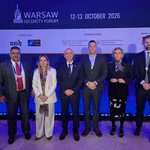
Cyprus Forum’s Executive President, Dr. Nicolas Kyriakides (@NicKyriakides), visited Poland, where he participated in the @WarsawForum (WSF) at the invitation of H.E. Mr. Marek Szczepanowski, Ambassador of the Republic of Poland to Cyprus.
He also participated in the Łukasiewicz – ITECH Annual Conference 2026: Security for Prosperity, a WSF side event, joining the panel “Redrawing the Board: Where Are We in the New Geoeconomic Order?” The discussion explored Europe’s position between the United States and China, the strategic role of trade, technology and supply chains, and the requirements for European strategic autonomy.
On the sidelines of the WSF, we organised a dinner attended by H.E. Mr. Nicos P. Nicolaou, Ambassador of the Republic of Cyprus to the Republic of Poland, alongside representatives from diplomacy, academia, policy, media and business.
Our sincere thanks to Ambassador Szczepanowski for the invitation and to everyone who joined us for dinner in Warsaw.
#CyprusForum #WarsawSecurityForum #Cyprus #Poland


That’s a wrap on #CyprusForum2026!
A heartfelt thank you to everyone who made this year’s Forum possible, our speakers and moderators, knowledge partners, supporting partners and collaborators, volunteers and organising team, The Landmark Nicosia, and, of course, every attendee who joined us.
Thank you for bringing your ideas, perspectives, energy and commitment to the conversations that shaped these days. Cyprus Forum would not be possible without the people and organisations who contribute their time, knowledge and support year after year.
Thank you for being part of #CyprusForum2026 and for continuing to Shape Policy Together.
See you next year! 🧡
#CyprusForum2026

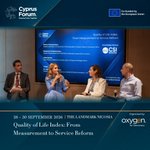
Surviving cancer is no longer the only measure of a good outcome. The panel "Quality of Life Index: From Measurement to Service Reform" brought together Marios Charalambides, Patient Advocate of the Republic of Cyprus; Dr Angelos Kassianos (@angkassianos), Assistant Professor in Health Psychology at the Cyprus University of Technology (@CyUniTech); Stephanie Christodoulidou, Head of Psychosocial Services at Europa Donna Cyprus; and Yiola Marcou, Medical Oncologist at the Bank of Cyprus Oncology Centre, moderated by Dr Sotiris Themistokleous of the Center for Social Innovation.
Dr Marcou said rapid advances in oncology mean far better chances of survival. Forty years ago the goal was simply to overcome the disease; today the question is also what treatment takes from the patient, and how they keep their social life and place in society. Employers may accommodate treatment, but this is not institutionalised. "The state must be there for everyone, and we must not depend on the kindness of those around us."
Ms Christodoulidou said the first word after a diagnosis is uncertainty. Patients have the right to be angry, sad or anxious, and "toxic positivity" does them harm. She called for psychological screening from diagnosis onwards, specialised psycho-oncology services, and state sexual health clinics, since sexual health remains one of the least discussed issues in care.
Mr Charalambides, whose office is new in Cyprus, said patients face fragmented services, a lack of trust in the information they receive, and exclusion from work and daily life. For those in remote areas, travelling to treatment is often the main worry.
Dr Kassianos said quality of life is a complex concept, and society fails those without access to good services, including minority and vulnerable groups. Not everyone has the same access or ability to understand information, and that is where the state's responsibility lies.
Proposals included flexible work for patients and survivors, modernised administrative forms, and accessible screening for people with disabilities and LGBTQ+ patients.

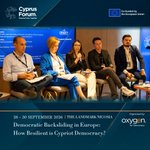
"When the foundations are missing, the building falls very easily." The panel "Democratic Backsliding in Europe: How Resilient Is Cypriot Democracy?" brought together Dr Yiannos Katsourides (@katsouridesy), Associate Professor at the University of Nicosia (@UNIC_ENG); Maria Stylianidi, Assistant Professor at Frederick University School of Law and Member of the Supervisory Committee of OLAF; Katerina Kalaitzaki, Lecturer in EU Public Law at UCLan Cyprus (@uclancyprus); Philip Petropoulos, Founder and President of Debate House; and Scott Greytak, Deputy Executive Director of Transparency International U.S. (@TransparencyUSA), moderated by Loucianos Lyritsas, Cyprus correspondent for Deutsche Welle (@DeutscheWelle).
Ms Kalaitzaki said democracy and the rule of law are interconnected: democracy determines who exercises power, and the rule of law governs how. Democracy weakens gradually, in ways not always visible, and the independence of the judiciary, public trust and access to justice are democratic questions. The Anti-Corruption Authority is a welcome step, but the whole chain of checks and balances needs strengthening.
Ms Stylianidi said the law is the first step, but a culture must be cultivated around it. Whistleblowers need real protection, and whistleblowing should be seen as a chance to correct problems rather than a threat. There is a difference, she said, between formal and substantive compliance.
Mr Petropoulos argued that citizens are not indifferent; the mechanisms through which politicians and citizens interact have shortcomings, and public engagement may need to be reinvented.
Mr Greytak said rising perceptions of corruption are driving democratic backsliding. Laws are only half of it; the rest is a culture that reinforces them. Authority and capacity on paper are not enough, he said, pointing to recent developments in the United States.
Dr Katsourides noted that Cypriot democracy is younger than many in Europe. Everyone wants democracy, but no one is satisfied with their own. In Cyprus' presidential system, he suggested, requiring parliamentary approval for certain appointments could strengthen checks, while acknowledging it could also slow policymaking.

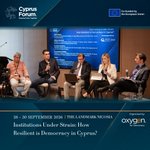
"Democratic resilience depends on the willingness of power to accept its limits." The panel "Institutions Under Strain: How Resilient Is Democracy in Cyprus?" brought together Fotini Tsiridou (@FTsiridou), Chairwoman of the House Standing Committee on Legal Affairs, Justice and Public Order; Nikitas Hatzimihail, Professor of Law at the University of Cyprus (@UCYOfficial); Dr Costas Paraskeva, Associate Professor of Public Law and Human Rights and Chair of the Department of Law at the University of Cyprus ; and Dr Panagiotis Christias, Associate Professor of Political and Social Philosophy at the University of Cyprus, moderated by Dr Kriton Dionysiou of the Institute of Studies for Politics and Democracy (@ISPD_Cyprus).
Ms Tsiridou said Cyprus has institutional safeguards, but Parliament needs stronger scrutiny tools, including mandatory ministerial attendance and consequences for officials who appear unprepared or miss deadlines. She favoured civic education over blanket restrictions such as social media bans, and said legislation on enforcing court judgments will move forward.
Professor Hatzimihail said Cyprus has developed a political culture in which institutions are larger than those who temporarily occupy them. "An institution must be greater than the person who happens to occupy it." The dangers are inertia, short-term thinking and bad precedents. AI in justice, he warned, can be an "overconfident assistant" that produces convincing but wrong answers.
Dr Paraskeva said Cyprus has survived major constitutional crises but still operates under constitutional exceptionalism. The breakdown of the 1960 bicommunal balance removed important checks and balances, and gaps remain in the administration's compliance with court judgments. "Without a strong and functioning constitutional structure, constitutional rights cannot be fully protected."
Dr Christias said democracy faces generational, technological and digital pressures, with younger citizens often seeing institutions as external to them and political communication becoming emotional rather than deliberative. "The trust the state should cultivate is not trust in the state, but the citizen's trust in themselves."

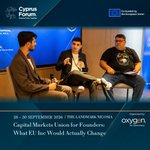
"Right now, if a founder wants to start a business in the EU, they have to choose one of 27 different legal regimes." The panel "Capital Markets Union for Founders: What EU Inc Would Actually Change" brought together Panayiotis Georgiou, Legal Engineer at Fidura, and Stefanos Kyprianou of APLA.
Mr Georgiou set out what an EU-wide company structure could change. Formation would become easier, allowing a founder to incorporate a company in 48 hours for less than €100. Company registers would also need to be harmonised at European level, he argued, so that investors no longer have to navigate the French, German or Cypriot register separately. Tax, however, remains a matter for member states, and that is exactly where he sees Cyprus' biggest opportunity.
Mr Kyprianou said founders want to know they can build one company and operate across Europe, without rebuilding it every time they expand into another country. "We need one Europe in a standard, not 27 products with a different label," he said. He questioned the "28th regime" label, since Europe already has 27 jurisdictions, and noted that key details are still being debated with the European Commission. Investors need reliable company data and banks need beneficial ownership information for KYC, he added, calling for more transparency. Pointing to Cyprus' highly integrated forex industry and the new AI strategy, he highlighted the role of education and regulatory sandboxes.

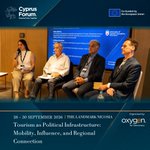
"Less souvenirs, less selfies, more encounters." The panel "Tourism as Political Infrastructure: Mobility, Influence, and Regional Connection" brought together Yiannis Kouis, Director of Tourism at the Deputy Ministry of Tourism (@DepMinTourismCy); Dr Fabio Carbone, Head of the UON Research Centre for Global Economic and Social Development (recorded); Philippos Drousiotis, Executive Chairman of the Cyprus Sustainable Tourism Initiative (CSTI) (@CySustTourism); and Raymond Hyma of the University of Warwick, Monash University and the PRIO Cyprus Centre (@PRIOCyprus). It was moderated by Dr Katerina Antoniou, Assistant Professor in Tourism and International Relations at UCLan Cyprus (@uclancyprus).
Mr Kouis presented Cyprus' national tourism strategy, which runs to 2035. Despite challenges including the island's division and instability in the Middle East, he said this year's results are very close to last year's record. The strategy is an inclusive effort built on open consultation, aiming to extend the tourist season towards a year-round destination, establish Cyprus as a quality destination and harness technology. "Our efforts must be socially beneficial."
In a recorded contribution, Dr Carbone spoke of the "tyranny of time" in tourism and called for bringing the human factor back into the experience. "Probably, post-tourists can be the tourists that rebel against the system," he said.
Mr Drousiotis said Cyprus is currently experiencing mass tourism, and the way forward is to become a sustainable destination. "Tourism is not a luxury problem; it's a necessity," he said. Where others speak of the hidden costs of tourism, he pointed to its hidden benefits, arguing that it makes people better and more tolerant.
Mr Hyma, who brings together people from divided societies to become researchers themselves, said he keeps coming back to Nicosia. "We've really discovered the possibilities of travel and tourism as an encounter for divided groups to come together for relationship building."

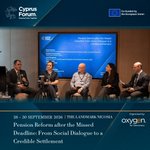
Cyprus is preparing its first fundamental pension reform since 1980. The panel "Pension Reform after the Missed Deadline: From Social Dialogue to a Credible Settlement" brought together Maria Christou, Social Insurance Officer at the Social Insurance Services, Ministry of Labour and Social Insurance (@minlabourcy); Andreas Charalambous, Chair of the Cyprus Fiscal Council; Lena Panayiotou, Assistant Director General of the Cyprus Employers and Industrialists Federation (OEB) (@OEBcy); and Andreas Alexi, Legal Officer at KEBE (@CCCI_Cyprus). It was moderated by Philippos Mannaris, CEO of Aon Solutions Cyprus.
Ms Christou said the reform aims to be stable, to strengthen solidarity between generations and to be fiscally responsible. Described as a radical structural change, it provides for an increase in all pensions from January 2027. The government intends to move quickly towards a framework agreement on a second phase, which would take three to four years, with universality and incentives for smaller businesses among the key concerns.
Mr Charalambous welcomed the reform's tidying up of the system, including bringing the so-called housewife's pension into it, and its support for low pensions. But with an ageing population, he warned, some provisions send the wrong message. Annual surpluses should only be invested differently once independent supervision is in place, and a second pillar should be introduced gradually, with a universal character. The question of adequacy, he said, must remain open.
Ms Panayiotou said the reform must serve several generations to come. The Social Insurance Fund is the foundation, and it must remain financially sound to avoid fiscal adventures. People want to know what they will receive, she said, and someone who leaves the labour market early should not receive the same benefit as someone who stays two or three years longer.
Mr Alexi said KEBE has supported strengthening low pensions from the start, but warned that one word in the bill, "may", could become a problem over the next five years. He also called for attention to how the private and public sectors are treated.

"Many will never describe themselves as caregivers, but simply as people who help." The panel "Informal Care as Essential Infrastructure: A Cyprus Policy Settlement" brought together Dr Shannon Pfohman, Executive Director of Eurocarers (@Eurocarers_info); Stavroulla Georgiou, Administrative Officer at the Deputy Ministry of Social Welfare (@welfaregovcy); and two informal carers, Filios Savvides and Antri Mina. It was moderated by Marios Kantaris, Chair of the Thalpo Informal Carer Network.
Mr Kantaris said much of care happens at home and in families, without formal recognition. Informal carers can be of any age, caring for a relative, a friend or a neighbour, and without them the care system would not survive. Yet caring can last months or years and affect carers' pensions and futures. The question, he said, is what recognition should mean in practice.
Ms Georgiou said informal care is an everyday reality for many people but still a new topic in public debate. As Cyprus undergoes demographic and social change, supporting informal carers has become a necessity, starting with better access to information and recognition of the high personal cost of caring. "Informal carers have been in the shadows," she said. "It's time to give them the floor." Much remains to be done, and there is a lot to learn from European partners.
Mr Savvides spoke about caring for his mother for the last 15 years. "You give the most, and at some point you find yourself forgetting. You do not live." Few people around him understood what he was going through. He stressed that not everyone can afford to leave work early to care, and said his challenge now is to rediscover who he is.
Ms Mina described her journey caring for her child: the long road to a diagnosis, the struggle with assessments, and the impact on her life as a woman, wife and sister. Psychological support was the help she valued most. "I was asking for the obvious," she said, "but real support did not come easily."

"The momentum is real. It's not just rhetoric." The panel "From Candidate Status to Membership: Moldova and the Credibility of EU Enlargement" brought together Cristina Cerevate, State Secretary for European Affairs of Moldova; Dr Dritan Abazović (@DritanAbazovic), former Prime Minister of Montenegro; Tedi Dobi, Deputy Minister of Justice of Albania; Marilena Raouna (@marilena_raouna), Former Minister of European Affairs of Cyprus; and Marko Skral, Deputy Head of Mission at the Embassy of Ukraine in Cyprus (@UkrEmbCy), moderated by George Hadjipavli of SEESOX, University of Oxford (@UniofOxford).
Ms Cerevate thanked Cyprus for helping Moldova open its first negotiating clusters this summer. For Moldova, she said, accession is an existential imperative and the only way to survive as a democracy, with the goal of being ready to join by 2030.
Mr Skral said a merit-based approach is essential for Ukraine, for whom moving towards the EU "is a matter of staying alive". Gradual integration should support transformation, not substitute for membership.
Dr Abazović argued that Montenegro knows exactly what it wants, while the EU has long been unsure. He called for enlargement decisions not to be blocked by a single member state, suggesting a two-thirds majority, and warned against second-class conditions for new members.
Mr Dobi said conditionality is essential but must not become a tool for delay, recalling that Albania's screening involved 73 institutions and 8,000 pages of reporting. What matters most, he said, is real change in people's lives.
Ms Raouna said there is now real commitment to enlargement as an investment in EU security, but the window will not stay open forever. Gradual integration brings candidates closer, and alignment with EU foreign policy is a key test of commitment. Unanimity reflects how consequential accession is, she argued. If conditions are met, Montenegro could complete negotiations by the end of 2026 and become the 28th member state by 2028.

Cyprus has made real progress on anti-corruption recommendations, but formal compliance is only the beginning. In the fireside discussion "From Commitments to Credibility: Delivering Transparency and Rule-of-Law Reform in Cyprus", Christodoulos Charalambous, Member of the Office of the Deputy Minister to the President, spoke with Dr Nicolas Kyriakides (@NicKyriakides), Executive President of the Cyprus Forum.
Mr Charalambous described GRECO (@CoeGreco), the Council of Europe's (@coe) Group of States against Corruption, as an institutional mirror for its member states. Its fifth evaluation round focused on central government and law enforcement, issuing 13 recommendations for the executive and 9 for the police. The government, he said, responded quickly to move from words to action. According to the latest compliance report, the large majority of recommendations have been fully or partly implemented. He put overall progress at 80 to 90%.
Among the key changes, he pointed to a clear institutional framework now set in law, and the publication of all government bills for public consultation, with comments made public and monitored by a designated body. The asset declaration system has also been expanded, with all those covered required to submit within four months, although GRECO has called for more frequent submissions. The budget of the Anti-Corruption Authority has been increased.
Preventing and fighting corruption must be approached carefully, he argued. When public frustration runs high, it becomes hard to tell what is serious from what is not. "If we discredit everything, we cannot make a new start." Prevention, he said, is what can make the difference, together with citizens who want to comply with the rules.
For Dr Kyriakides, the regulatory framework alone is not enough.

Location gives Cyprus relevance, but does it give it agency? The panel "From Strategic Location to Strategic Agency: Cyprus' Sovereign Capacity Test" brought together Mirko Kruppa, Chargé d'Affaires a.i. at the Embassy of Germany in Cyprus (@GerEmbNicosia); Manish, High Commissioner of India to Cyprus; Shay Gal (@ShayGal84), Founder and Principal of Line of State; and Symeon Kassianides, Group Chairman and CEO of Hyperion Group. It was moderated by Konstantin Valkov (@K_Valkov), Director of Special Projects and Lecturer at New Bulgarian University (@NBUSofia).
Opening the discussion, Mr Valkov argued that location alone does not explain what a country does: the map sets the stage, but agency is what a state does with it.
Mr Kruppa said Cyprus' geography has long made it a prize for whoever sought to control the region, and that the broader security architecture is changing dramatically. The question, he suggested, is how much agency Cyprus is ready to put forward.
Mr Gal pointed to new regional security arrangements, including the defence agreement between Saudi Arabia, Türkiye and Pakistan, and argued that the Cyprus problem has become a European problem.
Mr Kassianides said capability means the ability to adapt to changing circumstances. The real question is what Cyprus can deliver, he argued, noting that Cyprus has claimed its role as the easternmost part of the European Union and has good relations with its neighbours, with one exception.
High Commissioner Manish said Cyprus' strategic value depends on its practical ability to stay connected under pressure, reducing single points of dependency and being able to replace critical systems. He pointed to growing interest in connectivity corridors linking India, the Middle East and Europe, and said Cyprus can contribute to digital connectivity, with discussions already under way.

"What we have taken for granted is simply not the case." The panel "Israel, Palestine, and the Future of Regional Diplomacy: From Humanitarian Emergency to a Credible Political Horizon" brought together Dr Nimrod Goren (@GorenNimrod), President and Founder of the Mitvim Institute (@Mitvim) and Co-Founder of Diplomeds; Omar Shaban Ismail, Founder and CEO of PalThink for Strategic Studies; Farah Al Atassi (@FarahALAtassi), Senior Political Advisor to the transitional Syrian Government and President of the American Arab Center; and Narek Minasyan of the Armenian Council, moderated by Harry Tzimitras, Director of the PRIO Cyprus Centre (@PRIOCyprus).
Opening the discussion, Mr Tzimitras said the rules-based order is no longer what we knew, after Yemen, Gaza and Ukraine, and that no conflict, including Cyprus, can be considered frozen. He called for urgency in dialogue, local ownership rather than reliance on external forces, and implementable political processes.
Dr Goren focused on constructive ways forward, noting that Cyprus has long hosted sustained dialogue. Looking to the upcoming Israeli elections, he highlighted security, political representation and identity, and called for collaborative thinking about "the day after".
Mr Shaban Ismail warned that the war in Gaza is fuelling radicalisation, while many Palestinians, especially young people, want change. He stressed the urgency of ending the war and holding elections: "Elections are the only way for us to achieve peace with Israel." Gaza, he noted, is only an hour from Cyprus. "We are all connected."
Ms Al Atassi said the Board of Peace was first seen as a moment of momentum, bringing together people "working on peace instead of speaking of peace", but in her view has become commercially focused. Syria, she argued, can be a reliable partner for connectivity and energy. "Let's talk about opportunities rather than threats."
Mr Minasyan described the Armenia-Azerbaijan peace process, with a treaty finalised in 2025 and connectivity as the final missing piece. After 30 years without contact, the next step is to institutionalise stability on the ground.

Speaking to Alpha Cyprus from #CyprusForum2026, Executive President Nicolas Kyriakides reflected on the forum’s contribution to public dialogue and the importance of bringing different perspectives to the same table.
"The crimes of Nikos Metaxas were not an isolated incident, but a symptom, a characteristic of Cypriot society, which was reproduced in the political and institutional context." The panel "Missing-Person Investigations after the Metaxas Case: Risk Signals, Police Policy, and Accountability" brought together Michalis Paraskeva (@osr55blog), Member of Parliament; Andriani Tsili, PhD Candidate in Gender Studies and Research Project Manager at the University of Cyprus (@UCYOfficial); Evie Nicolaou of the Cyprus Police (@Cyprus_Police); and journalist Caroline Van den Berghe. It was moderated by Paris Prokopiou, Director of Pleiades; Andreas Sheittanis, Film Director and Writer at Parrot With a Carrot; and Andreas Hadjigeorgiou, Senior Lawyer at Michael Chambers & Co LLC and Visiting Lecturer in Human Rights at the University of Cyprus (@UCYOfficial).
Summarising the reflections of Mr Sheittanis and Ms Tsili, Mr Hadjigeorgiou described the case as a symptom of Cypriot society rather than an isolated incident. "We have a society that has contaminated its institutions with the wrong mindsets," Mr Sheittanis said.
Ms Nicolaou acknowledged that there were gaps and deficiencies in how the police handled the case. Since then, she said, the police have introduced a regulation setting out the actions officers must follow, including cooperation with other services and the public in locating missing people, while officers still assess risk case by case. Training on the subject has also increased.
Ms Van den Berghe shared the experience of Belgium, where a lack of accountability in police investigations of femicide led to a parliamentary committee.
Mr Paraskeva said no one has been held accountable. "If the police and the state in general believed that they made some mistakes and omissions, it means that someone is responsible for this," he said. The legal tools to act against gender-based violence exist, he argued, but are not applied, and Parliament could do more, as Belgium's example shows.

"Relations between our two countries are at an all-time high." In his first public address to Cypriots since presenting his credentials on 9 September, John Breslow, Ambassador of the United States to the Republic of Cyprus (@USEmbassyCyprus), delivered a formal keynote at Cyprus Forum 2026, introduced by Dr Nicolas Kyriakides (@NicKyriakides), Executive President of the Cyprus Forum.
Ambassador Breslow traced the foundations of the partnership, from the 2019 Eastern Mediterranean Security and Energy Partnership Act to the 2024 strategic dialogue and the roadmap for bilateral defence cooperation. "History teaches that peace is never maintained by wishful thinking," he said. "It is preserved by steadfast allies, principled diplomacy, and people who refuse to shrink from responsibility." On the Cyprus problem, he reaffirmed US support for a Cypriot-led, UN-facilitated effort to reunify the island as a bizonal, bicommunal federation with political equality, consistent with relevant UN Security Council resolutions. "This is a Cypriot solution for the Cypriot people, and America stands ready to support you in reaching it."
Drawing on his business background, he called Cyprus an attractive place to invest, but warned about opportunities not taken. Even one company walking away over unnecessary barriers is one too many, he said, urging Cyprus to cut red tape and to push back on EU regulations he believes hold back innovation. He highlighted American partnerships in aviation, technology and offshore gas, adding that "energy security is national security".
Closing on education, he noted that a landmark investment by the Ministry of Education (@cymoec) has brought the largest cohort of Fulbright (@FulbrightPrgrm) English teaching assistants in the programme's history, and invited partners to help young Cypriots find internships with American companies. "You don't build something that lasts by only looking at your end results. You build it by investing in people."

"We are not only talking about ramps or physical access; we are talking about real participation, which is often still missing." In the fireside discussion "SPARKing Democratic Change: Removing Barriers for Youth with Disabilities", Stavros Stavrou, President of the Centre of Theatre for Children and Young People – ASSITEJ Cyprus, spoke with Olga Constantinou, journalist at Alpha Cyprus (@alpha_cyprus).
Despite legal commitments, young people with intellectual and psychosocial disabilities still face barriers to participating as equal members of society. Progress has been made, especially on physical accessibility, but meaningful participation remains a major gap. The key barriers are access to information and the ability to take part in political and social decision-making, while bureaucracy and reluctance to make the required adaptations can still obstruct initiatives that already have support.
Accessibility, the discussion stressed, should be built into projects and programmes from the very beginning, not added later. Inclusion requires more than listening to people with disabilities: their input must translate into concrete action. Education and awareness from an early age are essential to building acceptance and reducing fear that comes from lack of knowledge. In cultural life, there are still very few artists with disabilities, a reflection of the barriers they face in entering the field. The relationship between NGOs and the state, it was argued, should be treated as a partnership, especially on disability issues.
