

psychiatry higher trainee WoS | rainforest ontologist, promiscuous realist | interested in historical, conceptual and philosophical issues in psychiatry
Glasgow, Scotland
Joined June 2017
- Tweets3.9K
- Following2.1K
- Followers1.2K
- Likes4.4K





Chris Meechan retweeted
Huge thanks to Sam Wilkinson for a fantastic talk for the SPG on 'diagnosis as verdict'
Watch and subscribe :) 👇🏼
youtu.be/5IDZNq2xh2Q?is=YBnB…
Huge thanks to Sam Wilkinson for a fantastic talk for the SPG on 'diagnosis as verdict'
Watch and subscribe :) 👇🏼
youtu.be/5IDZNq2xh2Q?is=YBnB…

Chris Meechan retweeted

What Is Disordered in a Personality Disorder?
In (weak) defense of personality psychopathology
psychiatrymargins.com/p/what…

Chris Meechan retweeted

Critical psychiatry is marked by an ambition to show logical flaws in the pillars of psychiatric theory. Here I consider, and find wanting, 2 of its key arguments as expressed in this recent QT'd piece by @joannamoncrieff.
clinicalphilosophy.blogspot.…

The Fonagy Report: A Missed Opportunity to Challenge the Neurodevelopmental Narrative
By Joanna Moncrieff, MD
An independent review in the UK to address ADHD and autism diagnosis and treatment has missed an opportunity to correct misleading notions.
buff.ly/vbxHa0d

Huge thanks to @awaisaftab for a wonderful talk to the Speculative Psychiatry Group on:
"The philosophical foundations of #HiTOP" based on his (et al) equally brilliant recent PPP paper
Watch and subscribe below :)
youtu.be/RM-R6pk7U14?si=lQKh…
3
152
Chris Meechan retweeted

1/3 @JRBneuropsiq here is link and final para of behind paywall bjpsych book review by R Poole of Open Access Psychiatry after Krapelin @AllenFrancesMD @mariusturda @awaisaftab @BeresfordPeter @FemiMind @ChrisMeechan2
cambridge.org/core/journals/…

Chris Meechan retweeted
link.springer.com/book/10.10… Open Access "Psychiatry after Kraepelin" reviewed in bjpsych behind paywall, so share last paragraph. Incredibly grateful to co-editor + all the authors. @AllenFrancesMD @mariusturda @JRBneuropsiq @awaisaftab @BeresfordPeter @FemiMind @ChrisMeechan2

Chris Meechan retweeted
International Network for Philosophy and Psychiatry (INPP) 2026 annual meeting in Nijmegen, Netherlands was a fantastic experience, one of the most memorable and rewarding conferences I’ve attended. It was also an honor to be invited as one of the keynote speakers. And I got to meet so many international friends and collaborators for the first time in person! The philosophy of psychiatry community in Netherlands is vibrant, steadfast, and impressive, and I come back home feeling quite inspired.


Important prep before presenting at the upcoming INPP conference. Looking forward to hopefully finally meeting @awaisaftab et al in person :)

2
103
Chris Meechan retweeted

In 2020, a student heard about object permanence in his undergrad psychology course. Object permanence is an early developmental stage when children come to understand that an object is still there, even when they can’t see it. It is acquired around the age of 18 months. Without it, we’d be profoundly disabled. Dogs have object permanence - if they didn’t, they would not chase after balls.
That student made a TikTok video, claiming that object permanence was actually a symptom of his ADHD. He said when he couldn’t see things anymore, it was like they did not exist for him. Others picked it up and more videos appeared. It spread. Blog posts were written which described fairly typical forgetfulness, and called it object permanence. Walk into a room and forget what you came for? Perhaps you lack object permanence, and therefore have ADHD. The more it was talked about, the wider it spread. Infographics appeared. Losing your keys could, apparently, be a sign of poor object permanence.
By 2025, parents were telling me that their teens had poor object permanence, and that’s why they couldn’t keep up with friends.
By 2026, author and influencer Alex Partridge wrote in his bestselling book that object permanence was a symptom of ADHD.
Object permanence went from one undergraduate’s TikTok video to mainstream acceptance within a few years. Most people now have no idea where it came from, or what the original concept of object permanence was. It’s become part of ADHD.
And that’s how new ideas are emerging and gaining credibility in neurodivergence. No science, no scrutiny - all it takes is a TikTok post and a catchy name.
Owen Chevalier tracked the evolution of object permanence in his paper, referenced below.
Are there other terms like this that you’ve noticed emerging?
Chevalier, O. (2024). "It starts on TikTok": Looping effects and the impact of social media on psychiatric terms. Philosophy, Psychiatry, & Psychology, 31(2).
Chris Meechan retweeted

In an incredible turn of events, the philosopher who finds queers suspicious now also finds the disabled suspicious: thetimes.com/comment/columni…

Chris Meechan retweeted
A nice, clear, patient - more patience than I can muster! - critique of the (Helmholtz/Frith/Seth) idea of our perception of the world being a "controlled hallucination". By Evan Thompson: iai.tv/articles/reality-is-n…

Chris Meechan retweeted

The therapeutic relationship is not anchored on moral judgement.
But neither is it rooted in pretending a clear evil is just a lifestyle choice.
Counsellors do their clients, their families and society at large a disservice playing pretend.


Chris Meechan retweeted
Folks love to bang the drum of “validity” when it comes to psychiatric classifications like the DSM but don’t really engage with the literature on how the natural kinds assumptions beneath Robins-Guze style validity are falling apart psychiatrymargins.com/p/psyc…

Psychiatric Diagnosis and the Endgame of Validity
From Validators to Utilitators
psychiatrymargins.com
Do truth and validity matter when it comes to psychiatric diagnoses?
Believe it or not, this is still being debated among psychiatric experts.
It's 2026. Perhaps we can do better.
medscape.com/viewarticle/dsm…
Chris Meechan retweeted

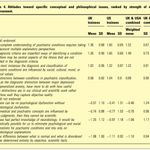
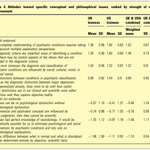
Our first attempt at Experimental Philosophy of Psychiatry just published in the Journal of Evaluation in Clinical Practice
onlinelibrary.wiley.com/doi/…

Chris Meechan retweeted
Studying psychology at university we were encouraged to read up-to-date research; older texts were deprecated. I can say, tho, that, excepting recent American therapy offerings, I've come to understand so much more psychiatry from the old classics than from more modern offerings.

Chris Meechan retweeted

𝗪𝗵𝗮𝘁 𝗮𝗿𝗲 𝗯𝗿𝗮𝗶𝗻𝘀, 𝗮𝗴𝗮𝗶𝗻??
Biological systems unlike computers, but what does that mean?
Join us in Neuroscience & Philosophy Salon discussion with Romain Brette of his great book.
July 9, noon (USA-EST)
umd.zoom.us/meeting/register…
Open to all; registration required.

Chris Meechan retweeted
Depends, if “related to” simply means “involved” in a general embodied sense, that’s true but it doesn’t privilege metabolism since one can also say that about genetics, neurochemistry, neurocircuitry, etc. It is, however, reductive to say that mental illnesses are disorders OF metabolism; you have taken a disorder attribution at a higher level (psychological-behavioral) and reduced it to a disordered processed at a lower level. When true, reductionism is a powerful scientific tool, but I don’t believe the reduction of mental disorders to disorders of metabolism is true.
